
Danielle Smith’s political gambit with Alberta sovereignty bears an uncanny resemblance to David Cameron’s fateful decision to call a referendum on the United Kingdom’s membership in the European Union. Both leaders, faced with mounting internal pressures and populist insurgencies, sought to contain nationalist sentiment by giving it a structured outlet. In so doing, each gambled with the stability of their broader political project. Cameron, convinced that a plebiscite would put the Brexit question to bed and silence his party’s right-wing flank, ended up catalyzing the very crisis he had hoped to avoid, leading to his own political demise. Smith may be following the same treacherous path.
At the heart of both movements is the seductive notion of “taking back control”, from Brussels in the case of Brexit, and from Ottawa in Smith’s Alberta. The appeal is emotional and immediate: a narrative of betrayal by distant elites, a promise of restored autonomy, and the fantasy of economic self-sufficiency. Cameron allowed that narrative to play out on a national stage, legitimizing it with a referendum. Smith is doing something similar through legislation and rhetoric, invoking Alberta’s right to ignore or nullify federal laws under the guise of defending provincial jurisdiction.
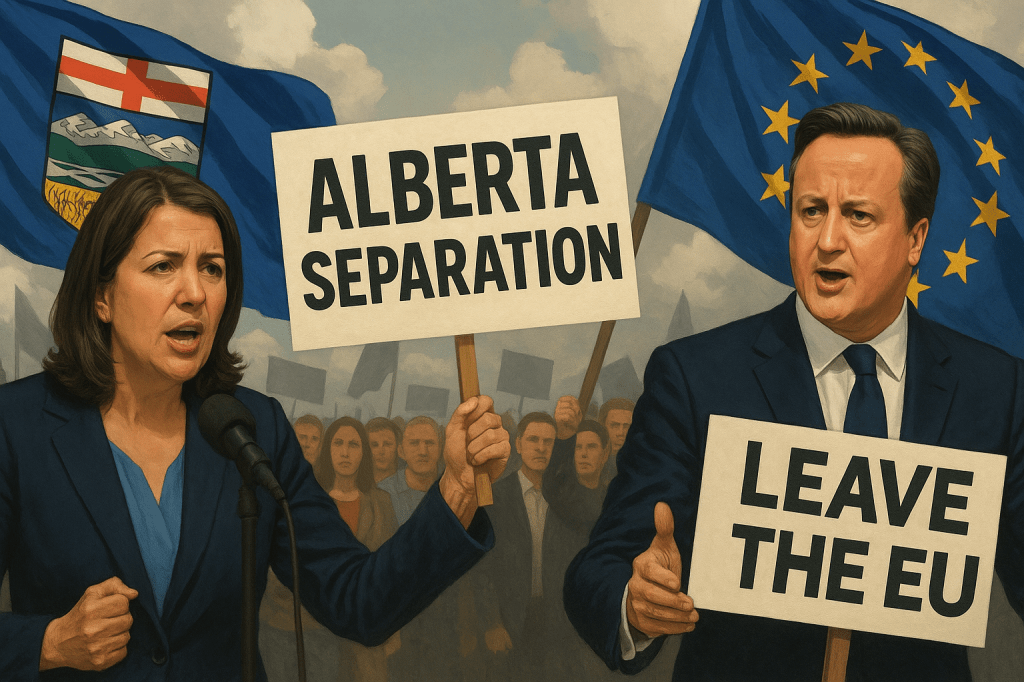
Yet here lies the danger. Like Cameron, Smith has chosen to weaponize the language of sovereignty without a clear or viable endpoint. Her Alberta Sovereignty Within a United Canada Act is not a roadmap to secession, but it flirts with the logic of separation. The very act of mobilizing this discourse strengthens the hand of more radical forces in the province; those who see confederation not as a partnership, but as a prison. If Smith cannot deliver meaningful change within the framework of the Canadian constitution, and she likely cannot, she risks being outflanked by the separatists she once sought to co-opt. Just as UKIP’s rise drove Cameron’s decisions, the Maverick Party and other Alberta-first voices are shaping Smith’s hand, perhaps more than she realizes.
Politically, the parallels are striking and cautionary. Cameron misread the electorate and overestimated his ability to control the narrative. He expected the rational case for Remain to win out but failed to grasp the emotional and symbolic power of “Leave.” When the vote went against him, he resigned, leaving his party and country in turmoil. Smith may also be underestimating the Pandora’s box she is prying open. If public expectations are raised for a decisive break with Ottawa, one that cannot be delivered through mere provincial legislation, she may find herself either forced to escalate into unconstitutional territory or retreat in humiliation.
Moreover, Smith’s strategy could fracture the broader conservative coalition in Alberta. Urban moderates and business conservatives, critical to her electoral base, may grow weary of perpetual constitutional conflict, especially if it begins to affect investment, interprovincial relations, or federal funding. Meanwhile, the more extreme nationalist voices she has tried to placate will grow disillusioned if her sovereignty agenda produces no tangible results. Like Cameron, Smith is dancing between factions with incompatible goals, and she may end up satisfying none.
The tragedy of Cameron’s Brexit lies not just in the decision itself, but in the hubris that preceded it; the belief that one could flirt with nationalist fire and not get burned. Smith now faces a similar moment. In reaching for short-term political gain through an aggressive assertion of provincial autonomy, she may be sacrificing long-term credibility and coherence. The lesson from Brexit is not just about consequences, it’s about the limits of strategic populism. Smith, like Cameron, could soon discover that once sovereignty becomes the language of politics, it is no longer possible to control who speaks it, or how far they want to go.
 The Rowanwood Chronicles