
For generations, the Wolfe Island ferry was a quiet, functional piece of public infrastructure. It was not glamorous, and it did not promise innovation. It simply worked often enough that island life could organize itself around its rhythms. That unspoken reliability ended not with a single breakdown, but with a cascade of decisions that treated a critical transportation link as a technology showcase rather than a lifeline.
The roots of the current crisis reach back to the decision to replace the Wolfe Islander III, a vessel launched in 1976 that, despite its age, delivered consistent service. In 2017, the Ontario Ministry of Transportation committed to a new, larger hybrid-electric ferry, the Wolfe Islander IV, built overseas and marketed as a modern, higher-capacity, lower-emissions solution. On paper, it was progress. In practice, it was a project that outran its own ecosystem.
The new vessel arrived in Ontario in 2021, years before the docks, charging infrastructure, and staffing capacity required to operate it were fully in place. This mismatch created an immediate limbo. A ferry designed to function as part of an integrated electric system instead sat idle while shore-side systems lagged behind. Training shortages and labour constraints compounded the delay, turning what should have been a transitional period into a prolonged absence from service.
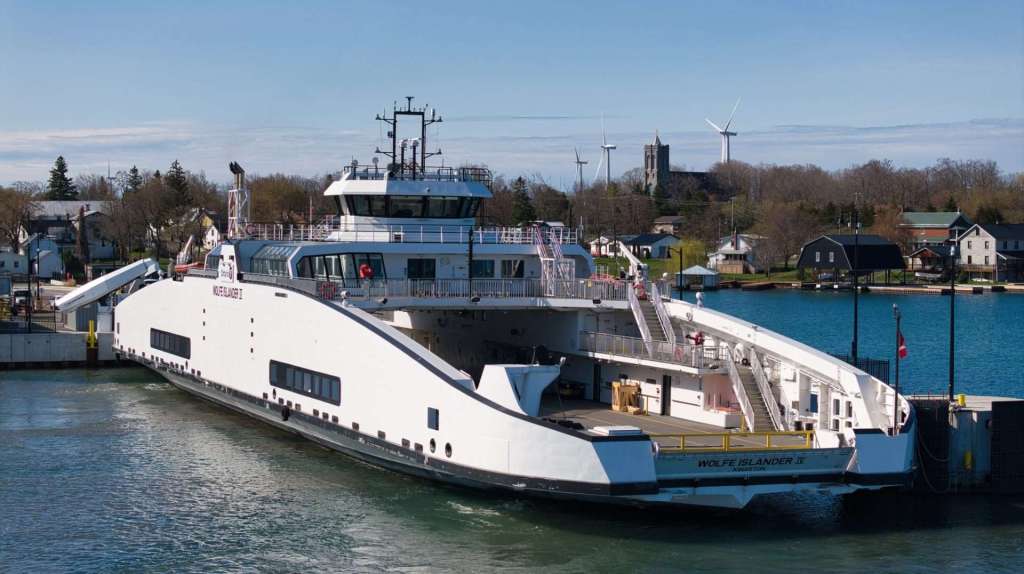
When the Wolfe Islander IV finally entered full-time operation in August 2024, expectations were high and patience already thin. Those expectations were quickly tested. Within months, the vessel suffered a grounding incident that damaged its hull and propulsion components. What was initially described as minor damage resulted in the ferry being removed from service for an extended period and sent to a Hamilton shipyard for repairs. The older Wolfe Islander III was pressed back into duty, once again carrying the weight of continuity.
The mechanical troubles did not end with that incident. The hybrid-electric design depended on shore-based charging infrastructure that was still incomplete, forcing the vessel to rely heavily on onboard diesel generators. Those generators, never intended for sustained primary operation, became a point of failure. By mid-2025, generator problems again sidelined the ferry. Brief returns to service were followed by further outages, including power system failures that left residents relying on temporary passenger shuttles and improvised arrangements.
These technical failures had predictable human consequences. The Wolfe Islander IV operates on a longer round-trip schedule than its predecessor, reducing the number of daily crossings. For island residents, this change reshaped daily life. Commutes grew longer and less predictable. Medical appointments, school schedules, supply deliveries, and emergency response planning all became more fragile. What had once been an inconvenience during rare outages became a chronic uncertainty.
Concerns around emergency access have been particularly acute. Wolfe Island relies on ferry access for ambulance transport to mainland hospitals. Longer crossing times and unreliable service are not abstract inconveniences in that context. They are measurable risks. Community petitions and advocacy groups emerged not out of nostalgia for the old ferry, but out of a clear understanding that transportation reliability is a public safety issue, not merely a service quality metric.
The deeper problem is not that a new ferry experienced teething issues. Complex infrastructure projects often do. The problem lies in the sequencing of decisions. The vessel was delivered before its supporting systems were ready. Operational assumptions were made about staffing and training capacity that did not hold. A technology-forward design was deployed into an environment that could not yet support it. Each of these choices transferred risk from the project plan onto the community it was meant to serve.
What has unfolded at Wolfe Island is a familiar Canadian infrastructure story. Ambition was not matched by coordination. Procurement timelines were allowed to drift out of alignment with construction and commissioning realities. Accountability became diffuse as responsibility spread across contractors, ministries, and timelines. Meanwhile, residents were left to absorb the consequences of decisions made far from the dock.
The Wolfe Island ferry saga is not primarily about electric propulsion or shipbuilding quality. It is about governance. It is about whether essential public services are designed around the lived realities of the communities that depend on them, or around abstract models of innovation and efficiency. Reliability, once lost, is difficult to regain. Trust follows the same rule.
Until the ferry system is treated first as critical infrastructure and only second as a demonstration project, Wolfe Island will continue to pay the price for a transition that was promised as an improvement and delivered as a disruption. The lesson is not that modernization is a mistake. The lesson is that modernization without readiness is not progress at all.
Sources
- Wikipedia. MV Wolfe Islander III and MV Wolfe Islander IV overview and service history. https://en.wikipedia.org/wiki/MV_Wolfe_Islander_IV
- CFRC Kingston. Wolfe Islander IV service launch, community concerns, and advocacy coverage. https://cfrc.ca/news-events/news
- Yahoo News Canada. Reports on grounding incident, repair timelines, and service disruptions. https://ca.news.yahoo.com
- Frontenac Islands municipal documents. Ministry of Transportation correspondence on ferry repairs and service updates. https://www.frontenacislands.ca
- Kingston Traffic and Infrastructure Project newsletters. Dock reconstruction and charging infrastructure delays. https://kingstontraffic.ca
 The Rowanwood Chronicles