
In the long sweep of human history, few structures have shaped daily life as thoroughly as systems of gendered power. Patriarchy and matriarchy are often presented as opposites, but this framing obscures more than it reveals. One is a historically dominant system of centralized authority. The other is a set of social arrangements that redistribute power, responsibility, and meaning in fundamentally different ways. Understanding the distinction is less about reversing hierarchy and more about examining which values a society chooses to place at its core.
Patriarchy is best understood not simply as male leadership, but as a worldview. Authority is concentrated, legitimacy flows downward, and social order is maintained through hierarchy. Political power, economic control, inheritance, and cultural narratives tend to align around masculine-coded traits such as dominance, competition, and control. Caregiving and relational labor are treated as secondary, often invisible, despite being essential to social survival. Even when patriarchal systems soften over time, their underlying logic remains intact. Power is something to be held, defended, and exercised over others.
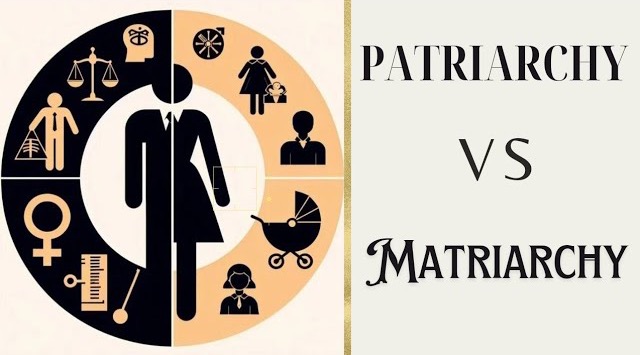
Matriarchy, by contrast, is frequently misunderstood as a mirror image of patriarchy. Anthropological evidence suggests otherwise. Societies described as matriarchal or matrilineal rarely exclude men or invert domination. Instead, they organize authority around kinship, continuity, and shared responsibility. Descent and inheritance often pass through the maternal line, anchoring identity in stable social bonds. Decision-making tends to be collective, with influence distributed across elders, family networks, and community councils rather than vested in singular rulers.
The most compelling argument for matriarchal systems lies not in claims of moral superiority, but in outcomes. Where patriarchy centralizes power, matriarchy diffuses it. This structural difference reduces the risk of authoritarian drift and limits the social damage caused by individual ambition. Authority becomes situational rather than absolute, exercised in service of group continuity rather than personal dominance.
Care occupies a radically different position in these systems. In patriarchal cultures, care is often framed as a private obligation or charitable act. In matriarchal societies, care functions as infrastructure. Child-rearing, elder support, emotional labor, and social repair are recognized as essential to collective resilience. Policies and customs evolve to protect long-term wellbeing rather than prioritize short-term extraction, whether economic or political.
Violence, too, is treated differently. Patriarchal systems have historically rewarded aggression, conquest, and coercion with status and legitimacy. Militarization becomes a cultural ideal rather than a last resort. Matriarchal societies, while not free of conflict, tend to favor mediation, kinship accountability, and reconciliation. Social cohesion is preserved by repairing relationships rather than punishing transgression alone.
Identity formation reveals another contrast. Patriarchy emphasizes individual achievement and competitive success. Worth is measured by rank, wealth, or dominance. Matriarchal systems emphasize relational identity. Individuals are defined by their roles within a web of mutual dependence. This orientation fosters cooperation and shared accountability, particularly during periods of crisis or scarcity.
Gender roles themselves often prove more flexible in matriarchal contexts. Patriarchy enforces rigid norms while presenting them as natural or universal. Matriarchal systems decouple masculinity from rule and femininity from subservience. Men retain agency and dignity without being positioned as default authorities. Leadership becomes contextual rather than gender-mandated.
It is important to note that few contemporary thinkers advocate for a pure matriarchy imposed upon modern states. The more serious project is post-patriarchal rather than anti-male. It asks whether societies organized around care, continuity, and distributed authority are better equipped to face complex global challenges than those organized around dominance and extraction.
From a cultural perspective, the question is not which gender should rule. It is which values should shape the structures that govern collective life. History suggests that systems prioritizing care, shared power, and relational responsibility produce more stable and humane outcomes. In an era defined by ecological strain, demographic shifts, and social fragmentation, these lessons are less ideological than practical.
It has long been argued that culture is not destiny, but design. Patriarchy is one design among many, not an inevitability. Matriarchal principles offer an alternative blueprint, not for reversing oppression, but for dismantling it altogether.





 The Rowanwood Chronicles