
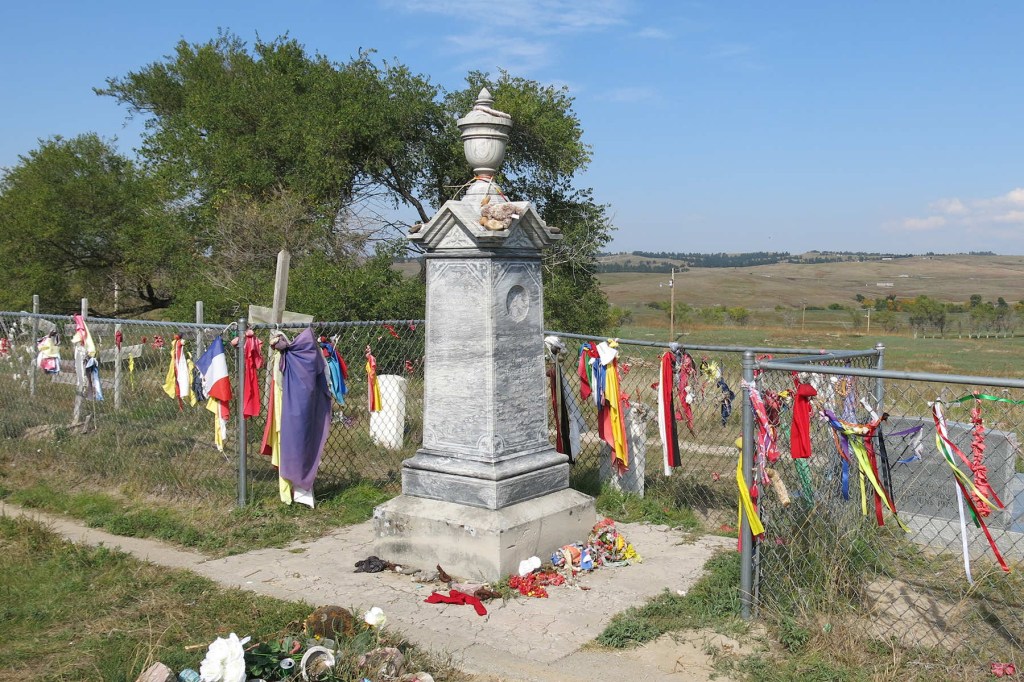
On December 29, 1890, near Wounded Knee Creek in what is now southwestern South Dakota, the U.S. Army’s 7th Cavalry surrounded a band of Lakota people led by Chief Spotted Elk, also known as Big Foot. What began as an effort to disarm a frightened group seeking refuge ended in slaughter. Eyewitness testimony, contemporary reports, and later historical study make clear that more than a hundred Lakota were killed outright, and estimates of the dead range commonly between 150 and 300, with many of the victims women and children. The column of Hotchkiss rapid-fire artillery on the ridge above the camp turned what might have been a chaotic surrender into an indiscriminate killing field. The event has been characterized by historians and by survivors’ accounts as a massacre, not a conventional military engagement.
Within months, the army rewarded participants. Between March 1891 and 1897 the military issued a disproportionate number of Medals of Honor for actions tied to the Wounded Knee operation. Nineteen medals were awarded specifically for Wounded Knee, and 31 for the broader 1890 campaign. Modern historians have long questioned the propriety of these awards. They point out the disproportion when compared with other actions, the context of civilian slaughter, and the fact that late nineteenth century standards for the medal differed dramatically from today’s criteria. Those facts do not erase the moral question at the heart of this controversy. The medals were given for killing civilians during what many contemporaries already described as a tragic, shameful episode.

For more than a century Native American leaders, scholars, and advocates have demanded that these honours be rescinded. They argue that keeping official military decorations for actions that amounted to the killing of noncombatants perpetuates a sanitized narrative of conquest and erases the suffering of the Lakota people. The push to revisit the medals intensified in 2024 when Congress and the Defense Department initiated reviews of honours awarded during Indian wars. Those reviews are not about rewriting history, they are about whether the United States wishes to continue officially celebrating actions that modern standards and moral judgment deem unconscionable.
Into that fraught moral and historical space stepped Defense Secretary Pete Hegseth with a blunt, public proclamation on September 26, 2025. He announced that the soldiers who received Medals of Honor for Wounded Knee will keep them and said the soldiers “deserve those medals.” The decision was presented as a closure to the controversy and as a defense of martial valor. But treating the medals as a neutral technicality betrays two failures. First, it ignores the weight of historical evidence and eyewitness testimony that Wounded Knee was, by any honest reading, a massacre that included large numbers of noncombatant deaths. Second, it substitutes a crude politics of honour for a sober assessment of what military decorations are meant to signify. Medals of Honor are supposed to commemorate extraordinary gallantry consistent with the laws of war. When the conduct being commemorated is the killing of women and children in a one-sided action, the moral legitimacy of the award is rightly in doubt.
Hegseth’s statement also displays a troubling detachment from the consequences of symbolic government acts. Official honours are not only personal rewards; they are public memory makers. Keeping these medals intact, while dismissing Native American calls for redress, sends a message about whose losses count in the American story. It is one thing to argue that you cannot retroactively apply modern sensibilities to historical actors. It is another to claim that the government should continue to sanctify actions widely recognized at the time as morally ambiguous or wrong. The choice to uphold the medals is not neutral. It privileges a narrative of conquest and martial glory over truth, accountability, and reconciliation. Contemporary Native leaders and organizations denounced the Pentagon’s decision, noting how it wounds descendants and undermines efforts at national healing.
A final point. Government honours are mutable instruments of civic character. The United States has in many other instances chosen to correct honors that later ethical standards rendered inappropriate. To choose not to correct here is to place precedent over conscience. Furthermore, Hegseth’s framing, that the decision preserves the dignity of soldiers, rings hollow when the dignity of the victims is excluded from the calculus. Respect for soldiers and respect for victims are not mutually exclusive. A mature republic can acknowledge the bravery of individuals without perpetuating institutional honours that legitimize immoral collective actions.
Wounded Knee is not merely an historical footnote. It is a continuing wound in the national memory. How a nation treats its darkest episodes tells us as much about its present character as its triumphs do. Preserving medals awarded for conduct rooted in massacre is not an act of courage. It is an abdication of moral leadership and a refusal to allow public honours to reflect justice. Hegseth’s September 26, 2025 statement helps explain why calls for truth and reconciliation remain necessary. Those calls do not demand erasure of history. They demand honesty and a willingness to let national symbols reflect a fuller, truer account of what happened at Wounded Knee.
Sources:
Hegseth decision reporting and reactions. Associated Press. Hegseth says Wounded Knee soldiers will keep their Medals of Honor.
Contemporary reporting and Native response. Reuters. Native Americans condemn Pentagon move to preserve Wounded Knee medals.
Contextual and historical overview. Britannica. Wounded Knee Massacre.
Primary accounts and museum histories. National Library of Medicine / Native Voices timeline and National Park Service battlefield materials.
Medal of Honor lists and army records. U.S. Army Medal of Honor listings for Indian Wars and Wounded Knee citations.
 The Rowanwood Chronicles