Five Hundred Posts

This is the 500th post on Rowanwood Chronicles, and I want to pause for a moment rather than rush past the number.

Five hundred posts means months of thinking in public. It means essays written early in the morning with coffee going cold, notes drafted in train stations and kitchens, arguments refined and re-refined, and ideas that only became clear because I was willing to write them out imperfectly first. It means following threads of geopolitics, technology, culture, relationships, power, science fiction, and lived experience wherever they led, even when they led somewhere uncomfortable or unfashionable.

This blog was never intended to be a brand or a platform. It has always been a workshop. A place to test ideas, to connect dots, to push back against lazy thinking, and to explore what it means to live ethically and deliberately in a complicated world. Some posts have aged well. Others mark exactly where my thinking was at the time, and I am content to leave them there as signposts rather than monuments.

What has surprised me most over these five hundred posts is not how much I have written, but how much I have learned from the responses, private messages, disagreements, and quiet readers who later surfaced to say, “That piece helped me name something.” Writing in public creates a strange kind of community, one built less on agreement than on shared curiosity.

To those who have been reading since the early days, thank you for staying. To those who arrived last week, welcome. To those who argue with me in good faith, you have sharpened my thinking more than you know. And to those who read quietly without ever commenting, you are still part of this.

I have no intention of slowing down. There are still too many systems to interrogate, futures to imagine, and human stories worth telling. Five hundred posts in, Rowanwood Chronicles remains what it has always been: a place to think carefully, write honestly, and refuse simple answers.

Onward.

Beyond Raylan and Boyd: The Quiet Revolution of Justified’s Women

It is almost impossible to talk about Justified without the gravitational pull of Raylan Givens and Boyd Crowder. The lawman and the outlaw. The hat and the sermon. Their dynamic is electric, their scenes mesmerizing. But if we stop there, we miss something quieter, yet no less vital: the women of Harlan County. They are not background ornaments. They are architects, operators, and sometimes arbiters of the county’s power.

Justified is, at its core, a show about negotiation: of power, of survival, of legacy, and its women navigate that negotiation with courage, intelligence, and persistence. They do not always receive accolades for their choices. They are rarely celebrated in tidy narrative terms. But they endure. They plan. They adapt. And through them, the show demonstrates that influence in Harlan County is rarely a matter of brute force alone.

From the first season, Ava Crowder (Joelle Carter) establishes the stakes for women in this world. Killing Bowman Crowder, her husband’s brother, is an act of necessity, not spectacle. What follows is not freedom but responsibility. Ava spends the rest of the series managing consequences, trying to carve stability in a world that punishes female assertiveness. By the time she runs the bar, she is no longer reacting to Boyd’s schemes—she is shaping outcomes herself. Her story is not about redemption. It is about agency and the cost of holding it.

Winona Hawkins (Natalie Zea) embodies a different but equally compelling form of strength. She does not wield influence through violence. She wields it through clarity and boundaries. Winona sees Raylan for who he is and refuses to shrink herself to accommodate him. She plans for herself and her child, navigating danger without illusion. In a genre where women are often defined by attachment to men, Winona functions as a moral and strategic measure, someone whose decisions ripple outward, shaping the male protagonist as much as he shapes hers.

Mags Bennett (Margo Martindale) is the series’ most commanding female presence. Mags is authority incarnate, her power flowing from land, legacy, and an encyclopedic understanding of loyalty and leverage. She manipulates, protects, and threatens with equal grace. Her final act is not defeat but authorship. Through Mags, Justified demonstrates that women can embody menace and sophistication simultaneously, and that female power does not need narrative apology.

Loretta McCready (Kaitlyn Dever) represents the adaptive, forward-looking dimension of female agency. Starting as a teenager growing weed to survive in a county that offers her nothing, she inherits Mags’ fortune and invests it strategically, buying land and positioning herself for the future. Loretta anticipates change, particularly legalization, and adapts faster than the men around her. She is clever, deliberate, and allowed to grow without punishment, one of the quietest, but most revolutionary arcs on the show.

Ava and Loretta represent two sides of the same coin: inherited constraint and adaptive ambition. One negotiates consequences, the other seizes opportunity. Both highlight Justified’s commitment to showing women who act deliberately within systems that seek to contain them.

Rachel Brooks (Erica Tazel) offers another vision of female authority. Beginning as a competent U.S. Marshal and rising to lead the office, Rachel reins in Raylan not through theatrics, but through competence and moral authority. Her power is quiet, principled, and unassailable, demonstrating that leadership is not measured in gunfights or legend alone.

Even secondary figures contribute meaningfully. Ellen May survives through stubborn presence rather than dominance. Wendy Crowe navigates family chaos with foresight disguised as meekness. Katherine Hale exercises influence without violence, through strategy and capital. And Helen Givens, Raylan’s stepmother, though less visible on-screen, represents moral grounding and continuity. She shapes Raylan’s choices not through confrontation, but through the quiet weight of family and conscience, reminding viewers that influence in Justified often comes from wisdom, care, and endurance, not only action or ambition.

Taken together, these women redefine what it means to hold space in a crime drama. They are not there to soften male narratives. They are not props for mythology or morality. They negotiate survival, power, and legacy in ways subtle, sometimes morally ambiguous, and always consequential. Strength in Justified is not always loud or victorious. Sometimes it is simply the refusal to disappear.

Raylan and Boyd carry the mythic frame of the series. They give us the Western, the duel, the rhetoric. But the women carry its realism. They see clearly, act deliberately, and influence the county, the protagonists, and the story itself in ways that make Harlan feel lived-in, generational, and real. They are not secondary. They are operators, planners, and survivors. And in a show obsessed with consequence, that is nothing short of revolutionary.

Why I Don’t Struggle With Dating

I’m in my late sixties now. I live on a small farm where the chickens have better time management than I do. I work when I feel like it, consult when the project’s interesting, and spend the rest of my time in the delightful company of women who know exactly who they are, and what they want. I’ve been called many things, some of them printable, but “a dragon” is a personal favourite. Apparently, I’m the kind of mythical creature who still believes in emotional literacy, direct communication, and showing up with actual feelings. Wild, I know.

And yes, I date. Often. With love, with humour, and above all, with a plan that includes snacks. Now, here’s the part where the other men clutch their pearls. “Dating? At your age? In this climate?” Yes, Geoffrey, in this climate. And I have a wonderful time doing it.

Because while a lot of men my age (and many younger too) are out there groaning that dating is broken, that women are too picky, too independent, too online, too much, I just smile into my coffee. Not because the world hasn’t changed. Of course it has, yet the tools for connection haven’t disappeared. They’ve just been upgraded. These days, you need emotional intelligence, a working knowledge of consent, and the radical ability to say what you mean without making it weird.

I suppose I had an advantage. I spent most of my adult life wandering: new countries, new jobs, new time zones. That sort of lifestyle trains you to find connection in the moment, to seek relationships that aren’t propped up by obligation or role, but by truth. Along the way, I stumbled into polyamory and, not long after, BDSM; not as lifestyle accessories, but as practices of honesty, intention, and trust. That’s what shaped me into the man I am today: romantic, responsible, and suspiciously good at calendar coordination.

Why don’t I struggle with dating? Simple: I know who I am, and I say so. I’m polyamorous. I’m a Dominant. I believe love is abundant, not scarce, and I show up with presence and clarity. I’m not interested in convincing anyone to like me. I’m interested in being myself and seeing who that naturally resonates with.

It’s like showing up to a party dressed as yourself, rather than as someone from the catalogue of “what men think women want.” It’s shockingly effective. Also, fewer dry-cleaning bills.

Meanwhile, the average bloke is still stuck in a loop: swiping furiously, confused why his “Hi” didn’t spark instant passion, grumbling that women only want six-foot investment bankers who play guitar on mountaintops. I hear it all the time:

“Women don’t like nice guys.”
“They only go for tall guys.”
“Dating’s a rigged game.”

Brother! You’re not playing the wrong game. You’re playing last season’s game. And you didn’t read the new instructions.

Today’s dating world rewards emotional fluency, not pickup artistry. Vulnerability, not vague texting. Boundaries, not bitterness. The new dating superpowers are things like “active listening,” “self-awareness,” and “being able to hear ‘no’ without falling apart.”

Most men I know who are struggling haven’t done the internal upgrade. They’re still trying to fix their dating lives with better profile photos and punchier icebreakers, instead of asking the truly dangerous question: Would I date me?

Here’s what my dating life looks like: maybe breakfast with one partner, a phone check-in with another, a lazy evening on the deck with the third. Nobody’s confused, nobody’s being played, and everyone’s emotionally fed. Why? Because they know I tell the truth. I listen. I own my shite when I get it wrong. That’s not magic, it’s just good relationship hygiene.

So if you’re a man out there feeling lonely, frustrated, or tempted to write another “Women today just don’t…” rant on Reddit, let me offer you something better: a challenge. Become someone you admire. Learn how to feel your feelings without fear. Learn to ask for what you want without pretending you don’t care. Practice showing up for others, even when there’s nothing in it for you.

Dating isn’t broken. You just need to update your operating system.

There is no shortage of love out here. No shortage of desire or connection. But there is a shortage of men willing to do the work to meet women as equals, as partners, as whole humans. That’s not a condemnation. It’s an invitation.

You don’t need to be rich, ripped, or romantic in six languages. You just need to be real. Because honesty is still the sexiest thing a man can offer.

On Grown Men and Their Troubling Aversion to Female Heroes

Welcome to the 21st century, where on one hand we have space travel, near-instant communication across the globe, and AI that can write essays about gladiators (I think, based on context). On the other hand, there exists an astonishing subset of adult human males who loudly complain whenever a TV show or movie gives a sword, a spotlight, or even a gladiator’s loincloth to a woman. Yes women leading stories – how utterly terrifying.

Let’s be clear: The House of Ashur is thriving with critics praising its storytelling and performances. Yet its fan numbers are being dragged down by vote-bombing campaigns from folks who apparently believe that Achilla (a fierce female gladiator protagonist) is too much to handle. That reaction isn’t just silly, it’s fish-slapping-ridiculous. These are people who, given a choice between a well-written lead and…..well, literally nothing else, somehow pick nothing elsejust because they don’t want it to be a woman. Really.

You might remember a certain Captain Marvel movie that suffered a similar fate before it was even in theaters. Hundreds of thousands of online ratings were dumped on the film before anyone had seen it, not because the plot was bad, but because the lead was female and some men (yes, mostly male) just couldn’t abide the idea that a woman could be “the big one” for a change. Review bombing became so bad that Rotten Tomatoes had to change their rating rules to stop it.  

Now, it’s easy to laugh – and we should – because the idea of voting against something simply because a woman is at the center is like refusing to eat soup because the spoon is pink. It’s arbitrary. If the story’s good, the gender of the lead doesn’t matter for most people. Ask yourself: would you care if Indiana Jones were a woman if the script were fire? What about James Bond? Samus Aran? Sarah Connor? The answer for most fans is no – those characters are beloved precisely because they’re compelling, not because they fit some old “male lead only” checklist.

When critics sneer at female leads in genre stories, they often don’t realize how absurd it looks from the outside. Complaining that female heroes “ruin” a franchise is like saying new toppings on pizza ruin Italian cuisine. Spoiler alert: there’s pizza with pineapple and it still exists. And it sells! Some people love it, some hate it, and the world keeps spinning.

Part of the “backlash” is rooted in fandom tradition resisting change – a legacy of decades when the default hero was male, yet media evolves. Women commanding the screen is not a threat to masculinity any more than men playing with dolls was a threat to toy sales. And when the backlash is so loud it drowns out the actual audience? That’s not fandom, it’s performance art disguised as insecurity.

Here’s the real kicker: many stories with female protagonists already succeedwithout complaint. Wonder Woman kicked ass at the box office, Xena ruled the ’90s, and modern audiences adore characters like Buffy, Rey, and Furiosa. They weren’t treated like novelty, they were embraced for what they were: interesting heroes with stories worth telling.  

So to the gentlemen (and keyboard gladiators) who can’t stomach a woman front and center: relax. Pop some popcorn, enjoy the spectacle, and if it’s not your cup of tea, fine. But don’t pretend that a female lead is a threat, it’s just a story, not an invasion force. Unless she actually is an invasion force, in which case….. alright, fair. That would be awesome.

In the end, if a story is good, its hero – male, female, gladiator, intergalactic space slug – deserves to be celebrated. Voting against something because of its protagonist’s gender isn’t just outdated, it’s downright comedic. And frankly, Achilla deserves better.

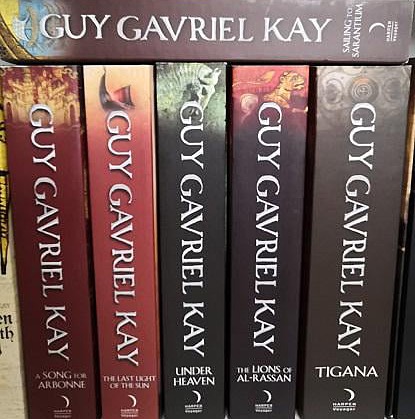
Fantasy as Memory: The Historical Imagination of Guy Gavriel Kay

One of my favourite fiction authors, Guy Gavriel Kay has shaped my reading life from his debut series “The Fionavar Tapestry”, published in the mid-1980s, to his most recent novel “Written on the Dark”, released earlier this year.

Kay does not write fantasy as spectacle or escape, but as remembrance. His work is concerned less with heroes than with consequence, asking what endures after ambition, love, and loss. That focus, and his habit of listening closely to history rather than reshaping it for comfort, is what sets his writing apart from others in the genre.

Guy Gavriel Kay’s writing style is often described as lyrical, restrained, and morally attentive, and that combination is very Canadian in the best sense of the word. His prose is elegant without being ornamental, emotionally resonant without tipping into melodrama, and deeply concerned with how history presses on individual lives.

Lyrical clarity rather than baroque fantasy
Kay’s sentences are musical, but they are rarely flashy. He favours cadence, balance, and carefully chosen imagery over density or excess. Unlike much epic fantasy, he does not bury the reader in invented terminology or ornate description. The beauty of the prose comes from rhythm and precision, not spectacle. This gives his work a reflective, almost classical feel, closer to historical fiction than to high fantasy in the Tolkienian tradition.

History refracted, not replicated
One of Kay’s defining stylistic traits is his use of “quarter-turn” history. His worlds are clearly inspired by specific historical periods and places, Byzantium, medieval Iberia, Tang-era China, Renaissance Italy, but they are never direct analogues. Stylistically, this allows him to write with the emotional authority of history without being constrained by factual retelling. The prose carries a sense of inevitability, consequence, and loss that feels historical, even when the setting is invented.

Melancholy as a narrative tone
Kay’s work is suffused with a quiet melancholy. Triumphs are provisional. Victories are costly. Even moments of joy are shadowed by what will be lost. Stylistically, this appears in his frequent use of memory, foreknowledge, and reflective distance. Characters often understand, sometimes too late, what a moment meant. This gives the writing a sense of adult seriousness and emotional depth that distinguishes him from more action-driven fantasy authors.

Moral complexity without cynicism
Kay is interested in moral ambiguity, but he is not cynical. His style allows multiple perspectives to coexist without collapsing into relativism. Characters act from loyalty, love, fear, faith, and ambition, often all at once. The prose is careful to see people rather than judge them. Even antagonists are given interiority and dignity. This ethical attentiveness is part of what makes his work feel humane and grounded.

Dialogue as character and culture
His dialogue is formal without being stiff, shaped by the social worlds his characters inhabit. People speak with restraint, implication, and subtext. Emotion is often conveyed by what is not said. This stylistic choice reinforces themes of honour, obligation, and social constraint, particularly in courtly or religious settings.

A Canadian sensibility
Although Kay’s settings are global and historical, his sensibility feels distinctly Canadian. There is a preference for understatement, for listening rather than declaring, for complexity over absolutes. Power is treated warily. Empire is examined with sadness rather than nostalgia. The writing resists grand national mythmaking and instead focuses on human cost, compromise, and quiet endurance.

Guy Gavriel Kay writes fantasy for readers who care about language, history, and moral weight. His style is not about escape so much as reflection. He invites the reader to slow down, to attend to memory and consequence, and to sit with beauty that is inseparable from loss. That combination, lyrical restraint, historical gravity, and ethical seriousness, is what makes his voice unmistakable and enduring.

When Interview Styles Collide: Why Some Political Conversations Feel Like Car Crashes

Every few years, Canadian audiences rediscover the same irritation: a high-profile interview that feels less like an exchange of ideas and more like a verbal wrestling match. The questions may be legitimate, even necessary, but the delivery leaves viewers tense, unsatisfied, and oddly unenlightened. The repeated clashes between Rosemary Barton and Mark Carney are a useful case study, not because either is acting in bad faith, but because they embody two very different traditions of public communication that were never designed to coexist comfortably.

The first tradition is the parliamentary press-gallery style that dominates Canadian political journalism. It is adversarial by design. It emerged in an era when access was limited, answers were evasive, and power was something to be pried open rather than invited to speak. In this model, interruption is not rudeness; it is a tool. The journalist asserts control of the frame, resists narrative-setting by the interviewee, and signals independence to both the audience and their peers. Toughness must be visible. Silence or patience can be misread as deference.

The second tradition is technocratic communication, exemplified by figures like Carney. This style evolved in central banks, international institutions, and policy forums where precision matters more than punch. Answers are layered, contextual, and carefully sequenced. The speaker often builds a framework before arriving at a conclusion, because conclusions without context are seen as irresponsible. This approach assumes the listener is willing to follow a longer arc in exchange for accuracy.

When these two traditions meet on live television, friction is inevitable. The journalist hears preamble and assumes evasion. The interviewee hears interruption and assumes misunderstanding. Each responds rationally within their own professional culture, and the conversation degrades anyway.

What makes this especially grating for audiences is that modern broadcast incentives amplify the worst aspects of the collision. Political interviews are no longer just about extracting information. They are performances of accountability. The interviewer must appear relentless, particularly when questioning elite figures who are widely discussed as potential leaders. Interruptions become proof of vigilance, even if they interrupt substance as much as spin.

At the same time, viewers are more sophisticated than broadcasters often assume. Many can tell the difference between a non-answer and a complex answer. When an interviewee remains calm and methodical while being repeatedly cut off, the aggression reads less like accountability and more like impatience. The audience senses that something useful is being lost, not exposed.

This is why these interviews linger unpleasantly after they end. It is not that hard questions are unwelcome. It is that hardness has been mistaken for haste. A genuinely rigorous interview would often benefit from letting a full answer land, then dissecting it carefully. Precision, not interruption, is what exposes weak arguments. Control of the conversation is not the same thing as control of the truth.

None of this requires villains. Barton is doing what her professional ecosystem rewards. Carney is speaking in the register his career trained him to use. The problem is structural, not personal.

If public broadcasting is meant to inform rather than merely provoke, it may be time to rethink whether visible combat is the best proxy for journalistic seriousness. Sometimes the most incisive move is not to interrupt, but to listen long enough to know exactly where to press next.

That, in the end, is why these moments grate. They remind us that we are watching two competent professionals speaking past one another, while the audience pays the price in lost clarity.

🧩 Messy Lists, Veto Power, and What We’re Actually Talking About

Polyamory has a funny habit of turning emotional work into policy debates. Messy lists and veto power are classic examples.

On the surface, they’re about rules. Underneath, they’re about fear, trust, and responsibility.


📋 What a Messy List Is (When It Works)

A messy list is usually an agreement not to date people whose involvement would have outsized impact on shared lives.

Common examples include:

  • Close friends
  • Coworkers
  • Family members
  • People deeply embedded in shared community spaces

At their best, messy lists are risk management, not control.

Healthy messy lists tend to be:

  • Short and specific
  • Based on foreseeable harm, not insecurity
  • Open to discussion and revision
  • Grounded in context, not categories

🚩 When Messy Lists Become a Problem

Messy lists stop being useful when they quietly turn into enforcement.

Red flags include:

  • Long or vague lists
  • Whole categories of people instead of specific situations
  • Rules that expand every time discomfort appears
  • Agreements that can’t be questioned

At that point, the list isn’t about safety. It’s about control.


🛑 Veto Power and Why It Feels Bad (Even When Unused)

Veto power is the ability, explicit or implied, for one partner to end or forbid another relationship.

Even if it’s “only for emergencies,” its existence shapes behavior:

  • People self-censor
  • New partners feel disposable
  • Emotional investment becomes conditional

The core issue isn’t hierarchy. It’s externalizing emotional regulation.

Instead of asking “What do I need?”, vetoes ask “What do you need to stop doing?”


🔄 Where the Two Blur Together

A messy list becomes a veto when:

  • Breaking it automatically ends a relationship
  • Context doesn’t matter
  • Growth doesn’t matter
  • Discomfort alone justifies enforcement

The language may say agreement.
The structure says control.


🧭 A More Functional Approach

Many people move away from vetoes and rigid lists toward boundaries and consequences.

Examples:

  • “I won’t stay in relationships that destabilize my closest friendships.”
  • “I need advance discussion if something affects my work or housing.”
  • “I’ll limit my access to shared spaces if I feel unsafe.”

These don’t forbid choice.
They clarify impact.


❓ The Real Question

Instead of asking:

  • Do we allow vetoes?
  • What’s on the messy list?

Try asking:

What do we do when something genuinely threatens our shared life?

If the only answer is control, the structure is fragile.
If the answer includes communication, boundaries, and accountability, it has resilience.

Polyamory isn’t about avoiding mess.
It’s about learning how to handle it without taking away someone else’s autonomy.

A Year in the Wilds of The Rowanwood Chronicles

A reflective essay by the fellow who somehow decided that blogging about politics, climate, gender, and quantum mechanics was a relaxing hobby

I did not set out to become a blogger. No one does. Blogging is something that happens to you when you’ve said “someone should really write about this” one too many times and then realize the someone is you. That was my first year of The Rowanwood Chronicles. A steady accumulation of small irritations, large curiosities, and the occasional planetary existential dread finally pressuring me into a keyboard.

Over the past twelve months I have written about food systems, seismic faults, mononormativity, AI governance, and the demise of centralized social media platforms. This is, I admit, not a tidy list. Most writers pick a lane. I picked several highways, a few dirt roads, and one unmarked trail that led straight into a thicket of gender theory. Some readers have thanked me. Others have quietly backed away like I had started talking about cryptocurrency at a family barbecue. Fair enough.

The funny thing about running a blog with the byline “Conversations That Might Just Matter” is that you end up feeling mildly responsible for the state of the world. Somewhere in the back of my mind I became convinced that if I took one week off, climate policy would collapse, privacy laws would be gutted by corporate lawyers, and Canada would discover a massive geological fault running directly under my house. It is exhausting being the only person preventing civilization from tipping off its axis, but I have bravely carried on.

Along the way, I learned a few things.

First, people really do want long-form writing. They want context. They want to know why their health system is groaning like a Victorian heroine on a staircase. They want someone to explain decentralized social media without sounding like a blockchain evangelist who drinks only powdered mushroom tea. They want nuance rendered in plain language. I can do that. Sometimes even coherently.

Second, writing about politics is like trying to pet a squirrel. You can do it, but you have to keep your hands calm, your movements measured, and be prepared for the possibility that something small and unpredictable will bite you. Every time I published a political piece, I felt like I was tiptoeing across a frozen lake holding a hot cup of tea. Most of the time it held. Some days it cracked.

Third, the world is endlessly, maddeningly fascinating. One moment I was researching drought-related crop instability in the Global South. The next, I was reading government reports about flood plain management. Then I found myself knee-deep in a rabbit hole about the Tintina Fault, which sits there in the Yukon like an unbothered geological time bomb politely waiting its turn. Writing the blog became my excuse to satisfy every curiosity I have ever had. It turns out I have many.

What surprised me most was what readers responded to. Not the posts where I worked terribly hard to sound authoritative. Not the deeply researched pieces where I combed through reports like a librarian possessed. No. What people loved most were the pieces where I sounded like myself. Slightly bemused. Occasionally outraged. Often caffeinated. Always trying to understand the world without pretending to have mastered it.

That was the gift of the year. The realization that a blog does not need to be grand to be meaningful. It simply needs to be honest. Steady. And maybe a little mischievous.

I will admit that I sometimes wondered whether writing about governance, equity, and science from my small corner of Canada made any difference at all. But each time someone wrote to say a post clarified something for them, or started a discussion in their household, or helped them feel less alone in their confusion about the world, I remembered why I started.

I began The Rowanwood Chronicles because I wanted to understand things. I kept writing because I realized other people wanted to understand them too.

So here I am, a year older, slightly better informed, and armed with a list of future topics that spans everything from biodiversity corridors to the psychology of certainty. The world is complicated. My curiosity is incurable. And The Rowanwood Chronicles is still the place where I try to make sense of it all.

If nothing else, this year taught me that even in a noisy world full of predictions and outrage, there is room for thoughtful conversation. There is room for humour. There is room for stubborn optimism. And there is definitely room for one more cup of tea before I press publish.

Rethinking “Developing Countries” and Embracing the Majority World

When we talk about developing countries, we rarely stop to ask what the phrase actually means. It slips off the tongue so easily, a piece of polite shorthand meant to distinguish between rich and poor, industrial and agrarian, modern and traditional. But behind that convenience hides a great deal of inherited hierarchy. Calling one part of the planet “developing” assumes there is a finish line defined elsewhere; that a good society looks like a Western one, with high GDP, gleaming infrastructure, and endless economic growth.

In recent years, many writers and thinkers have begun to push back on that language, arguing that it keeps us trapped in a colonial frame of mind. Arturo Escobar, in his landmark Encountering Development, described “development” as one of the most powerful cultural projects of the twentieth century, a system of ideas that reshaped the world to fit Western priorities. The word itself became a quiet command: grow like us, consume like us, measure like us.

Where the Language Came From
The phrase Third World first appeared during the Cold War, used to describe nations that aligned with neither the capitalist West nor the communist East. Soon it came to mean “poor countries”;  those still struggling with the legacies of colonialism, low industrial output, or weak infrastructure. By the 1980s, the term had begun to sound uncomfortable, and developing world emerged as its polite successor. Yet the underlying assumptions didn’t change. To be “developing” was to be “not yet there.”

The problem isn’t just historical accuracy; it’s the moral geometry of the words. They draw the map as a staircase, with the G7 at the top and everyone else climbing, slowly or not at all. They suggest that the proper destiny of the planet is to become more like the already-industrialised nations, despite the ecological and social costs that model now reveals.

Why Words Matter
Language shapes policy, and policy shapes lives. When international agencies use developing, they often frame assistance, trade, and climate policy around the assumption that economic growth is the central measure of progress; but GDP tells us nothing about clean water, community cohesion, or cultural vitality. It counts bombs and hospital beds the same way, as “economic activity.”

When we say “developing,” we subtly affirm that Western modernity is the gold standard. That is not only inaccurate but increasingly unwise in an age of ecological constraint and social fragmentation. There are other ways to live well on this planet, and many of them are already being practiced by the people our old vocabulary patronizes.

The Rise of the Majority World
One alternative that resonates deeply is Majority World. The term flips the script: most of humanity lives outside the wealthy industrialized nations. To call those countries “developing” is not only condescending, it’s mathematically absurd. As development writer Sadaf Shallwani notes, “The terms ‘developing world’ and ‘Third World’ imply that development is a linear process, and that certain ‘developed’ countries have finished developing and are the norm towards which all countries should strive.”

The phrase Majority World reframes the global conversation. Instead of a minority of wealthy states defining progress, it recognizes that the majority of the planet’s population, and its cultural, ecological, and creative wealth, resides elsewhere. It’s not a euphemism; it’s a shift in perspective.

Calling Africa, Asia, Latin America, and the Pacific the Majority World centres humanity, not hierarchy. It invites curiosity instead of comparison. It allows us to speak about global issues: climate, migration, food security, health, as shared human challenges rather than one-way rescue missions.

Beyond Renaming: Rethinking Progress
Of course, simply changing labels isn’t enough. The deeper challenge is to redefine what progress itself means. For decades, “development” has equated to industrialization, export-driven growth, and consumer expansion. But that model has left deep scars on both people and planet.

Around the world, alternative visions of well-being are emerging. Bhutan measures Gross National Happiness. New Zealand’s Wellbeing Budgetprioritizes mental health, environment, and equity alongside economic performance. In Latin America, the Andean philosophy of Buen Vivir, “good living”, emphasizes balance with nature and community rather than domination or accumulation.

Each of these ideas challenges the unspoken assumption that there is a single road to modernity. They remind us that prosperity can mean dignity, education, safety, and belonging, not necessarily industrial sprawl and high consumption.

The term Majority World aligns beautifully with this plural understanding. It carries a quiet humility, an admission that the Western model is not universal, and that many societies are rich in social capital, resilience, and wisdom even without high per-capita income.

A Linguistic Act of Respect
For writers, journalists, and policymakers, choosing our words carefully is a small but vital act of respect. Before typing “developing country,” we might pause to ask: developing by whose standards? Toward what end? Whose story does this phrase tell, and whose does it erase?

When we speak instead of the Majority World, we acknowledge shared humanity and diversity of experience. It invites us to listen rather than prescribe, to recognize that there are as many definitions of progress as there are landscapes and languages.

This linguistic shift is also emotionally honest. It reminds those of us in the so-called “developed” world that we are the minority, not the model, and that our own path is far from sustainable. The future will depend not on teaching others to emulate us, but on learning together how to live well within planetary boundaries.

A More Honest Vocabulary
The phrase Majority World is not perfect, but it moves us closer to linguistic integrity. It removes the hierarchy, restores proportion, and invites humility. It replaces the idea of a “developing world” that needs guidance with a mosaic of societies co-creating their futures on equal moral footing.

Language is never neutral. The words we choose reveal the maps in our minds, who we see at the center, who we see at the margins. Changing those words changes the map.

Perhaps, in time, “development” itself will fade as a global organizing idea, replaced by something more ecological, more plural, and more just. Until then, we can begin with something simple and powerful: calling the world as it is, in its vastness and complexity, a Majority World that has always been, in truth, the heart of humanity.

References:
• Escobar, Arturo. Encountering Development: The Making and Unmaking of the Third World. Princeton University Press, 1995.
• Ziai, Aram. “The Discourse of ‘Development’ and Why the Concept Still Matters.” Third World Quarterly, 2013.
• Trainer, Ted. “Third World Development: The Simpler Way Critique of Conventional Theory and Practice.” Real-World Economics Review 95 (2021).
• Shallwani, Sadaf. “Why I Use the Term ‘Majority World’ Instead of ‘Developing Countries’ or ‘Third World.’” sadafshallwani.net, 2015.
• Wellbeing Economy Alliance. “What Is a Wellbeing Economy?” 2023.

The House That Pierre Built

There is a faint creak coming from the blue house on Parliament Hill these days. Nothing as dramatic as a collapse. It is more like the weary sigh of old beams shifting under new weather. The Conservative caucus, still licking its wounds from a disappointing election, has begun to sound like that: restless, adjusting, unsure whether to stay or start packing boxes.

This week’s events made the sound louder. On Monday, Chris d’Entremont, MP for Nova Scotia’s Acadie–Annapolis, announced he was leaving the Conservatives to sit with Prime Minister Mark Carney’s Liberals. By Friday, Matt Jeneroux of Edmonton Riverbend revealed he would resign his seat in the spring. Two moves in five days would be noteworthy in any week. Coming before a leadership review, they ring like the snap of dry timber.

The facts are plain. D’Entremont said he could work more effectively for his region within government than in opposition. Jeneroux cited family and personal reasons, but the timing spoke volumes. Both men belong to the moderate, results-first wing of the party, the same wing that has looked increasingly uncomfortable under Pierre Poilievre’s sharply populist and combative leadership.

Poilievre remains a gifted communicator and fundraiser. A party is not built on charisma alone. The post-election landscape has left his caucus divided between those who want to double down on grievance politics and those who long for the days when Conservatives prided themselves on competence and calm. The upcoming January 2026 leadership review will force everyone to pick a side. Until then, MPs are doing the math on loyalty, re-election odds, and what they can still stomach.

There is arithmetic of another kind. Each defection moves the Liberals closer to a working majority and signals to uneasy Conservatives that crossing the floor might not mean political exile. It might mean relevance. Carney has left the door visibly ajar.

Beyond the chamber, Canadians watching from their kitchen tables may not feel much sympathy for inside-Ottawa melodrama, but they understand this much. When politicians start talking about family reasons, something larger is usually stirring in the walls.

So yes, the house still stands. But its timbers are talking. More MPs will listen to those creaks in the night and wonder whether to stay in a room where the wallpaper no longer feels like their colour.

Three possible tunes

If the past week is the prelude, the coming months could bring one of three tunes. The first is modest renovation. Poilievre steadies his leadership, wins the review, and a few more moderates quietly retire. The second is a managed reshuffle, with new leadership emerging after further defections. The third, less likely but not impossible, is a structural split. Red Tories in one wing, populists in another.

For now, the tea is still warm, the windows hold against the wind, and the Prime Minister has his recruitment list open. The rest of us can only keep an ear to the rafters and note how often the floorboards sigh.

Background and watchlist

The table below presents the verifiable facts we have, short background on each item, and why these MPs or groups are worth watching right now.

MP or GroupProvince or RidingStatus or FactsWhy to WatchSource Highlights
Chris d’EntremontNova Scotia · Acadie–AnnapolisCrossed the floor to the Liberals on November 4 2025First visible defection and the catalytic event. Cited alignment with government priorities.AP News November 4 2025 · Politico Canada November 4 2025
Matt JenerouxAlberta · Edmonton RiverbendAnnounced resignation effective spring 2026Timing fuels speculation of wider caucus unrest and coincides with a looming leadership review.Global News November 5 2025
Michael ChongOntario · Wellington–Halton HillsSenior moderate MP currently in caucusLong record of institutional moderation. Profile suggests potential isolation under combative leadership.Parliament of Canada profile · Hill Times analysis November 2025
Scott AitchisonOntario · Parry Sound–MuskokaFormer leadership candidate in 2022Advocates collegial tone and pragmatic policy. Leadership tone mismatch makes him a watchlist name.Leadership race records · CBC archives
Michelle Rempel GarnerAlberta · Calgary regionProminent independent Conservative voicePublicly critical on tone and culture issues. Could opt for retirement, re-alignment, or become a focal point for dissent.Policy Magazine profiles · Angus Reid commentary
Atlantic moderate MPsNova Scotia New Brunswick NewfoundlandGroup with regional pragmatic recordsRegionally pragmatic centrists who may feel alienated by Ottawa populism. The first defection came from this region.AP News November 2025 · Hill Times November 2025
Urban and suburban Ontario MPsGreater Toronto area and surrounding suburbsVarious MPs in ridings with narrow marginsIf local voters reject leader tone, re-election prospects dim and MPs may pre-emptively retire or seek other paths.Angus Reid Institute polling October 2025
Cross party pragmatistsVariousBackbenchers with a history of cross-party workThose who prefer cooperation to confrontation may choose to step away rather than remain in an increasingly combative caucus.Policy Magazine October 2025 · parliamentary reporting
Andrew Scheer and institutional figuresNationalSenior caucus roles and institutional influenceMore likely to organize a leadership challenge or delegate push than to cross the floor themselves.Hill Times November 2025 inside reporting

Speculation, modestly poured

If another resignation comes before Christmas, the pattern will be undeniable. The party’s centrist wing would be peeling away. A quiet exodus of three or four MPs could change committee balances and morale. Whether Poilievre can steady his caucus before the January review will decide if the blue house merely needs a new coat of paint or if the tenants start looking for a different address altogether.

Sources

  • AP News November 4 2025
  • Politico Canada November 4 2025
  • Global News November 5 2025
  • The Hill Times November 2025
  • Policy Magazine October 2025
  • Angus Reid Institute polling October 2025
  • Parliament of Canada public profiles and records