Her Power, My Rules: When a Submissive is a Real Alpha

She commands a room with a glance. Corporate meetings, brand deals, photo shoots, livestreams watched by thousands, she owns them all. My girl is a powerhouse in every sense. She’s in her 30s, brilliant, ferociously independent, raising kids and rising in an industry where power is often performative, and women are taught to either outdo men or obey them.

She does neither. She submits – to me.

I’m her older Daddy Dom. Retired. Steady. Quiet. A man who no longer needs to impress anyone, and in our private world, behind the soft chime of a voice note or the sharp tone of a command, she kneels. Not because she’s weak, because she chooses to lay down her power at my feet.

That’s not a contradiction. That’s the truth of submission most people can’t grasp: real power doesn’t vanish under discipline – it expands.

I Don’t Dom Her Potential – I Hold It
She didn’t come to me for control. She already controls everything. What she needed was containment. Someone who could see the whole of her and not be intimidated. Someone who would honor the woman, the brand, the mother, the CEO, and still grab her by the throat when the time was right.

My rules aren’t petty. They’re structural. She checks in before meetings, sends me her weekly intentions, wears specific underthings I’ve chosen for her to major events. I don’t micromanage her brand, I support the woman behind it. I help her carve out rituals that let her breathe.

And when she forgets herself, or needs to be brought back down from the ledge of performance and pressure? I correct her. Not cruelly. Not theatrically. Just enough to remind her that she doesn’t have to do it all alone.

She Makes Money. I Make Meaning.
There’s something that happens when an ambitious woman comes home to a Dominant who doesn’t need anything from her. I don’t want her money. I don’t curate her followers. I care that she ate today. That she’s sleeping enough. That she remembers who she is when the cameras are off.

She once said to me, “I’ve never had a man ask for less from me, and yet get more.”

She’s right. I don’t push her to produce. I make space for her to rest. And in that space, her submission blooms like something sacred.

Because here’s the truth: it takes a patient, considerate man to hold a woman like her. She is the Alpha Wolf in the public square, yet in my presence, she is a girl again. Not smaller, just softer. More fluid. More honest.

And I protect that space like it’s sacred.

Submission Is a Rebellion, Too
When we first began, she worried what people might think. “You’re older. You’re retired. You’re not in the scene like I am,” she said.

“You don’t need another performer,” I told her. “You need someone who sees past your act.”

She laughed. That was the moment we both knew.

She’s used to being the one people orbit, but in our dynamic, she surrenders. Not as a loss, but as a conscious, defiant act of rebellion against the world that insists she always be on.

When she kneels, she’s not giving up status. She’s reclaiming her soul.

We Negotiate With Truth, Not Fantasy
Our D/s doesn’t run on clichés. There are no 24/7 protocols that disregard her children’s needs. There are no humiliating tasks that undermine her role in the industry. Our play is intense, yes, but always integrated.

Sometimes she wears my collar under a power suit. Sometimes she sends a voice memo in the car before a pitch meeting “Daddy, I’m scared. Tell me I’ve got this.”

I tell her. Every time. Because my Dominance isn’t performative. It’s responsive. It adapts to her evolution without compromising its authority.

She calls it the most grown-up relationship she’s ever had.

Not Everyone Will Understand Us, and That’s Okay
Sometimes people within our inner circle ask her why a woman like her; beautiful, public, successful, would kneel to a retired, older man. They don’t understand that what we have isn’t about age or power imbalances. It’s about Resonance. Safety. Depth.

She once whispered in bed, after a scene, “I feel small and safe in your hands. Like everything I don’t show the world can just…..fall away.”

That’s the highest compliment a submissive can give, because when a woman like her chooses to submit, it’s not from need. It’s from trust.

And when a man like me receives it, it’s not from conquest. It’s from care.

There are many kinds of D/s relationships. Ours is not performative, or photogenic, or built for display. It is deeply intentional, ethically structured, and spiritually rich. She brings the storm. I hold the stillness. She is the Alpha in the world, but in my arms?

She is mine. Entirely.

Great Textpectations: And Other Hauntings From Ghosters Anonymous

Ah yes, ghosting, the ultimate disappearing act of the digital age. It’s like ditching a party through the bathroom window without so much as a “thanks for the snacks.” Passive-aggressive? Check. Lazy? Double check. But effective? Sure, if you count avoiding awkward conversations as an accomplishment. Spoiler alert – it’s not.

Let’s be real. Ghosting is less about sparing someone’s feelings and more about dodging accountability. It’s like saying, “I’m too emotionally constipated to have an adult conversation, so here’s eternal silence instead.” Bravo, ghoster. You’ve unlocked the relationship equivalent of turning off your phone and calling it self-care.

Now, here’s the plot twist: some people ghost people they actually like. Why, you ask? Oh, just a cocktail of commitment issues, fear of vulnerability, and the maturity of a houseplant. Think of it as emotional dodgeball, except they threw the ball, ran home, and never came back.

Research (and common sense) shows that people with attachment avoidance are the reigning champions of ghosting. These are the folks who would rather fake their own death than text, “This isn’t working out.” Instead, they fade away like a bad Wi-Fi signal, leaving you wondering if it was something you said, did, or wore (it wasn’t).

Here’s the kicker, ghosting isn’t about you. It’s about them. Their fears. Their insecurities. Their inability to handle adult-level emotions. So, when someone ghosts you, consider it a blessing. You just dodged a lifetime of, “Why won’t they talk about their feelings?” Pop the champagne and move on.

That said, let’s not sugarcoat it, ghosting hurts. It’s the emotional equivalent of yelling into an empty canyon and waiting for an echo that never comes. One minute you’re texting about your favorite pizza toppings, the next you’re refreshing your messages like a stock ticker in free fall. And just when you’ve pieced yourself back together, in shuffles the ghost turned zombie.

Ah yes, the zombie; a ghoster who rises from the dead with a “Hey stranger!” text at 2 a.m., as if they didn’t vanish like a magician’s rabbit. It’s the ultimate insult: “I didn’t care enough to stay, but I’m bored enough to come back.” Block them, delete the thread, and light a sage stick for good measure.

So, what’s the moral of the story? Ghosting is the coward’s way out. It’s a neon sign flashing, “I can’t handle hard conversations!” If you’re ghosted, clap for yourself because you dodged an emotional grenade. And if the zombie reappears? Ghost them right back. Poetic justice tastes even better than that pizza you never got to share.

Time for a Change: Rethinking Canada’s Outdated School Calendar

For generations, Canadian schools have followed a familiar rhythm: two long semesters separated by a ten-week summer break. This model, which mirrors the American academic calendar, has been treated as a given, but as family structures, work patterns, and educational needs evolve, cracks are beginning to show in this once-stable system. Increasingly, educators, parents, and community leaders are asking whether it still serves students well, or whether Canada should adopt a more balanced approach to the school year, such as the three-term model used in the United Kingdom.

The long summer break is a historical holdover from an agrarian society. At a time when most families worked the land, it made sense to release children from classrooms during planting and harvest seasons. In modern Canada, where the vast majority of children live in urban or suburban areas and are no longer expected to work the land, that rationale has faded. What remains is a tradition that no longer aligns with today’s educational or social realities.

One of the most significant drawbacks of the extended summer holiday is the well-documented problem of “summer slide”, a regression in academic achievement that occurs when students are away from structured learning for too long. This effect is especially pronounced among students from low-income families, who may have fewer opportunities for summer enrichment such as camps, travel, or private tutoring. Research by the Brookings Institution and other educational bodies has shown that summer learning loss can account for up to two-thirds of the achievement gap between students from different socioeconomic backgrounds by the time they reach high school. Compressing the summer break and redistributing time off across the year could help mitigate this decline and promote more equitable learning outcomes.

This is where the UK model offers a compelling alternative. British schools typically divide the academic year into three terms: the Autumn term, the Spring term, and the Summer term. Each term lasts roughly 12 to 13 weeks and is separated by a one- or two-week “half-term” break in the middle, as well as a longer holiday between terms. Specifically, the Autumn term runs from early September to mid-December, with a one-week break in late October and a two-week Christmas holiday. The Spring term resumes in early January and runs to Easter, with a mid-February break. The Summer term begins after Easter and ends in mid- to late July, with a break in late May and then a final six-week summer holiday.

This structure creates a school calendar that is more evenly distributed across the year. The frequent breaks reduce the mental and emotional fatigue that can accumulate over long semesters. Students benefit from regular intervals of rest and reset, which helps maintain focus and engagement. Teachers, too, report reduced burnout, and a greater ability to manage workloads and lesson planning. The predictability of this system also makes it easier for families to plan holidays, arrange childcare, and balance work obligations.

In Canada, there are already signs of a shift. Some schools have experimented with balanced-year calendars, particularly in Ontario and British Columbia. These models usually feature a shortened summer break, typically five to six weeks, and more frequent breaks during the school year. Feedback from these pilot programs has been largely positive. Students return from breaks more refreshed and are better able to retain information across the academic year. Educators note a smoother teaching rhythm with fewer interruptions caused by fatigue or disengagement. Families appreciate the greater flexibility in scheduling vacations and the reduced pressure to fill an entire summer with costly activities.

Beyond the educational and practical benefits, rethinking the school year is also a matter of social equity. When only a portion of the population can afford enriching summer experiences, gaps in learning and personal development inevitably widen. A more evenly spaced calendar can create more frequent and accessible opportunities for intervention, support, and enrichment that are available to all students, not just the most privileged.

Of course, change will not be without challenges. Teachers’ unions, school boards, and provincial ministries would need to collaborate closely to implement new calendars. Working parents would require advance notice to plan around a revised schedule. But these challenges are not insurmountable. Other countries, including Australia and Germany, have successfully adopted modified calendars that better suit modern life while preserving high educational standards.

Canada has a proud tradition of public education that adapts to meet the needs of its citizens. The time has come to revisit the structure of the academic year. Updating the calendar to reflect 21st-century realities would not mean abandoning heritage, but rather honoring the purpose of education itself: to provide all students with the best possible chance to learn, grow, and succeed. A shift toward a term-based calendar, inspired by models like that of the UK, could be a transformative and forward-looking step in that direction.

Sources
• Brookings Institution: “Summer learning loss – what is it, and what can we do about it?” (2020) — https://www.brookings.edu/articles/summer-learning-loss-what-is-it-and-what-can-we-do-about-it/
• EdCan Network (Canadian Education Association): “Rethinking the School Calendar” (2014) — https://www.edcan.ca/articles/rethinking-the-school-calendar/
• Public Health Ontario: “Balanced School Day: Literature Review” (2015) — https://www.publichealthontario.ca/-/media/documents/b/2015/balanced-school-day.pdf

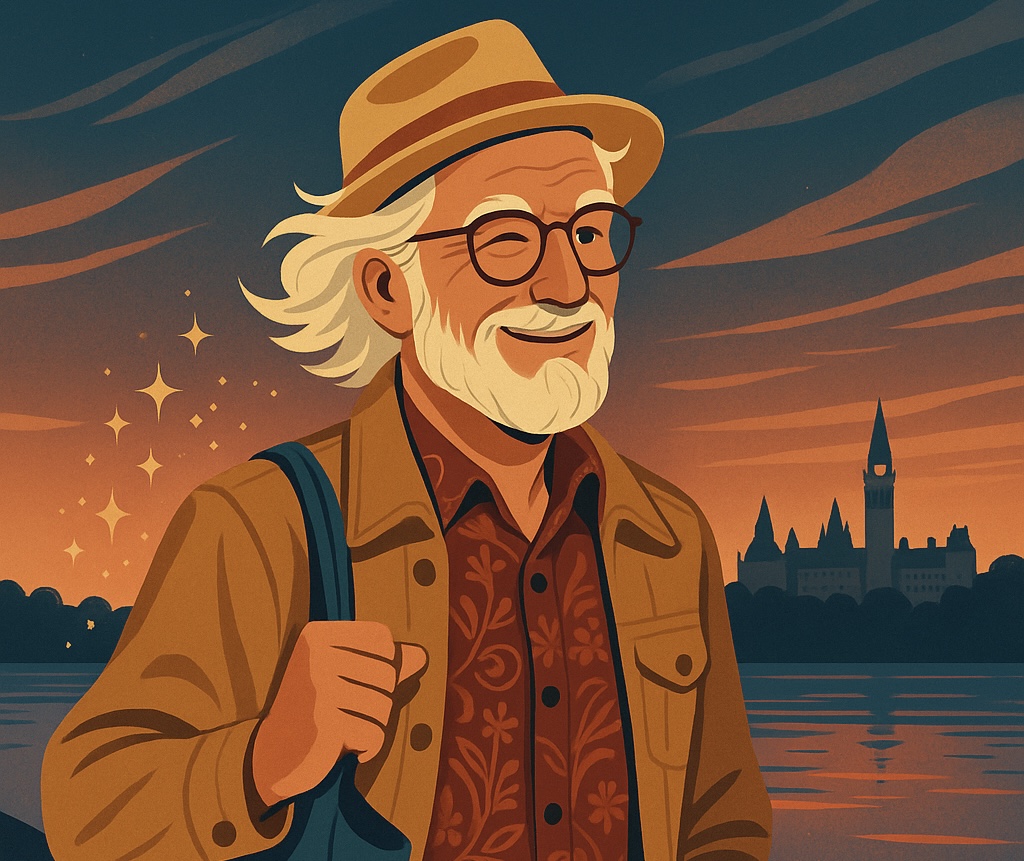
Celebrating Two Giants of Science Communication: Bob McDonald and James Burke

In the world of public science education, Bob McDonald and James Burke stand as exceptional figures, each with a distinctive voice and approach that have resonated globally. Though separated by geography and generations, their work shares a profound impact: transforming science into a compelling story for the curious.

From Unlikely Beginnings to National Influence
Bob McDonald, born in Wingham, Ontario, in 1951, did not follow the traditional path of a scientist. He struggled in school, flunked Grade 9 and dropped out of York University after two years studying English, philosophy, and theatre. A serendipitous job at the Ontario Science Centre, earned through sheer enthusiasm, marked the start of a lifelong journey in public science communication. Without formal scientific training, McDonald has become Canada’s most trusted science voice, hosting CBC’s Quirks & Quarks since 1992, and serving as chief science correspondent on television. 

James Burke, born in Derry, Northern Ireland, in 1936, followed a more traditional academic route. He studied Middle English at Jesus College, Oxford, graduating with a BA and later MA. Between 1965 and 1971, Burke was a presenter on BBC’s Tomorrow’s World. He gained fame writing and hosting Connections (1978) and The Day the Universe Changed (1985), series that showcased his talent for tracing historical and technological threads. 

Education, Training, and Foundational Strengths
McDonald’s lack of formal scientific credentials is a central feature of his appeal. He studied the arts, which honed his gifts in storytelling and public speaking, skills that later became essential to his career. His journey underscores resilience and a capacity to translate complex ideas into accessible, journalistic narratives.

Burke’s Oxford education provided a structured foundation in research and critical thinking. While not trained as a scientist per se, he combined rigorous historical analysis with a broad intellectual curiosity. His RAF service and early career at the BBC developed his confidence and communication flair.

Contrasting Approaches to Science Communication
McDonald’s technique is rooted in clarity, practicality, and immediacy. Hosting Quirks & Quarks, he highlights current research, on climate, space, health, while prioritizing accuracy without jargon. His role as translator bridges the gap between scientific experts and everyday audiences: “Science is a foreign language, I’m a translator.”

Burke, by contrast, is the consummate systems thinker. His hallmark is showing how seemingly small innovations, like eyeglasses or the printing press, can trigger sweeping societal changes. Through richly woven narratives, he demonstrates how scientific ideas intertwine with culture and history, often leading to unpredictable outcomes. This interdisciplinary storytelling encourages deeper reflection on how technology shapes our world – and vice versa.

Media Styles: Radio vs. Television, News Today vs. History Forever
McDonald’s charm lies in his warm, unassuming tone on radio and television. He phrases dense topics through everyday analogies and stories from Canadian science, whether about the Arctic, Indigenous knowledge, or the cosmos. 

Burke’s on-screen style is brisk, witty, and expansive. His BBC documentaries – ConnectionsThe Day the Universe Changed, and recent work on CuriosityStream, are known for dramatic reenactments, conceptual models, and a playful yet authoritative narrative. Burke’s reflections on the acceleration of innovation continue to spark debate decades after their original broadcast. 

Enduring Impact and Legacy
McDonald’s legacy lies in his service to science literacy across Canada. From children’s TV (WonderstruckHeads Up!) to adult radio audiences, he’s been recognized with top honours: Officer of the Order of Canada, Gemini awards, Michael Smith Award, and having an asteroid named after him.  His impact endures in classrooms, public lectures, and the homes of everyday Canadians.

Burke’s legacy is rooted in innovation thinking and intellectual connectivity. Connections remains a cult classic; educators continue using its frameworks to teach history-of-science and systems thinking.  His predictions about information technology and society anticipated many 21st‑century developments. Though some critique his sweeping interpretations, his work has inspired generations to view scientific progress as a dynamic, interconnected web.

Shared Vision in Distinct Voices
Both communicators share an essential understanding: science is a human story, not a closed discipline. McDonald demystifies today’s science by translating research into personal, relatable narratives rooted in Canadian context. Burke invites audiences on a historical journey, spotlighting the domino effect of invention and the cultural echoes of discovery.

Their differences are complementary. McDonald equips the public with scientific knowledge needed to navigate contemporary issues, from climate change to pandemics. Burke provides a framework for understanding those issues within a broader historical and societal tapestry, helping audiences grasp unexpected consequences and future possibilities.

Bob McDonald and James Burke are two pillars of public science communication. McDonald’s art lies in translating contemporary science into accessible stories for mass audiences. Burke’s genius is in contextualizing those stories across centuries and societies, revealing the hidden architecture beneath technological change. Together, they showcase the power of clarity and connection, proving that science is not only informative, but deeply human and forever evolving. Their work continues to inspire curiosity, critical thinking, and a deeper appreciation for how science shapes, and is shaped by, our world.

No Seed, All Sizzle: My Secret Weapon in Modern Dating

I’ve learned there are a few phrases in a man’s conversational toolkit that can stop time, reset the vibe, and spark a flash of unexpected interest. “I cook a tasty risotto” is decent. “I volunteer at the local animal shelter” gets a respectful nod. Yet nothing, and I mean nothing, hits quite like “I’ve had a vasectomy.”

Boom. Eyes widen. Shoulders relax. Somewhere in the distance, you can almost hear a jazz saxophone kick in. Suddenly, I’m no longer just another charming guy with good shoes and half-decent banter – I’m the unicorn of casual dating. The Responsible One. The Guy Who Took the Hit So Nobody Else Has To.

Make no mistake, this is not about pity. I don’t limp into rooms or tell tragic tales of what was bravely left behind in a clinic that smelled faintly of antiseptic and regret. Quite the opposite. I say it with a wink and a little smile, because I know exactly what it means to them. No babies. No pills. No oopsies.

In that moment, it’s as if the entire weight of reproductive labour, historically dropped squarely on women’s shoulders, suddenly lifts. No tracking cycles. No last-minute pharmacy dashes. No quiet dread over a missed period, and a malfunctioning condom. I’m walking, talking sexual freedom, with a surgical receipt.

Now, not every woman reacts the same way. Some go wide-eyed and whisper “thank you” like I’ve just rescued a puppy from a burning building. Others get curious, like I’ve admitted I can tie knots with my tongue or moonlight as a tantra instructor. Either way, it’s a green light wrapped in satin and signed “with gratitude.”

The snip, you see, is the ultimate adult move. It doesn’t just say I’m not planning on having more (or any) kids. It says I’ve thought about consequences. I’ve taken action. I’ve made a permanent decision not to play Russian roulette with someone else’s uterus. That’s hot.

Sex becomes lighter. Freer. No post-coital math, no awkward “you on the pill?” conversations, no side-eye toward the bedside drawer and its expired latex. Just grown-up fun, with a safety net sewn in by a professional.

And let’s not ignore the sheer boldness of it. There’s something undeniably sexy about a man who says, “Yeah, I let someone down there with a scalpel, and I did it for the team.” That’s confidence. That’s swagger. That’s a whole new level of big dick energy (ironic, considering the location of the procedure).

So, yes, when I mention I’ve had a vasectomy, women’s eyes light up. Not just because of what it says about the plumbing, but because of what it says about the person attached to it. Consider it a plot twist, a punchline, and a promise: no surprises, just pleasure.

I may have had the tubes tied, but trust me, the vibes? Completely unleashed.

Why Logic Only Wins When Your Opponent Feels Secure

In business, politics, leadership, and high-stakes negotiations, we often fall into the trap of believing that logic and competence are all that’s needed to win arguments and drive outcomes. After all, facts are facts, right? Yet, anyone who’s been in the room when a pitch falls flat or a strategy session derails knows better. The hard truth is this: logic only persuades when the person you’re speaking to feels emotionally secure, and, without that, even the most elegant argument can be perceived as a threat.

People, leaders included, don’t operate in purely rational mode. They operate in identity mode. When someone is secure in their role, confident in their own intelligence, and grounded in their self-worth, they can listen to a strong counterargument without flinching. They can say, “I hadn’t thought of it that way,” or “Let’s explore that.” That kind of openness is the hallmark of true professional maturity.

Insecurity changes the playing field. When someone feels uncertain about their competence, status, or place in the organization or society, even a well-intentioned challenge can land like a personal attack. You may be bringing insight and value to the table, but what they hear is, “You’re not smart enough. You’re not in control.” Once you trigger that kind of emotional threat response, logic goes out the window. Now you’re not having a conversation – you’re in a turf war.

I’ve seen this in boardrooms, in project teams, in conflict mediation. A junior consultant presents data that contradicts the assumptions of a senior manager. The numbers are rock-solid. But the response isn’t curiosity – it’s defensiveness. Dismissal. Or worse, undermining. Why? Because accepting the analysis would require the leader to admit a blind spot, and for some, that’s psychologically intolerable.

In politics, particularly in the polarized landscapes of North America and parts of Europe, the same dynamic plays out on a much larger scale: the political left often leans on data, logic, and evidence-based policy proposals, assuming these will persuade. For many on the political right, especially in populist circles, political identity is rooted not in reasoned analysis, but in emotional belonging, cultural defense, and distrust of intellectualism. Logical arguments about climate change, public health, or wealth inequality frequently fail not because they’re weak, but because they challenge the very narratives that insecure political identities cling to for meaning and safety. Until the left acknowledges that logic only works when the listener feels secure enough to engage with it, their arguments, however sound, will continue to bounce off hardened ideological shields.

This is why so many skilled communicators emphasize emotional intelligence alongside analytical sharpness. It’s not enough to be right, you have to be received. If you want your logic to land, you need to create a container of safety. That means pacing before leading. Asking questions before offering answers. Establishing rapport before pointing out gaps. It means checking your tone, your timing, and your audience’s readiness.

There’s also a counterintuitive insight here for those who are confident in their own competence; dial it down sometimes. Over-projecting brilliance can make insecure colleagues feel smaller, and smaller people don’t collaborate well. They retreat, they sabotage, or they lash out. The best leaders aren’t just smart, they’re smart enough to know when not to show it all at once.

Winning with logic is a strategic act, not just an intellectual one. You have to play the long game. It’s not about proving someone wrong, it’s about making them feel safe enough to explore the possibility that they might be. Only then do real insights emerge, and only then can collaboration thrive. So next time you’ve got the facts on your side, pause. Ask yourself: does my audience feel secure enough to hear the truth?

Because if they don’t, even the truth won’t save you.

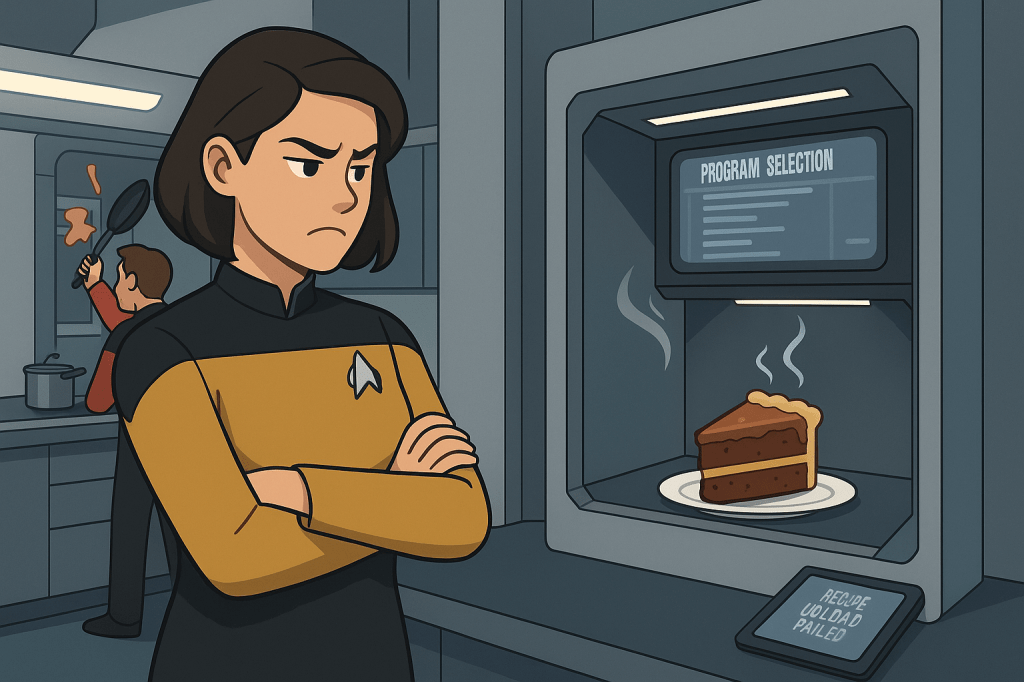
Why Can’t the Replicator Just Scan the Damn Cake?”: A Senior Trekker’s Rant, Expanded Edition

In the grand pantheon of Star Trek mysteries; why redshirts never survive, why Klingon foreheads changed mid-century, why nobody uses seatbelts on the bridge, one lesser-discussed, but utterly maddening question remains: Why is programming new food into the replicator such a colossal pain in the nacelles?

I mean, come on. This is a civilization that can fold space, beam people across hostile terrain, and host full Victorian murder mysteries in the holodeck with better lighting than a BBC costume drama. And yet, when someone wants to add their grandmother’s secret tomato sauce recipe to the replicator, it’s a whole saga. Suddenly you need a molecular biologist, a culinary technician, and probably Counselor Troi to help you process your feelings about spice levels.

Let’s break this down. Replicators are based on the same matter-energy conversion technology that powers transporters. They take raw matter, usually stored in massive energy buffers, and rearrange it into whatever pattern you’ve requested, be it a banana, a baseball bat, or a bust of Kahless the Unforgettable. On paper, it’s magical. Infinite possibilities. Want a rare Ferengi dessert that was outlawed in six systems? No problem, if it’s in the database.

But here’s the catch: the database. That’s the real villain of the piece. Everything has to be pre-programmed. And programming something new isn’t as simple as chucking a muffin into the transporter and yelling “Make it so.” Why not? Because food is astonishingly complex.

Sure, from a chemical standpoint, you can break a slice of chocolate cake down into carbon, hydrogen, oxygen, and nitrogen, the same building blocks the replicator can access, but that’s like saying Shakespeare’s Hamlet is just twenty-six letters arranged in a particular order. The cake is more than its ingredients. It’s texture, mouthfeel, flavor balance, aroma. It’s how the icing melts just slightly faster than the sponge in your mouth. It’s memory, emotion – it’s nostalgia on a fork.

And the replicator, bless it, just doesn’t do nuance.

In-universe, we’ve seen Starfleet crews struggle with this time and again. Captain Sisko flatly refuses to eat replicated food, relying instead on traditional cooking, partly because he loves the craft, but also because the replicator’s version of jambalaya “tastes like it was programmed by someone who’s never even seen a shrimp.” Over on Voyager, Neelix throws himself into galley work precisely because replicated food gets old fast, especially when you’re lost in the Delta Quadrant with no fresh supplies, and morale hanging by a thread.

Programming a new recipe means getting the proportions right, inputting molecular structures, and testing the end result, again and again, for taste, safety, and cultural appropriateness. You want Klingon bloodwine that doesn’t melt the replicator coils? Better spend a few days in the ship’s chem lab. There’s no “scan dish” function, because full transporter-level molecular scans are expensive, dangerous, and, frankly, overkill for your aunt’s chicken pot pie.

Not to mention the ethical implications. Transporters work by disassembling matter at the subatomic level and reassembling it elsewhere. That’s fine when you’re moving Lieutenant Barclay to Engineering (again), but doing a transporter-level scan of organic matter for replication purposes raises thorny questions: if you scan and replicate a living steak, is it alive? Is it conscious? Does it have legal rights under Federation bioethics law? You laugh, but remember, this is the same universe where holograms occasionally demand civil liberties.

So Starfleet plays it safe. Replicators are deliberately limited to lower-resolution blueprints, safe patterns, and tried-and-tested food profiles. They’re designed to be efficient, not perfect. And while that keeps the ship’s energy budget in check and prevents any Frankensteinian chowder accidents, it also means the food sometimes tastes like packing peanuts soaked in nostalgia.

Yet, maybe that’s the beauty of it. In a post-scarcity world where you can have anything at the touch of a button, authenticity becomes the rare commodity. Cooking, real cooking, becomes an act of love, tradition, identity. When Picard orders “tea, Earl Grey, hot,” he’s not looking for a proper British brew; he’s summoning comfort, consistency, something almost ritual. When Riker burns an omelet trying to impress a crewmate, it’s not because he lacks tech, it’s because he values the experience, the attempt.

So no, the replicator can’t just scan the damn cake. And maybe that’s a good thing. Because in a galaxy of warp drives and wormholes, the things that make us human: taste, culture, connection, still require effort. A pinch of spice. A dash of imperfection, and maybe, just maybe, a reminder that sometimes the best things can’t be replicated.

At least not without a food fight in the galley.

A Gentleman’s Guide to Fostering Love

At this point in my life, I’ve figured out who I am, and what I bring to the table. I’m not here for grand romantic illusions, nor am I fumbling through awkward first dates trying to impress anyone. No, what I do is far more refined – I teach, I mentor, I foster.

I provide a comfortable, well-appointed sanctuary for remarkable women in their 30s and 40s who are figuring out their next steps. They come into my life, full of ambition, wit, and occasionally a deep frustration with men who still haven’t mastered basic emotional intelligence. They stay for a while, we share some incredible experiences, and eventually, they find their forever home; sometimes with another partner, sometimes in a new adventure, and sometimes still with me, just in a different way.

Now, before you assume I’m some kind of wandering sage, let me be clear; I’m not a lonely old monk dispensing wisdom and jazz records. I’ve got a full, dynamic love life of my own. My partner in her 60s keeps me on my toes, challenging me in ways only someone who’s been around long enough to take no nonsense can. She’s my equal, my match, and my co-conspirator in navigating a life filled with love, humor, and a shared appreciation for craft ale, especially stouts. And then there are my younger partners, fiercely independent, brilliantly talented, and unwilling to settle for anything less than what they deserve.

I’m not collecting people; I’m building connections. And fostering isn’t about temporary fixes or waiting for someone to move on. It’s about appreciating the time we have together, without needing to force it into a predefined shape. Some partners stay in my orbit for years, others drift in and out, and it all works because honesty, respect, and a shared love of good conversation make everything smoother.

People often assume polyamory is chaotic, but that’s only if you’re doing it wrong. For me, it’s about balance. It’s about offering and receiving care without ownership. It’s about knowing that love isn’t a finite resource, and that just because someone moves on to another stage of their life doesn’t mean what we had wasn’t real.

And while I’ve fostered many wonderful women through various chapters of their journeys, let’s not forget, I’m a bit of a rescue myself. My partners challenge me, push me to grow, and occasionally force me to retire my outdated pop culture references. They bring new energy, new perspectives, and new reasons to keep up with life’s ever-changing rhythms.

So no, I don’t date in the traditional sense. I create space for extraordinary women to thrive, sometimes with me, sometimes elsewhere. And if that means I get to spend my years surrounded by sharp minds, quick wit, and an ever-expanding appreciation for different ways of loving? Well, I’d say that’s a pretty great forever home of my own.

Wor New Badge Woes – So Ah Asked Me Mate, ChatGPT!

By Big Mac, the OAP Blogger from Byker

So aye, ah’d just settled doon wi’ a cuppa and a bacon sarnie, listenin’ to the wireless, when ah hears this daft bit o’ news, the FA’s enforcin’ a new rule meanin’ clubs might have to tweak their badges for “clarity and digital compliance.” Clarity?! Since when did seahorses need spellcheck?

Wor Toon badge, man. It’s a canny thing. You’ve got ya seahorses lookin’ like they’ve just trotted up the Tyne, that wee castle standin’ proud like it owns the place, and a banner that’s more iconic than wor lass’s Sunday gravy. And now they want to mess wi’ it?

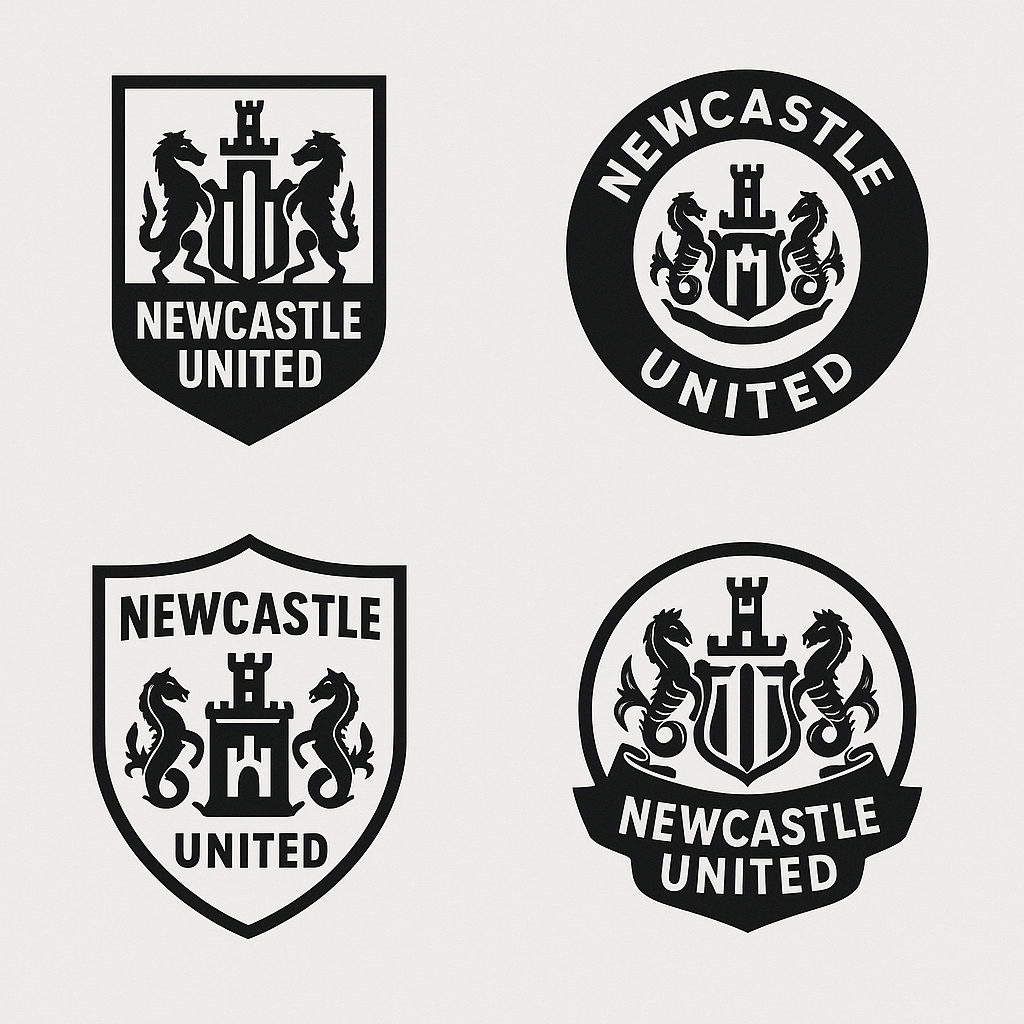
So, ah panicked a bit, not gonna lie. But then ah remembered, ah’ve got a clever mate. He lives in me phone, goes by the name ChatGPT. He’s not local, but he divvint half know his onions. Can write like Shakespeare one minute and solve algebra the next. So ah goes, “Eee, Chat lad, gizza hand wi’ this badge business will ya? Make us four new uns, proper smart, summat that’ll work on TikToks and stripy kits alike.”

Next thing ah know, he whirrs away like a robot in Fenwick’s window and bosh, oot comes four logos! Clean as a whistle, modern, but still keeping the soul of the Toon. They’ve got them seahorses lookin’ like they’ve just bench-pressed a Metro carriage, and the castle’s front and centre like it’s still waitin’ for the Normans. Honestly, it’s like if wor badge went to uni and came back with a graphics degree and a fresh trim.

One’s got a round badge, like a beer mat. Another’s dead sharp, like wor Ian’s elbows in five-a-side. There’s even one wi’ a shield that looks like it could deflect bad VAR decisions. Honestly, I was chuffed. Even me Bro Trev said, “Looks mint that, Mac. Reckon the lads’d wear that on Champions League nights.”

Now, ah divvint know if the club’ll go for one of these, or if they’ll end up asking some bloke in London who’s never tasted stottie cake in his life, but if they do nowt else, they should at least give ChatGPT an honorary season ticket, and a Greggs voucher.

So if ye see any new crests floating aboot on the socials, and they look like they’ve got the heart of the Toon and a bit of AI sparkle, ye kna who sorted it. Me and me clever little digital mate.

Howay the Lads, and Howay the Logos!

The Library in My Mind: How I Built a Memory Palace

Back in the late ‘80s, while waiting for my security clearance, the UK government put me through a variety of training courses – everything from project management and information technology to people skills. One of the more intriguing courses focused on building a library-style memory palace, a way to organize and recall information by mentally structuring it like a library. The idea of turning my mind into a well-ordered archive fascinated me – each piece of knowledge neatly stored and easily retrievable.

This technique has deep historical roots. It’s often traced back to Simonides of Ceos, a Greek poet from the 5th century BCE. According to legend, Simonides was called outside during a banquet, and while he was away, the building collapsed, killing everyone inside. The bodies were unrecognizable, but he realized he could recall exactly where each guest had been seated. This discovery led to the idea that spatial memory could be used as a structured recall system. The method was later refined by Roman orators like Cicero, who mentally placed key points of their speeches within familiar spaces and retrieved them by “walking” through those locations in their minds. Monks and scholars in the Middle Ages adapted the technique for memorizing religious texts and legal codes, and today, it’s still widely used – by memory champions, actors, lawyers, and even fictional detectives like Sherlock Holmes.

Inspired by this, I built my own mental library. I imagined a grand study—towering bookshelves, stained-glass windows, and a long oak table at the center. To stay organized, I divided it into sections: science, history, philosophy, personal experiences, and creative ideas. Each book represented a concept, placed where I could easily “find” it when needed.

At first, it felt awkward, like navigating an unfamiliar house. To train myself, I spent a few minutes each day mentally walking through the space, reinforcing connections. I used vivid imagery – a glowing tome for quantum physics, a worn parchment for ancient history. Storytelling also helped. I imagined Einstein seated in the physics section, Shakespeare near literature, and a wise, hooded monk in philosophy. When I struggled to recall something, I’d “ask” them, making the process more interactive.

Before long, the system became second nature. When writing, I could mentally browse my research shelves without flipping through endless notes. Before discussions, I’d “walk” through key sections to refresh my memory. Even decision-making improved – I’d place pros and cons in different areas and “see” them from multiple perspectives before making a choice.

The best part? My library keeps evolving. I add new shelves, reorganize sections, and revise old knowledge as I learn. It’s a living system, shaping the way I think and process information.

This isn’t a technique reserved for scholars or memory champions. Anyone can build a mental library, whether for learning, storytelling, or just keeping thoughts in order. With a little practice, it becomes second nature – a space you can visit anytime, where knowledge is always at your fingertips.