AI and the Future of Creative Writing

In recent years, artificial intelligence has made its mark on many industries, from healthcare to finance, but one of the most striking developments is its encroachment on the world of creative writing. As AI systems like ChatGPT become more advanced, the boundaries between human and machine-generated content blur. We’re left wondering, are we witnessing the dawn of a new creative era, or are we simply setting ourselves up for an intellectual shortcut that could undermine the craft of storytelling?

The impact of AI on literature, journalism, and speculative fiction is already apparent. Authors are using AI as a tool to assist with everything from generating ideas to drafting full-length novels. While this opens up exciting possibilities for writers who may struggle with writer’s block, it also raises a host of questions about authenticity. Can a machine, devoid of lived experience, truly capture the nuances of human emotion or the subtleties of cultural context? AI may be adept at mimicking patterns of language, but does it understand the story it tells? And even more importantly, does it feel the story?

Journalism, a field traditionally built on human insight and investigative rigor, is also seeing a dramatic shift. AI-driven tools can now write articles with stunning speed, churning out copy on everything from politics to sports. The convenience is undeniable. Newsrooms, under pressure from tight deadlines and dwindling resources, find AI a helpful ally in meeting the demand for continuous content. But there’s a worrying undercurrent here: Can we trust a machine to provide the nuanced, ethical, and context-rich reporting that we need in an increasingly complex world? The thought of an algorithm determining what’s “newsworthy” is chilling, particularly when considering how data-driven models often fail to detect or represent bias, or how they may inadvertently amplify misinformation.

Perhaps the most exciting, and also the most concerning, role AI is playing is in speculative fiction. Writers have long used the genre to explore what might happen in the future, and with AI capable of generating entire worlds and characters in minutes, the scope for innovation is limitless. But there’s a risk that AI-generated speculative fiction will end up being more formulaic than fantastic. If every story is based on pre-existing patterns or data sets, will we lose the very essence of speculative fiction – the wild, unexpected ideas that challenge our assumptions about the world? The creative chaos that makes the genre so thrilling could give way to an artificial predictability that lacks true human imagination.

At the heart of these concerns is the broader issue of creativity itself. Writing, like all art, is a deeply personal expression. It reflects the writer’s experiences, their worldview, their struggles. Can an AI, which operates purely on patterns and algorithms, truly replicate this? Even if it can produce a perfectly structured story, does it have the soul that comes from a human hand? There is something to be said for the imperfections in art – the missed commas, the stray metaphors, the oddities that make it feel real. AI, by its very nature, smooths out those edges.

At this point I should perhaps clarify my own use of AI tools. I am a storyteller by nature, and this blog is only one of many creative outlets.  I tend to use AI in a consistent manner – for researching a topic when I feel I need more information, and then to edit my first rough draft. I always edit/rewrite my published work as I find AI to have questionable grammar and horrible punctuation. If this changes, I will write a piece about it, and mention my new process in the About section.

So, as we hurtle toward this AI-infused future, we must ask ourselves, what is the value of a story? Is it the perfect sentence, the perfect insight, or is it the unique perspective of the person telling it? AI is undoubtedly changing the landscape of creative writing, but whether it enriches or diminishes the craft remains to be seen. As writers, readers, and cultural observers, it’s essential that we hold onto the human essence of storytelling – because once we lose that, we may never get it back.
Placing the works of EE “Doc” Smith into its Societal Context

I read a fair amount of science fiction, as can clearly be seen from the content of this blog.  My first introduction to speculative fiction, beyond C.S. Lewis, was the works of E.E. “Doc” Smith, loaned to me by a fellow classmate during my early teens. I devoured every book by this author I could find, reading without judgement, just enjoying the galactic adventure. Like I have said many times about my annual reading of Frank Herbert’s Dune, it’s not the story that changes, but the perspective that the additional year gives me.  

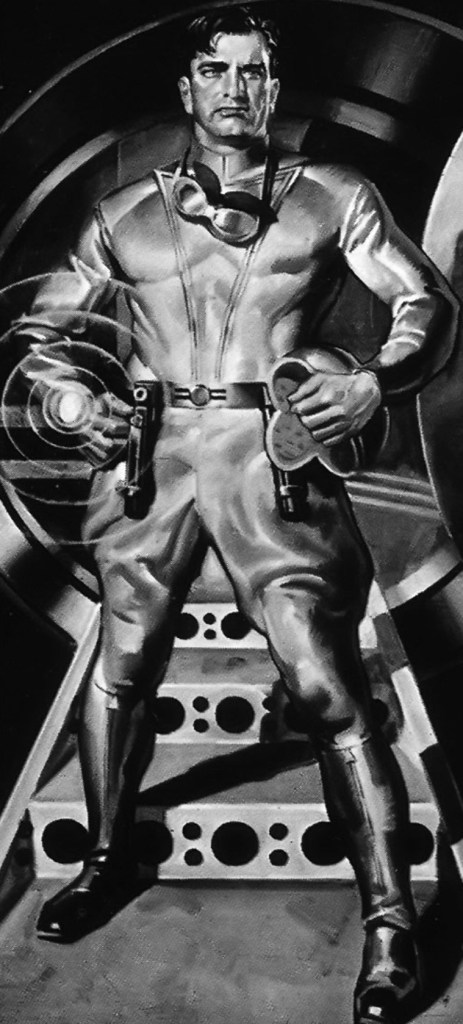
E.E. “Doc” Smith is an undeniable cornerstone of science fiction, particularly in shaping the grand, sweeping narratives of the space opera subgenre. His works, from the Lensman to the Skylark series, established many of the storytelling conventions that would define science fiction for generations. Yet, these same works are deeply entwined with the patriarchal and often misogynistic norms of their time, offering a fascinating lens through which to examine the cultural attitudes of the early-to-mid 20th century. Smith’s legacy is both a celebration of speculative ambition, and a study in the limitations of its era.

The Lensman series, perhaps Smith’s most iconic work, epitomizes the space opera’s blend of high-stakes interstellar conflict and moral idealism. Published between 1934 and 1950, these novels follow the genetically perfected heroes of the Galactic Patrol, led by the stalwart Kimball Kinnison, in their battle against the shadowy forces of Boskone. While the series broke ground in envisioning a universe of sprawling galactic civilizations, its treatment of gender roles reveals a narrower imagination. Female characters, such as Clarissa MacDougall, are largely confined to nurturing or supportive roles, their significance often framed in relation to male protagonists. Even Clarissa’s ascension to the ranks of the Lensmen – a notable exception – feels more like a narrative anomaly than a redefinition of gender dynamics. The series reflects its time, portraying men as protectors and leaders while relegating women to emotional or domestic spheres.

Similarly, the Skylark series, begun in 1928, offers an early blueprint for the modern space opera, chronicling the scientific and exploratory exploits of Richard Seaton and his morally ambiguous rival, Marc “Blackie” DuQuesne. Once again, women – characters like Dorothy Seaton and Margaret Spencer – are predominantly relegated to roles as love interests, hostages, or secondary figures. Though occasionally resourceful or intelligent, their contributions are overshadowed by the male protagonists’ heroics. These dynamics reinforce traditional gender hierarchies, with men as agents of innovation and action while women serve as symbols of emotional stability or moral guidance.

In the Family d’Alembert series, co-written with Stephen Goldin during the 1960s and 1970s, there is a slight shift in representation. Yvette d’Alembert, part of a circus-trained secret agent duo, emerges as a rare competent female protagonist. Yet even her capabilities are often contextualized by her physical appeal and partnership with her brother Jules. By this time, feminist movements were beginning to reshape societal norms, but science fiction, especially that rooted in the pulp tradition, lagged in reflecting these changes. Yvette’s portrayal, while an improvement, still clings to the vestiges of earlier patriarchal frameworks.

Smith’s later works, such as Subspace Explorers (1965), continue to explore grand themes like telepathy, space exploration, and societal advancement, but the underlying gender dynamics remain unchanged. Female characters with psychic abilities feature in the narrative, yet their roles are secondary, reinforcing the notion that leadership and innovation are male domains.

These patterns are not mere quirks of individual stories but reflections of a broader societal framework. Smith’s fiction mirrors the rigid gender roles of early-to-mid 20th-century society, a time when women were often confined to domestic or secondary positions. His male protagonists, embodying traits of strength, rationality, and dominance, contrast sharply with the nurturing and emotional roles assigned to women. While Smith does not explicitly demean women, the systemic sidelining of female characters speaks to the cultural misogyny of the era. His works helped establish many tropes that would define space opera, but they also reinforced a male-centric vision of the genre that took decades to challenge.

Despite these limitations, Smith’s influence on science fiction is profound. His imaginative depictions of intergalactic civilizations, advanced technologies, and epic storytelling inspired luminaries such as Isaac Asimov, Arthur C. Clarke, and even George Lucas. Modern readers, however, often critique his works for their outdated gender dynamics and lack of diversity. These critiques, while valid, do not diminish the historical significance of his contributions. Instead, they offer an opportunity to reevaluate his legacy in light of the genre’s ongoing evolution.

E.E. “Doc” Smith’s works remain a double-edged artifact of science fiction history: a testament to the boundless creativity of speculative fiction, and a reminder of the cultural constraints of its time. By recognizing these dual aspects, we can celebrate his role in shaping the genre while continuing to push for more inclusive and equitable narratives in speculative storytelling.

The Weight of Words: A Lifelong Romance with Hardcovers

I usually think of myself as a modern man, fully bought into our digital world, and then I wander into the farmhouse library, and I realize that this space is a place outside of time, and I remember my ongoing love affair with hardback books. As I first wrote and edited this piece, I found myself switching back and forth between hardcover and hardback, mixing as I often do my British and Canadian English.  Rather than going with a uniform approach, I left the nouns and adjectives as I found them on the page.  

Screenshot

I still to this day buy hardback books because they embody something rare in our fast-paced, ephemeral world: permanence. There’s a kind of quiet romance to their weight in my hands—a grounding reassurance that I’m holding more than just paper and ink. Each hardcover feels like a promise, an intimacy that won’t vanish with the swipe of a screen or a fleeting notification. They are timeless, like the lingering warmth of a lover’s voice after they’ve left the room, soft yet unwavering.

On my shelves, their spines stand like steadfast sentinels, guarding fragments of my life. Each book holds a memory: a novel devoured on a long train ride, a cookbook sprawled across the counter on a rainy Sunday, a travel guide flipped through during quiet nights when the world outside was covered with snow. Their dust jackets, often worn and peeling at the edges, only make them dearer. Like laughter lines etched on a familiar face, they tell stories of years well-lived and hands well-loved.

Hardback books are resilient in ways I admire. Their pages hold firm, their spines don’t surrender, and their beauty only deepens with age. When I open one, the faint creak of the binding feels like the exhale of a secret shared just between us. The embossed covers beg to be touched, as though inviting me to connect not just with the words within, but with the countless others who’ve held the same book. In their permanence, I find companionship—kindred spirits who, like me, sought solace or joy in those very same pages.

My collection is a reflection of who I am. Beloved fiction titles transport me to worlds where I’ve found companionship in characters who now feel like lifelong friends. Illustrated cookbooks add bursts of color and life, inspiring meals that have punctuated moments of celebration, comfort, and discovery. And then there are my permaculture and agroforestry guides, rooted in a deep love for the earth and a longing to live in harmony with its rhythms. Together, they form an eclectic tapestry of passions that, when viewed as a whole, feel like an unspoken autobiography.

Perhaps, above all, I buy hardbacks for the future they promise. I picture someone I care for—perhaps a partner, or one of their children—one day standing before my shelves. They’ll trace the spines, pull a book down, and find my notations in the margins or a bookmark still tucked between the pages. Those scribbles and marks, though small, will be echoes of me—a life lived in dialogue with stories, recipes, and ideas.

Hardback books, like love, aren’t always practical, but they are endlessly worth it. They ask for time, for care, for patience. And in return, they give so much more—a place to lose myself, to learn, to dream, and, more often than not, a place to be found.

Indifference – A Reflection on a Personal Conversation

I want to reflect upon a fascinating conversation I had late Christmas night with a dear friend. We ended up talking about personal boundaries, and the ways we protect ourselves emotionally. It was one of those deep, reflective discussions that linger long after the words are spoken.

At some point, I shared a hard lesson I learned from an ex-partner about the concept of indifference. That simple admission opened a door to a much larger, layered conversation about what indifference truly means, how it functions, and the role it plays in our relationships; both with others and with ourselves.

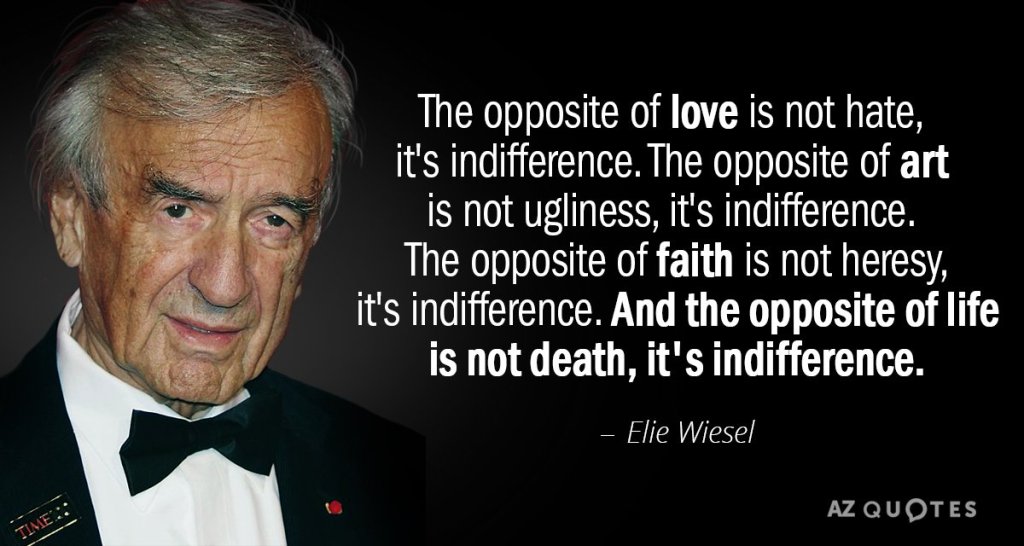
What struck me was how much weight the word indifference carries. It’s such a profound concept when you think about it. Philosophers like Elie Wiesel have said that indifference, not hatred, is the true opposite of love. Love and hate, after all, are both fiery, emotional investments; they require energy, passion, and focus. But indifference? That’s the absence of all of that. It’s an emotional void, a refusal to care.

We talked about how indifference can be more painful than outright hate. At least with hate, you know you’re being seen, felt, acknowledged in some way. Indifference, on the other hand, feels like being erased, like you don’t matter enough to warrant any reaction at all. In relationships, it can create this deep loneliness; a silent, aching space where love or even conflict should be.

But then we got into the darker side of indifference, how it can also be wielded as a kind of weapon. It’s not always passive, you know? Sometimes it’s deliberate, a way to assert control or punish without saying a word. We’ve all seen or felt it in some form: the cold shoulder, the ignored text, the subtle withholding of care or acknowledgment. Those silences and omissions can be sharper than words.

We explored a few examples, like in romantic relationships, when one partner uses indifference to send a cruel, unspoken message: “You don’t matter.” Or in workplaces, where a boss might undermine someone by pretending their contributions don’t exist. That kind of calculated indifference is devastating because it’s so insidious. It leaves the other person questioning their worth.

What’s tricky is that indifference isn’t always malicious. It can be a survival mechanism too, right? Sometimes, detaching and withdrawing emotionally is a way to protect ourselves from toxic dynamics or emotional exhaustion. The question is whether indifference is being used as self-preservation or as a means to harm or manipulate someone else.

Honestly, the more we talked about it, the more I realized how thin the line is between healthy detachment and destructive indifference. I think perhaps that intention is everything, whether it’s about creating space for yourself or shutting someone out entirely.

The whole conversation left me reflecting on my own tendencies and how I’ve used or experienced indifference in my life. It’s a lot to sit with, but also something I feel like I need to understand better.

What do you think? Have you ever found yourself wrestling with indifference, either as a tool or as something you’ve been on the receiving end of?