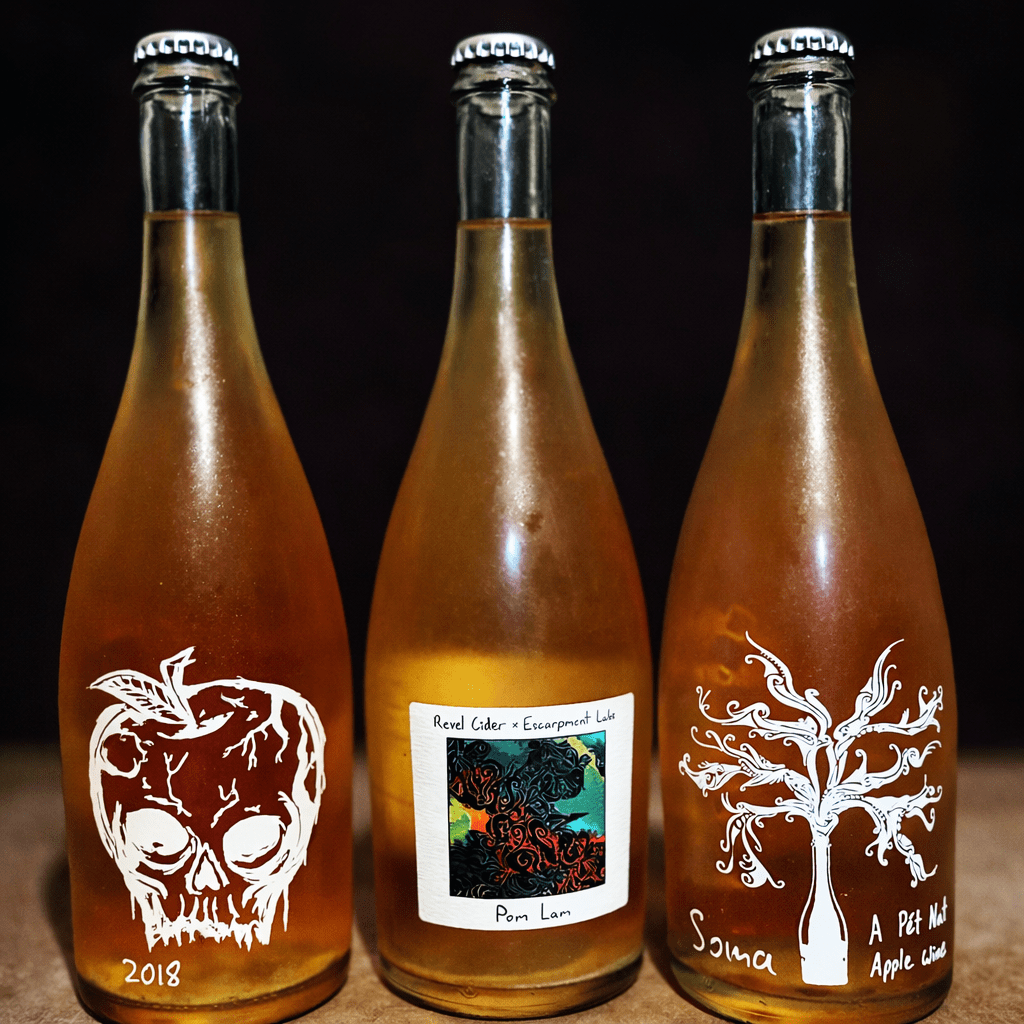
Revel Cider “Soma” 2018 Pét-Nat Apple Wine from Ontario

Soma is the sort of bottle that looks like it’s about to behave itself, and then gently does not. I bought this wine when it was first released and it’s been sitting in my cellar waiting for the right moment to help celebrate life. 

Made by Revel Cider in Ontario, the 2018 Soma is a Pétillant-Naturel apple wine, which is a polite way of saying it was allowed to do its own thing. Nothing added, nothing taken away. The apples were cryoconcentrated by winter itself, left to freeze so the good bits could huddle together and become more interesting. Wild yeasts were invited in. Fermentation finished in the bottle. Bubbles happened naturally. Order was optional.

In the glass, Soma arrives lightly coloured, with a fine, energetic sparkle. There is sediment, because of course there is, and it’s best treated like a houseguest who means well. Pour gently if you prefer clarity. Embrace it if you enjoy a little texture and mystery. Either approach is correct.

On the nose, this is all orchard and apple skin, with a hint of cider cellar and fresh bread dough drifting in from the fermentation. It flirts briefly with funk, then thinks better of it. The result is fresh, restrained, and quietly confident rather than loud or performative.

The palate is dry, crisp, and surprisingly serious beneath its playful fizz. The cryoconcentration gives the cider some backbone, adding depth and structure without tipping into sweetness. Apple flavours are precise and grown-up: more skin and flesh than juice. The bubbles keep things lively, lifting the acidity and carrying everything neatly through to a clean, savoury finish that knows when to leave.

At around 11.5 percent alcohol, Soma is very much a sit-down cider, not a lawnmower cider. It behaves more like a natural wine that happens to be made from apples, and it rewards being served cold, upright, and with a bit of attention. It’s excellent on its own and even better with food, particularly cheese or anything roasted and comforting.

The 2018 Soma manages the neat trick of being thoughtful without being smug. It’s playful without being silly, natural without being preachy, and serious enough to keep your interest while still feeling like it’s having fun. A bottle that sparkles, literally and otherwise.

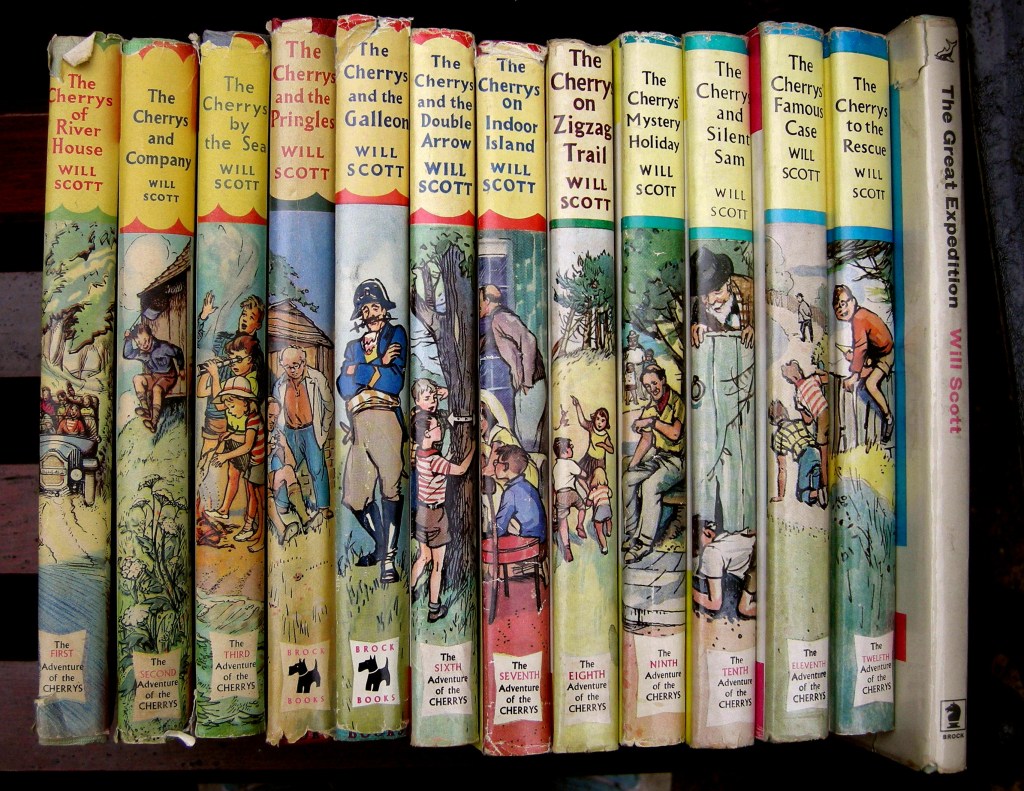
The Cherrys Books: Family, Adventure, and Imagination

William Matthew Scott, better known by his pen name Will Scott, was a British writer born in 1893 in Leeds, Yorkshire, and active as a novelist, playwright, short-story writer, and children’s author until his death in 1964 in Herne Bay, Kent. In his earlier career he wrote detective novels and plays including The Limping Man, and is said to have contributed around 2,000 short stories to magazines and newspapers, which was considered a record in the United Kingdom during his lifetime. His shift into children’s fiction came relatively late and was inspired by his own grandchildren, for whom he began inventing stories that eventually became The Cherrys series.  

Published between 1952 and 1965The Cherrys consists of 14 books aimed at children around ten years old. These books are set in a series of fictional English villages and bays, often around the Kentish coast, and centre on a single extended family: Captain and Mrs Cherry and their four children, Jimmy, Jane, Roy, and Pam. The family’s unusual animal companions, a monkey named Mr Watson and a parrot called Joseph, add to the charm of the stories.  

At the heart of The Cherrys is a simple but powerful idea: childhood is an adventure to be nurtured by imagination and shared experience. Rather than portraying children operating independently of adults, as was common in much children’s fiction of the era, these books emphasize active parental involvement, especially through the father figure, Captain Cherry. A retired explorer, he delights in creating games, puzzles, treasure hunts, mystery trails, and “happenings” that turn ordinary days into extraordinary quests. These events span coastlines, forests, gardens, and even indoor spaces transformed by imagination into jungles, deserts, or deserted islands.  

The recurring concept of a “happening” – a structured, imaginative adventure, is one of the defining features of the series. Whether decoding maps, tracking mysterious figures, solving puzzles, or embarking on seaside explorations, each book presents a series of linked episodes that encourage curiosity, teamwork, problem-solving, and play. Scott’s approach reflects a belief in the value of learning through play, where the boundaries between fantasy and reality are fluid but always grounded in cooperative activity with family and friends.  

Another important theme in The Cherrys is engagement with the natural and built environment. Scott often provided maps of the stories’ fictional settings , such as Market Cray or St Denis Bay, and used them as stages for the characters’ activities. This emphasis on place encourages readers to see their own landscapes as rich with potential for discovery. The stories also reflect a positive view of the mid-century British countryside and coast, celebrating local topography and community life.  

Because Scott was writing at a time when much of children’s literature featured independent adventures without adults, The Cherrys stood out in its portrayal of grown-ups as co-adventurers rather than obstacles. This inclusive structure bridges the generational gap, showing children and adults working together, learning from one another, and finding joy in shared challenges.  

Despite their popularity in their day, these books are no longer in print, making them a somewhat forgotten gem of 1950s and 1960s British children’s literature. Yet for those who discover them today, the series offers a window into a world where imagination, family bonds, adventure, and everyday wonder are woven seamlessly into the narrative fabric. 

Campbeltown in Short Supply: A Pre‑Burns Night Puzzle

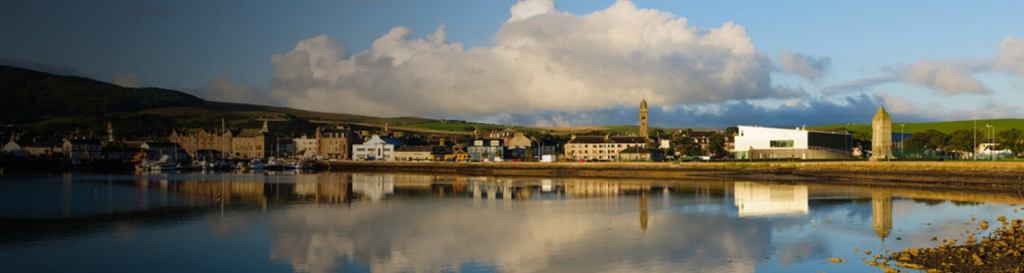
In the run‑up to Burns Night, when invitations to raise a dram in honour of Scotland’s national bard are circulating and whisky lists are being pondered, one question quietly confronts many enthusiasts: why is good single malt from Scotland, particularly from Campbeltown, so difficult to find? Historically, Campbeltown was once celebrated as the whisky‑making capital of the world, its docks loaded with casks and its distilleries numbering in the dozens. Today, that legacy has dwindled to a trio of working sites: Springbank, Glen Scotia, and Glengyle, whose combined output forms only a tiny fraction of Scotland’s total whisky production.  

The contraction of the Campbeltown region from a bustling 19th‑century centre to just three survivors underscores a broader shift in Scotch whisky’s industrial geography. Economic downturns, world wars, and changing markets saw most local distilleries close their doors; the survivors have maintained a commitment to traditional craft rather than high‑volume output. Springbank, founded in 1828 and still family‑owned, is notable for carrying out every stage of whisky production on site and for producing multiple distinct spirits from the same distillery. Glengyle’s output, marketed under the Kilkerran name to avoid confusion with another brand, remains limited by design, often amounting to small, carefully managed batches. Glen Scotia continues alongside them with a modest annual capacity, and a small range of core expressions.  

This lineage of craftsmanship contributes directly to scarcity. The distilleries’ capacity, often measured in hundreds of thousands rather than millions of litres, cannot hope to match the output of giants in Speyside or the Highlands, and the maturation process itself imposes inevitable delays. Whisky that will only reach ten, fifteen, or more years of age must be laid down long before demand becomes apparent. The result is a perennial mismatch between global appetite and available matured stocks.  

The scarcity is compounded by collector and secondary markets, which prize older bottlings and limited releases. Annual special editions or festival releases often sell out immediately and surface on secondary markets at marked‑up prices. That dynamic leaves fewer bottles for casual purchase on regular retail shelves, and for many drinkers the prospect of finding a Springbank 15 or Kilkerran 12 in a local shop feels remote. Even widely respected expressions such as Glen Scotia’s Victoriana or Double Cask appear more steadily only because their production and positioning make them easier to distribute.  

Yet the character and heritage that make these whiskies worth celebrating in the first place are inseparable from this scarcity. The maritime influence of ageing on the Kintyre peninsula, the persistence of traditional methods against industrial homogenization, and the small‑scale stewardship of family and independent producers distinguish Campbeltown malts from the bulk‑produced spirits that dominate global shelves. In a whisky world increasingly defined by scale and brand recognition, the quiet resilience of Campbeltown’s remaining distilleries serves as a reminder of the irreplaceable value of regional diversity.

Five Hundred Posts

This is the 500th post on Rowanwood Chronicles, and I want to pause for a moment rather than rush past the number.

Five hundred posts means months of thinking in public. It means essays written early in the morning with coffee going cold, notes drafted in train stations and kitchens, arguments refined and re-refined, and ideas that only became clear because I was willing to write them out imperfectly first. It means following threads of geopolitics, technology, culture, relationships, power, science fiction, and lived experience wherever they led, even when they led somewhere uncomfortable or unfashionable.

This blog was never intended to be a brand or a platform. It has always been a workshop. A place to test ideas, to connect dots, to push back against lazy thinking, and to explore what it means to live ethically and deliberately in a complicated world. Some posts have aged well. Others mark exactly where my thinking was at the time, and I am content to leave them there as signposts rather than monuments.

What has surprised me most over these five hundred posts is not how much I have written, but how much I have learned from the responses, private messages, disagreements, and quiet readers who later surfaced to say, “That piece helped me name something.” Writing in public creates a strange kind of community, one built less on agreement than on shared curiosity.

To those who have been reading since the early days, thank you for staying. To those who arrived last week, welcome. To those who argue with me in good faith, you have sharpened my thinking more than you know. And to those who read quietly without ever commenting, you are still part of this.

I have no intention of slowing down. There are still too many systems to interrogate, futures to imagine, and human stories worth telling. Five hundred posts in, Rowanwood Chronicles remains what it has always been: a place to think carefully, write honestly, and refuse simple answers.

Onward.

🗓️ Five Things We Learned This Week

Week of December 27, 2025 – January 2, 2026

Even in the quiet stretch between Christmas and New Year’s, the world did not pause. Across science, politics, climate, conservation, and global systems, this past week offered reminders that change continues — sometimes quietly, sometimes decisively.


✈️ India’s Air Travel Crisis Revealed Systemic Fragility

In the days following Christmas, India’s largest airline faced widespread cancellations and delays after stricter pilot fatigue rules collided with already stretched staffing. By December 30, operations had stabilized, but only after tens of thousands of passengers were affected.

Why it matters: The disruption exposed how regulatory enforcement, labor shortages, and tight scheduling can cascade into national-scale failures — a warning for aviation systems worldwide.


🌍 The United Nations Expanded Climate Adaptation Financing

On December 29, the UN announced a significant expansion of its climate adaptation finance framework, directing additional concessional funding toward countries already experiencing severe climate impacts.

Why it matters: While mitigation often dominates headlines, adaptation funding is where climate policy becomes tangible for vulnerable communities facing floods, drought, and displacement.


🐘 Kenya Reported Its Lowest Elephant Poaching Levels in Decades

Kenyan wildlife authorities confirmed on December 28 that elephant poaching has dropped to historic lows, crediting community-based conservation programs, improved ranger coordination, and aerial surveillance.

Why it matters: This rare conservation success shows that sustained investment, local engagement, and enforcement can reverse even long-running environmental crises.


⚖️ The U.S. Supreme Court Halted a Major Immigration Enforcement Rule

On December 30, the U.S. Supreme Court temporarily blocked the rollout of a new federal immigration enforcement policy, pending further legal review.

Why it matters: The decision reinforces judicial limits on executive power and reshapes the near-term landscape for immigration enforcement, labor policy, and civil rights debates.


🔭 The James Webb Telescope Detected Water Vapor on a Rocky Exoplanet

NASA scientists confirmed between December 31 and January 1 that Webb telescope data shows strong evidence of water vapor in the atmosphere of TRAPPIST-1e, one of the most promising Earth-like exoplanets identified so far.

Why it matters: This finding strengthens the case for studying potentially habitable worlds beyond our solar system and marks another leap forward in observational astronomy.


Closing thoughts: From airline systems and courtrooms to savannas and distant star systems, this week’s stories remind us that progress, risk, and discovery do not respect holiday calendars. Paying attention — even during the quiet weeks — remains an act of civic and intellectual care.

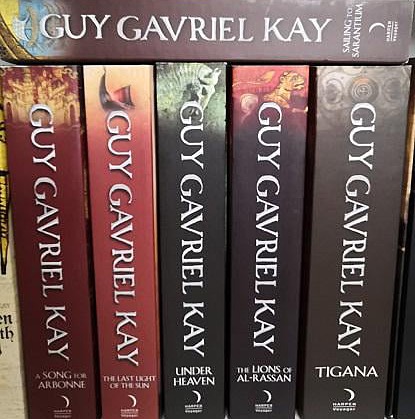
Fantasy as Memory: The Historical Imagination of Guy Gavriel Kay

One of my favourite fiction authors, Guy Gavriel Kay has shaped my reading life from his debut series “The Fionavar Tapestry”, published in the mid-1980s, to his most recent novel “Written on the Dark”, released earlier this year.

Kay does not write fantasy as spectacle or escape, but as remembrance. His work is concerned less with heroes than with consequence, asking what endures after ambition, love, and loss. That focus, and his habit of listening closely to history rather than reshaping it for comfort, is what sets his writing apart from others in the genre.

Guy Gavriel Kay’s writing style is often described as lyrical, restrained, and morally attentive, and that combination is very Canadian in the best sense of the word. His prose is elegant without being ornamental, emotionally resonant without tipping into melodrama, and deeply concerned with how history presses on individual lives.

Lyrical clarity rather than baroque fantasy
Kay’s sentences are musical, but they are rarely flashy. He favours cadence, balance, and carefully chosen imagery over density or excess. Unlike much epic fantasy, he does not bury the reader in invented terminology or ornate description. The beauty of the prose comes from rhythm and precision, not spectacle. This gives his work a reflective, almost classical feel, closer to historical fiction than to high fantasy in the Tolkienian tradition.

History refracted, not replicated
One of Kay’s defining stylistic traits is his use of “quarter-turn” history. His worlds are clearly inspired by specific historical periods and places, Byzantium, medieval Iberia, Tang-era China, Renaissance Italy, but they are never direct analogues. Stylistically, this allows him to write with the emotional authority of history without being constrained by factual retelling. The prose carries a sense of inevitability, consequence, and loss that feels historical, even when the setting is invented.

Melancholy as a narrative tone
Kay’s work is suffused with a quiet melancholy. Triumphs are provisional. Victories are costly. Even moments of joy are shadowed by what will be lost. Stylistically, this appears in his frequent use of memory, foreknowledge, and reflective distance. Characters often understand, sometimes too late, what a moment meant. This gives the writing a sense of adult seriousness and emotional depth that distinguishes him from more action-driven fantasy authors.

Moral complexity without cynicism
Kay is interested in moral ambiguity, but he is not cynical. His style allows multiple perspectives to coexist without collapsing into relativism. Characters act from loyalty, love, fear, faith, and ambition, often all at once. The prose is careful to see people rather than judge them. Even antagonists are given interiority and dignity. This ethical attentiveness is part of what makes his work feel humane and grounded.

Dialogue as character and culture
His dialogue is formal without being stiff, shaped by the social worlds his characters inhabit. People speak with restraint, implication, and subtext. Emotion is often conveyed by what is not said. This stylistic choice reinforces themes of honour, obligation, and social constraint, particularly in courtly or religious settings.

A Canadian sensibility
Although Kay’s settings are global and historical, his sensibility feels distinctly Canadian. There is a preference for understatement, for listening rather than declaring, for complexity over absolutes. Power is treated warily. Empire is examined with sadness rather than nostalgia. The writing resists grand national mythmaking and instead focuses on human cost, compromise, and quiet endurance.

Guy Gavriel Kay writes fantasy for readers who care about language, history, and moral weight. His style is not about escape so much as reflection. He invites the reader to slow down, to attend to memory and consequence, and to sit with beauty that is inseparable from loss. That combination, lyrical restraint, historical gravity, and ethical seriousness, is what makes his voice unmistakable and enduring.

Public Funding for Private Arenas: Economic Realities Behind the Ottawa Senators Proposal

The renewed push for a taxpayer supported arena at Ottawa’s LeBreton Flats arrives at a moment when the economic evidence is clear. Professional sports franchises continue to seek public subsidies while independent academic research demonstrates that taxpayer funded arenas provide little to no measurable economic return to host cities.

The current lobbying effort by Capital Sports Development Inc. mirrors a common strategy in North America: frame the project as an economic generator rather than a private entertainment investment. The empirical data provides a different assessment.

Economic research and city outcomes

Consensus across economic literature is stable. Major reviews and empirical studies show that sports arenas do not create net new economic activity. Spending at arenas typically reallocates existing entertainment consumption within a city. Construction jobs are temporary. Longer term measures such as regional GDP, employment, and household income do not show statistically significant improvement following arena construction.

Representative findings

StudyScopeFinding
Noll & ZimbalistMultiple stadium projectsEconomic effects extremely small or negative
Coates & HumphreysCross city panel analysesNo association between franchises and long term income growth
Bradbury, Coates & Humphreys (2023)Historical reviewLittle to no tangible economic impact from stadium subsidies
Journalist’s Resource (2024)Literature roundupPublic stadium funding rarely produces the projected economic returns

Comparative evidence from recent arena projects

Recent Canadian and North American arena projects reveal the scale of public exposure when municipal and provincial governments participate. The table below summarizes selected examples and a chart illustrates the variation in public contributions.

Arena ProjectApproximate Public Contribution (Millions CAD)Funding Notes
Calgary Event Centre537Municipal and provincial contributions for arena and district infrastructure
Rogers Place, Edmonton226Municipal funding combined with tax increment and CRL mechanisms
UBS Arena, New York0Privately financed on state land lease
T-Mobile Arena, Las Vegas0Privately financed

Why public private partnerships often underperform

Public private partnerships are presented as compromise solutions but frequently shift long term fiscal risk onto taxpayers while securing stable private returns for franchise owners. Cost overruns, maintenance liabilities and revenue shortfalls commonly become municipal obligations. Promised spinoff benefits such as meaningful tourism increases or broad district revitalization are often overstated in proponent studies.

Opportunity cost

Public funds allocated to stadium projects carry opportunity costs. Funds used for an arena are not available for transit, housing, healthcare, climate adaptation or education. These alternatives typically deliver higher social and economic returns than subsidizing privately owned entertainment facilities. Private financing eliminates this trade off.

Policy conclusion

Evidence supports a default policy of requiring private financing for professional sports facilities. Public funds should be reserved for investments that yield broad-based returns and reduce systemic risk for residents. Where public contributions are proposed they should be subject to independent review, enforceable community benefits, strict caps on public exposure and, where appropriate, direct public approval through referendum or legislative vote.

Sources and further reading

  • Bradbury, J C, Coates, D and Humphreys, B R. The economics of stadium subsidies. Policy retrospective. 2023.
  • Coates, D and Humphreys, B R. Do subsidies for sports franchises, stadiums, and mega events work? Econ Journal Watch.
  • Noll, R G and Zimbalist, A. Sports, Jobs and Taxes. Review of economic impacts of sports teams and stadiums.
  • Journalist’s Resource. Public funding for sports stadiums: a primer and research roundup. 2024.
  • Reporting on Ottawa Senators lobbying activity and StrategyCorp engagement. SportsBusiness Journal and national coverage.

For readers seeking original reports and news coverage please consult academic databases and major news outlets for the documents cited above.

Two Views on the Seattle Pride – World Cup Controversy: You Decide

The 2026 FIFA World Cup is nearly upon us, and already one match has become the talk of the globe. Iran and Egypt are scheduled to play in Seattle on June 26, coinciding with the city’s Pride celebrations. Meanwhile, Belgium and New Zealand play at Vancouver at the same time. It’s a situation that could have been prevented, or at least mitigated, depending on how you look at it.

Below are two perspectives. Read both, then make up your mind: should FIFA swap the venues, or should Pride go ahead as planned and the teams have taken responsibility to negotiate in advance?

Option 1: Swap the Venues – A Simple, Fair Fix
The simplest solution to this controversy is also the fairest: swap the venues. Play Belgium – New Zealand in Seattle and Egypt – Iran in Vancouver. Both games are final group-stage matches, kicking off simultaneously, so competitive integrity is preserved. No team gains any advantage; the rules remain intact.

Geography favors this solution. Seattle and Vancouver are only about 200 km apart, a trivial distance for professional teams, officials, and even fans. Logistically, operations: from security to transportation are already prepared for both matches, so moving the venue is feasible.

This approach respects all parties involved. Pride celebrations continue in Seattle, where they belong, but the teams whose cultural norms clash with the event are placed in a context free of conflict. FIFA would be acting pragmatically and diplomatically, resolving an unnecessary international flashpoint while keeping the tournament fair and orderly.

Swapping the venues is a small adjustment with a big payoff: fairness, reduced tension, and the smooth running of a world-class event.

Option 2: Pride Has Every Right – Teams Should Plan Ahead
The other perspective focuses on cultural context and foresight. Pride is a legitimate, deeply rooted celebration in North America. Seattle has every right to organize its programming around local values and the communities it serves. Pride is not a provocation, it is inclusion in action.

Iran and Egypt, aware that they would play in North America, could have negotiated with FIFA long before the draw about the possibility of sensitive match locations. Waiting until the schedule is published to object is a choice; one that creates conflict that could have been avoided.

From this perspective, Pride remains non-negotiable. Host cities are entitled to celebrate their values, and visiting teams are expected to understand and adapt to the context in which they play. International competitions operate in a global arena; foresight, planning, and cultural diplomacy are just as important as on-field performance.

The lesson here: Pride doesn’t yield. Teams who find themselves in potential conflict have a responsibility to raise concerns in advance, not retroactively, after the headlines are already written.

Your Choice
A precedent for FIFA deferring to host-country cultural norms exists. In the 2022 World Cup in Qatar, players were prohibited from displaying Pride symbols or any politically or ideologically charged messaging, with yellow cards threatened for violations. 

FIFA justified this as respecting the legal and cultural framework of the host nation, even though it conflicted with broader global expectations of inclusion. This shows that FIFA has historically prioritized the host country’s cultural context when determining what is permissible on the field, a reality that frames the Seattle situation.

There it is: two options, two perspectives. Should FIFA make a practical swap to prevent conflict, or should Pride proceed as a cultural right and the teams accept responsibility for negotiating ahead of time?

The tournament, the culture, and the politics all converge in one match in one city. Now it’s up to you: which approach do you support?

Five Things We Learned This Week

Week of December 6–12, 2025

Each week, we take a step back from the noise and look at five developments from around the world that stood out — across science, culture, sport, politics, and the natural world.

🌠 1. Geminid Meteor Shower Peaks with One of the Best Displays in Years

The annual Geminid meteor shower peaked this week, delivering bright, frequent meteors across much of the globe. Astronomers noted especially favorable viewing conditions, with the shower producing vivid fireballs caused by debris from asteroid 3200 Phaethon.

Why it matters: In a world often dominated by bad news, predictable and awe-inspiring celestial events remind us that some rhythms remain constant — and shared by everyone under the same sky.

🎮 2. The 2025 Streamer Awards Highlight the Scale of Live-Streaming Culture

Held on December 6, the 2025 Streamer Awards drew massive global audiences and celebrated creators shaping the modern entertainment landscape. Livestreaming continues to redefine celebrity, media economics, and community building — particularly among younger audiences.

Why it matters: What began as a niche subculture is now a dominant media force, influencing advertising, politics, and how people connect across borders.

🏆 3. Women’s World Floorball Championships Begin in the Czech Republic

The 15th Women’s World Floorball Championships kicked off this week, bringing together 16 national teams. The tournament highlights the rapid global growth of the sport and increasing investment in women’s international competition.

Why it matters: Expanding visibility for women’s sports strengthens international athletic ecosystems and reflects broader cultural shifts toward equity and representation.

🌍 4. Powerful Earthquake Strikes Northeastern Japan

A magnitude-7.6 earthquake struck off Japan’s Aomori coast on December 8, injuring dozens and prompting tsunami advisories and evacuations. Emergency services responded quickly, and authorities warned of ongoing aftershocks.

Why it matters: Japan’s preparedness limited loss of life, underscoring the importance of long-term investment in disaster readiness as seismic and climate risks persist worldwide.

🛂 5. Mediterranean Migration Continues as Boats Reach Malta

Dozens of migrants were brought ashore in Malta this week after dangerous crossings from North Africa. The arrivals highlight the ongoing humanitarian and political pressures shaping migration policy across the Mediterranean.

Why it matters: Migration remains one of the defining global challenges of our time, intersecting with climate change, conflict, and economic inequality.


Closing thoughts:
This week’s stories span wonder and warning — from meteor-lit skies to seismic shocks, cultural change, and enduring humanitarian challenges. Together, they remind us that the world is vast, interconnected, and constantly in motion.

Five Things is a weekly Rowanwood Chronicles feature, tracking global developments from Saturday to Friday.

The Pie and a Pint Life

There’s a certain romance to the idea of a life lived in fifteen-minute circles. Not a metaphorical fifteen minutes, no, I mean a geography, a rhythm, a practical enchantment where everything one might need for daily sustenance and delight rests just a short stroll or a gentle bike ride away. I call it the “pie and a pint” model of living. The pie represents all the tangible necessities of life: food fresh from the market, clothing that fits just so, perhaps even a bookshop that smells faintly of vanilla and old paper. The pint, meanwhile, is the social lifeblood: laughter, conversation, music, the gentle buzz of humanity swirling around the edges of one’s existence.

It is, I admit, a model born of a lazy idealism, the sort that insists life can be both comfortable and endlessly charming. Imagine leaving home in the morning and, in the span of a quarter-hour, acquiring a warm pastry and a loaf of bread that smells faintly of honey. On the way back, one might linger by the corner café, exchanging pleasantries with a barista who knows your name and your preferred roast. At the market, the butcher waves. The grocer slides a bag of oranges across the counter as though performing a small, daily miracle. Every errand becomes a small ritual, a comforting loop that roots one in the neighborhood and the hours of the day.

The pint, of course, is the flourish to the pie’s sustenance. Perhaps it’s an evening spent in a local pub, the kind where the wooden floors creak with memory, and the beer tastes better because it was poured by someone who knows you, not just your credit card number. Or perhaps it’s a quiet chair in a communal park, a flask of something warming tucked beneath a coat, as the world meanders by. This is the part of life that reminds one why human existence is worth the effort: stories exchanged, music shared, glances that say more than words ever could. The pie fills the stomach, the pint fills the heart.

The beauty of this model is its intimacy. Fifteen minutes, one discovers, is long enough to venture, to explore, but short enough to return. One becomes familiar with the rhythms of place, the subtle shifts in light across a street corner, the seasonal hints in the produce at the market. There is less rush, less constant negotiation with time. A walk to acquire a loaf of bread is also a walk to notice the scarlet leaves tumbling along the sidewalk, to hear a snippet of laughter from a nearby table, to greet a neighbor with a wave and a nod. Life, when framed in such increments, folds into itself, gentle and satisfying.

Of course, one must admit this model is not without whimsy. It presumes a city or town willing to play along, one that fits neatly into the radius of desire. It presumes the world will conspire to place the essential and the pleasurable within reach, and for those willing to walk fifteen minutes, or perhaps pedal gently, the world indeed becomes a smaller, sweeter place. It is a model both humble and audacious: humble in its insistence on simple joys, audacious in its refusal to accept life as a matter of endless commuting and distant errands.

So here it is: the pie and a pint life. A life that honors the mundane and the magical alike, that balances sustenance with delight, that finds happiness not in distant horizons but in the familiar arcs of the day. Fifteen minutes may not sound like much, but in those fifteen minutes, one can hold the universe in the grasp of a warm hand and a warm heart. It is a small radius, yes, but sometimes, the smallest circles hold the greatest magic.