There are moments in modern football when the game appears to have outpaced its own laws. The corner kick, once a simple restart, has become one of those moments. In the contemporary Premier League, it is no longer merely a delivery into the box. It is a rehearsed collision.
The modern corner is defined less by the flight of the ball and more by the bodies that await it. Attackers arrive early, establish position, and, with increasing boldness, occupy the goalkeeper’s space. There is grappling, blocking, and the subtle art of standing precisely where a goalkeeper would prefer to move. By the time the ball is struck, the contest is already compromised.
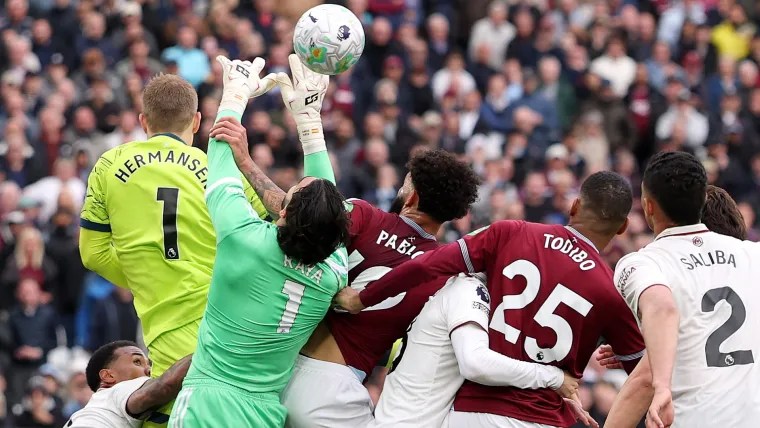
Referees, operating under the laws set by the International Football Association Board, are asked to distinguish between legitimate physicality and unlawful interference. It is an impossible burden. What appears to one official as clever positioning appears to another as a foul. VAR, constrained by thresholds of clarity, has not resolved the ambiguity. The result is inconsistency, frustration, and a growing sense that the goalkeeper has become an unprotected participant in his own six-yard domain.
And yet, the solution may already exist, not in elite football, but in its humbler cousin.
The Small-Sided Clarity
In 5-a-side football, the “D” is inviolate. It belongs to the goalkeeper alone. Outfield players may approach it, circle it, and shoot toward it, but they may not enter. The effect is immediate and unmistakable. The goalkeeper operates in clear space. The chaos is removed not by subjective judgment, but by geometric certainty.
No referee is required to interpret a tangle of limbs. No attacker is permitted to establish a blocking position before the play unfolds. The contest, when it comes, is between the ball and the goalkeeper, not between the goalkeeper and a crowd.
It is, in its way, elegant.
The Six-Yard Box Proposal
It is here that a modest proposal suggests itself. At a corner kick in elite football, all outfield players, attacking and defending alike, would be required to remain outside the six-yard box until the ball is struck. The goalkeeper alone would be permitted to occupy that space.
The principle is not foreign to the game. At a penalty, players are held beyond the eighteen-yard line until the kick is taken. At free kicks, distance is enforced as a matter of routine. Football already understands the value of temporary spatial restriction in the service of fairness.
Why, then, does the corner remain exempt?
Such a rule would not abolish contest. It would merely delay it. Attackers could still make their runs, defenders could still track them, and the ball would still arrive into a contested area. What would disappear is the premeditated obstruction, the quiet pinning of the goalkeeper before the play has even begun.
The six-yard box would become, briefly, what it was always intended to be: a space for goalkeeping.
Consequences and Considerations
There would, of course, be objections. Coaches would argue that a legitimate avenue of attacking play had been curtailed. Set-piece specialists would lament the loss of carefully constructed routines. Traditionalists would mutter, as they always do, about the erosion of the game’s organic chaos.
But the counterargument is difficult to ignore. What is being removed is not skill, but exploitation. The current state of affairs rewards those who can most effectively interfere before the ball is in play. It is a loophole masquerading as tactics.
A six-yard exclusion would shift the emphasis back to timing, delivery, and aerial ability. It would privilege the moment of the kick, not the wrestling match that precedes it.
Enforcement, too, would be simpler than the current regime. Encroachment is visible. It is measurable. It requires no interpretation of intent, only observation of position. The referee’s task would be clarified rather than complicated.
A Return to First Principles
Football has always balanced freedom with structure. Too much of the former invites chaos; too much of the latter stifles the game’s spirit. The corner kick, in its present form, has tipped too far toward disorder, not in the play itself, but in the moments before it.
The lesson from 5-a-side is not that space must be rigidly controlled, but that certain spaces, at certain times, benefit from clarity. The goalkeeper’s domain, at the instant before a corner is delivered, may be one of those times.
The game need not be reinvented. It need only be reminded that fairness is often a matter of inches, and that sometimes, the simplest line on the pitch is the one that restores it.