🗓️ Five Things We Learned This Week

Week of January 3 – January 9, 2026

The first full week of 2026 made it clear that the world did not ease into the new year quietly. From geopolitics and protest movements to shared moments of wonder in the night sky, this past week offered reminders of how quickly events continue to unfold across multiple fronts.


🇻🇪✈️ The United States Captured Venezuela’s President in a Shock Operation

On January 3, U.S. military forces carried out a rapid operation in Venezuela that resulted in the capture of President Nicolás Maduro and his wife. Reports indicate they were transported to the United States to face longstanding charges, immediately triggering international legal and diplomatic debate.

Why it matters: This unprecedented move fundamentally alters regional geopolitics and raises serious questions about sovereignty, international law, and escalation in the Western Hemisphere.


📣✊ Iran Cut Internet Access as Protests Expanded Nationwide

By January 9, Iranian authorities had imposed widespread internet restrictions as protests against economic conditions and political repression spread across multiple cities. The shutdowns accompanied an intensified security response.

Why it matters: Internet blackouts remain a defining tool of modern authoritarian control, highlighting the growing tension between digital connectivity, civil resistance, and state power.


🌕🔭 A Brilliant Wolf Supermoon Lit Up Early January Skies

On the nights of January 3 and 4, skywatchers around the world were treated to a striking Wolf Supermoon, appearing larger and brighter due to its close proximity to Earth.

Why it matters: Shared celestial events offer rare moments of collective experience, reminding us that some rhythms still transcend borders, politics, and conflict.


🎯🏆 Luke Littler Retained His World Darts Championship Title

The 2026 PDC World Darts Championship concluded on January 3, with Luke Littler successfully defending his title in a dramatic final that drew significant global viewership.

Why it matters: The growing popularity of international niche sports reflects shifting entertainment landscapes and the rise of new global sporting figures.


🕊️🌍 The United Nations Advanced Quiet Peacebuilding Efforts

Throughout the week of January 3 to 9, the UN Department of Political and Peacebuilding Affairs reported continued diplomatic engagements focused on de-escalation and dialogue in regions including the Middle East and Yemen.

Why it matters: While rarely headline-grabbing, sustained diplomacy remains essential to preventing conflict escalation and creating space for long-term stability.


Closing thoughts: This week’s five stories remind us that history does not pause for calendars. Power shifts, public resistance, human achievement, and cosmic wonder all unfolded simultaneously, shaping the opening chapter of 2026 in ways both dramatic and subtle.

From Evidence to Exemption: How Bill 5 Rewrites Ontario’s Relationship with the Past

For more than four decades, Ontario’s archaeological system has rested on a quiet but essential bargain. Cultural heritage, once disturbed, cannot be reassembled. In exchange for allowing land to be developed, altered, and intensively used, the province embedded a requirement that trained professionals, operating at arm’s length from political power, would determine what lay beneath the surface and how it should be treated. This arrangement did not make archaeology anti-development. It made development accountable to history.

The recent amendments to the Ontario Heritage Act under Bill 5 weaken that bargain. They replace a system grounded in professional judgment and transparent process with one increasingly shaped by political discretion. The shift is not merely administrative. It strikes at the epistemological foundation of heritage protection by moving decisions about archaeological value away from evidence-based assessment and toward executive authority exercised behind closed doors.

Archaeology functions differently from most heritage disciplines because its subject matter is frequently unknown until it is destroyed. Unlike a heritage building or a designated landscape, an archaeological site often announces its existence only when machinery is already at work. The pre-Bill 5 framework recognized this reality by requiring assessment in areas of archaeological potential before development proceeded. That precautionary logic treated uncertainty as a reason for care, not as a justification for exemption. Bill 5 inverts that logic by allowing unknown sites to be bypassed if they are not already identified, a circular standard that guarantees loss precisely where knowledge is thinnest.

The damage here is cumulative rather than dramatic. Each unassessed site removed from the record narrows the historical archive permanently. Archaeology does not merely recover objects. It reconstructs patterns of land use, migration, trade, conflict, and environmental adaptation across thousands of years. When sites are destroyed without study, those patterns become fragmented, distorted, or irretrievable. Over time, this produces a thinner, more selective account of Ontario’s past, one shaped less by evidence than by what happened to survive political timelines.

The implications for Indigenous heritage are particularly severe. Many archaeological sites represent ancestral places that remain culturally and spiritually significant, regardless of whether they are formally registered or visible on the landscape. A system that allows cabinet or ministerial exemptions without robust, mandatory Indigenous consultation risks repeating older colonial patterns, where Indigenous history is treated as an obstacle to progress rather than a foundational layer of the land itself. When decisions are centralized and expedited, relationships grounded in consent, stewardship, and shared authority are the first casualties.

There is also an institutional cost. Professional archaeology in Ontario has long operated as a regulated field with ethical obligations, peer accountability, and methodological standards. When political actors gain the ability to override or pre-empt that process, expertise becomes advisory rather than determinative. Over time, this erodes the authority of professional judgment and encourages a culture where heritage protection is viewed as discretionary, negotiable, or expendable in the face of economic pressure.

Transparency suffers as well. Archaeological assessments, reports, and registers create a public record. They allow decisions to be scrutinized, challenged, and improved. Executive exemptions, by contrast, concentrate power while reducing visibility. Even when exercised legally, such authority diminishes public trust by removing heritage decisions from open processes and situating them within cabinet deliberations that are structurally insulated from external review.

The broader cultural consequence is a subtle recalibration of values. Heritage protection becomes framed not as a public good but as a regulatory burden to be managed or avoided. The past is no longer something held in trust for future generations, but something weighed against short-term policy objectives. That framing does not abolish archaeology outright. It renders it fragile, contingent, and politically vulnerable.

Ontario’s archaeological record is finite. Every exemption that allows development to proceed without assessment trades long-term knowledge for short-term convenience. Once made, that trade cannot be reversed. Bill 5 thus does not merely streamline process. It alters the moral economy of heritage protection by shifting authority away from evidence, expertise, and public accountability toward discretion exercised in the name of urgency.

History rarely announces its loss in the moment it occurs. The damage becomes visible only later, when questions can no longer be answered, when gaps appear where continuity should exist, and when future scholars inherit a record shaped less by what once was than by what was allowed to disappear.

The Big One Is Not a Metaphor

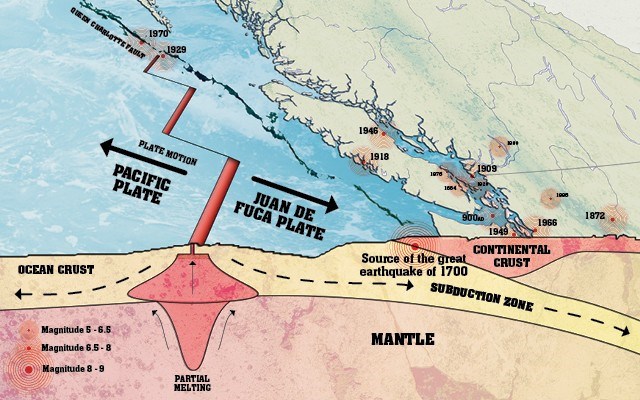
On Canada’s west coast, the phrase “the Big One” has drifted too easily into metaphor. It is used casually, invoked vaguely, and then set aside as a distant abstraction. The most recent British Columbia Disaster and Climate Risk and Resilience Assessment strips that comfort away. What it describes is not speculative catastrophe but a rigorously modelled scenario grounded in geology, history, and infrastructure analysis. A magnitude 9.0 megathrust earthquake off Vancouver Island is not only possible; it is among the more likely high-impact earthquake scenarios facing the province.

The source of the risk is the Cascadia Subduction Zone, where the Juan de Fuca Plate is slowly, but inexorably being driven beneath the North American Plate. This is not a fault that slips frequently and harmlessly. It locks, accumulates strain over centuries, and then fails catastrophically. The last full rupture occurred in January 1700, an event reconstructed through coastal subsidence records in North America and tsunami documentation preserved in Japanese archives. Geological evidence indicates that such megathrust earthquakes recur on timescales of hundreds, not thousands, of years. In emergency management terms, this places Cascadia squarely within the planning horizon.

The provincial assessment models a magnitude 9.0 earthquake occurring offshore of Vancouver Island. The projected consequences are stark. Approximately 3,400 fatalities and more than 10,000 injuries are expected. Economic losses are estimated at 128 billion dollars, driven by the destruction of roughly 18,000 buildings and severe damage to at least 10,000 more. These figures do not rely on worst-case fantasy. They emerge from known building inventories, population distribution, soil conditions, and transportation dependencies. They reflect what happens when prolonged, intense shaking intersects with modern urban density.

Geography shapes the damage unevenly, but decisively. Vancouver Island bears the brunt, particularly along its western coastline, where proximity to the rupture zone amplifies shaking and tsunami exposure. Eastern Vancouver Island, including Victoria, remains highly vulnerable due to soil conditions and aging infrastructure. On the mainland, a narrow, but densely populated band stretching from the United States border through Metro Vancouver to the Sunshine Coast experiences significant impacts, especially in areas built on deltaic and reclaimed land. Liquefaction in these zones undermines foundations, buckles roadways, and fractures buried utilities, compounding the initial damage long after the shaking stops.

The earthquake does not arrive alone. A tsunami follows as an inseparable companion hazard. The assessment projects wave arrival on the west coast of Vancouver Island within 10 to 20 minutes, leaving little time for anything other than immediate self-evacuation. The east coast of Vancouver Island and the Lower Mainland face longer lead times, roughly 30 to 60 minutes, but also greater population exposure. In parallel, major aftershocks, widespread landslides, fires ignited by damaged gas and electrical systems, and flooding from compromised dikes and water infrastructure unfold across days and weeks.

Probability is often misunderstood in public discussion, oscillating between complacency and panic. The assessment estimates a 2 to 10 per cent chance of such an extreme event occurring within the next 30 years. That range may sound small, but emergency management does not measure risk by likelihood alone. It multiplies likelihood by consequence. A low-frequency, ultra-high-impact event demands attention precisely because recovery, once required, will dominate public policy, fiscal capacity, and social stability for decades.

Comparative modelling reinforces this conclusion. United States federal planning scenarios for Cascadia earthquakes project casualty figures in the tens of thousands when the full Pacific Northwest is considered. Insurance industry analyses warn that a major Cascadia rupture would strain or overwhelm existing insurance and reinsurance systems, prolonging recovery and shifting costs to governments and individuals. These are not contradictions of the British Columbia assessment but confirmations of its scale.

What emerges from this body of evidence is not a call for fear, but for seriousness. Preparedness for Cascadia is not primarily about individual survival kits, though those matter. It is about seismic retrofitting of critical infrastructure, realistic tsunami evacuation planning, protection of water and fuel lifelines, and governance systems capable of functioning under extreme disruption. It is also about public literacy: understanding that strong shaking may last several minutes, that evacuation must be immediate and on foot, and that official assistance will not be instantaneous.

The Big One is not an unknowable threat lurking beyond prediction. It is a known risk with defined parameters, measurable probabilities, and foreseeable consequences. The only variable that remains open is how well institutions and communities choose to prepare. History shows that Cascadia will rupture again. Policy choices made before that moment will determine whether the event becomes a national trauma measured in generations, or a severe but survivable test of resilience.

Sources: 
British Columbia Ministry of Emergency Management and Climate Readiness. Disaster and Climate Risk and Resilience Assessment, October 2025, Chapter 5 Earthquake Scenarios. Province of British Columbia.
Yahoo News Canada. “B.C. report warns magnitude 9.0 quake could kill thousands.” 2025.
Geological Survey of Canada. Earthquakes and the Cascadia Subduction Zone. Natural Resources Canada.
U.S. Federal Emergency Management Agency. Cascadia Subduction Zone Earthquake and Tsunami Planning Scenarios.
Wikipedia. “Cascadia Subduction Zone” and “1700 Cascadia Earthquake.”

Why Canada Should Make Voting Compulsory: Lessons from Australia

Canada prides itself on being a democratic nation, yet voter turnout tells a different story. In the 2021 federal election, just over 62% of eligible Canadians cast a ballot. Compare that with Australia, where voting has been mandatory since 1924, and turnout regularly exceeds 90%. The contrast is striking, and instructive. If Canada is truly committed to representative democracy, it should make voting compulsory.

Australia’s experience shows how dramatically voting laws can reshape political engagement. When the country introduced compulsory voting in 1924, turnout jumped from under 60% to over 91% in just one election. This wasn’t just a statistical change; it was a transformation of civic culture. Elections became more representative, and policy debates began to reflect a broader range of voter concerns. In Australia, “a parliament elected by a compulsory vote more accurately reflects the will of the electorate,” notes the Australian Election Commission. Canada could reap the same benefits.

One of the most compelling arguments for compulsory voting is the way it strengthens democratic legitimacy. When turnout is low, election results can be skewed by the interests of a narrow, often more affluent and ideologically extreme segment of the population. This leads to policies that favour the vocal few rather than the silent majority. By contrast, when everyone must vote, politicians must listen to everyone, including the marginalized and the poor. As historian Judith Brett puts it, “Now that means that politicians, when they’re touting for votes, know that all of the groups, including the poor, are going to have a vote. And I think that makes for a more egalitarian public policy.”

Critics argue that compulsory voting infringes on personal freedom. But Australians have lived with the system for a century, and public support for it remains strong, hovering around 70% since 1967. In fact, in 2022, 77% of Australians said they would still vote even if it weren’t mandatory. This suggests that making voting compulsory doesn’t stifle freedom; it cultivates civic responsibility.

Furthermore, compulsory voting could help counter political polarization in Canada. In voluntary systems, political parties often cater to their most radical base to energize turnout. But in Australia, where turnout is nearly universal, parties are forced to appeal to the political centre. This moderating influence is desperately needed in Canada’s increasingly divided political landscape.

Canada’s current voter turnout rates are simply not good enough. A democracy where one-third of citizens routinely sit out elections is a democracy with a legitimacy problem. If we want politics that are more representative, inclusive, and moderate, then it’s time to follow Australia’s lead. Voting is not just a right, it’s a duty. And like jury service or paying taxes, it should be expected of every citizen.

Source:
• BBC News (2022). “Why Australia makes voting mandatory.” https://www.bbc.com/news/world-australia-61505771
• Australian Electoral Commission. “Compulsory voting.” https://www.aec.gov.au/Voting/Compulsory_Voting/
• Elections Canada (2021). Voter Turnout. https://www.elections.ca/content.aspx?section=ele&dir=turn&document=index&lang=e

Ottawa at 25: The Amalgamation That Never Delivered

As Ottawa approaches the 25th anniversary of amalgamation this January, the moment invites a frank assessment. In 2001 the provincial government promised that merging 13 municipalities into a single-tier City of Ottawa would streamline governance, cut waste, improve services and stabilize taxes. Amalgamation was sold as modern, efficient and inevitable, a rational response to the untidy patchwork of local governments that once defined the region.

Two and a half decades later the record is far more complicated. Some benefits were real. Many others were aspirational. And for large portions of the city, especially rural and semi-rural communities, amalgamation has been a system that works to them, not for them. Bigger, it turns out, was not better.

The Promise of Better Services – The Reality of Uneven Delivery
The early pitch for amalgamation was simple: unify services and everyone wins. In practice, the outcome has been uneven across geography and income.

Urban residents gained the most. They saw expanded recreation programming, new library access and coordinated planning. Rural areas, by contrast, experienced reduced responsiveness in road maintenance, snow clearing, bylaw enforcement and transit. Communities like West Carleton, Rideau-Goulbourn and Osgoode have spent two decades reminding City Hall that “one size fits all” is not a service model; it is a compromise imposed on communities with profoundly different needs.

The city’s signature public-transit investment – the O-Train LRT system – was supposed to embody the advantages of centralization. Instead it has become a case study in the limits of mega-city governance: severe construction delays, cost overruns, and a nationally publicized public inquiry detailing systemic failures in oversight, transparency and project management. The LRT problems are not merely technical. They illustrate the deeper strain of running a sprawling municipality where accountability is diffused across layers of bureaucracy rather than rooted in local leadership.

The Financial Question: Where Were the Savings?
The financial rationale for amalgamation rested on scale. A bigger city would deliver efficiencies; efficiencies would reduce costs; reduced costs would protect taxpayers.

This never materialized.

Transition costs reached an estimated $189 million. Savings projections were optimistic, not guaranteed. The Transition Board did not promise tax cuts, and indeed taxes did not fall. In many rural and suburban areas they increased sharply, partly due to uniform tax policies that replaced diverse local rates.

Cost pressures accumulated in other ways:
• The city’s share of funding for provincial property-assessment operations has outpaced inflation every year since amalgamation.
• Capital projects, particularly transit, have grown more expensive while their benefits remain unevenly distributed.
• Ottawa now faces an annual transit operating shortfall approaching $140 million, straining a tax base already stretched by road, infrastructure and policing costs.

The efficiencies that were supposed to stabilize municipal finances largely failed to appear. In their place came the financial stresses of a city whose physical footprint rivals Toronto’s but without the provincial funding model Toronto enjoys.

Lost Local Control – And Lost Trust
Perhaps the most significant cost of amalgamation has been the erosion of local governance. Prior to 2001 communities had councils attuned to their unique needs and accountable to residents they lived beside. Today many rural and semi-rural residents feel politically peripheral; listened to, but not heard.

Ward representation cannot replicate local councils. Nor can city-wide policies reflect the distinct rhythms of a village like Manotick, the agricultural economy of Osgoode, or the infrastructure realities of West Carleton. The result has been a steady accumulation of resentment: a sense that rural areas subsidize urban priorities while their own needs remain secondary.

The weakening of local identity has democratic implications. Decision-making concentrated at the centre becomes less transparent, less responsive and harder for residents to influence. The LRT inquiry offered a stark reminder of what can happen when oversight drifts too far from citizens and too far from the specific communities most affected.

A Quarter Century Later: What Has Ottawa Gained – And What Has It Lost?
It would be simplistic to call Ottawa’s amalgamation a failure. Some benefits are undeniable: unified planning, expanded programming, strengthened economic-development strategies and early years of reasonably controlled citywide spending.

But at a structural level, amalgamation has not delivered its central promises. Taxes did not fall. Services did not equalize. Financial pressures did not ease. The governance system is more centralized but not more accountable. And the diversity of Ottawa’s communities – rural, suburban and urban – often exceeds the capacity of a single administrative structure to manage well.

The lesson is not that amalgamation should be reversed. The lesson is that centralized government must be paired with robust local power, transparent decision-making and an honest recognition that “efficiency” cannot override community identity or regional diversity.

As the 25-year mark approaches, Ottawa has an opportunity to look clearly at what was promised, what was delivered and what must change to make this city work fairly for everyone. Amalgamation may be permanent, but its shortcomings do not have to be.

Sources: 
en.wikipedia.org
todayinottawashistory.wordpress.com
app06.ottawa.ca (Rural Affairs Committee reports)
ottawa.ca (Long-Range Financial Plan II and III)
spcottawa.on.ca (WOCRC rural community report)
imfg.org (Single-tier municipal governance studies)
globalnews.ca (Ottawa LRT Public Inquiry)
ottawa.citynews.ca (Transit financial shortfall)
obj.ca (De-amalgamation commentary)


The Ferry That Would Not Settle: Wolfe Island and the Cost of Getting It Wrong

For generations, the Wolfe Island ferry was a quiet, functional piece of public infrastructure. It was not glamorous, and it did not promise innovation. It simply worked often enough that island life could organize itself around its rhythms. That unspoken reliability ended not with a single breakdown, but with a cascade of decisions that treated a critical transportation link as a technology showcase rather than a lifeline.

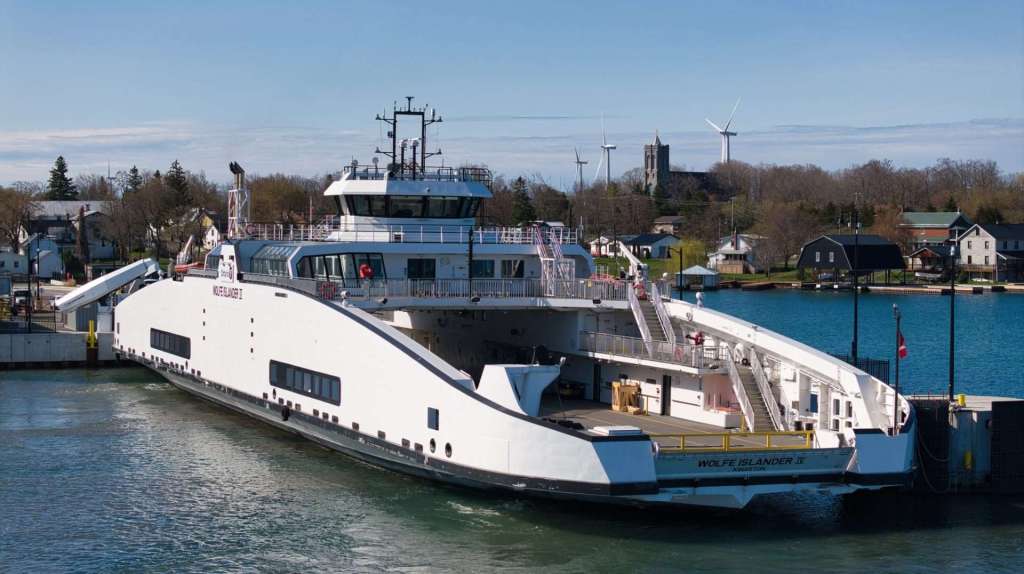
The roots of the current crisis reach back to the decision to replace the Wolfe Islander III, a vessel launched in 1976 that, despite its age, delivered consistent service. In 2017, the Ontario Ministry of Transportation committed to a new, larger hybrid-electric ferry, the Wolfe Islander IV, built overseas and marketed as a modern, higher-capacity, lower-emissions solution. On paper, it was progress. In practice, it was a project that outran its own ecosystem.

The new vessel arrived in Ontario in 2021, years before the docks, charging infrastructure, and staffing capacity required to operate it were fully in place. This mismatch created an immediate limbo. A ferry designed to function as part of an integrated electric system instead sat idle while shore-side systems lagged behind. Training shortages and labour constraints compounded the delay, turning what should have been a transitional period into a prolonged absence from service.

When the Wolfe Islander IV finally entered full-time operation in August 2024, expectations were high and patience already thin. Those expectations were quickly tested. Within months, the vessel suffered a grounding incident that damaged its hull and propulsion components. What was initially described as minor damage resulted in the ferry being removed from service for an extended period and sent to a Hamilton shipyard for repairs. The older Wolfe Islander III was pressed back into duty, once again carrying the weight of continuity.

The mechanical troubles did not end with that incident. The hybrid-electric design depended on shore-based charging infrastructure that was still incomplete, forcing the vessel to rely heavily on onboard diesel generators. Those generators, never intended for sustained primary operation, became a point of failure. By mid-2025, generator problems again sidelined the ferry. Brief returns to service were followed by further outages, including power system failures that left residents relying on temporary passenger shuttles and improvised arrangements.

These technical failures had predictable human consequences. The Wolfe Islander IV operates on a longer round-trip schedule than its predecessor, reducing the number of daily crossings. For island residents, this change reshaped daily life. Commutes grew longer and less predictable. Medical appointments, school schedules, supply deliveries, and emergency response planning all became more fragile. What had once been an inconvenience during rare outages became a chronic uncertainty.

Concerns around emergency access have been particularly acute. Wolfe Island relies on ferry access for ambulance transport to mainland hospitals. Longer crossing times and unreliable service are not abstract inconveniences in that context. They are measurable risks. Community petitions and advocacy groups emerged not out of nostalgia for the old ferry, but out of a clear understanding that transportation reliability is a public safety issue, not merely a service quality metric.

The deeper problem is not that a new ferry experienced teething issues. Complex infrastructure projects often do. The problem lies in the sequencing of decisions. The vessel was delivered before its supporting systems were ready. Operational assumptions were made about staffing and training capacity that did not hold. A technology-forward design was deployed into an environment that could not yet support it. Each of these choices transferred risk from the project plan onto the community it was meant to serve.

What has unfolded at Wolfe Island is a familiar Canadian infrastructure story. Ambition was not matched by coordination. Procurement timelines were allowed to drift out of alignment with construction and commissioning realities. Accountability became diffuse as responsibility spread across contractors, ministries, and timelines. Meanwhile, residents were left to absorb the consequences of decisions made far from the dock.

The Wolfe Island ferry saga is not primarily about electric propulsion or shipbuilding quality. It is about governance. It is about whether essential public services are designed around the lived realities of the communities that depend on them, or around abstract models of innovation and efficiency. Reliability, once lost, is difficult to regain. Trust follows the same rule.

Until the ferry system is treated first as critical infrastructure and only second as a demonstration project, Wolfe Island will continue to pay the price for a transition that was promised as an improvement and delivered as a disruption. The lesson is not that modernization is a mistake. The lesson is that modernization without readiness is not progress at all.

Sources

From Vision to Momentum: Alto Enters Its Defining Phase

For years, Canada’s ambitious dream of linking its greatest cities with true high-speed rail has hovered in the realm of feasibility studies and future pipe dreams. Now, in the closing weeks of 2025, that dream has shifted decidedly toward reality; not because steel is yet being laid, but because the Alto high-speed rail initiative has crossed a crucial threshold from concept to concerted preparation and public engagement.

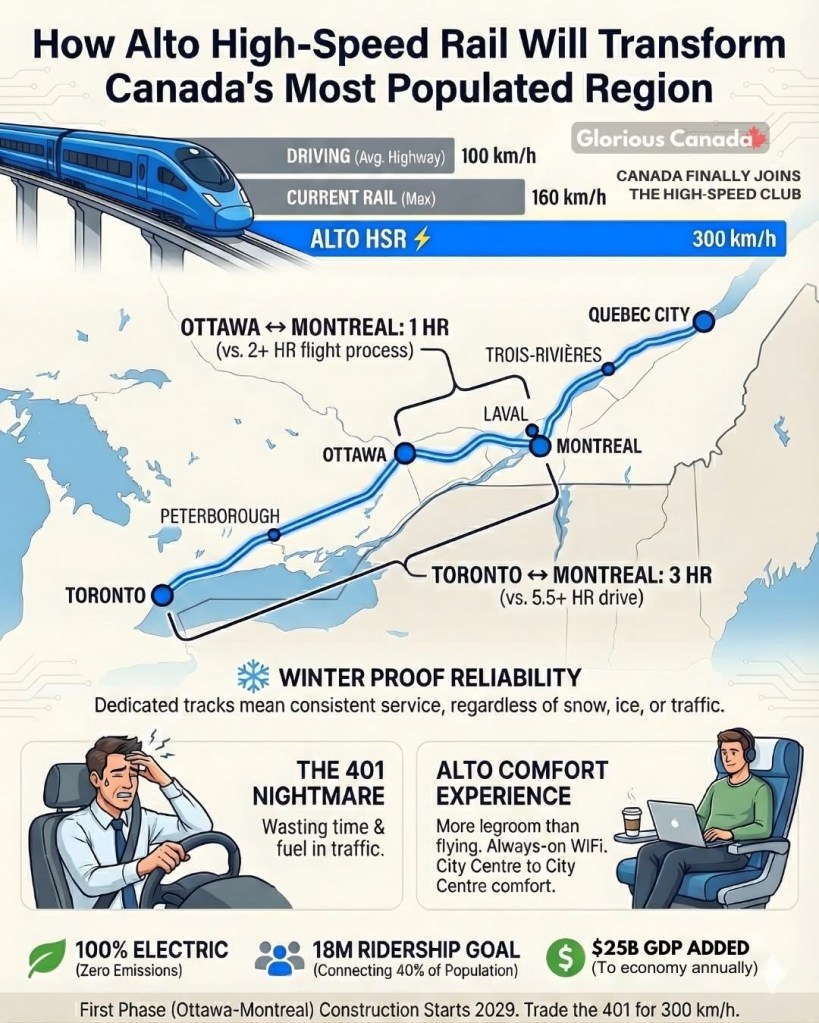
At its core, Alto is a transformative infrastructure vision: a 1,000-kilometre electrified passenger rail network connecting Toronto to Québec City with trains capable of 300 km/h speeds, slicing travel times compared to what today’s intercity rail offers and binding half the nation’s population into a single, rapid mobility corridor. The design phase, backed by a multi-billion-dollar co-development agreement with the Cadence consortium, is well underway, and the federal government has signaled its intent to see this project delivered as one of the largest infrastructure investments in decades.  

The most noteworthy milestone in recent weeks has been a strategic decision about where Alto will begin to take physical shape. On December 12, officials announced that the Ottawa–Montreal segment – roughly 200 km – will be the first portion of the network to advance toward construction, with work slated to begin in 2029. This choice reflects a practical staging strategy: by starting with a shorter, clearly defined corridor that spans two provinces, engineering and construction teams can mobilize simultaneously in Ontario and Québec and begin delivering economic and skills-development benefits sooner rather than later.  

This announcement isn’t just about geography; it marks a shift in Alto’s progression from broad planning to community-level engagement. Beginning in January 2026, Alto will launch a comprehensive three-month consultation process that includes open houses, virtual sessions, and online feedback opportunities for Canadians along the corridor. These sessions will inform critical decisions about alignment, station locations, and mitigation of environmental and community impacts. Indigenous communities, municipalities, and public institutions will be active participants in these discussions as part of Alto’s ongoing commitment to consultation and reconciliation, a recognition that this project’s success hinges not only on engineering prowess, but on thoughtful, inclusive planning.  

Beyond route planning, Alto and Cadence are also turning to Canada’s industrial capacity, particularly the steel sector, to gauge the domestic supply chain’s readiness for what will undeniably be a massive procurement exercise. With thousands of kilometres of rail and related infrastructure components needed, early outreach to the steel industry is intended not just to assess production capacity, but to maximize Canadian content and economic benefit from the outset.  

Yet not every question has a definitive answer. Strategic discussions continue over the optimal location for Alto’s eventual Toronto station, with the CEO publicly acknowledging that a direct connection to Union Station may not be guaranteed; a decision that could shape ridership patterns and integration with existing transit networks across the Greater Toronto Area.  

As the calendar turns toward 2026, the Alto project sits at an inflection point: one foot firmly planted in detailed design and consultation, the other inching closer to the realm of shovels and steel rails. Political support appears robust, and fiscal planning, including major project acceleration initiatives and supportive legislation, has built momentum. Yet, as any transportation planner will tell you, the distance between planning and construction is long, often winding, and frequently subject to political, economic, and community pressures.

Still, for advocates and observers alike, the significance of the latest developments cannot be overstated. Alto has graduated from “what if?” to “when and how,” and that alone marks a major step forward in Canada’s transportation evolution.

The Fine Line: Public Funding vs. Hospital Foundations in Canada

Canada’s healthcare system is publicly funded, built on the principle that access to essential medical care should not depend on one’s ability to pay. Yet despite this ideal, hospitals across the country increasingly rely on charitable foundations to fill financial gaps; particularly when it comes to acquiring or upgrading capital equipment such as MRI machines, surgical suites, or even hospital beds. This raises an urgent question: where do we draw the line between what taxpayers should fund and what private donations should cover?

Historically, charitable giving and volunteerism have been strong elements of Canadian civic life. From Terry Fox Runs to hospital galas, Canadians have given generously of both time and money. Foundations like those supporting SickKids in Toronto or the Ottawa Hospital routinely raise millions for major equipment and infrastructure projects. This philanthropy has enabled many hospitals to expand their services, acquire cutting-edge technology, and improve patient care. However, relying on private donors to cover essential infrastructure can lead to inequities and accountability challenges.

Public funding should remain the primary source of capital investment for core hospital services. A hospital’s ability to deliver life-saving care should not depend on how wealthy its local community is or how effective its fundraising team happens to be. A well-off urban centre like Vancouver or Toronto may be able to raise tens of millions in months, while smaller or rural hospitals struggle to replace outdated X-ray machines. This creates a two-tiered system by the back door, one that undermines the universality and equity at the heart of Medicare.

Moreover, capital equipment is not a luxury; it is central to a hospital’s mission. When hospitals must wait on campaign goals or donor approvals to purchase a new CT scanner, patients pay the price through longer wait times and reduced diagnostic accuracy. Public infrastructure should be predictable, planned, and guided by population health needs—not marketable donor narratives or foundation marketing strategies.

Local philanthropic families who donate millions often have their names emblazoned across hospital wings or research centres, a modern version of constructing Victorian Follies or erecting statues in the town square. While some see this as genuine civic pride, and a way to give back, others question whether it’s philanthropy or vanity, blurring the line between public good and private legacy.

That said, there is still a legitimate and valuable role for hospital foundations. Philanthropy should enhance care, not substitute for the basics. Foundations can support research initiatives, pilot programs, staff development, and the “extras” that make hospitals more human; like family rooms, healing gardens, or neonatal cuddler programs. They can even accelerate the purchase of capital equipment, but only where government has committed base funding or provided a clear upgrade timeline.

Ultimately, drawing the line is about reinforcing accountability. Governments must be transparent about what the public system will fund and ensure consistent, equitable investment across the country. Hospital foundations should be free to inspire generosity, but not to carry the burden of maintaining essential care. Public healthcare must never become dependent on private generosity. That’s not a donation, it’s a symptom of underfunding.

Sources
• Canadian Institute for Health Information (CIHI). “National Health Expenditure Trends, 2023.” https://www.cihi.ca/en/national-health-expenditure-trends
• Globe and Mail. “Canada’s hospitals increasingly rely on fundraising to cover capital costs.” https://www.theglobeandmail.com/canada/article-hospitals-capital-equipment-fundraising/
• CanadaHelps. “The Giving Report 2024.” https://www.canadahelps.org/en/the-giving-report/

The Pie and a Pint Life

There’s a certain romance to the idea of a life lived in fifteen-minute circles. Not a metaphorical fifteen minutes, no, I mean a geography, a rhythm, a practical enchantment where everything one might need for daily sustenance and delight rests just a short stroll or a gentle bike ride away. I call it the “pie and a pint” model of living. The pie represents all the tangible necessities of life: food fresh from the market, clothing that fits just so, perhaps even a bookshop that smells faintly of vanilla and old paper. The pint, meanwhile, is the social lifeblood: laughter, conversation, music, the gentle buzz of humanity swirling around the edges of one’s existence.

It is, I admit, a model born of a lazy idealism, the sort that insists life can be both comfortable and endlessly charming. Imagine leaving home in the morning and, in the span of a quarter-hour, acquiring a warm pastry and a loaf of bread that smells faintly of honey. On the way back, one might linger by the corner café, exchanging pleasantries with a barista who knows your name and your preferred roast. At the market, the butcher waves. The grocer slides a bag of oranges across the counter as though performing a small, daily miracle. Every errand becomes a small ritual, a comforting loop that roots one in the neighborhood and the hours of the day.

The pint, of course, is the flourish to the pie’s sustenance. Perhaps it’s an evening spent in a local pub, the kind where the wooden floors creak with memory, and the beer tastes better because it was poured by someone who knows you, not just your credit card number. Or perhaps it’s a quiet chair in a communal park, a flask of something warming tucked beneath a coat, as the world meanders by. This is the part of life that reminds one why human existence is worth the effort: stories exchanged, music shared, glances that say more than words ever could. The pie fills the stomach, the pint fills the heart.

The beauty of this model is its intimacy. Fifteen minutes, one discovers, is long enough to venture, to explore, but short enough to return. One becomes familiar with the rhythms of place, the subtle shifts in light across a street corner, the seasonal hints in the produce at the market. There is less rush, less constant negotiation with time. A walk to acquire a loaf of bread is also a walk to notice the scarlet leaves tumbling along the sidewalk, to hear a snippet of laughter from a nearby table, to greet a neighbor with a wave and a nod. Life, when framed in such increments, folds into itself, gentle and satisfying.

Of course, one must admit this model is not without whimsy. It presumes a city or town willing to play along, one that fits neatly into the radius of desire. It presumes the world will conspire to place the essential and the pleasurable within reach, and for those willing to walk fifteen minutes, or perhaps pedal gently, the world indeed becomes a smaller, sweeter place. It is a model both humble and audacious: humble in its insistence on simple joys, audacious in its refusal to accept life as a matter of endless commuting and distant errands.

So here it is: the pie and a pint life. A life that honors the mundane and the magical alike, that balances sustenance with delight, that finds happiness not in distant horizons but in the familiar arcs of the day. Fifteen minutes may not sound like much, but in those fifteen minutes, one can hold the universe in the grasp of a warm hand and a warm heart. It is a small radius, yes, but sometimes, the smallest circles hold the greatest magic.

The Fragile Independence of NGOs: Funding, Mission, and the Cost of Survival

After more than 25 years advising organizations across sectors, I’ve come to appreciate the vital role NGOs play in filling the gaps governments can’t, or won’t, address. From frontline social services to environmental stewardship to global health and education, their work is often visionary, community-led, and deeply human. But I’ve also seen behind the curtain. And one uncomfortable truth emerges time and again: far too many NGOs are built on a financial foundation so narrow that one funding shift, often from a single government department, can bring the entire structure down.

This doesn’t mean these organizations lack heart or competence. Quite the opposite, but when 60 to 80 percent of their time and energy is spent chasing the next tranche of funding just to pay rent or keep skeleton staff employed, something is clearly out of balance. I’ve worked with executive directors who are more skilled in crafting grant proposals than in delivering the programs they were trained to lead. I’ve seen staff burn out, not from the intensity of service delivery, but from the treadmill of fundraising cycles that reward persistence over purpose.

The tension is most pronounced when a single government agency becomes the main or only funder. In those cases, the NGO may retain its legal independence, but it quickly becomes functionally dependent, unable to challenge policy, adapt freely, or pivot when the community’s needs shift. I’ve often told boards in strategic planning sessions: “If your NGO would cease to exist tomorrow without that one government grant, then you don’t have a sustainable organization, you have an outsourced program.”

This is not a call for cynicism. It’s a call for structural realism. NGOs need funding. Governments have a legitimate role in supporting social initiatives. But the risk lies in overconcentration. With no diversified base of support, whether from individual donors, private philanthropy, earned income, or even modest membership models, NGOs are vulnerable not only to budget cuts, but to shifts in political ideology. A change in government should not spell the end of essential community services. And yet, it too often does.

What’s the solution? It starts with transparency and strategy. Boards must get serious about income diversity, even if that means reimagining their business model. Funders, including governments, should fund core operations, not just shiny new projects, and do so on multi-year terms to allow for proper planning. And NGO leaders need to communicate their value clearly, not just to funders, but to the communities they serve and the public at large. You can’t build resilience without buy-in.

Supporting NGOs doesn’t mean ignoring their structural weaknesses. In fact, the best way to support them is to help them confront those weaknesses head-on. Mission matters. But so does the means of sustaining it. And in today’s volatile funding landscape, the most mission-driven thing an NGO can do might just be to get smart about its money.