Community Wealth Building and the Reassertion of Local Economic Power

Scotland’s proposed Community Wealth Building legislation should be read not as a technical reform of local government practice, but as a quiet intervention in the geopolitical and economic settlement that has shaped the North Atlantic world since the late twentieth century. It arrives at a moment when assumptions about globalisation, capital mobility, and the neutrality of markets are being reassessed across Europe and beyond. In this context, the Bill represents an attempt to recover economic agency at the level of the state and the community without retreating into protectionism or nostalgia.

For several decades, economic development across the United Kingdom and much of the West followed a broadly convergent logic. Growth was expected to flow from attracting external capital, integrating into global supply chains, and minimising friction for mobile firms. Local institutions were repositioned as facilitators rather than shapers of economic life. The consequences of this model are now widely acknowledged: hollowed-out local economies, fragile supply chains, stagnant wages, and deepening territorial inequality. Community Wealth Building emerges as a response to this structural failure, not as a rejection of markets, but as a refusal to treat them as self-justifying.

The Scottish Bill formalises this response by embedding Community Wealth Building into the routine machinery of governance. It does so through process rather than command. Ministers would be required to articulate a national strategy, while local authorities and designated public bodies would be tasked with producing coordinated action plans. This architecture reflects an understanding that economic power is already widely distributed across public institutions, but rarely aligned. Procurement, employment, land management, and investment decisions are typically made in isolation. The legislation seeks to bring these decisions into a shared strategic frame.

The Five Pillars as Instruments of Sovereignty

At the centre of this frame are the five pillars of Community Wealth Building: spending, workforce, land and property, inclusive ownership, and finance. These pillars correspond directly to the points at which wealth either embeds itself locally or leaks outward. Public spending can anchor local supply chains or reinforce distant monopolies. Employment can stabilise communities or entrench precarity. Land can function as a productive commons or a speculative asset. Ownership can concentrate power or distribute it. Finance can circulate locally or exit at the first sign of volatility.

The Bill’s significance lies in treating these domains not as discrete policy areas, but as interdependent levers of economic sovereignty. This is a departure from the fragmented governance model that characterised late neoliberal public administration, in which efficiency was prized over coherence and coordination.

The Preston Model as Proof of Concept

This approach has a clear and often-cited precedent in the Preston Model developed in Lancashire. Following the collapse of a major inward investment project, Preston City Council and a group of anchor institutions reoriented their procurement and economic strategy toward local suppliers and inclusive ownership models. By coordinating spending decisions and nurturing local capacity, Preston demonstrated that local economies retain more agency than is commonly assumed.

The results were incremental rather than transformative, but they were measurable and durable. Procurement spend retained within the local and regional economy increased substantially, job quality improved, and confidence in local economic stewardship was restored. The lesson of Preston was not ideological but institutional: resilience is often built through aligned, routine decisions rather than grand economic interventions.

From Voluntary Practice to Statutory Expectation

Scotland’s proposed legislation draws on this experience while addressing one of its principal limitations. The Preston Model depended heavily on political continuity and local leadership. By placing Community Wealth Building on a statutory footing, the Scottish Government seeks to ensure durability beyond electoral cycles. This reflects a broader European trend toward embedding economic governance within legal and institutional frameworks rather than relying on discretion and goodwill.

In this respect, the Bill aligns more closely with continental traditions of social market governance than with the United Kingdom’s recent reliance on deregulated competition and capital mobility. It represents a subtle but meaningful shift in how economic legitimacy is constructed.

Geopolitics, Resilience, and Strategic Autonomy

The geopolitical implications of this shift should not be underestimated. In an era defined by fractured supply chains, sanctions regimes, and strategic competition, economic resilience has become inseparable from national and regional security. Shorter supply chains, diversified ownership, and locally rooted finance reduce exposure to external shocks. Community Wealth Building thus complements wider debates about strategic autonomy unfolding across Europe and among middle powers navigating an increasingly unstable global order.

Although sub-state in form, Scotland’s legislation participates in this reorientation by strengthening the internal foundations of economic resilience. It does not promise insulation from global forces, but it does offer a means of engagement that is less extractive and more adaptive.

Cultural Memory and Economic Stewardship

Culturally, the Bill resonates with long-standing Scottish debates over land, ownership, and democratic control. From land reform movements to community buyouts, there exists a deep political memory of extraction and dispossession. Community Wealth Building translates these concerns into contemporary administrative language. It offers a way to address structural imbalance without framing the issue as a moral repudiation of global capitalism.

Instead, the economy is treated as a system that can be shaped through institutional design and stewardship. This framing avoids both nostalgia and utopianism, positioning reform as a matter of governance rather than ideology.

A Quiet Recalibration

Critics argue that the legislation lacks enforcement mechanisms and risks becoming aspirational. Such critiques assume that economic change only follows dramatic intervention. Historical experience suggests otherwise. Durable change more often arises from the cumulative effect of aligned institutions acting consistently over time. By normalising local economic stewardship across public bodies, the Bill establishes the conditions for gradual but compounding transformation.

Seen in this light, Scotland’s Community Wealth Building law forms part of a broader recalibration underway across the Western political economy. It signals a move away from the assumption that prosperity must be imported, and toward the idea that it can be cultivated. In a period marked by uncertainty and realignment, this modest ambition may prove to be its most consequential feature.

Sources

Canadian Rural Access Inequalities 

Canada often celebrates its vast rural, remote, and northern regions as integral to its identity, yet the majority of financial resources and policy attention remain concentrated in urban centers. While cities drive much of the economy, neglecting rural and northern areas undermines the long-term sustainability of the country. These regions are critical for natural resource industries, agriculture, and preserving Canada’s cultural heritage, yet they face declining populations, crumbling infrastructure, and limited services.

Despite the guarantees of the Canadian Charter of Rights and Freedoms, which emphasizes equality and fairness, these regions frequently face disparities in healthcare, education, infrastructure, and other essential services. These inequities persist due to a combination of logistical, financial, and policy-related barriers. Below is a discussion of this premise, supported by examples and potential solutions.

Challenges Faced by Rural, Remote, and Northern Communities
1. Healthcare Disparities
Remote communities often experience significant shortages of healthcare professionals, facilities, and specialized care. For instance, residents in northern Manitoba or Nunavut might travel hundreds or even thousands of kilometers to access basic medical care.
Example: In Nunavut, life expectancy is 10 years shorter than the national average, largely due to limited access to healthcare and the high cost of transporting goods and services.

2. Education Inequities
Access to quality education is another persistent issue. Small, remote communities may have only one school, often underfunded and lacking specialized programs, teachers, or technology.
Example: Many First Nations reserves face underfunded schools, with per-student funding far below what urban or provincial schools receive.

3. Infrastructure Gaps
The lack of reliable infrastructure, such as roads, internet access, and public transit, further marginalizes these communities.
Example: In rural Ontario and northern Quebec, poor internet connectivity has hindered students’ access to online learning opportunities, particularly during the COVID-19 pandemic.

4. Economic Disparities
Many rural and northern regions rely on resource extraction industries, which are cyclical and often leave communities economically vulnerable. Diversification of local economies is limited by the lack of investment and infrastructure.

5. Climate Challenges
Northern communities are disproportionately affected by climate change. Melting permafrost damages homes and infrastructure, while extreme weather events increase the costs of living and delivering essential services.

Causes of Inequities
1. Geography and Population Density
The low population density of rural and northern regions increases the cost of delivering services, making it less appealing for private companies and harder for governments to justify investments.

2. Policy Gaps
Federal and provincial governments often adopt a one-size-fits-all approach to programs, which fails to consider the unique needs of remote communities. For example, healthcare and education funding formulas are typically based on population rather than geographic need.

3. Jurisdictional Challenges
Overlap between federal, provincial, and municipal responsibilities can lead to delays, inefficiencies, or outright neglect. Indigenous communities, in particular, face systemic inequities due to ongoing jurisdictional disputes (e.g., the federal government’s underfunding of Indigenous child welfare services).

Potential Solutions
1. Tailored Policies and Funding
Governments should allocate funding based on need rather than population. For example, increasing healthcare subsidies for rural and northern areas could attract professionals through loan forgiveness programs or financial incentives.

2. Invest in Infrastructure
Investing in critical infrastructure such as broadband internet, roads, and public transit would connect isolated regions with urban centers, enabling better access to services.
Example: The Universal Broadband Fund has made strides in improving rural internet access, but continued expansion is necessary.

3. Support for Indigenous Communities
Indigenous communities often face compounded challenges. Ensuring equitable funding for on-reserve schools, healthcare, and housing would address systemic inequities.
Example: Implementing the recommendations of the Truth and Reconciliation Commission could help bridge gaps in access to education and other services.

4. Decentralized Service Delivery
Adopting community-led approaches and decentralizing decision-making processes would empower local governments and organizations to tailor programs to their specific needs.

5. Mobile and Digital Solutions
Expanding the use of telemedicine and online learning platforms can bridge gaps in healthcare and education. However, this requires concurrent investment in digital infrastructure.

6. Sustainable Economic Development
Governments should invest in programs to diversify local economies by supporting industries such as tourism, renewable energy, and sustainable agriculture.

While Canada prides itself on its commitment to equality, rural, remote, and northern communities continue to lag behind due to systemic barriers and geographic realities. Addressing these challenges requires a combination of targeted policies, increased investment, and a commitment to collaboration across all levels of government. By focusing on long-term solutions, Canada can uphold the values enshrined in its Charter of Rights and ensure fair and equitable access to programs and services for all its citizens.

Rebalancing financial resources is essential to support infrastructure, healthcare, and economic development in these areas. Strategic investment would not only boost regional economies but also safeguard the Canada we pride ourselves on.

For further reading, the following sources provide valuable insights:
• “Life and Death in Northern Canada,” Canadian Medical Association Journal (CMAJ)
• “Broadband Connectivity in Rural and Remote Areas,” Canadian Radio-television and Telecommunications Commission (CRTC)
• Truth and Reconciliation Commission of Canada: Calls to Action

From Evidence to Exemption: How Bill 5 Rewrites Ontario’s Relationship with the Past

For more than four decades, Ontario’s archaeological system has rested on a quiet but essential bargain. Cultural heritage, once disturbed, cannot be reassembled. In exchange for allowing land to be developed, altered, and intensively used, the province embedded a requirement that trained professionals, operating at arm’s length from political power, would determine what lay beneath the surface and how it should be treated. This arrangement did not make archaeology anti-development. It made development accountable to history.

The recent amendments to the Ontario Heritage Act under Bill 5 weaken that bargain. They replace a system grounded in professional judgment and transparent process with one increasingly shaped by political discretion. The shift is not merely administrative. It strikes at the epistemological foundation of heritage protection by moving decisions about archaeological value away from evidence-based assessment and toward executive authority exercised behind closed doors.

Archaeology functions differently from most heritage disciplines because its subject matter is frequently unknown until it is destroyed. Unlike a heritage building or a designated landscape, an archaeological site often announces its existence only when machinery is already at work. The pre-Bill 5 framework recognized this reality by requiring assessment in areas of archaeological potential before development proceeded. That precautionary logic treated uncertainty as a reason for care, not as a justification for exemption. Bill 5 inverts that logic by allowing unknown sites to be bypassed if they are not already identified, a circular standard that guarantees loss precisely where knowledge is thinnest.

The damage here is cumulative rather than dramatic. Each unassessed site removed from the record narrows the historical archive permanently. Archaeology does not merely recover objects. It reconstructs patterns of land use, migration, trade, conflict, and environmental adaptation across thousands of years. When sites are destroyed without study, those patterns become fragmented, distorted, or irretrievable. Over time, this produces a thinner, more selective account of Ontario’s past, one shaped less by evidence than by what happened to survive political timelines.

The implications for Indigenous heritage are particularly severe. Many archaeological sites represent ancestral places that remain culturally and spiritually significant, regardless of whether they are formally registered or visible on the landscape. A system that allows cabinet or ministerial exemptions without robust, mandatory Indigenous consultation risks repeating older colonial patterns, where Indigenous history is treated as an obstacle to progress rather than a foundational layer of the land itself. When decisions are centralized and expedited, relationships grounded in consent, stewardship, and shared authority are the first casualties.

There is also an institutional cost. Professional archaeology in Ontario has long operated as a regulated field with ethical obligations, peer accountability, and methodological standards. When political actors gain the ability to override or pre-empt that process, expertise becomes advisory rather than determinative. Over time, this erodes the authority of professional judgment and encourages a culture where heritage protection is viewed as discretionary, negotiable, or expendable in the face of economic pressure.

Transparency suffers as well. Archaeological assessments, reports, and registers create a public record. They allow decisions to be scrutinized, challenged, and improved. Executive exemptions, by contrast, concentrate power while reducing visibility. Even when exercised legally, such authority diminishes public trust by removing heritage decisions from open processes and situating them within cabinet deliberations that are structurally insulated from external review.

The broader cultural consequence is a subtle recalibration of values. Heritage protection becomes framed not as a public good but as a regulatory burden to be managed or avoided. The past is no longer something held in trust for future generations, but something weighed against short-term policy objectives. That framing does not abolish archaeology outright. It renders it fragile, contingent, and politically vulnerable.

Ontario’s archaeological record is finite. Every exemption that allows development to proceed without assessment trades long-term knowledge for short-term convenience. Once made, that trade cannot be reversed. Bill 5 thus does not merely streamline process. It alters the moral economy of heritage protection by shifting authority away from evidence, expertise, and public accountability toward discretion exercised in the name of urgency.

History rarely announces its loss in the moment it occurs. The damage becomes visible only later, when questions can no longer be answered, when gaps appear where continuity should exist, and when future scholars inherit a record shaped less by what once was than by what was allowed to disappear.

🗓️ Five Things We Learned This Week

Week of December 27, 2025 – January 2, 2026

Even in the quiet stretch between Christmas and New Year’s, the world did not pause. Across science, politics, climate, conservation, and global systems, this past week offered reminders that change continues — sometimes quietly, sometimes decisively.


✈️ India’s Air Travel Crisis Revealed Systemic Fragility

In the days following Christmas, India’s largest airline faced widespread cancellations and delays after stricter pilot fatigue rules collided with already stretched staffing. By December 30, operations had stabilized, but only after tens of thousands of passengers were affected.

Why it matters: The disruption exposed how regulatory enforcement, labor shortages, and tight scheduling can cascade into national-scale failures — a warning for aviation systems worldwide.


🌍 The United Nations Expanded Climate Adaptation Financing

On December 29, the UN announced a significant expansion of its climate adaptation finance framework, directing additional concessional funding toward countries already experiencing severe climate impacts.

Why it matters: While mitigation often dominates headlines, adaptation funding is where climate policy becomes tangible for vulnerable communities facing floods, drought, and displacement.


🐘 Kenya Reported Its Lowest Elephant Poaching Levels in Decades

Kenyan wildlife authorities confirmed on December 28 that elephant poaching has dropped to historic lows, crediting community-based conservation programs, improved ranger coordination, and aerial surveillance.

Why it matters: This rare conservation success shows that sustained investment, local engagement, and enforcement can reverse even long-running environmental crises.


⚖️ The U.S. Supreme Court Halted a Major Immigration Enforcement Rule

On December 30, the U.S. Supreme Court temporarily blocked the rollout of a new federal immigration enforcement policy, pending further legal review.

Why it matters: The decision reinforces judicial limits on executive power and reshapes the near-term landscape for immigration enforcement, labor policy, and civil rights debates.


🔭 The James Webb Telescope Detected Water Vapor on a Rocky Exoplanet

NASA scientists confirmed between December 31 and January 1 that Webb telescope data shows strong evidence of water vapor in the atmosphere of TRAPPIST-1e, one of the most promising Earth-like exoplanets identified so far.

Why it matters: This finding strengthens the case for studying potentially habitable worlds beyond our solar system and marks another leap forward in observational astronomy.


Closing thoughts: From airline systems and courtrooms to savannas and distant star systems, this week’s stories remind us that progress, risk, and discovery do not respect holiday calendars. Paying attention — even during the quiet weeks — remains an act of civic and intellectual care.

Arctic Gateways: Why Greenland Matters More Than Maps Suggest

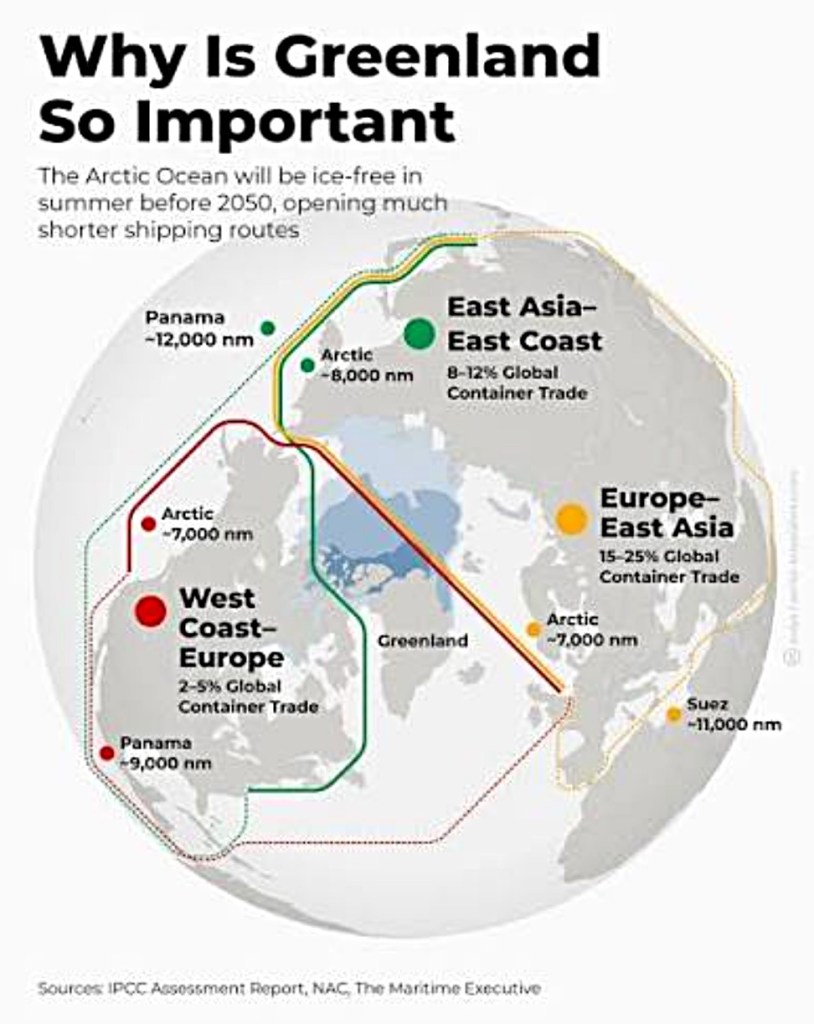
There is a deceptively simple geographic fact that sits quietly beneath much of the current Arctic maneuvering. In the entire Arctic region, there is effectively only one deep-water port that remains reliably ice-free year-round without the benefit of icebreakers, and that port is Nuuk, Greenland. This is not a trivia point. It is a structural constraint that shapes strategy, logistics, and power projection across the high north.

Nuuk’s status is the product of oceanography rather than politics. The West Greenland Current carries relatively warm Atlantic water northward along Greenland’s western coast, keeping the approaches to Nuuk navigable even through winter. By contrast, most other Arctic ports, including those in northern Canada, are either seasonally accessible or require sustained icebreaking support. Russia is often cited as an exception, but ports like Murmansk rely heavily on infrastructure, icebreaker fleets, and state subsidy to maintain year-round access. Nuuk stands apart in that its ice-free condition is natural, persistent, and proximate to the North Atlantic.

From a United States perspective, this matters enormously. American interest in Greenland is not primarily about territory in the nineteenth-century sense. It is about access, logistics, and denial. An ice-free port in the Arctic functions as a fixed node in what is otherwise a hostile operating environment. It enables sustained naval presence, resupply, maintenance, and potentially dual-use civilian and military shipping without the constant friction of ice conditions. In a future where Arctic sea lanes become more commercially viable and militarily contested, control or influence over such a node is strategically priceless.

This helps explain why U.S. engagement with Greenland has intensified well beyond rhetoric. Investments in airports, telecommunications, scientific infrastructure, and diplomatic presence all serve a dual purpose. They embed American interests into Greenland’s development trajectory while ensuring that any future expansion of Arctic activity occurs within a framework friendly to U.S. security priorities. The infamous proposal to “buy” Greenland was widely mocked, but it reflected a blunt articulation of a real strategic anxiety: the United States does not want its primary Arctic foothold to drift politically or economically toward rivals.

Canada’s position is more complex and, in some ways, more constrained. Canada has the longest Arctic coastline of any nation, yet no equivalent year-round ice-free deep-water port in its Arctic territory. This creates a persistent asymmetry. Canadian sovereignty claims rest on presence, governance, and stewardship rather than on continuous maritime access. The North is Canadian not because it is heavily used, but because it is administered, inhabited, and regulated.

As a result, Canada’s northern strategy cannot simply mirror that of the United States. Where Washington focuses on access and power projection, Ottawa must focus on resilience, legitimacy, and long-term habitation. Investments in northern communities, Indigenous governance, search and rescue, environmental monitoring, and seasonal port infrastructure are not secondary to sovereignty. They are sovereignty. Canada’s emphasis on the Northwest Passage as internal waters is inseparable from its need to demonstrate effective control without relying on year-round commercial shipping.

At the same time, the existence of Nuuk as the only naturally ice-free Arctic port creates both a vulnerability and an opportunity for Canada. The vulnerability lies in over-reliance on allied infrastructure. In any future crisis or competition scenario, Canadian Arctic operations would almost certainly depend on U.S. logistics routed through Greenland. The opportunity lies in cooperation. Joint development of northern capabilities, shared situational awareness, and integrated Arctic planning allow Canada to compensate for geographic disadvantages without surrendering policy autonomy.

What this ultimately reveals is that the Arctic is not opening evenly. It is opening selectively, along corridors dictated by currents, ice dynamics, and climate variability. Nuuk sits at the intersection of those forces. It is a reminder that geography still matters, even in an age of satellites and cyber power. For the United States, Greenland is a keystone. For Canada, it is a neighbor whose strategic weight must be acknowledged, managed, and integrated into a broader vision of a stable, governed, and genuinely Canadian North.

In that sense, the conversation about ice-free ports is not really about shipping. It is about who gets to shape the rules of the Arctic as it transitions from a frozen margin to a contested frontier.

Ottawa at 25: The Amalgamation That Never Delivered

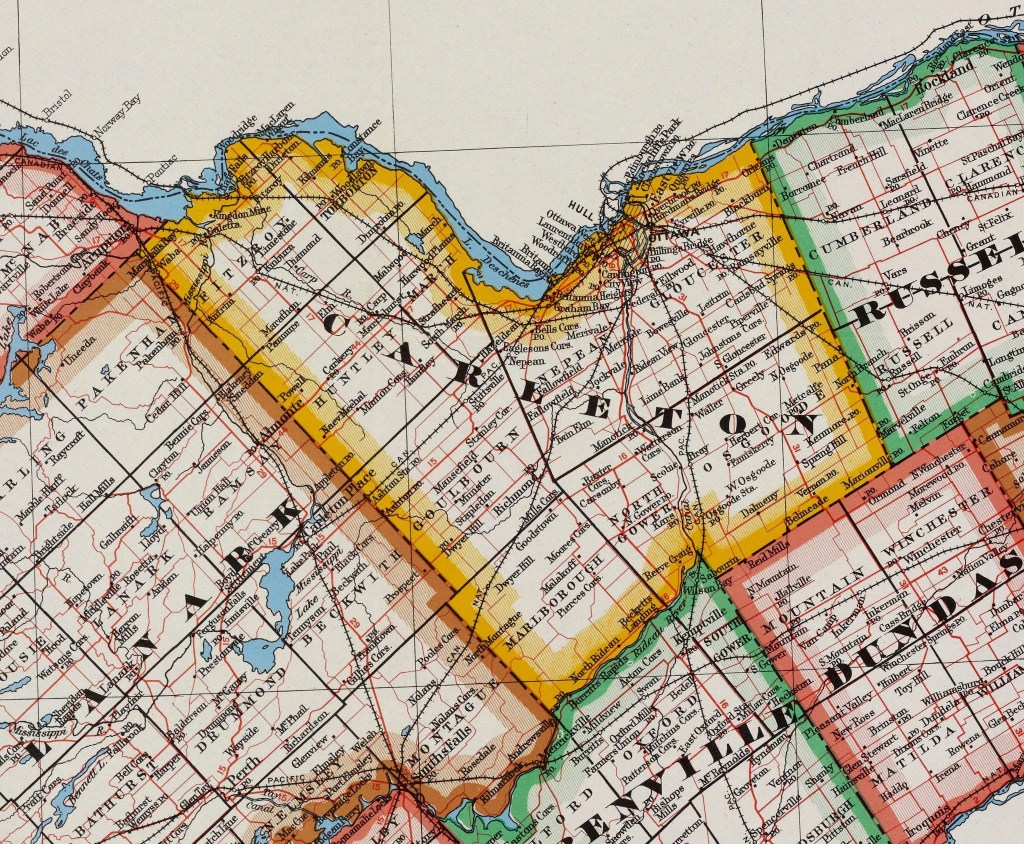
As Ottawa approaches the 25th anniversary of amalgamation this January, the moment invites a frank assessment. In 2001 the provincial government promised that merging 13 municipalities into a single-tier City of Ottawa would streamline governance, cut waste, improve services and stabilize taxes. Amalgamation was sold as modern, efficient and inevitable, a rational response to the untidy patchwork of local governments that once defined the region.

Two and a half decades later the record is far more complicated. Some benefits were real. Many others were aspirational. And for large portions of the city, especially rural and semi-rural communities, amalgamation has been a system that works to them, not for them. Bigger, it turns out, was not better.

The Promise of Better Services – The Reality of Uneven Delivery
The early pitch for amalgamation was simple: unify services and everyone wins. In practice, the outcome has been uneven across geography and income.

Urban residents gained the most. They saw expanded recreation programming, new library access and coordinated planning. Rural areas, by contrast, experienced reduced responsiveness in road maintenance, snow clearing, bylaw enforcement and transit. Communities like West Carleton, Rideau-Goulbourn and Osgoode have spent two decades reminding City Hall that “one size fits all” is not a service model; it is a compromise imposed on communities with profoundly different needs.

The city’s signature public-transit investment – the O-Train LRT system – was supposed to embody the advantages of centralization. Instead it has become a case study in the limits of mega-city governance: severe construction delays, cost overruns, and a nationally publicized public inquiry detailing systemic failures in oversight, transparency and project management. The LRT problems are not merely technical. They illustrate the deeper strain of running a sprawling municipality where accountability is diffused across layers of bureaucracy rather than rooted in local leadership.

The Financial Question: Where Were the Savings?
The financial rationale for amalgamation rested on scale. A bigger city would deliver efficiencies; efficiencies would reduce costs; reduced costs would protect taxpayers.

This never materialized.

Transition costs reached an estimated $189 million. Savings projections were optimistic, not guaranteed. The Transition Board did not promise tax cuts, and indeed taxes did not fall. In many rural and suburban areas they increased sharply, partly due to uniform tax policies that replaced diverse local rates.

Cost pressures accumulated in other ways:
• The city’s share of funding for provincial property-assessment operations has outpaced inflation every year since amalgamation.
• Capital projects, particularly transit, have grown more expensive while their benefits remain unevenly distributed.
• Ottawa now faces an annual transit operating shortfall approaching $140 million, straining a tax base already stretched by road, infrastructure and policing costs.

The efficiencies that were supposed to stabilize municipal finances largely failed to appear. In their place came the financial stresses of a city whose physical footprint rivals Toronto’s but without the provincial funding model Toronto enjoys.

Lost Local Control – And Lost Trust
Perhaps the most significant cost of amalgamation has been the erosion of local governance. Prior to 2001 communities had councils attuned to their unique needs and accountable to residents they lived beside. Today many rural and semi-rural residents feel politically peripheral; listened to, but not heard.

Ward representation cannot replicate local councils. Nor can city-wide policies reflect the distinct rhythms of a village like Manotick, the agricultural economy of Osgoode, or the infrastructure realities of West Carleton. The result has been a steady accumulation of resentment: a sense that rural areas subsidize urban priorities while their own needs remain secondary.

The weakening of local identity has democratic implications. Decision-making concentrated at the centre becomes less transparent, less responsive and harder for residents to influence. The LRT inquiry offered a stark reminder of what can happen when oversight drifts too far from citizens and too far from the specific communities most affected.

A Quarter Century Later: What Has Ottawa Gained – And What Has It Lost?
It would be simplistic to call Ottawa’s amalgamation a failure. Some benefits are undeniable: unified planning, expanded programming, strengthened economic-development strategies and early years of reasonably controlled citywide spending.

But at a structural level, amalgamation has not delivered its central promises. Taxes did not fall. Services did not equalize. Financial pressures did not ease. The governance system is more centralized but not more accountable. And the diversity of Ottawa’s communities – rural, suburban and urban – often exceeds the capacity of a single administrative structure to manage well.

The lesson is not that amalgamation should be reversed. The lesson is that centralized government must be paired with robust local power, transparent decision-making and an honest recognition that “efficiency” cannot override community identity or regional diversity.

As the 25-year mark approaches, Ottawa has an opportunity to look clearly at what was promised, what was delivered and what must change to make this city work fairly for everyone. Amalgamation may be permanent, but its shortcomings do not have to be.

Sources: 
en.wikipedia.org
todayinottawashistory.wordpress.com
app06.ottawa.ca (Rural Affairs Committee reports)
ottawa.ca (Long-Range Financial Plan II and III)
spcottawa.on.ca (WOCRC rural community report)
imfg.org (Single-tier municipal governance studies)
globalnews.ca (Ottawa LRT Public Inquiry)
ottawa.citynews.ca (Transit financial shortfall)
obj.ca (De-amalgamation commentary)

The Ferry That Would Not Settle: Wolfe Island and the Cost of Getting It Wrong

For generations, the Wolfe Island ferry was a quiet, functional piece of public infrastructure. It was not glamorous, and it did not promise innovation. It simply worked often enough that island life could organize itself around its rhythms. That unspoken reliability ended not with a single breakdown, but with a cascade of decisions that treated a critical transportation link as a technology showcase rather than a lifeline.

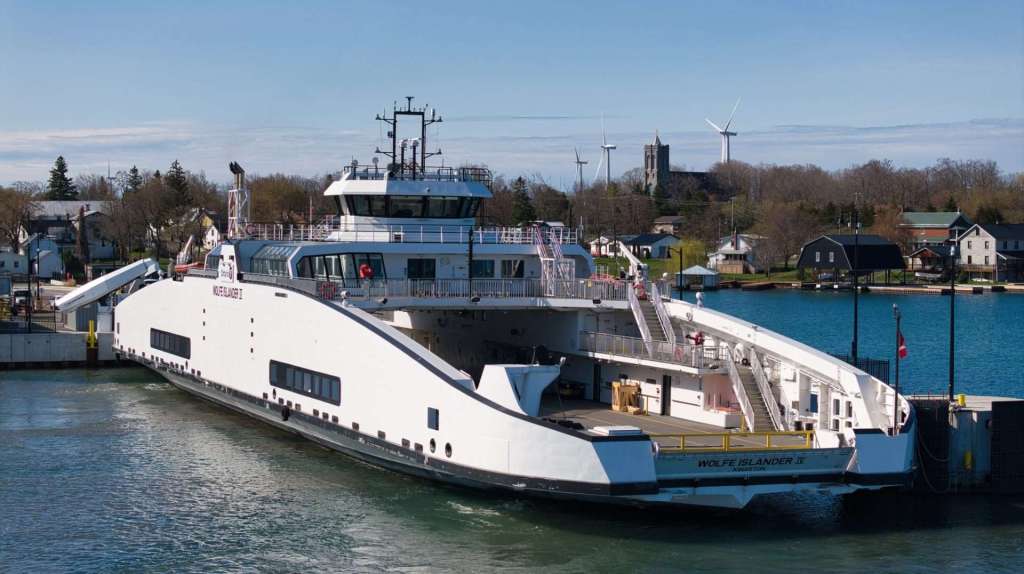
The roots of the current crisis reach back to the decision to replace the Wolfe Islander III, a vessel launched in 1976 that, despite its age, delivered consistent service. In 2017, the Ontario Ministry of Transportation committed to a new, larger hybrid-electric ferry, the Wolfe Islander IV, built overseas and marketed as a modern, higher-capacity, lower-emissions solution. On paper, it was progress. In practice, it was a project that outran its own ecosystem.

The new vessel arrived in Ontario in 2021, years before the docks, charging infrastructure, and staffing capacity required to operate it were fully in place. This mismatch created an immediate limbo. A ferry designed to function as part of an integrated electric system instead sat idle while shore-side systems lagged behind. Training shortages and labour constraints compounded the delay, turning what should have been a transitional period into a prolonged absence from service.

When the Wolfe Islander IV finally entered full-time operation in August 2024, expectations were high and patience already thin. Those expectations were quickly tested. Within months, the vessel suffered a grounding incident that damaged its hull and propulsion components. What was initially described as minor damage resulted in the ferry being removed from service for an extended period and sent to a Hamilton shipyard for repairs. The older Wolfe Islander III was pressed back into duty, once again carrying the weight of continuity.

The mechanical troubles did not end with that incident. The hybrid-electric design depended on shore-based charging infrastructure that was still incomplete, forcing the vessel to rely heavily on onboard diesel generators. Those generators, never intended for sustained primary operation, became a point of failure. By mid-2025, generator problems again sidelined the ferry. Brief returns to service were followed by further outages, including power system failures that left residents relying on temporary passenger shuttles and improvised arrangements.

These technical failures had predictable human consequences. The Wolfe Islander IV operates on a longer round-trip schedule than its predecessor, reducing the number of daily crossings. For island residents, this change reshaped daily life. Commutes grew longer and less predictable. Medical appointments, school schedules, supply deliveries, and emergency response planning all became more fragile. What had once been an inconvenience during rare outages became a chronic uncertainty.

Concerns around emergency access have been particularly acute. Wolfe Island relies on ferry access for ambulance transport to mainland hospitals. Longer crossing times and unreliable service are not abstract inconveniences in that context. They are measurable risks. Community petitions and advocacy groups emerged not out of nostalgia for the old ferry, but out of a clear understanding that transportation reliability is a public safety issue, not merely a service quality metric.

The deeper problem is not that a new ferry experienced teething issues. Complex infrastructure projects often do. The problem lies in the sequencing of decisions. The vessel was delivered before its supporting systems were ready. Operational assumptions were made about staffing and training capacity that did not hold. A technology-forward design was deployed into an environment that could not yet support it. Each of these choices transferred risk from the project plan onto the community it was meant to serve.

What has unfolded at Wolfe Island is a familiar Canadian infrastructure story. Ambition was not matched by coordination. Procurement timelines were allowed to drift out of alignment with construction and commissioning realities. Accountability became diffuse as responsibility spread across contractors, ministries, and timelines. Meanwhile, residents were left to absorb the consequences of decisions made far from the dock.

The Wolfe Island ferry saga is not primarily about electric propulsion or shipbuilding quality. It is about governance. It is about whether essential public services are designed around the lived realities of the communities that depend on them, or around abstract models of innovation and efficiency. Reliability, once lost, is difficult to regain. Trust follows the same rule.

Until the ferry system is treated first as critical infrastructure and only second as a demonstration project, Wolfe Island will continue to pay the price for a transition that was promised as an improvement and delivered as a disruption. The lesson is not that modernization is a mistake. The lesson is that modernization without readiness is not progress at all.

Sources

From Vision to Momentum: Alto Enters Its Defining Phase

For years, Canada’s ambitious dream of linking its greatest cities with true high-speed rail has hovered in the realm of feasibility studies and future pipe dreams. Now, in the closing weeks of 2025, that dream has shifted decidedly toward reality; not because steel is yet being laid, but because the Alto high-speed rail initiative has crossed a crucial threshold from concept to concerted preparation and public engagement.

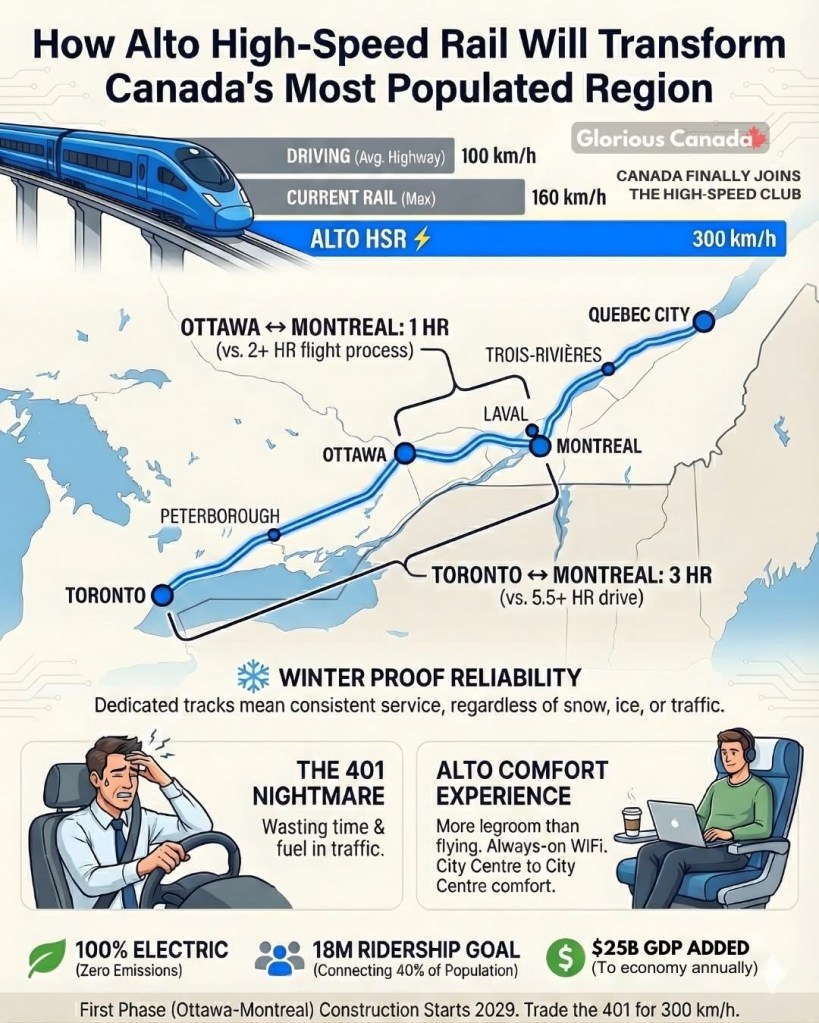
At its core, Alto is a transformative infrastructure vision: a 1,000-kilometre electrified passenger rail network connecting Toronto to Québec City with trains capable of 300 km/h speeds, slicing travel times compared to what today’s intercity rail offers and binding half the nation’s population into a single, rapid mobility corridor. The design phase, backed by a multi-billion-dollar co-development agreement with the Cadence consortium, is well underway, and the federal government has signaled its intent to see this project delivered as one of the largest infrastructure investments in decades.  

The most noteworthy milestone in recent weeks has been a strategic decision about where Alto will begin to take physical shape. On December 12, officials announced that the Ottawa–Montreal segment – roughly 200 km – will be the first portion of the network to advance toward construction, with work slated to begin in 2029. This choice reflects a practical staging strategy: by starting with a shorter, clearly defined corridor that spans two provinces, engineering and construction teams can mobilize simultaneously in Ontario and Québec and begin delivering economic and skills-development benefits sooner rather than later.  

This announcement isn’t just about geography; it marks a shift in Alto’s progression from broad planning to community-level engagement. Beginning in January 2026, Alto will launch a comprehensive three-month consultation process that includes open houses, virtual sessions, and online feedback opportunities for Canadians along the corridor. These sessions will inform critical decisions about alignment, station locations, and mitigation of environmental and community impacts. Indigenous communities, municipalities, and public institutions will be active participants in these discussions as part of Alto’s ongoing commitment to consultation and reconciliation, a recognition that this project’s success hinges not only on engineering prowess, but on thoughtful, inclusive planning.  

Beyond route planning, Alto and Cadence are also turning to Canada’s industrial capacity, particularly the steel sector, to gauge the domestic supply chain’s readiness for what will undeniably be a massive procurement exercise. With thousands of kilometres of rail and related infrastructure components needed, early outreach to the steel industry is intended not just to assess production capacity, but to maximize Canadian content and economic benefit from the outset.  

Yet not every question has a definitive answer. Strategic discussions continue over the optimal location for Alto’s eventual Toronto station, with the CEO publicly acknowledging that a direct connection to Union Station may not be guaranteed; a decision that could shape ridership patterns and integration with existing transit networks across the Greater Toronto Area.  

As the calendar turns toward 2026, the Alto project sits at an inflection point: one foot firmly planted in detailed design and consultation, the other inching closer to the realm of shovels and steel rails. Political support appears robust, and fiscal planning, including major project acceleration initiatives and supportive legislation, has built momentum. Yet, as any transportation planner will tell you, the distance between planning and construction is long, often winding, and frequently subject to political, economic, and community pressures.

Still, for advocates and observers alike, the significance of the latest developments cannot be overstated. Alto has graduated from “what if?” to “when and how,” and that alone marks a major step forward in Canada’s transportation evolution.

The Pie and a Pint Life

There’s a certain romance to the idea of a life lived in fifteen-minute circles. Not a metaphorical fifteen minutes, no, I mean a geography, a rhythm, a practical enchantment where everything one might need for daily sustenance and delight rests just a short stroll or a gentle bike ride away. I call it the “pie and a pint” model of living. The pie represents all the tangible necessities of life: food fresh from the market, clothing that fits just so, perhaps even a bookshop that smells faintly of vanilla and old paper. The pint, meanwhile, is the social lifeblood: laughter, conversation, music, the gentle buzz of humanity swirling around the edges of one’s existence.

It is, I admit, a model born of a lazy idealism, the sort that insists life can be both comfortable and endlessly charming. Imagine leaving home in the morning and, in the span of a quarter-hour, acquiring a warm pastry and a loaf of bread that smells faintly of honey. On the way back, one might linger by the corner café, exchanging pleasantries with a barista who knows your name and your preferred roast. At the market, the butcher waves. The grocer slides a bag of oranges across the counter as though performing a small, daily miracle. Every errand becomes a small ritual, a comforting loop that roots one in the neighborhood and the hours of the day.

The pint, of course, is the flourish to the pie’s sustenance. Perhaps it’s an evening spent in a local pub, the kind where the wooden floors creak with memory, and the beer tastes better because it was poured by someone who knows you, not just your credit card number. Or perhaps it’s a quiet chair in a communal park, a flask of something warming tucked beneath a coat, as the world meanders by. This is the part of life that reminds one why human existence is worth the effort: stories exchanged, music shared, glances that say more than words ever could. The pie fills the stomach, the pint fills the heart.

The beauty of this model is its intimacy. Fifteen minutes, one discovers, is long enough to venture, to explore, but short enough to return. One becomes familiar with the rhythms of place, the subtle shifts in light across a street corner, the seasonal hints in the produce at the market. There is less rush, less constant negotiation with time. A walk to acquire a loaf of bread is also a walk to notice the scarlet leaves tumbling along the sidewalk, to hear a snippet of laughter from a nearby table, to greet a neighbor with a wave and a nod. Life, when framed in such increments, folds into itself, gentle and satisfying.

Of course, one must admit this model is not without whimsy. It presumes a city or town willing to play along, one that fits neatly into the radius of desire. It presumes the world will conspire to place the essential and the pleasurable within reach, and for those willing to walk fifteen minutes, or perhaps pedal gently, the world indeed becomes a smaller, sweeter place. It is a model both humble and audacious: humble in its insistence on simple joys, audacious in its refusal to accept life as a matter of endless commuting and distant errands.

So here it is: the pie and a pint life. A life that honors the mundane and the magical alike, that balances sustenance with delight, that finds happiness not in distant horizons but in the familiar arcs of the day. Fifteen minutes may not sound like much, but in those fifteen minutes, one can hold the universe in the grasp of a warm hand and a warm heart. It is a small radius, yes, but sometimes, the smallest circles hold the greatest magic.

Five Things We Learned This Week

Week of November 29 – December 5, 2025

✈️ 1. India’s IndiGo airline chaos causes airport gridlock

Stricter pilot-fatigue rules triggered a cascade of flight cancellations for IndiGo, India’s largest airline, leaving hundreds stranded across major cities and prompting authorities to cap airfares. The disruption entered a fifth day on Dec 5, affecting travel for thousands nationwide. Source.

Why it matters: The crisis exposed systemic fragility in high-volume air travel and shows how labor and regulatory shifts can ripple quickly through global supply and travel networks, with major economic and social consequences.

🛫 2. Airbus slashes delivery targets after A320-series defects — aviation under pressure

On Dec 5, Airbus revealed that recent cosmic-radiation–linked software glitches and metal panel defects grounded thousands of A320 aircraft and forced the company to drastically cut delivery targets for 2026. Source.

Why it matters: As the A320 is one of the world’s most widely used commercial jets, any large-scale fleet issue creates global consequences for airlines, passengers and supply chains.

🏆 3. 2026 FIFA World Cup draw sets stage — hosts and underdogs get historic matchups

The 2026 World Cup draw, finalized Dec 5, places host nations and underdog teams in matchups that analysts say could disrupt traditional football expectations. Media outlets are calling it a “dream bracket” for the joint hosts Mexico, the United States and Canada. Source.

Why it matters: The draw influences everything from training and tactics to ticket sales and tourism. Major sporting events continue to shape global culture, economics and diplomatic soft power.

🌐 4. IMF to begin high-stakes China economic review amid global uncertainty

The IMF announced its first Article IV review of the Chinese economy since mid-2024, with findings scheduled to be presented in Beijing on Dec 10. The review comes as China faces slowing exports and continued global trade strain. Source.

Why it matters: China remains a central pillar of global economic stability. A cautious or negative IMF assessment could influence markets, trade flows and political decision-making across multiple regions.

🔄 5. Atlantic tuna population review shows mixed recovery

A new multinational marine-biology assessment released this week reports mixed results for several Atlantic tuna populations. While some species show encouraging recovery, others continue a concerning decline linked to overfishing, illegal catch activity and warming waters. Source.

Why it matters: Tuna stocks shape global food security, marine health and economic stability in fishing-dependent countries. This year’s update could influence future quotas and conservation agreements.


Further Reading