Five Things We Learned This Week

Week of December 6–12, 2025

Each week, we take a step back from the noise and look at five developments from around the world that stood out — across science, culture, sport, politics, and the natural world.

🌠 1. Geminid Meteor Shower Peaks with One of the Best Displays in Years

The annual Geminid meteor shower peaked this week, delivering bright, frequent meteors across much of the globe. Astronomers noted especially favorable viewing conditions, with the shower producing vivid fireballs caused by debris from asteroid 3200 Phaethon.

Why it matters: In a world often dominated by bad news, predictable and awe-inspiring celestial events remind us that some rhythms remain constant — and shared by everyone under the same sky.

🎮 2. The 2025 Streamer Awards Highlight the Scale of Live-Streaming Culture

Held on December 6, the 2025 Streamer Awards drew massive global audiences and celebrated creators shaping the modern entertainment landscape. Livestreaming continues to redefine celebrity, media economics, and community building — particularly among younger audiences.

Why it matters: What began as a niche subculture is now a dominant media force, influencing advertising, politics, and how people connect across borders.

🏆 3. Women’s World Floorball Championships Begin in the Czech Republic

The 15th Women’s World Floorball Championships kicked off this week, bringing together 16 national teams. The tournament highlights the rapid global growth of the sport and increasing investment in women’s international competition.

Why it matters: Expanding visibility for women’s sports strengthens international athletic ecosystems and reflects broader cultural shifts toward equity and representation.

🌍 4. Powerful Earthquake Strikes Northeastern Japan

A magnitude-7.6 earthquake struck off Japan’s Aomori coast on December 8, injuring dozens and prompting tsunami advisories and evacuations. Emergency services responded quickly, and authorities warned of ongoing aftershocks.

Why it matters: Japan’s preparedness limited loss of life, underscoring the importance of long-term investment in disaster readiness as seismic and climate risks persist worldwide.

🛂 5. Mediterranean Migration Continues as Boats Reach Malta

Dozens of migrants were brought ashore in Malta this week after dangerous crossings from North Africa. The arrivals highlight the ongoing humanitarian and political pressures shaping migration policy across the Mediterranean.

Why it matters: Migration remains one of the defining global challenges of our time, intersecting with climate change, conflict, and economic inequality.


Closing thoughts:
This week’s stories span wonder and warning — from meteor-lit skies to seismic shocks, cultural change, and enduring humanitarian challenges. Together, they remind us that the world is vast, interconnected, and constantly in motion.

Five Things is a weekly Rowanwood Chronicles feature, tracking global developments from Saturday to Friday.
The Pie and a Pint Life

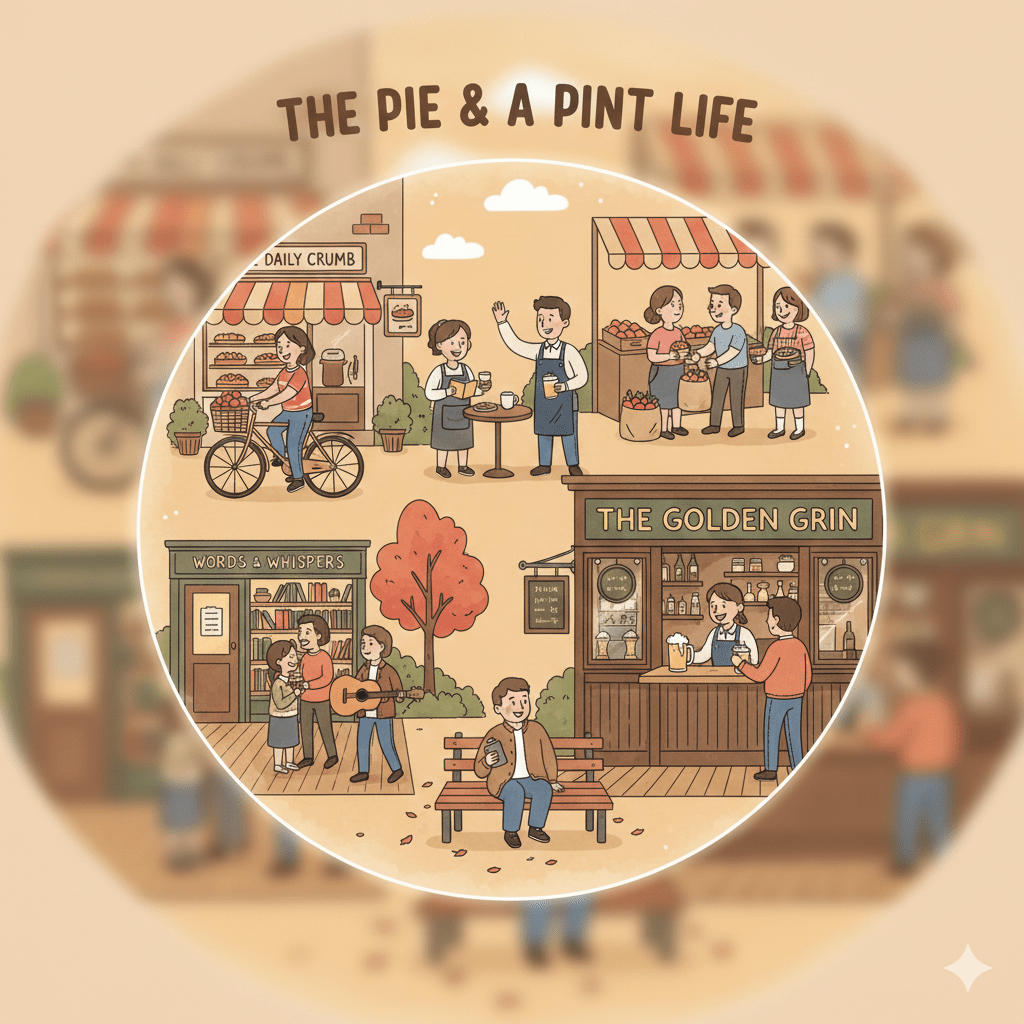
There’s a certain romance to the idea of a life lived in fifteen-minute circles. Not a metaphorical fifteen minutes, no, I mean a geography, a rhythm, a practical enchantment where everything one might need for daily sustenance and delight rests just a short stroll or a gentle bike ride away. I call it the “pie and a pint” model of living. The pie represents all the tangible necessities of life: food fresh from the market, clothing that fits just so, perhaps even a bookshop that smells faintly of vanilla and old paper. The pint, meanwhile, is the social lifeblood: laughter, conversation, music, the gentle buzz of humanity swirling around the edges of one’s existence.

It is, I admit, a model born of a lazy idealism, the sort that insists life can be both comfortable and endlessly charming. Imagine leaving home in the morning and, in the span of a quarter-hour, acquiring a warm pastry and a loaf of bread that smells faintly of honey. On the way back, one might linger by the corner café, exchanging pleasantries with a barista who knows your name and your preferred roast. At the market, the butcher waves. The grocer slides a bag of oranges across the counter as though performing a small, daily miracle. Every errand becomes a small ritual, a comforting loop that roots one in the neighborhood and the hours of the day.

The pint, of course, is the flourish to the pie’s sustenance. Perhaps it’s an evening spent in a local pub, the kind where the wooden floors creak with memory, and the beer tastes better because it was poured by someone who knows you, not just your credit card number. Or perhaps it’s a quiet chair in a communal park, a flask of something warming tucked beneath a coat, as the world meanders by. This is the part of life that reminds one why human existence is worth the effort: stories exchanged, music shared, glances that say more than words ever could. The pie fills the stomach, the pint fills the heart.

The beauty of this model is its intimacy. Fifteen minutes, one discovers, is long enough to venture, to explore, but short enough to return. One becomes familiar with the rhythms of place, the subtle shifts in light across a street corner, the seasonal hints in the produce at the market. There is less rush, less constant negotiation with time. A walk to acquire a loaf of bread is also a walk to notice the scarlet leaves tumbling along the sidewalk, to hear a snippet of laughter from a nearby table, to greet a neighbor with a wave and a nod. Life, when framed in such increments, folds into itself, gentle and satisfying.

Of course, one must admit this model is not without whimsy. It presumes a city or town willing to play along, one that fits neatly into the radius of desire. It presumes the world will conspire to place the essential and the pleasurable within reach, and for those willing to walk fifteen minutes, or perhaps pedal gently, the world indeed becomes a smaller, sweeter place. It is a model both humble and audacious: humble in its insistence on simple joys, audacious in its refusal to accept life as a matter of endless commuting and distant errands.

So here it is: the pie and a pint life. A life that honors the mundane and the magical alike, that balances sustenance with delight, that finds happiness not in distant horizons but in the familiar arcs of the day. Fifteen minutes may not sound like much, but in those fifteen minutes, one can hold the universe in the grasp of a warm hand and a warm heart. It is a small radius, yes, but sometimes, the smallest circles hold the greatest magic.

The Strategic Shift Behind the 2025 U.S. National Security Strategy

The newly released 2025 U.S. National Security Strategy signals a significant departure from the traditional principles that defined American foreign policy for decades. Longstanding commitments to collective defense, liberal internationalism, and multilateral cooperation have been replaced with a posture that treats global engagement as a burden and alliances as conditional assets rather than enduring partnerships.

This shift, framed as a necessary rebalancing of national priorities, is being interpreted by analysts and allied governments as a proactive threat. The threat is not overt or kinetic. Instead, it emerges through the document’s language, strategic preferences, and economic positioning. The resulting landscape places NATO allies, especially Canada, in a vulnerable and uncertain position.

A Reimagined Alliance System

The Strategy redefines alliances in transactional terms. Rather than relying on shared values, mutual defense responsibilities, and long-term strategic vision, the document characterizes alliances as fiscal and strategic obligations that must be justified by allies through increased spending and alignment with U.S. interests. Reports highlight the new emphasis on defense burden-sharing and the suggestion that U.S. commitments may be scaled back for countries that do not meet Washington’s expectations.

This reframing undermines the foundational trust of the NATO system. It places countries like Canada, which historically spends below preferred thresholds, in a position where strategic reliability could be questioned, weakening the security guarantees that NATO has long been built upon.

Europe Recast as a Strategic Project

The Strategy’s rhetoric toward Europe marks a sharp departure from conventional diplomatic framing. The document describes Europe as struggling with demographic decline, economic stagnation, and cultural erosion, and it presents the United States as a guardian poised to steer the continent’s political future. Analysts have flagged the Strategy’s explicit support for “patriotic” political movements in Europe, a development interpreted as a willingness to influence or reshape domestic politics within allied states.

Such language introduces profound uncertainty into the transatlantic relationship. Rather than treating allies as sovereign equals, the Strategy positions them as ideological battlegrounds. For Canada, this suggests that allies’ internal affairs may no longer be off-limits to U.S. strategic intervention, further eroding norms of mutual respect.

The Western Hemisphere as Exclusive American Sphere

A revival of a hemispheric dominance doctrine – effectively a twenty-first century interpretation of the Monroe Doctrine – marks one of the most consequential pivots in the document. The Strategy asserts the Western Hemisphere as an exclusive zone of American influence, intended to be economically aligned, politically manageable, and strategically compliant with U.S. goals.

This shift directly affects Canada. Economic interdependence, continental supply chains, and cross-border migration policies are recast as tools of strategic leverage. Analysts warn that this places Canada in a subordinate position in regional planning and policy formation. Canada’s economic autonomy becomes more limited under a framework that prioritizes U.S. control over hemispheric trade, energy, technology, and resource security.

From Partnership to Asset Management

The Strategy’s architecture suggests a broader conceptual change: allies are treated less as partners and more as assets whose value is measured against U.S. priorities. This represents a decisive break from the postwar model of shared responsibility and common purpose. Guarantees once considered automatic – such as the collective defense obligations that underpin NATO – appear increasingly conditional.

Such a shift introduces strategic instability. Allies must now anticipate fluctuating levels of American engagement based on domestic political calculations rather than consistent treaty commitments. This new posture raises questions about the reliability of alliances in moments of crisis.

Why the Strategy Constitutes a Proactive Threat

Several core elements of the document create a proactive threat to NATO partners and particularly to Canada.

  • Erosion of Collective Defense Norms
    By tying U.S. commitments to spending thresholds and ideological alignment, the Strategy weakens the notion of mutual defense and introduces uncertainty into NATO’s core purpose.
  • Weaponization of Economic Interdependence
    The emphasis on economic nationalism transforms North American trade and supply-chain relationships into pressure points that can be exploited for political or strategic gain.
  • Normalization of Political Intervention in Allied States
    The encouragement of “patriotic” European political movements signals a new willingness to involve itself in domestic ideological debates within allied countries.
  • Marginalization of Allies Not Deemed Strategically Essential
    Countries outside Washington’s immediate priorities risk being sidelined, placing Canada at long-term strategic risk.

A New Geopolitical Landscape for Canada

The 2025 National Security Strategy marks a reordering of global priorities that places Canada in a precarious position. The traditional assumptions underlying Canada’s security and economic planning – predictable U.S. leadership, reliable NATO guarantees, and a shared democratic project – are directly challenged by the Strategy’s new direction.

In this emerging landscape, Canada may face a future in which the United States no longer acts as a steady anchor of the transatlantic alliance, but instead as a dominant regional power pursuing unilateral advantage. The resulting realignment may require Canada and other NATO members to rethink foreign policy strategies, diversify partnerships, and strengthen regional autonomy to avoid becoming collateral variables in an American-centered strategic calculus.

This is the environment the new document creates: one where allies must navigate not the threat of abandonment, but the more subtle and destabilizing threat of conditional partnership, shifting expectations, and ideological intervention.

Howay Man, It’s Football Not Flamin’ NFL

By Big Mac, the OAP Blogger from Byker

Aye, listen pet. Ah’ve seen some daft things in football ower the years. Ah watched the Toon gan up, gan down, gan sideways, and last season – miracle of miracles – actually lift a major trophy. Ah still get goosebumps thinkin’ about it. Ah had te check the telly twice te make sure it wasn’t one of them daft deepfake things the young’uns are always bletherin’ aboot.

But even with the Toon finally bringin’ silverware home, this new carry-on from FIFA still takes the biscuit. Hydration breaks. Three whole minutes each half. Mandatory. Like the lads are gannin’ te evaporate the second they break into a jog.

Divvent get us wrang, ah’m aall for keepin’ players alive. But come on, man. We played Sunday league in Byker when the pitch was harder than a tax inspector’s conscience. If ye wanted water, ye drank from the same rusty pipe the dogs used. Nobody keeled ower from dehydration. Well….. not from that, anyway.

But this isn’t really aboot water. Nah! 

This is FIFA flingin’ themselves at the Yanks like a lovestruck teenager.

“Oooh America, look! We’ve made football more like your telly-friendly sports! Plenty stoppages! Lovely little gaps for adverts! We’ll even chop the match into neat wee portions like a ready meal!”

Imagine stoppin’ the derby twenty-odd minutes in so some commentator can gan, “This hydration break is brought to you by Big Stan’s Super Ford Outlet, where every truck comes with a free hat.”

Aye, mint that.

Ye divvent need te be Hercule blinkin’ Poirot te see what’s gannin’ on. FIFA’s pockets are twitchin’ like a ferret in a sleeping bag. Broadcasters are lickin’ their lips like they’ve just spotted a free buffet. And we’re supposed te swallow this as “player welfare”. Aye, alreet man. Ah’ve heard better lies from a Sunderland fan.

Next thing ye knaa, they’ll be stoppin’ the match for a “sponsored mindfulness moment”. Or the ref will pull oot a tablet te show us a deodorant ad before a corner kick. It’s aall comin’. Mark Big Mac’s words.

And honestly? If Alan Shearer had been forced te stop mid-run for a hydration break, he’d’ve downed the bottle, volleyed it into Row Z, and carried on scorin’ without blinkin’.

So aye, FIFA can keep their corporate claptrap. Let the Americans have their ad slots. The rest of us’ll be here in Byker, shoutin’ at the telly, callin’ it what it is:

The daftest idea since someone decided the Toon needed a third kit “just for marketing”.

Australia: The Prize No One Talks About

There’s a story playing out on the world stage that barely makes a ripple in most media cycles. While the headlines fixate on Ukraine, Gaza, or Taiwan, an unspoken contest is quietly unfolding for influence over a country that has, for too long, been treated as a polite and distant cousin in global affairs: Australia.

We’re used to thinking of the United States as having eyes on Canada, economically, culturally, and strategically. The integration is old news: NORAD, pipelines, the world’s longest undefended border, and the quiet assumptions of shared destiny. But if you really want to understand the next chapter of global power politics, don’t look north. Look west. Look south. Look to Australia.

What’s emerging now is not a scramble for land or flags, but for strategic intimacy, a deep intertwining of interests, logistics, defense capabilities, and ideological alignment. Australia is the prize not because it’s weak, but because it’s vital: geographically, economically, and politically.

The American Pivot
The United States is already entrenched. Through AUKUS, it has committed to helping Australia build nuclear-powered submarines and integrate into the U.S. military-industrial supply chain. But this is more than just a defense pact. It’s about locking Australia into a security and technology architecture that positions it as a forward base for U.S. naval and cyber operations, a southern anchor against Chinese ambitions in the Indo-Pacific.

What few people understand is this: Australia is becoming America’s new front line. Not in the sense of war, but in the grand strategy of containment, deterrence, and projection. The U.S. doesn’t want Australia as a vassal, it wants it as a platform, a co-pilot, a bulwark. In many ways, it’s happening already.

India Enters the Frame
But Washington isn’t the only capital watching Canberra. New Delhi is quietly but deliberately courting Australia too, not for bases, but for bonds.

India sees Australia through a different lens: not as a strategic outpost, but as an extension of its civilizational, economic, and diasporic reach. With a large and growing Indian community in Australia, rising trade links, and joint naval exercises in the Indian Ocean, India’s interest is long-term and layered.

What India understands, and what many in the West overlook, is that Australia is a natural expansion point for a rising democratic Asia. It’s a source of energy, food, space, and credibility. In a world where climate instability and resource scarcity are redefining security, having Australia in your corner isn’t optional. It’s essential.

Why It Matters
This isn’t a turf war. It’s not a return to Cold War blocs. It’s more fluid than that, a web of influence where infrastructure, education, culture, and soft power matter just as much as tanks and treaties.

The real story is this: Australia is shifting from the periphery to the center of global strategic thought. It’s no longer just “down under.” It’s at the crossroads of the world’s most dynamic (and dangerous) geopolitical contest: the one unfolding across the Indo-Pacific.

And here’s the kicker: Australians are waking up to this. The era of benign non-alignment is over. The decisions they make in the next decade, about alliances, sovereignty, and identity — will echo far beyond their shores.

So the next time someone tells you it’s all about Europe or the South China Sea, remind them: The most consequential strategic competition of the 21st century might just be quietly unfolding in the sunburnt country; and it’s not just China who’s watching. The U.S. and India are, too. And they both want Australia in their future.

Empowering Homeowners for a Resilient, Clean Energy Future

As climate change accelerates, extreme weather events are no longer a distant threat, they are a pressing reality affecting our homes, our communities, and our energy systems. Power outages during heat waves, ice storms, or high winds are becoming more frequent and severe. In response, it is time for local government to actively encourage homeowners and cottage owners to take control of their energy future by installing solar panels, small wind turbines, and battery storage.

Distributed generation, the ability for households to produce and store their own electricity, is not just an environmental choice. It is a resilience strategy. When power lines fail during storms, homes with solar panels and batteries can maintain critical functions and even contribute power back to the grid. This reduces stress on centralized utilities and helps keep neighborhoods safe and functional during emergencies. Communities that embrace decentralized energy are less vulnerable and more self-sufficient.

Critics often argue that increasing local generation threatens the revenue of traditional utility companies. While it is true that utilities rely on steady consumption to fund infrastructure, this concern overlooks an opportunity: utilities can evolve by integrating distributed energy into their business models. Programs that pay homeowners for excess energy exported to the grid, time-of-use pricing, and community battery projects all allow utilities to remain profitable while supporting a more resilient and cleaner energy system. Resistance rooted in short-term financial interests should not stand in the way of long-term public benefit.

Encouraging household renewable energy is also an economic investment in our communities. Solar panel and small wind turbine installations create local jobs in manufacturing, installation, and maintenance. Money saved on electricity bills stays in the local economy, supporting small businesses and families. Municipal incentives, such as property tax credits, grants, or low-interest loans, can lower the initial cost barrier, making clean energy accessible to more residents. Over time, these measures pay for themselves in reduced infrastructure strain and a healthier, more sustainable environment.

Practical policy steps can make this vision a reality. Local governments can streamline permitting processes for solar and wind installations, adopt bylaws that encourage battery storage, and explore bulk purchase programs to reduce costs. Public education campaigns can inform residents about how to safely integrate renewable technologies into their homes. Together, these measures signal that the municipality is committed to both climate action and community resilience.

The transition to clean, distributed energy is not optional; it is necessary. By supporting homeowners and cottage owners in adopting solar, small wind, and battery storage, local governments can protect communities, strengthen the economy, and reduce greenhouse gas emissions. The tools are available, the climate urgency is clear, and the time to act is now. Empowering residents to generate and store their own electricity is one of the most effective steps a municipality can take toward a safer, cleaner, and more resilient future.

Quebec’s Agrifood Strategy: A National Lesson in Food Security

Quebec has quietly become a national leader in agrifood planning and food security. At a time when global food systems are increasingly fragile, the province offers a clear and pragmatic model for how public policy, local investment, and social equity can combine to build a more resilient, sustainable food system. The rest of Canada would do well to take note.

Central to Quebec’s approach is its comprehensive provincial framework, Politique bioalimentaire 2018–2025: Alimenter notre monde. This policy articulates a long-term vision for food sovereignty and ecological stewardship. It promotes value-added processing, regional production, and stronger local supply chains. What sets Quebec apart is not simply the breadth of the strategy, but the coordination behind it. Provincial and federal funds are deployed in tandem, targeting greenhouse expansion, food transformation infrastructure, agri-environmental practices, and innovation. In 2023, Quebec committed $175 million toward increasing regional food self-sufficiency, a move that signaled a shift away from dependence on volatile global supply chains.

This funding strategy has been reinforced by the Canada–Quebec Sustainable Canadian Agricultural Partnership agreement, which committed $955 million over five years to support producers across the province. The agreement includes enhanced compensation under AgriStability, infrastructure renewal programs, and expanded support for environmental and climate-smart practices. With a 25 percent increase over the previous five-year framework, this is one of the most ambitious agrifood investments in the country.

Quebec’s focus on food processing has also paid dividends. In Saguenay–Lac-Saint-Jean, for example, Céréales Normandin received over $3.5 million in combined provincial and federal support to expand its grain-processing capacity. By transforming local cereals into flour, semolina, and plant-based protein concentrates, the facility strengthens Quebec’s ability to retain value within the province. It also reduces dependency on long-haul transportation and foreign inputs. This kind of investment represents a structural shift toward field-to-fork sovereignty.

But production and processing are only part of the story. Quebec integrates food security into its broader public health and education agenda. The province supports farm-to-school programs that connect children directly with local farms, using classroom engagement and institutional procurement to build food literacy and sustainable eating habits. Programs like AgrÉcoles and Farm to School Québec are designed not as symbolic gestures, but as long-term educational investments. They are complemented by robust health policy measures, including proposed front-of-package nutrition labels and consideration of a sugary drinks tax. While other provinces rely on voluntary industry commitments, Quebec has shown a willingness to legislate for public health.

Climate adaptation is another defining element. Quebec has made significant advances in controlled-environment agriculture, particularly hydro-powered greenhouses. These facilities now supply roughly half of the province’s fruits and vegetables year-round. This model aligns well with Quebec’s decarbonization goals and offers a buffer against supply chain disruptions caused by weather, wildfires, or border issues. The greenhouse sector also creates jobs in rural regions, adding social and economic depth to what might otherwise be seen as technical infrastructure.

Quebec’s broader social policy reinforces its food security efforts. The province maintains Canada’s most generous child benefits and has indexed income supports to inflation, resulting in lower levels of food insecurity compared to most other provinces. By recognizing that hunger is not just a supply issue but a matter of income and social policy, Quebec links its agrifood system to social resilience. This integrated approach provides not only food, but dignity and stability.

Cultural identity plays a role as well. Quebec has long embraced supply management in sectors like dairy and maple syrup, not as a form of protectionism, but as a tool for supporting regional producers and maintaining quality standards. This model may not translate directly across all of Canada, but it offers a reminder that local economies thrive when policy reflects place-based values.

Perhaps the most compelling lesson from Quebec is its refusal to silo food policy. Instead, it has created a system where agriculture, health, education, environment, and social equity intersect. The result is not just a stronger food system, but a stronger society. In an era of climate disruption, geopolitical instability, and growing inequality, Quebec is showing how to build something that is local, resilient, and future-ready.

Canada as a whole will face increasing pressure in the years ahead to secure its food systems. If policy-makers are serious about ensuring affordability, sustainability, and sovereignty, they would be wise to study what Quebec has already built.

Sources
• Government of Canada. “Canada and Quebec sign a new $955 million agreement over five years to support Quebec’s agricultural sector.” March 2023. https://www.canada.ca/en/agriculture-agri-food/news/2023/03/canada-and-quebec-sign-a-new-955-million-agreement-over-5-years-to-support-quebecs-agricultural-sector.html
• Government of Canada. “Over $3.5 million for Céréales Normandin to expand its product range.” March 2024. https://www.canada.ca/en/economic-development-quebec-regions/news/2024/03/increasing-quebecs-food-selfsufficiency-over-35m-for-cereales-normandin-to-expand-its-product-range.html
• Equiterre. “Farm to School Québec.” https://www.equiterre.org/en/articles/project-local-food-procurement-farm-to-school-quebec
• The 14. “Reinforcing policies to improve Quebec’s food supply.” https://the-14.com/reinforcing-policies-to-improve-quebecs-food-supply
• West Quebec Post. “Quebec to invest $175 million over five years to increase food self-sufficiency.” https://www.westquebecpost.com/quebec-to-invest-175-million-over-five-years-to-increase-food-self-sufficiency

Alignment: The Key to Lasting Romantic Connections

I occasionally find myself in discussion groups, talking about relationship dynamics and the choices people make, so perhaps it’s time I turn the lens inward, and share more about how I approach life, particularly when it comes to romantic relationships. For me, what I desire in such a partnership isn’t simply about affection or companionship. It’s about creating a bond rooted in shared ethics, values, and priorities. For me, these foundational elements are essential for building depth, harmony, and longevity in any relationship.

Ethics at the Core
Ethics shape who we are; they define our principles and guide how we navigate the world. In relationships, alignment in ethics fosters trust and respect. Integrity is key; partners who embrace honesty create emotional safety, allowing the relationship to flourish. Without it, feelings of betrayal and insecurity can take root.

Fairness and respect also stand out. When partners honour each other’s boundaries, needs, and individuality, the relationship becomes a space of equality and support. Misalignment here can lead to power imbalances and resentment. Additionally, shared ethical perspectives on broader issues, such as social justice, environmental concerns, or interpersonal conduct, create a deeper sense of connection. It’s not just about compatibility in the small, everyday things; it’s about seeing the world through similar lenses.

Shared Values
Values are the compass points of our lives, reflecting what we hold dearest. When partners align in their values, they’re better equipped to navigate life’s challenges and create a shared future. Core values like family, ambition, and personal growth can either unite or divide couples. For example, two people deeply invested in family will find it easier to agree on time spent with loved ones or decisions about raising children.

Lifestyle choices also come into play. Whether it’s a shared passion for travel, commitment to health, or dedication to community, these mutual priorities smooth the day-to-day rhythms of a relationship. Conversely, mismatched values, be they cultural, religious, or practical, can lead to friction unless both partners are willing to communicate and adapt.

Alignment in Priorities
If ethics and values form the foundation of a relationship, priorities are how these ideals take shape in everyday life. Partners need to align not only in long-term aspirations but also in short-term goals. Whether it’s career ambitions, health milestones, or financial planning, harmony in priorities ensures a sense of direction and teamwork.

The balance of time and energy is equally vital. A couple’s ability to negotiate how they spend their time, be it between work, hobbies, or family, can either strengthen the bond or create tension. Flexibility matters too. Life is unpredictable, and partners must adapt to shifting circumstances, whether that means embracing parenthood, navigating career changes, or even relocating.

Why Alignment Matters
When ethics, values, and priorities align, relationships thrive. Shared principles foster emotional intimacy, as partners understand each other on a fundamental level. This alignment also enhances communication, minimizing misunderstandings and creating a solid foundation for navigating life’s complexities. While disagreements are inevitable, a shared framework reduces the risk of major, relationship-ending conflicts.

Cultivating Alignment
Building alignment doesn’t happen by chance; it requires effort and intention. Open communication is essential. Regular conversations about personal ethics, values, and priorities allow partners to identify shared ground and address potential conflicts. Active listening deepens this connection, fostering empathy and respect.

Of course, no two people will align perfectly, which is where compromise comes in. The willingness to adapt and meet halfway bridges gaps that might otherwise feel insurmountable. Finally, shared experiences, whether joyful or challenging, solidify bonds over time, creating a relationship that evolves alongside its participants.

A Foundation for Fulfillment
At its heart, desiring alignment in ethics, values, and priorities reflects a desire for a relationship that is both loving and rooted in mutual respect. Differences are inevitable, but with open communication, adaptability, and a commitment to nurturing alignment, partners can create a connection that stands the test of time. This balance fosters trust, deepens intimacy, and lays the groundwork for a partnership that is not only fulfilling but enduring.

In the end, alignment isn’t about perfection. It’s about building a shared life that honors both individuals while creating something greater together. That, to me, is the essence of a meaningful romantic connection.

Five Things We Learned This Week

Week of November 29 – December 5, 2025

✈️ 1. India’s IndiGo airline chaos causes airport gridlock

Stricter pilot-fatigue rules triggered a cascade of flight cancellations for IndiGo, India’s largest airline, leaving hundreds stranded across major cities and prompting authorities to cap airfares. The disruption entered a fifth day on Dec 5, affecting travel for thousands nationwide. Source.

Why it matters: The crisis exposed systemic fragility in high-volume air travel and shows how labor and regulatory shifts can ripple quickly through global supply and travel networks, with major economic and social consequences.

🛫 2. Airbus slashes delivery targets after A320-series defects — aviation under pressure

On Dec 5, Airbus revealed that recent cosmic-radiation–linked software glitches and metal panel defects grounded thousands of A320 aircraft and forced the company to drastically cut delivery targets for 2026. Source.

Why it matters: As the A320 is one of the world’s most widely used commercial jets, any large-scale fleet issue creates global consequences for airlines, passengers and supply chains.

🏆 3. 2026 FIFA World Cup draw sets stage — hosts and underdogs get historic matchups

The 2026 World Cup draw, finalized Dec 5, places host nations and underdog teams in matchups that analysts say could disrupt traditional football expectations. Media outlets are calling it a “dream bracket” for the joint hosts Mexico, the United States and Canada. Source.

Why it matters: The draw influences everything from training and tactics to ticket sales and tourism. Major sporting events continue to shape global culture, economics and diplomatic soft power.

🌐 4. IMF to begin high-stakes China economic review amid global uncertainty

The IMF announced its first Article IV review of the Chinese economy since mid-2024, with findings scheduled to be presented in Beijing on Dec 10. The review comes as China faces slowing exports and continued global trade strain. Source.

Why it matters: China remains a central pillar of global economic stability. A cautious or negative IMF assessment could influence markets, trade flows and political decision-making across multiple regions.

🔄 5. Atlantic tuna population review shows mixed recovery

A new multinational marine-biology assessment released this week reports mixed results for several Atlantic tuna populations. While some species show encouraging recovery, others continue a concerning decline linked to overfishing, illegal catch activity and warming waters. Source.

Why it matters: Tuna stocks shape global food security, marine health and economic stability in fishing-dependent countries. This year’s update could influence future quotas and conservation agreements.


Further Reading

The Fragile Independence of NGOs: Funding, Mission, and the Cost of Survival

After more than 25 years advising organizations across sectors, I’ve come to appreciate the vital role NGOs play in filling the gaps governments can’t, or won’t, address. From frontline social services to environmental stewardship to global health and education, their work is often visionary, community-led, and deeply human. But I’ve also seen behind the curtain. And one uncomfortable truth emerges time and again: far too many NGOs are built on a financial foundation so narrow that one funding shift, often from a single government department, can bring the entire structure down.

This doesn’t mean these organizations lack heart or competence. Quite the opposite, but when 60 to 80 percent of their time and energy is spent chasing the next tranche of funding just to pay rent or keep skeleton staff employed, something is clearly out of balance. I’ve worked with executive directors who are more skilled in crafting grant proposals than in delivering the programs they were trained to lead. I’ve seen staff burn out, not from the intensity of service delivery, but from the treadmill of fundraising cycles that reward persistence over purpose.

The tension is most pronounced when a single government agency becomes the main or only funder. In those cases, the NGO may retain its legal independence, but it quickly becomes functionally dependent, unable to challenge policy, adapt freely, or pivot when the community’s needs shift. I’ve often told boards in strategic planning sessions: “If your NGO would cease to exist tomorrow without that one government grant, then you don’t have a sustainable organization, you have an outsourced program.”

This is not a call for cynicism. It’s a call for structural realism. NGOs need funding. Governments have a legitimate role in supporting social initiatives. But the risk lies in overconcentration. With no diversified base of support, whether from individual donors, private philanthropy, earned income, or even modest membership models, NGOs are vulnerable not only to budget cuts, but to shifts in political ideology. A change in government should not spell the end of essential community services. And yet, it too often does.

What’s the solution? It starts with transparency and strategy. Boards must get serious about income diversity, even if that means reimagining their business model. Funders, including governments, should fund core operations, not just shiny new projects, and do so on multi-year terms to allow for proper planning. And NGO leaders need to communicate their value clearly, not just to funders, but to the communities they serve and the public at large. You can’t build resilience without buy-in.

Supporting NGOs doesn’t mean ignoring their structural weaknesses. In fact, the best way to support them is to help them confront those weaknesses head-on. Mission matters. But so does the means of sustaining it. And in today’s volatile funding landscape, the most mission-driven thing an NGO can do might just be to get smart about its money.