Losing the Diplomatic High Ground: America’s Isolation on Palestine

The international recognition of Palestine by Canada, Australia, and now the United Kingdom represents more than a symbolic act. It is a tectonic shift in global diplomacy that leaves Israel increasingly isolated. But perhaps the greater casualty is the United States, which finds its credibility and diplomatic standing downgraded by clinging to unconditional support for Israel in defiance of its closest allies. For Washington, the erosion of moral and strategic authority is becoming harder to disguise.

For decades, American foreign policy has rested on two pillars: an unwavering defense of Israel and a claim to universal principles of democracy, human rights, and international law. These pillars are now in conflict. As humanitarian conditions in Gaza dominate global headlines and images of suffering circulate daily, the United States insists that Israel’s military actions fall within the bounds of self-defense. Yet its closest allies no longer accept that narrative. By moving to recognize Palestine, Canada, Australia, and the U.K. are declaring that the humanitarian and political costs of Israel’s occupation and military campaigns can no longer be justified. In doing so, they implicitly rebuke Washington’s stance and downgrade America’s claim to moral leadership.

The credibility gap is stark. In London, Ottawa, and Canberra, leaders framed recognition of Palestine as a step toward justice, peace, and accountability. British Prime Minister Keir Starmer emphasized that recognition was both a matter of principle and of practical necessity for a two-state solution. Canadian and Australian leaders voiced similar reasoning, pointing to the humanitarian catastrophe in Gaza and the futility of endless deferrals of Palestinian statehood. In Washington, by contrast, the Biden administration maintains that recognition should only come after negotiations, a formula that has effectively stalled for three decades while Israeli settlement expansion continued unchecked. To many observers abroad, the U.S. position now looks like obstruction rather than leadership.

The diplomatic costs of this divergence are real. In forums such as the United Nations and the G20, the United States will find itself increasingly out of step not only with traditional critics in the Global South but with its own allies in the Anglosphere. Where once Washington could count on Canada or the U.K. to stand shoulder-to-shoulder in defense of Israel, it now risks looking like the last holdout defending a morally untenable status quo. That weakens American leverage on other issues, from rallying support for Ukraine against Russia to building coalitions in the Indo-Pacific to counter China. Allies may privately question why they should follow Washington’s lead on those fronts if the U.S. refuses to apply its professed values consistently.

At home, the contradictions are becoming sharper. Public opinion in the United States has shifted markedly, especially among younger Americans, who are far more sympathetic to Palestinians than their parents’ generation. Within the Democratic Party, calls for conditioning military aid to Israel or pressing harder for humanitarian access in Gaza are growing louder. Recognition moves by allies give these voices new legitimacy. If Canada and the U.K., two of Washington’s closest partners, can recognize Palestine, progressives ask, why can’t the U.S.? This deepens the political fault lines at home, with Republicans portraying recognition as rewarding terrorism while Democrats remain divided.

The broader danger is that the United States undermines its own strategic role as a credible broker in the Middle East. For decades, Washington has claimed to be the only power capable of mediating peace, precisely because of its unique leverage over Israel. But if the U.S. remains the only major Western democracy refusing to accept Palestinian statehood, it risks forfeiting that position. The European Union, or even a coalition of Arab states working with global partners, could step into the vacuum. Meanwhile, China and Russia eagerly exploit the perception of American hypocrisy, casting themselves as champions of Palestinian rights to gain influence across the Arab world and the wider Global South.

Washington still has choices. It can double down on its current course, shielding Israel diplomatically and vetoing recognition measures in international bodies. That would preserve its role as Israel’s protector but at the cost of deepening isolation and accelerating its decline in moral authority. Alternatively, it can begin to align more closely with its allies, signaling openness to Palestinian statehood while maintaining Israel’s security. Such a shift would not be politically easy, but it would restore some credibility and help rebuild American leadership. A third path lies in leveraging its support for Israel to demand concessions: humanitarian access, restraint in settlements, genuine negotiation. This would require a level of assertiveness toward the Netanyahu government that Washington has so far lacked.

The choice matters because America’s global position is at stake. Recognition of Palestine by Canada, Australia, and the U.K. is not just a rebuke of Israel, it is a rebuke of Washington’s failure to adapt to changing realities. The longer the United States clings to its lonely defense of Israel’s current policies, the more it downgrades its own diplomatic standing. Superpowers do not stay superpowers by ignoring their allies, and moral leadership cannot be maintained when it is visibly contradicted by one’s closest friends.

The United States once held the diplomatic high ground by presenting itself as both Israel’s ally and a defender of universal values. That balance has been lost. If Washington does not recalibrate soon, it risks becoming a diminished power: a superpower in name, but isolated, distrusted, and out of step with the very countries that once formed the backbone of its alliances. Recognition of Palestine is a turning point — not only for Israel and the Palestinians, but for America’s place in the world.

References
• Associated Press. “UK recognizes Palestinian state, joining Australia and Canada.” AP News. September 2025. Link
• Associated Press. “Canada joins push to recognize Palestinian statehood.” AP News. August 2025. Link
The Australian. “Australia, UK and Canada join to recognise Palestine.” The Australian. August 2025. Link
• Angus Reid Institute. “Most Canadians believe Israel is committing genocide in Gaza.” Angus Reid. September 2025. Link
• Times of Israel. “Israel mulling halt to security ties with UK if it recognizes Palestine.” Times of Israel. August 2025. Link
• World Policy Hub. “A historic shift: Why Europe is moving toward recognizing the state of Palestine.” World Policy Hub. August 2025. Link

Donald Trump’s Canadian Problem

A new survey released earlier this month offers a revealing glimpse into how Canadians view Donald Trump’s presidency, and the results are as decisive as they are sobering. The polling, conducted September 5–12, 2025 among 1,614 Canadians, asked respondents whether they approve or disapprove of the way Trump is handling his job as President of the United States. The breakdown by party support tells a clear story: Canadians overwhelmingly disapprove of Trump, regardless of partisan affiliation.

Among Liberals, an astonishing 99 percent disapprove, leaving a mere one percent in support. The New Democrats mirror this almost exactly, with 99 percent disapproval and just one percent approval. Green Party supporters follow close behind at 98 percent disapproving and 2 percent approving. Even Bloc Québécois voters, often unpredictable in their alignment, reject Trump by 93 percent to 7 percent.

These numbers show a remarkable national consensus, across progressive and nationalist lines alike, that Trump is fundamentally out of step with Canadian values. With one glaring exception. Among Conservative supporters, 45 percent approve of Trump, while 55 percent disapprove. That means nearly half of Conservative voters in this country are willing to line up behind one of the most polarizing figures in global politics.

This divergence is striking. The data shows a Canada almost united in its rejection of Trumpism, with Conservatives standing as the outliers. If we think of this not as abstract polling but as a snapshot of political culture, it becomes clear that the Conservative Party is grappling with a profound tension.

For the majority of Canadians, Trump represents everything they do not want in a leader: brash nationalism, disdain for institutions, transactional diplomacy, and an open hostility toward climate action. Canada’s self-image is one of consensus, moderation, and multilateralism, and Trump’s style cuts directly against that grain. It is little surprise then that Liberals, New Democrats, Greens, and Bloc voters reject him almost unanimously.

But nearly half of Conservatives see something different in Trump. They see a political figure who fights against what they perceive as “elites,” who speaks in blunt, sometimes brutal terms about immigration, cultural change, and national identity, and who promises to roll back the tide of progressive reform. For these voters, admiration of Trump is less about the technical details of his policy record and more about his role as a cultural symbol. Supporting him signals a desire to push Canadian politics in a harder, more populist direction.

This matters because Canadian Conservatives cannot easily ignore those numbers. A party with nearly half its base aligned sympathetically with Trump is inevitably influenced by that worldview. Yet the same data shows the broader Canadian electorate is not only uninterested in Trumpism, it is actively repulsed by it. When 99 percent of Liberals and New Democrats disapprove, 98 percent of Greens disapprove, and even 93 percent of Bloc voters disapprove, the lesson is clear: any Conservative strategy that tries to import Trump’s politics wholesale will run up against a wall of national resistance.

That leaves Conservatives in a bind. Court the Trump-sympathetic faction too aggressively, and they risk alienating the vast majority of Canadians who will never accept that style of politics. But turn away from it too decisively, and they risk fracturing their own base, where that 45 percent approval rating represents a large, vocal, and motivated bloc. It is the Canadian version of the dilemma Republicans themselves face in the United States: balancing the energy of the Trump base against the broader electorate’s distaste for him.

The deeper implication of this poll is that Canadian political culture is becoming increasingly entangled with the culture wars of the United States. That nearly half of Conservative supporters here look favorably on Trump is not an accident; it is the result of years of shared media consumption, online communities, and ideological cross-pollination. Canadian Conservatives watch Fox News, follow American conservative influencers, and engage in the same debates about “woke politics,” immigration, and freedom as their American counterparts. In that sense, Trump’s shadow stretches across the border, shaping not just U.S. politics but the fault lines within Canada’s right.

For the rest of Canada, this polling is a reminder of just how far apart our political tribes are drifting. On one side, overwhelming consensus against Trumpism, reflecting confidence in Canada’s more moderate, multilateral, and socially inclusive traditions. On the other, a significant portion of Conservatives willing to buck the national consensus in favor of an imported populist model.

The divide is not just about Donald Trump himself, it is about what he represents. For most Canadians, he symbolizes chaos, division, and a brand of politics fundamentally alien to our values. For nearly half of Conservatives, he symbolizes resistance to cultural liberalism, elite consensus, and globalist institutions. That chasm of perception tells us more about Canadian politics in 2025 than any single election poll.

The numbers are clear. Donald Trump may never be on a Canadian ballot, but his influence is already shaping our political landscape. And if this polling is any indication, Canada’s Conservatives are out of alignment with the overwhelming majority of their fellow citizens. The question is whether they double down on that path, or find a way back toward a politics that actually speaks to the broad Canadian mainstream.

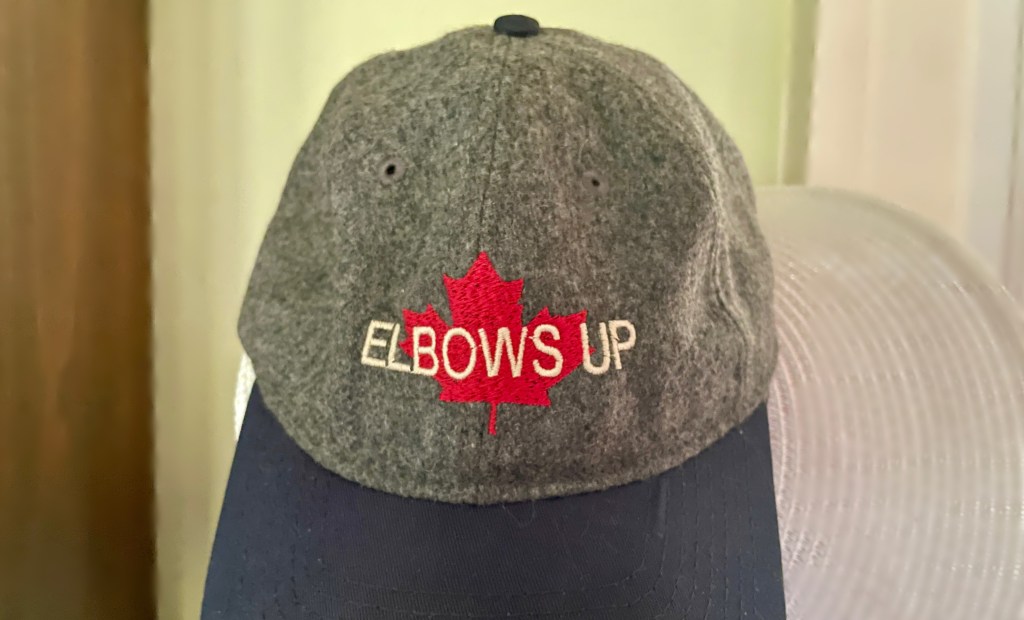
Elbows Up: How Canada’s Cooling Ties With America Expose U.S. Insecurity

With Canadian travel, spending, and goodwill toward the United States in steep decline, Washington’s defensive tone reveals a superpower under pressure and struggling to cope.

In recent months, the cross-border relationship between Canada and the United States has come under an unusual strain. What was once seen as one of the closest, most dependable partnerships in the world is now marked by tensions over trade, culture, and public perception. Data shows Canadians are spending less on American goods, traveling less often to the U.S., and expressing rising skepticism about their southern neighbor. Against this backdrop, the American response has been marked not by calm confidence, but by a defensive edge: an insecurity that suggests Washington is feeling the pressure and coping badly.

The tone was set when U.S. Ambassador Pete Hoekstra accused Canadians of harboring an “elbows up” attitude toward his country. Speaking to reporters, Hoekstra complained that Canadian leaders and the media were fanning what he called “anti-American sentiment” and warned against framing ongoing trade disputes as a “war.” His words revealed just how sensitive U.S. officials have become about Canada’s growing assertiveness. Where past American diplomats might have dismissed Canadian criticism as the grumblings of a junior partner, Hoekstra’s defensive language betrayed a sense of vulnerability.

If the rhetoric sounded strained, the economic numbers were even more alarming for Washington. Canadian travel to the United States, long a reliable driver of border-state economies, has fallen sharply. According to industry data, cross-border car trips by Canadians dropped by more than a third year-over-year in August 2025, with similar declines in road travel overall. Air bookings are also down, as Canadians increasingly avoid American destinations. Analysts warn that even a 10 percent fall in Canadian travel represents a loss of over US$2 billion in U.S. tourism spending, affecting thousands of jobs in hotels, restaurants, and retail along the border.

Nor is the pullback limited to tourism. Surveys indicate Canadians are choosing to buy fewer American goods, opting instead for domestic or third-country alternatives whenever possible. Retailers and importers report declining sales of U.S. products in sectors ranging from consumer electronics to clothing. The “buy Canadian” mood, once a marginal theme, has gone mainstream. These choices, multiplied across millions of households, amount to a quiet but powerful act of economic resistance, one that chips away at America’s largest export market.

For the United States, the twin shocks of declining Canadian tourism and shrinking demand for U.S. goods are more than economic nuisances. They strike at the heart of America’s self-image as Canada’s indispensable partner. When Canadians spend less, travel less, and look elsewhere for their needs, it signals a cultural cooling that U.S. officials have little experience confronting. Historically, American policymakers could take for granted that Canadians would continue to flow across the border for shopping trips, vacations, or work, while Canadian governments would swallow irritants in the name of preserving harmony. That assumption no longer holds.

The American response, however, has been reactive rather than reflective. Instead of acknowledging Canadian frustrations, whether over tariffs, trade disputes, or political rhetoric, U.S. officials have scolded Ottawa for being too combative. By objecting to the term “trade war,” by lecturing Canadians about their “attitude,” Washington has reinforced the perception that it neither understands nor respects Canada’s grievances. The tone has become one of deflection: the problem, U.S. diplomats suggest, is not American policy, but Canadian sensitivity.

This defensiveness has left Washington exposed. It reveals that, beneath the rhetoric of confidence, U.S. officials recognize that Canada’s resistance carries real consequences. With fewer Canadians traveling south, U.S. border states lose billions in revenue. With Canadian households buying less from U.S. suppliers, American exporters face measurable losses. And with Canadian leaders willing to frame disputes in sharp terms, U.S. diplomats find themselves on the back foot, struggling to preserve an image of partnership.

For Canada, this shift represents a moment of self-assertion. By spending less in the U.S. and leaning into domestic pride, Canadians are signaling that friendship with America cannot be assumed, it must be earned and respected. For the United States, it represents an uncomfortable reality: even its closest ally is no longer willing to automatically defer.

In the end, the story is less about Canadian hostility than about American fragility. A confident superpower would shrug off criticism, listen carefully, and adjust course. What we see instead is irritation, defensiveness, and rhetorical overreach. By lashing out at Canada’s “elbows up” attitude, Washington has confirmed what the numbers already show: it is under pressure, it is losing ground, and it is coping badly.

Five Things We Learned This Week

Week of September 13–19, 2025

Another week of sports shocks, economic shifts, and global moments. Below are five items that turned heads between Saturday, September 13 and Friday, September 19, 2025. Each item is date-checked and drawn from primary reporting so you can follow the facts and the context.


⚽ Canada ends New Zealand’s World Cup dominance to reach final

On September 19 Canada defeated defending champions New Zealand 34-19 in the Women’s Rugby World Cup semi final at Ashton Gate, booking a spot in the final for only the second time in the nation’s history. Why it matters: The result breaks a decade of New Zealand dominance, underlines the rise of Canada’s women’s program, and sets the stage for a historic final.

💷 UK borrowing surges and the pound weakens amid budget pressures

In mid September government borrowing rose well above forecasts, pushing August borrowing to its highest level in years. The pound weakened as markets digested the higher deficit and the risk of tougher fiscal measures. Why it matters: Higher borrowing raises questions for autumn budget planning and could force policy adjustments that affect growth and household budgets.

🧮 S&P Global updates show mixed growth with regional divergence

The September economic outlook from S&P Global revised growth up for economies such as the United States, Japan, Brazil and India while downgrading forecasts for Canada, Germany and Russia. Inflation remains uneven globally. Why it matters: The patchwork outlook changes the balance of global risks and opportunities, influencing trade, investment and policy choices.

📈 FAANG and AI stocks push markets higher as Fed cut odds rise

Tech giants and AI-related firms led gains during the week as investors continued to price a nearer Federal Reserve easing. The market rotation highlighted renewed appetite for growth names. Why it matters: Shifting expectations about monetary policy affect asset valuations, capital flows and corporate funding decisions.

🔭 Near-Earth asteroid 2025 FA22 made a safe flyby and was closely tracked

The object known as 2025 FA22, estimated between 130 and 290 meters, passed safely on September 18. Observatories used the close approach to refine orbital data and practice planetary defence procedures. Why it matters: Even large near-Earth objects can be monitored and ruled out as threats, which builds confidence in detection and response systems.


Closing thoughts: This week mixed sporting triumph and market optimism with sober economic readings and planetary vigilance. As these stories unfold they will shape policy decisions, investment priorities and public conversation. We will keep tracking developments and bringing you the five things worth your attention each week.

Sources

The Double Standard: Blocking AI While Deploying AI

In an era when artificial intelligence threatens to displace traditional journalism, a glaring contradiction has emerged: news organizations that block AI crawlers from accessing their content are increasingly using AI to generate the very content they deny to AI. This move not only undermines the values of transparency and fairness, but also exposes a troubling hypocrisy in the media’s engagement with AI.

Fortifying the Gates Against AI
Many established news outlets have taken concrete steps to prevent AI from accessing their content. As of early 2024, over 88 percent of top news outlets, including The New York TimesThe Washington Post, and The Guardian, were blocking AI data-collection bots such as OpenAI’s GPTBot via their robots.txt files. Echoing these moves, a Reuters Institute report found that nearly 80 percent of prominent U.S. news organizations blocked OpenAI’s crawlers by the end of 2023, while roughly 36 percent blocked Google’s AI crawler.

These restrictions are not limited to voluntary technical guidelines. Cloudflare has gone further, blocking known AI crawlers by default and offering publishers a “Pay Per Crawl” model, allowing access to their content only under specific licensing terms. The intent is clear: content creators want to retain control, demand compensation, and prevent unlicensed harvesting of their journalism.

But Then They Use AI To Generate Their Own Content
While these publishers fortify their content against external AI exploitation, they increasingly turn to AI internally to produce articles, summaries, and other content. This shift has real consequences: jobs are being cut and AI-generated content is being used to replace human-created journalism.
Reach plc, publisher of MirrorExpress, and others, recently announced a restructuring that places 600 jobs at risk, including 321 editorial positions, as it pivots toward AI-driven formats like video and live content.
Business Insider CEO Barbara Peng confirmed that roughly 21 percent of the staff were laid off to offset declines in search traffic, while the company shifts resources toward AI-generated features such as automated audio briefings.
• CNET faced backlash after it published numerous AI-generated stories under staff bylines, some containing factual errors. The fallout led to corrections and a renewed pushback from newsroom employees.

The Hypocrisy Unfolds
This dissonance, blocking AI while deploying it, lies at the heart of the hypocrisy. On one hand, publishers argue for content sovereignty: preventing AI from freely ingesting and repurposing their work. On the other hand, they quietly harness AI for their own ends, often reducing staffing under the pretense of innovation or cost-cutting.

This creates a scenario in which:
AI is denied access to public content, while in-house AI is trusted with producing public-facing content.
Human labor is dismissed in the name of progress, even though AI is not prevented from tapping into the cultural and journalistic capital built over years.
Control and compensation arguments are asserted to keep AI out, yet the same AI is deployed strategically to reshape newsroom economics.

This approach fails to reconcile the ethical tensions it embodies. If publishers truly value journalistic integrity, transparency, and compensation, then applying those principles selectively, accepting them only when convenient, is disingenuous. The news media’s simultaneous rejection and embrace of AI reflect a transactional, rather than principled, stance.

A Path Forward – or a Mirage?
Some publishers are demanding fair licensing models, seeking to monetize AI access rather than simply deny it. The emergence of frameworks like the Really Simple Licensing (RSL) standard allows websites to specify terms, such as royalties or pay-per-inference charges, in their robots.txt, aiming for a more equitable exchange between AI firms and content creators.

Still, that measured approach contrasts sharply with using AI to cut costs internally, a strategy that further alienates journalists and erodes trust in media institutions.

Integrity or Expedience?
The juxtaposition of content protection and AI deployment in newsrooms lays bare a cynical calculus: AI is off-limits when others use it, but eminently acceptable when it serves internal profit goals. This selective embrace erodes the moral foundation of journalistic institutions and raises urgent questions:
• Can publishers reconcile the need for revenue with the ethical imperatives of transparency and fairness?
• Will the rapid rise of AI content displace more journalists than it empowers?
• And ultimately, can media institutions craft coherent policies that honor both their creators and the audience’s right to trustworthy news

Perhaps there is a path toward licensing frameworks and responsible AI use that aligns with journalistic values, but as long as the will to shift blame, “not us scraping, but us firing”, persists, the hypocrisy remains undeniable.

The Future of Museums, Part Two: Digitization, Repatriation, and the New Cultural Commons

If the first step in the ethical evolution of museums is reckoning with the origins of their collections, the second must be reimagining how cultural treasures can be shared, studied, and celebrated without being hoarded. Fortunately, the 21st century offers tools our forebears could only dream of. Digital technology, particularly high-resolution 3D scanning, modeling, and immersive virtual platforms, is rewriting the rules of preservation and access. When used with cultural sensitivity and ethical intention, these tools allow us to honour ownership, facilitate repatriation, and still nourish a global commons of cultural knowledge.

Take 3D scanning: what was once an expensive novelty is now a powerful instrument of restitution and democratization. Museums can now create hyper-detailed digital replicas of artifacts, capturing every chisel mark, brushstroke, or weave of fabric. These models can be studied, shared online, integrated into augmented or virtual reality tools, or even 3D printed, all without requiring the physical artifact to remain on display in a distant capital city. This changes the equation. The original object can go home, back to the community or country from which it was taken, while its likeness continues to serve educational and scientific purposes worldwide.

There is a quiet but profound dignity in this digital compromise. It allows for the physical return of heritage to those to whom it belongs, not just legally, but spiritually and historically, while also supporting the broader mission of museums to educate and inspire. And in many cases, the digital version can do things the original never could. Scholars can examine its dimensions in microscopic detail. Teachers can beam it into classrooms. Visitors can manipulate it, interact with it, and even walk through the worlds from which it came.

Yet let’s not pretend digital tools are a panacea. A scan cannot replicate the scent of parchment, the weight of a carved idol, or the sacredness of a funerary mask imbued with ancestral memory. Creating these models demands money, time, and skilled technicians, resources that smaller institutions may lack. But for those who can muster them, the return is substantial: ethical legitimacy, global engagement, and future-proof access to cultural heritage.

Enter the virtual museum, a concept whose time has truly come. With internet access now ubiquitous in much of the world, online museum platforms are exploding. Whether it’s the British Museum’s virtual galleries or the immersive tours of the Louvre, these digital spaces offer a new kind of cultural experience: borderless, accessible, and unconstrained by bricks, mortar, or geopolitics. For those unable to travel, due to distance, disability, or cost, virtual museums are not just convenient; they are transformational.

These platforms do more than display scanned objects. They weave in video, sound, oral histories, and expert commentary. They let users “handle” objects virtually, walk through reconstructions of lost cities, or compare artworks from across time zones and traditions. And crucially, they offer a space where repatriated artifacts can remain visible to the world. A sculpture returned to Nigeria or a mask restored to a Pacific island doesn’t need to vanish from global consciousness. Its story, and its scanned image, can be co-curated with local voices, shared respectfully, and kept safe in the digital domain.

This co-curation is vital. A truly decolonized digital strategy doesn’t just upload images, it shares authority. It ensures that the descendants of artifact-makers help decide how those objects are described, displayed, and interpreted. Digital museums can become sites of collaboration, not appropriation; places where cultural equity is baked into the code.

And then there’s the sustainability argument. Virtual museums dramatically reduce the environmental costs of international exhibitions, staff travel, and artifact shipping. They offer resilience against disaster, a fire, flood, or war may destroy a gallery, but not its digital twin. In a world of increasing instability, that matters.

So where does this leave us? It leaves us at the edge of something hopeful. The combination of digital modeling and virtual museums does not replace the need for physical repatriation, it complements and strengthens it. It allows us to move beyond the binary of “ours” versus “theirs,” and into a more nuanced, shared stewardship of humanity’s treasures.

The museum of the future is not a fortress. It is a node in a network, a partner in a dialogue, and a bridge across histories. If museums can embrace this vision, ethical, inclusive, and digitally empowered, they can transform from institutions of possession to institutions of connection. And that, perhaps, is the most valuable exhibit of all.

A Dangerous Symbol: Why Alberta’s Citizenship Marker Is a Badge of Exclusion

A government that tattoos its citizens with a loyalty stamp is not protecting democracy. It is manufacturing division.

Alberta’s plan to add a visible Canadian citizenship marker to driver’s licences and provincial photo IDs is sold as a pragmatic fix for administrative headaches, and a modest boost to election integrity. In reality it is a blunt instrument that will stigmatize newcomers, invite profiling, escalate privacy risks, and do virtually nothing to solve the narrow problems the government points to. This policy is not about efficiency. It is about visibility, and visibility in this case is a tool for exclusion.

Start with the claim that this will protect elections. The province has pointed to a handful of isolated incidents to justify a universal treatment of every person who carries a licence in Alberta. The scale does not remotely justify the sweep. Elections Alberta has not identified a systemic problem that requires permanently marking who is a citizen on the everyday card that everyone carries. There are far less intrusive ways to strengthen the integrity of the ballot than turning driver’s licences into a public ledger of status. If the problem is rare, the solution should be targeted, not universal.

Now consider the everyday, lived consequences of adding a visible citizenship marker. A small tag on a card is not a neutral bureaucratic convenience. It is a social signal that will be read within seconds by a wide range of people who exercise power over daily life: police officers, service providers, employers, landlords, front-line staff in health clinics and banks. The absence of that tag is, in practice, the same as a visible mark. When a human scans an ID and sees no “CAN” or similar symbol, they will know the person is likely not a citizen. That knowledge will change behavior.

The harm here is predictable. Racialized and immigrant communities will carry this burden disproportionately. Citizenship status correlates strongly with place of birth, language, and race. Policies that place a visible marker on status therefore do discrimination by another name. The Alberta Human Rights Act protects characteristics such as race, colour, ancestry and place of origin. A policy that has the predictable effect of singling out people because of those characteristics should be treated with deep suspicion. The government’s design converts private legal status into a public marker that will be used, intentionally or not, to exclude, interrogate and penalize.

Privacy is another casualty. Adding more personal data to a card that lives in pockets and purses increases the risk of misuse and error. The same announcement that proposed the citizenship marker also proposed including health numbers on the same cards. Those are sensitive identifiers. Combining multiple markers and numbers into a single, widely used document creates a tempting target for fraud and function creep. Once institutions are accustomed to seeing citizenship on an ID, the line between appropriate use and mission creep becomes dangerously thin. History shows that extra data on everyday documents rarely stays limited to the original, narrow purpose.

There is also the basic problem of accuracy. Mistakes happen. Bureaucratic records are imperfect. Imagine being wrongly marked, or left unmarked, and then facing a delay in accessing health care, government supports, or a job because an overworked clerk or a skeptical stranger read your card and assumed something about your rights. Fixing those mistakes takes time, money and dignity that many people cannot spare. That risk is not hypothetical. Governments themselves admit to data mismatches and unexplained records when they discuss the systems they use. We should not make people pay for a government’s sloppy data by making their legal status visible on a daily basis.

Finally, consider the chilling effect. Communities that feel targeted withdraw. They stop reporting crime. They stop seeking services. They withdraw from civic life. That is a perverse outcome for a democratic society. If the government’s aim is social cohesion and civic participation, stamping people’s IDs with a citizenship marker pushes in precisely the opposite direction.

There are sensible alternatives that protect both security and dignity. Back-end verification systems allow agencies to check status when the law requires it without turning every encounter into a status interrogation. Voluntary proof-of-citizenship cards could be issued for the small number of people who want a single card for passport office interactions or specific benefits applications. Strengthening poll-worker training and refining procedures at the point of service can shore up election integrity without branding the population. A proper privacy impact assessment and an independent human-rights review should be prerequisites for any change that touches identity.

This is not merely a policy error. It is a marker of values. Do we want a province that solves narrow administrative problems by creating new, visible categories that will be used to sort people? Or do we want a province that insists on privacy, on minimizing state visibility into people’s legal status, and on solving problems with proportionate measures?

If Alberta proceeds, expect legal pushback. Policies with predictable discriminatory effects should, and will, be challenged. Human-rights law recognizes that discrimination can occur through effects rather than explicit language. A seemingly neutral policy that disproportionately burdens persons who belong to protected groups will not withstand careful legal scrutiny.

The loudest argument for the citizenship marker is convenience. Convenience is not a trump card when human dignity hangs in the balance. We can tidy up administrative processes without creating a social scoring system that singles people out in grocery stores, hospitals, and bus stations. We can secure ballots without making identity a visible badge of belonging.

The test for public policy is simple. Does it solve the problem at hand with the least intrusion necessary? Adding citizenship to everyone’s everyday ID fails that test. It substitutes spectacle for problem solving, visibility for nuance, and bluntness for proportionality.

Alberta should drop this plan, sit down with civil-society groups, privacy experts and human-rights lawyers, and design targeted, less intrusive solutions. Failing that, opponents should prepare for court, for public protest and for relentless political pressure. Democracies survive on inclusion, not on visible lists of who belongs. If we care about the health of our civic life we should resist anything that turns identity into a signal for exclusion.

Sources: 
Global News, “Alberta adding proof of Canadian citizenship to provincial driver’s licences”, Jack Farrell and Lisa Johnson, Sept 15, 2025.
CityNews Edmonton, “Immigration lawyer, critics raise concerns about citizenship marker on Alberta ID”, Sept 16, 2025.
Statement from Premier Danielle Smith, official announcement posts, Sept 2025.
Institute for Canadian Citizenship commentary, reaction coverage, Sept 2025.
Alberta Human Rights Act commentary and analysis, relevant legal background.

Jeff Beck: Redefining the Electric Guitar

“Performing This Week… Live at Ronnie Scott’s” by Jeff Beck is my absolute favourite live album, and there is rarely a month goes by without it being played or watched at home. While there are many outstanding modern guitarist, this is why Jeff Beck is top of my list. 

Jeff Beck’s claim to the title of the finest modern guitarist rests on four pillars. He altered the vocabulary of the electric guitar. He bridged genres without compromise. He proved, live and on record, that virtuosity can serve melody. He earned the reverence of institutions and peers who rarely agree. Few players changed how the instrument could sound and feel across so many eras, while refusing to be boxed in by fashion or formula.

The breakthrough arrived fast. With the Yardbirds in 1965 and 1966, Beck used the electric guitar as a sound design tool, not just a solo voice. On Heart Full of Soul he bypassed an actual sitar, and bent a fuzzed-out Stratocaster line into something convincingly raga-like, helping introduce Indian inflections to British rock radio. Shapes of Things pushed further, with controlled feedback and an Eastern scale that many historians now tag as a first true psychedelic rock single. Those records did not copy American blues forms. They mutated them, igniting a new language of sustain, noise and melody that others would chase for years.   

Beck’s solo debut Truth, cut in 1968 with Rod Stewart and Ronnie Wood, turned that language into shock therapy. It was a heavy, spacious record that foreshadowed the architecture of Led Zeppelin, and the rise of hard rock on both sides of the Atlantic. Tracks such as Beck’s Bolero and the reimagined Shapes of Things pointed toward the sonic mass that would soon be called heavy metal, yet they kept dynamics and drama at the center. The result was less a genre template than a manifesto about force and finesse.    

Then he changed course again. Blow by Blow in 1975 and Wired in 1976 reshaped the commercial prospects of instrumental music. Beck applied blues phrasing to jazz-rock structures with George Martin in the producer’s chair, landing a platinum instrumental LP and a No. 4 slot on the Billboard 200. Fusion could be lyrical rather than clinical, and the guitar could carry an entire album without a singer. Those records did not just broaden a fan base. They expanded the market for instrumental rock and set a standard that fusion and rock guitarists still measure against.    

Technique made those pivots possible. Beck abandoned the pick, playing with fingers that plucked and snapped strings while the right hand worked the Stratocaster’s vibrato arm and the volume knob in real time. He could swell a note into the mix like a violinist, then smear its pitch with a glissando that mimicked slide guitar, or tease harmonics into vocal shapes. This was not gear-driven flash. It was touch, control and micro-dynamics turned into grammar. Many great players mastered the how of speed and articulation. Beck mastered the why of phrasing, timbre and breath.    

The stage confirmed it. The 2007 Ronnie Scott’s residency in London remains a benchmark for modern guitar performance. Backed by Vinnie Colaiuta and Tal Wilkenfeld, Beck moved from lyrical balladry to feral fusion without breaking the spell of melody. The set list stretched across his career, yet everything sounded current because the tone lived at his fingertips, not in presets. It was a masterclass in restraint and risk, caught on a live album and film that have become essential study texts for working guitarists.   

Recognition followed the work, not the other way around. Beck is a two-time Rock and Roll Hall of Fame inductee, first with the Yardbirds in 1992 and again as a solo artist in 2009. He holds the record for the most wins in the Grammy category that best maps his lane, Best Rock Instrumental Performance, and earned eight Grammys in total. These honors matter here because they span decades and styles. Institutions often lag behind innovation. In Beck’s case they kept pace, acknowledging that his instrumental music moved listeners and players alike.     

Influence is the last measure. Beck shaped how guitarists think about feel. The modern vocabulary of fingerstyle electric lead, of singing vibrato-arm inflection, of volume-knob dynamics used as composition, owes him a debt. The tributes that poured in at his passing were notable less for celebrity and more for specificity. Players did not just say he was great. They cited the details of his touch and control that they had tried, and failed, to replicate. That is the quiet test of greatness. When the best explain what makes someone singular, and the explanation centers on the unteachable, the case is closed.   

Call it a contest on taste if necessary, but if the criteria are innovation, breadth, touch, live authority and a recorded legacy that keeps revealing new corners, the verdict is clear. Jeff Beck did not simply play the guitar. He reinvented it every decade he held one.

Sources:
Rock & Roll Hall of Fame. Jeff Beck inductee profile.
Grammy.com. Jeff Beck artist page.
Associated Press. Obituary and career overview.
Guitar Player. How to Play Guitar Like Jeff Beck.
Premier Guitar. Jeff Beck and the Magic Volume Knob.
Guitar World. Jeff Beck whammy bar and slide phrasing.
Wikipedia. Blow by Blow album page. Chart position and certification.
Ultimate Classic Rock. Yardbirds’ Shapes of Things.
Wikipedia. Heart Full of Soul. Raga influence and fuzz usage.
Guitar Player. Truth retrospective.
MusicRadar. Beck’s Bolero feature.
Live at Ronnie Scott’s album page.
A Green Man Review. Ronnie Scott’s live review.  

AI and the Future of Professional Writing: A Reframing

For centuries, every major technological shift has sparked fears about the death of the crafts it intersects. The printing press didn’t eliminate scribes, it transformed them. The rise of the internet and word processors didn’t end journalism, they redefined its forms. Now, artificial intelligence fronts the same familiar conversation: is AI killing professional writing, or is it once again reshaping it?

As a business consultant, I’ve immersed myself in digital tools: from CRMs to calendars, word processors to spreadsheets, not as existential threats, but as extensions of my capabilities. AI fits into that lineage. It doesn’t render me obsolete. It offers capacity, particularly, the capacity to offload mechanical work, and reclaim time for strategic, empathic, and creative labor.

The data shows this isn’t just a sentimental interpretation. Multiple studies document significant declines in demand for freelance writing roles. A Harvard Business Review–cited study that tracked 1.4 million freelance job listings found that, post-ChatGPT, demand for “automation-prone” jobs fell by 21%, with writing roles specifically dropping 30%  . Another analysis on Upwork revealed a 33% drop in writing postings between late 2022 and early 2024, while a separate study observed that, shortly after ChatGPT’s debut, freelance job hires declined by nearly 5% and monthly earnings by over 5% among writers.  These numbers are real. The shift has been painful for many in the profession.

Yet the picture isn’t uniform. Other data suggests that while routine or templated writing roles are indeed shrinking, strategic and creatively nuanced writing remains vibrant. Upwork reports that roles demanding human nuance: like copywriting, ghostwriting, and marketing content have actually surged, rising by 19–24% in mid-2023. Similarly, experts note that although basic web copy and boilerplate content are susceptible to automation, high-empathy, voice-driven writing continues to thrive.

My daily experience aligns with that trend. I don’t surrender to AI. I integrate it. I rely on it to break the blank page, sketch a structure, suggest keywords, or clarify phrasing. Yet I still craft, steer, and embed meaning, because that human judgment, that voice, is irreplaceable.

Many professionals are responding similarly. A qualitative study exploring how writers engage with AI identified four adaptive strategies, from resisting to embracing AI tools, each aimed at preserving human identity, enhancing workflow, or reaffirming credibility. A 2025 survey of 301 professional writers across 25+ languages highlighted both ethical concerns, and a nuanced realignment of expectations around AI adoption.

This is not unprecedented in academia: AI is already assisting with readability, grammar, and accessibility, especially for non-native authors, but not at the expense of critical thinking or academic integrity.  In fact, when carefully integrated, AI shows promise as an aid, not a replacement.

In this light, AI should not be viewed as the death of professional writing, but as a test of its boundaries: Where does machine-assisted work end and human insight begin? The profession isn’t collapsing, it’s clarifying its value. The roles that survive will not be those that can be automated, but those that can’t.

In that regard, we as writers, consultants, and professionals must decide: will we retreat into obsolescence or evolve into roles centered on empathy, strategy, and authentic voice? I choose the latter, not because it’s easier, but because it’s more necessary.

Sources
• Analysis of 1.4 million freelance job listings showing a 30% decline in demand for writing positions post-ChatGPT release
• Upwork data indicating a 33% decrease in writing job postings from late 2022 to early 2024
• Study of 92,547 freelance writers revealing a 5.2% drop in earnings and reduced job flow following ChatGPT’s launch  ort showing growth in high-nuance writing roles (copywriting, ghostwriting, content creation) in Q3 2023
• Analysis noting decreased demand (20–50%) for basic writing and translation, while creative and high-empathy roles remain resilient
• Qualitative research on writing professionals’ adaptive strategies around generative AI
• Survey of professional writers on AI usage, adoption challenges, and ethical considerations
• Academic studies indicating that AI tools can enhance writing mechanics and accessibility if integrated thoughtfully

From Isak to Woltemade: Murphy’s Cross Keeps the Toon Dream Alive

By Big Mac, the OAP Blogger from Byker

Ey up! Big Mac from Byker here, sharpening me quill to spin a fresh yarn now that things’ve changed at St. James’ Park. The Magpies have lost Alexander Isak, and the Toon Army is keen to see how Jacob “Murph” Murphy fares without his partner in crime. But right out the gate, there’s signs Murph’s crossing ability still has that Geordie magic, he helped us get the win over Wolves yesterday. Let’s have a proper chat about it.

Isak’s Exit: A Legend in the Making Moving On
First off, let’s get the facts straight. Alexander Isak officially left Newcastle United for Liverpool on deadline day, 1st September 2025.  It was a British record transfer fee of £125 million, making him the most expensive British-club deal of the summer, and a landmark move in English football.  Isak had been one of our deadliest strikers: since signing in summer 2022, he scored 62 goals in 109 appearances for Newcastle in all competitions.  He was central to the 2024-25 season’s highs, not least the Carabao Cup win.  But the Sad Toon struggle is real when a talisman like him departs.

Enter Woltemade & Murphy Rising
Newcastle didn’t hang about replacing Isak. Nick Woltemade came in from Stuttgart for a club‐record fee, signed to fill the void left by Isak.  The immediate test was yesterday’s match vs Wolves at St James’ Park, a hard-fought 1-0 win. But the beauty of it was in how Murphy still showed he’s got the eye, the deliverer. 

Woltemade got the winner in his debut, heading in a cross from Murphy in the 29th minute.  That cross was right on the money – perfect delivery. It told us that even without Isak alongside him, Murphy can still pick out a header, find a forward, link up. That moment felt like a bridge between what was, and what could be with this new era.

Comparing to Legends: Shearer & Solano
Now, folks often talk about legends, and there’s no bigger in this town than Alan Shearer and Nolberto Solano. Shearer, of course, was clinical, ferocious, the kind of striker who could score with half-a-chance. And Solano, silky on the right, with whipped crosses, set-pieces, and those clever passes. Together, they were one of the best striker-provider pairs in Toon history.

Comparing Murph & Isak to Shearer & Solano ain’t sacrilege, because what we’re seeing with Murphy now is some of the same DNA: the ability to spot runs, to deliver quality service, to anticipate what the striker is gonna do. Isak and Murphy had chemistry; Isak knew where to be, Murphy knew where to aim. But with Isak gone, we’re yet to see if Murphy can build a new kind of connection, as dependable and electric as Shearer & Solano’s. Yesterday’s assist for Woltemade gives me hope.

The Magic of Murphy: Crossing, Timing, Vision
If there’s a reason Murphy remains so important, it’s this: his crossing ability, his timing, and his work ethic. Yesterday, aside from the cross that led to Woltemade’s goal, he had a few other chances: one disallowed, one fizzed just past.  Wolves weren’t pushovers. They threatened. But Murphy was steady, patient, looked for the chance, delivered. That’s what Solano used to do in his day, always eyeing the overlapping full-backs, always ready to whip in a cross that could split defences.

With Isak gone, we’re seeing Murphy change gear. Not just being the assist man for a known finisher, but spotting new runs, new patterns, and making those crosses count for others. Woltemade rose well. That’s not just his header, that’s Murphy’s accuracy and vision. The way he picks out the far post cross, knowing someone will be there, that kind of thing Shearer used to feed off, with Solano or others.

Challenges Ahead & Hope for the New Era
Of course, it’ll be tricky. Isak was more than a finisher; he had movement, clever link-ups, pace, vision, and knew how to press. Wolves’ game showed that Newcastle is adjusting. We’ll see good crosses, and sometimes they won’t be met. Woltemade got cramp and had to come off; there’s going to be trial and error. But Murphy is looking like the kind of lad who can lead the front-line service, even without Isak.

Filling the shoes of a legend isn’t easy, and Shearer’s boots are massive, but if Murphy keeps delivering crosses like that, and if Woltemade or others keep the runs that Murphy can feed, we might be building something new, something special. The crowd yesterday were singing for Murphy after the game; you could feel the faith was shifting slightly, from, “What will we do without Isak?” to, “Alright, we’ve still got survivors.”

Final Thought from Big Mac
So, here’s what I reckon: Isak has moved on, and yes, it hurts a bit, seeing one of our best high up at another club. But football moves ever onward, and from yesterday’s cross for Woltemade’s debut goal, I saw a glimpse of that old magic. Not exactly Shearer & Solano, not yet, but the seeds are planted.

Murphy, with his vision and crosses, is stepping up. Woltemade’s debut gave us a moment of hope. The Toon Army will be behind them, and if they keep weaving this kind of understanding, maybe the next legendary partnership is forming before we know it.

Howay the lads – the pitch still got room for new legends.