The Quiet Rebirth: Canada’s Path to a Parliamentary Republic

With the King and Queen in Ottawa, I thought I might just post this small Republican fantasy, laid out for all to read. 

Prologue: The End of the Crown
In the year 2032, following a decade of public debate, constitutional conferences, and grassroots engagement, Canada formally transitioned from a constitutional monarchy to a parliamentary republic. The catalyst was a national referendum, driven by rising republican sentiment in Quebec, a resurgent Western populism demanding proportional representation, and an Indigenous-led movement for political sovereignty within the Canadian state.

The result was overwhelming: 68% of Canadians voted in favour of replacing the monarchy with a democratically elected head of state, establishing a fully Canadian republic with a new constitution rooted in reconciliation, regional balance, and democratic renewal.

A President for All Canadians
The new President of Canada is elected by ranked-choice ballot every seven years, with a non-renewable term. The position is ceremonial, but symbolically powerful: a national unifier who replaces the King and Governor General, chosen by the people rather than inherited title. Quebec supported the reform overwhelmingly. For the first time, the Canadian state acknowledged its dualistic identity: one anglophone and one francophone society within a shared democratic framework. Official bilingualism was strengthened. The first President, a Métis jurist from Saskatchewan, addressed the country in Cree, French, and English during their inaugural speech.

The Two Houses of Parliament
A. The House of Commons

Reformed to use Mixed Member Proportional Representation (MMP):
• 60% of MPs are elected directly in ridings.
• 40% are elected from regional party lists to reflect actual vote share.

This addressed a central grievance of Western provinces, especially Alberta and Saskatchewan, who had long seen their votes “wasted” under the old system. Under MMP:
• Western-based parties gained consistent, proportional representation.
• Coalition governments became the norm, requiring negotiation and respect across regions.

B. The Senate of Canada
Recast as an Elected Council of the Federation:
• Each province and territory elects equal numbers of Senators, regardless of population, to ensure regional parity.
• Senators serve staggered eight-year terms.
• Legislation must pass both Houses, but the Senate cannot permanently block Commons bills, only delay and revise.

Crucially, Indigenous Peoples were granted 20 permanent Senate seats:
• These seats are chosen by First Nations, Métis, and Inuit national councils, not political parties.
• Their mandate: to protect Indigenous rights, oversee federal treaty obligations, and act as stewards of land, climate, and cultural legislation.

Indigenous Representation in Governance
For the first time in Canadian history, Indigenous Nations are formally recognized as constitutional partners. Their rights are not granted by the Crown, they are affirmed by co-sovereignty agreements embedded in the Constitution.
Twenty seats in the House of Commons are permanently reserved for national Indigenous representatives, elected by pan-Indigenous vote.
Twenty Senate seats, as noted, are selected by national Indigenous councils and rotate among Nations.
• All legislation affecting land, language, or treaty obligations must be reviewed by an Indigenous-Led Standing Committee.

This gave concrete form to the nation-to-nation vision long promised under UNDRIP.

Quebec’s Role in the Republic
• With the monarchy gone, Quebec’s national identity was affirmed in law: it was recognized as a distinct society, with its own civil code, cultural protections, and immigration quotas.
• French became the co-equal language of the state, not merely a translation.
• The Republican Constitution of Canada acknowledged the right of Quebec to self-determination, but also embedded it in a new federal partnership of equals, making secession less urgent and less attractive.

Quebec found itself more powerful inside the republic than outside the monarchy-bound confederation it had long resented.

A More Responsive and Inclusive Democracy
The post-monarchy Canada is:
More representative, with diverse voices in Parliament.
More cooperative, with minority governments requiring negotiation.
More just, with Indigenous peoples at the table, not petitioning from the outside.
More regionally balanced, with the West and Quebec no longer sidelined.
More future-focused, with a Senate that values long-term planning over short-term headlines.

A Canada Reimagined
By 2040, the republican Canada is no longer simply a continuation of its colonial past. It is a democratic partnership of peoples, Indigenous, settler, immigrant, Quebecois, and regional, bound not by allegiance to a Crown, but by shared stewardship of land, rights, and future generations.

It was not a revolution. It was a quiet rebirth, a new chapter written in many voices, with none silenced, and none above the law.

Alberta at the Crossroads: Resource Sovereignty and Federal Cohesion

It began with a simple yet startling poll result: one‑third of Albertans said they would consider leaving Canada if the next federal government were Liberal, a figure up from 25 percent in 2001 and drawn from a 219 Ipsos survey that found 33 percent of respondents believing Alberta would be better off as a separate country. In the same year, an Angus Reid Institute study reported that half of Albertans saw separation as a “real possibility,” even if the practical likelihood was judged low. Other surveys have shown support fluctuating between 23 percent and 33 percent, but the headline number – one in three – captured the public imagination, and became shorthand for a deep provincial malaise.

That malaise has its roots in a storied history of perceived federal overreach. Albertans, and Western Canadians more broadly, still speak in hushed tones of the National Energy Program of 1980, when Ottawa’s sudden push to capture a greater share of oil revenues felt like an economic and cultural assault. Recent Liberal governments, with their emphasis on carbon pricing (the “carbon tax”), tighter environmental assessments through Bill C‑69, and tanker bans under Bill C‑48, have reawakened memories of Pierre Trudeau’s NEP and convinced many that, once again, the province’s lifeblood industry is under siege.

Yet the idea of actually breaking away faces almost insurmountable constitutional and practical barriers. The Supreme Court of Canada’s 1998 Reference re Secession of Quebec made clear that any province seeking to leave must first secure a “clear expression” of the popular will through a referendum on a clear question, and then negotiate terms of separation with Ottawa, and the other provinces, no small feat under Canada’s amending formula, which generally requires approval by Parliament plus seven provinces representing at least 50 percent of the national population. Indigenous nations in Alberta, whose treaty rights are with the Crown, would also have to be brought into the process, introducing further complexity and potential legal challenges.

Contrasting sharply with this looming constitutional labyrinth is the decade of Stephen Harper’s Conservative government (2006–2015), celebrated in Alberta as “our decade.” Under Harper who, though born in Ontario, was politically shaped in Calgary, Alberta’s oil patch felt valued rather than vilified. Pipelines advanced, carbon pricing was minimal, and fiscal transfers were viewed as fair. When Harper left office, Alberta enjoyed low unemployment, a booming energy sector, and a sense of national relevance seldom felt under Liberal administrations.

That stark contrast helps explain why talk of a fourth Liberal mandate elicits such fury.  It’s not just a change of political party, but a reopening of old wounds. Many Albertans feel that, under Liberal governments, their province unwittingly subsidizes federal programs and public services elsewhere, amid equalization debates, even as Ottawa imposes restraints on drilling and export infrastructure. Yet when Alberta needs federal support, whether for pipeline approvals through British Columbia, bailouts of orphaned wells (some $1.7 billion in 2020), or trade negotiations, it turns to the very same system it denounces.

At the heart of this contradiction lies a fundamental misunderstanding on both sides of the debate. Constitutionally, Alberta does own the oil and gas beneath its soil: Section 92A of the Constitution Act, 1982 grants provinces exclusive resource management powers. But that ownership comes with responsibilities and shared consequences. Oil and gas development contributes to national greenhouse‑gas targets, affects international trade obligations (e.g., under CUSMA), and relies on pipelines, rail lines, and workforce mobility that cross provincial boundaries and fall under federal jurisdiction.

This “siege mentality” sees only extraction and profit, ignoring that Alberta’s prosperity is woven into the Canadian federation: workers from Ontario and the Maritimes staff the oil sands; revenues fund national research and infrastructure; federal courts enforce property and contract law; and Ottawa’s diplomatic channels open markets abroad. The province’s economy is both “ours” and “Canada’s,” yet too often the narrative paints Alberta as a cash cow and Ottawa as a meddling bureaucrat.

Should Albertans ever find themselves voting for separation, they would quickly learn that the question is only the beginning. A referendum, no matter how decisive, would simply trigger constitutional negotiations. Debates over dividing federal debts and assets, the fate of interprovincial infrastructure, the status of Indigenous treaties, and even Canada’s seat at the United Nations would follow, all under the watchful eyes of domestic courts and foreign governments skeptical of a rump Canada and a new oil‑rich microstate.

In this light, the polling spikes in separatist sentiment reflect more than a serious bid for nationhood, they signal profound alienation. Up to 33 percent talking of leaving, up to 50 percent seeing separation as possible, and around 23 percent saying they would vote “yes” in a referendum are metrics of anger rather than blueprints for new borders. They underscore a demand for respect, recognition, and real partnership with the federal government, an insistence that Alberta’s economic contributions be matched with political influence and cultural validation.

Ultimately, Alberta’s future lies not in walking away from Canada, but in finding a new equilibrium within it. That requires:
1. Acknowledging interdependence: Alberta must recognize that its resource wealth, workforce, and infrastructure exist because of—and for—the Canadian market and legal framework.
2. Embracing diversification: Beyond oil and gas, investments in hydrogen, clean technology, and critical minerals can reduce the economic anxiety that fuels separatist talk.
3. Renewing federalism: Ottawa needs to move beyond top‑down policies and engage province‑by‑province on environmental and economic goals, respecting regional realities while upholding national standards.

The story woven by those polls, legal analyses, and emotional testimonies is not one of imminent breakup but of a province at a crossroads. The choice before Alberta, and Canada, is whether to deepen the divide into a chasm of mistrust, or to build new bridges of collaboration that honor both provincial autonomy and federal unity.

A Kingdom Reclaimed: Ridley Scott’s Epic at 20

As a huge fan of Ridley Scott’s work, I would place Kingdom of Heaven Director’s Cut in my top 20 movies that I can watch over and over again. 

As Ridley Scott’s Kingdom of Heaven marks its 20th anniversary, the film’s journey from a critically panned theatrical release to a revered director’s cut exemplifies the transformative power of cinematic restoration. Initially released in May 2005, the film was met with lukewarm reception, largely due to its truncated 144-minute runtime that compromised character development and thematic depth. However, the subsequent release of the 194-minute director’s cut unveiled a more nuanced and emotionally resonant narrative, prompting a reevaluation of the film’s artistic merit. 

The theatrical version suffered from significant omissions that diluted the story’s complexity. Key character arcs, such as that of Sibylla (Eva Green), were severely underdeveloped. In the director’s cut, Sibylla’s internal conflict is poignantly portrayed through the inclusion of her son, Baldwin V, who inherits his uncle King Baldwin IV’s leprosy. Faced with the harrowing decision to euthanize her child to spare him from suffering, Sibylla’s character gains profound depth, transforming her from a peripheral figure into a tragic heroine .  

Similarly, the protagonist Balian’s (Orlando Bloom) motivations are more coherently depicted in the extended version. The director’s cut reveals that the priest Balian murders is his half-brother, who desecrated his wife’s corpse, stole her cross, and would inherit his estate if he died without an heir. This context provides a clearer understanding of Balian’s actions, and enriches his character’s moral complexity .  

The director’s cut also restores the film’s thematic exploration of faith, conscience, and the human cost of war. The additional footage allows for a more deliberate pacing, enabling the audience to engage with the philosophical underpinnings of the narrative. The portrayal of King Baldwin IV (Edward Norton) as a leper king striving for peace, and Saladin’s (Ghassan Massoud) honorable conduct, further emphasize the film’s message of religious tolerance and the futility of fanaticism. 

Despite the improvements, it’s noteworthy that an even longer version, reportedly exceeding four hours, remains unreleased. This elusive cut is rumored to contain additional scenes that could further enhance character development and thematic richness. Given the substantial enhancements observed in the director’s cut, the prospect of an extended version is tantalizing for cinephiles and advocates of auteur-driven storytelling. 

In retrospect, Kingdom of Heaven serves as a testament to the importance of preserving directorial vision in filmmaking. The director’s cut not only rehabilitated the film’s reputation, but also underscored Ridley Scott’s prowess in crafting epic narratives that resonate on both emotional and intellectual levels. As the film reaches its two-decade milestone, it stands as a compelling argument for the value of artistic integrity, and the enduring impact of thoughtful storytelling.

Can Food Belts Enhance Ontario’s Food Security Future?

Ontario is facing an escalating food security crisis, with food banks reporting unprecedented demand and rural communities increasingly unable to afford basic nutrition. In response, a new policy proposal is gaining traction among local leaders and agricultural advocates: the creation of provincially designated “food belts” to permanently protect farmland and strengthen local food systems.

Recent data paint a sobering picture. More than one million Ontarians accessed food banks between April 2023 and March 2024, a 25% increase over the previous year and nearly double the figures from four years prior. According to Feed Ontario’s 2024 Hunger Report, food bank use has surged across every region, including traditionally self-sufficient rural areas like Grey-Bruce, where the cost of a nutritious food basket consumes over 40% of a family’s income on Ontario Works. In Northumberland County, the monthly shortfall between assistance levels and basic expenses surpasses $1,300 even before rent is considered.

Amid this growing crisis, Ontario Green Party Leader Mike Schreiner has introduced the concept of food belts, designated agricultural zones protected from development, designed to ensure ongoing food production close to population centres. The idea has received support from municipal officials, including Markham and Waterloo Region councillors, who are increasingly alarmed by the pace at which farmland is being lost to suburban sprawl.

Between 2016 and 2021, Ontario lost over 620,000 acres of farmland, according to the 2021 Census of Agriculture. That represents more than 1,200 farms, not phased out due to productivity or retirement, but lost to development and land speculation. Once prime agricultural land is paved over, it is virtually impossible to restore, raising serious concerns about the province’s long-term food capacity.

In Waterloo Region, where one in eight households now reports food insecurity, the link between land use and hunger is becoming clearer. Eleven percent of those turning to food banks come from households with at least one working adult, reflecting broader structural challenges beyond poverty alone. At the same time, 50% of food banks have been forced to reduce services, while 40% have cut back on the amount of food distributed, according to Feed Ontario.

Food belts are proposed as a systemic solution. Modeled in part on the province’s existing Greenbelt, food belts would differ by prioritizing food production rather than simply preserving green space. Enabling legislation, potentially through amendments to Ontario’s Planning Act or the Provincial Policy Statement, would establish a policy framework, followed by municipal implementation through Official Plans and comprehensive land-use reviews.

The food belt model would involve identifying prime agricultural lands for protection, particularly in high-growth regions such as the Greater Golden Horseshoe. Within these zones, land use would be restricted to agricultural and food-related purposes, including greenhouses, food processing, and housing for seasonal farm workers. Non-agricultural development would be prohibited or tightly regulated.

To support farmers within the belts, advocates suggest a suite of provincial incentives. These could include property tax relief, grants for sustainable practices, support for young and new farmers, and investment in local food infrastructure such as processing facilities and distribution hubs. The intent is to foster both agricultural stability and economic opportunity in rural areas.

Crucially, food belts would not operate in isolation. Stakeholder engagement would be central to their design and implementation, involving farmers, Indigenous communities, conservationists, and municipal planners. A provincial oversight body could monitor compliance, enforce regulations, and report on agricultural output and environmental indicators within the belts.

Beyond farmland protection, proponents argue that food belts represent a strategic investment in Ontario’s long-term food resilience. By shortening supply chains, reducing reliance on imported goods, and anchoring food production within commuting distance of major urban centres, food belts could help the province navigate future disruptions caused by climate change, inflation, and geopolitical instability.

“Simply put, we cannot eat subdivisions,” Schreiner has said, warning that continued inaction could erode Ontario’s ability to feed itself. The Green Party’s position echoes findings from agricultural policy experts who have long cautioned that land-use planning must be treated as a food security issue, not just an environmental or economic concern.

As of 2024, Ontario’s policy landscape lacks a formal mechanism to establish food belts, though growing public and political interest may push the province to act. For now, the concept remains in the realm of advocacy and municipal discussion, but pressure is mounting.

With food insecurity no longer confined to urban poverty and food banks unable to keep pace, the proposal for food belts offers a rare convergence of long-term strategy and immediate relevance. Whether Queen’s Park chooses to seize the moment remains to be seen. What is clear, however, is that Ontario’s food future will depend not only on how the land is farmed, but on whether that land remains farmland at all.

Sources
• CBC News: https://www.cbc.ca/news/canada/kitchener-waterloo/foodbelt-reaction-schreiner-markham-councillors-1.7536995
• Feed Ontario Hunger Report 2024: https://feedontario.ca/research/hunger-report-2024
• Statistics Canada, Census of Agriculture 2021: https://www150.statcan.gc.ca/n1/daily-quotidien/220511/dq220511b-eng.htm
• Greenbelt Act, 2005: https://www.ontario.ca/laws/statute/05g01
• Grey Bruce Public Health: https://www.publichealthgreybruce.on.ca
• HKPR Health Unit (Northumberland): https://www.hkpr.on.ca

Five Things We Learned This Week

Here is the latest edition of “Five Things We Learned This Week” for May 17–23, 2025, highlighting significant global developments across various sectors.

🛑 1. UN Warns of Escalating Humanitarian Crisis in Gaza

UN Secretary-General António Guterres described the current stage of the Gaza conflict as possibly its “cruellest phase,” with Palestinians facing immense suffering amid escalating Israeli military operations. He warned that the entire population is at risk of famine and criticized the limited humanitarian aid reaching Gaza, citing that only a fraction of permitted aid trucks have reached those in need due to insecurity. In the past 24 hours, at least 60 people were killed, including strikes on Khan Younis, Deir al-Balah, and Jabaliya, with over 50 people still buried under rubble. UN agencies and aid groups have raised alarms about inadequate food and medical supplies, with over 9,000 children treated for malnutrition and the healthcare system near collapse—94% of hospitals are damaged or destroyed. Israeli airstrikes have also targeted hospitals, further straining emergency services. Despite easing an 11-week blockade, aid remains minimal, far below pre-war levels. International criticism of Israel’s military actions continues, with leaders calling for a ceasefire and increased humanitarian access. Meanwhile, discussions are underway among Western nations about formally recognizing the state of Palestine, adding a new diplomatic dimension to the ongoing crisis. 

💉 2. NHS England Launches World’s First Gonorrhoea Vaccine

On May 21, NHS England introduced the world’s first gonorrhoea vaccine, demonstrating an efficacy of 30–40%. This development aims to combat the rising rates of gonorrhoea infections and represents a significant advancement in public health efforts to control sexually transmitted infections. 

📉 3. Trump’s New Tariff Threats Shake Global Markets

President Donald Trump’s evolving trade policies continue to send shockwaves through global markets. After a brief period of de-escalation in the U.S.-China trade war, markets were rattled on May 23, 2025, when Trump threatened to impose a 25% tariff on Apple iPhones not manufactured in the U.S. and a 50% tariff on EU goods starting June 1. These moves undermined recent optimism following tariff reductions between the U.S. and China, which had reignited S&P 500 gains and stabilized investor sentiment. However, concerns about tariffs resurfaced alongside rising inflation, tepid economic growth, and persistent federal debt nearing 100% of GDP. Despite some temporary relief—such as tariff pauses and incentives for auto and tech firms—Trump’s unpredictable trade tactics, especially his criticism of Apple’s offshore manufacturing and pressure on trading partners like the UK and India, have reintroduced uncertainty. Furthermore, even with promising AI infrastructure investments from the Middle East, the U.S.-China relationship is strained by export restrictions and sanctions tied to Huawei’s semiconductor use. Economists warn these erratic policies could spur stagflation and erode S&P 500 earnings growth, highlighting the risks of Trump’s tariff-heavy strategy amid widening fiscal deficits and global trade tensions. 

🧬 4. Discovery of New Dwarf Planet Candidate in Outer Solar System

Astronomers have reported the discovery of 2017 OF201, a new dwarf planet candidate located in the outer reaches of the Solar System. This celestial body adds to our understanding of the Solar System’s composition and the diversity of objects within it. 

🎭 5. Hay Festival of Literature and Arts Commences in Wales

The Hay Festival of Literature and Arts began on May 22 in Hay-on-Wye, United Kingdom. This annual event is one of the largest literary festivals globally, attracting authors, thinkers, and readers to celebrate literature, arts, and ideas through various talks, readings, and performances. 

Stay tuned for next week’s edition as we continue to explore pivotal global developments.

A Strategic Reset: Is the UK’s 12-Year Deal with the EU a Trial Run for Rejoining?

In a move that may mark the beginning of a new chapter, or even a slow reversal, in post-Brexit Britain, Prime Minister Keir Starmer’s government has signed a sweeping 12-year deal with the European Union. Spanning trade, fisheries, defense, energy, and youth mobility, the agreement is being sold as a pragmatic step toward economic stability. Yet, for keen observers of European geopolitics and domestic UK policy, this isn’t just about cutting red tape or smoothing customs formalities. It’s about direction, intent, and trajectory; a trajectory, some might argue subtly, but surely points back toward Brussels.

Let’s be clear – this is not rejoining the EU. The UK retains its formal sovereignty, its independent trade policy, and its seat at the World Trade Organization. Yet, in practical terms, this agreement represents a partial realignment with the European regulatory and political sphere. It’s a détente, but one that many suspect could serve as a trial run for re-entry.

Trade and Regulatory Alignment: Quiet Integration
The most immediate impacts will be felt in trade. The deal includes a new sanitary and phytosanitary (SPS) agreement that significantly eases checks on animal and plant products, long a point of friction for exporters. British sausages and cheeses can once again cross the Channel with ease, and exporters have been granted breathing room after years of customs chaos.

The price? The UK will align dynamically with EU food safety rules and standards. Not only that, but the European Court of Justice (ECJ) will have an oversight role in this domain. It’s a politically delicate concession that the previous Conservative government would have balked at, but it is one that Starmer is positioning as an economic necessity rather than a political capitulation.

This kind of soft alignment, regulatory cooperation without full membership, mirrors the arrangements held by countries like Norway and Switzerland. The UK isn’t there yet, but it’s moving in that direction, and the economic benefits are likely to reinforce the case.

Fisheries: Symbolism and Compromise
Few sectors embody the emotion of Brexit like fisheries. The 2016 Leave campaign made maritime sovereignty a powerful symbol of national self-determination. Now, the UK has agreed to extend EU access to its waters for another 12 years, hardly the full “taking back control” once promised.

However, the government insists that the deal does not grant additional quotas to EU vessels, and preserves the right to annual negotiations. To offset the political fallout, £360 million is being invested into modernizing the UK fishing industry, a sweetener aimed at skeptical coastal communities.

Yet symbolism matters. This agreement effectively freezes the reassertion of full UK control over its fisheries until 2038. That’s long enough for an entire generation of voters to become accustomed to a cooperative status quo.

Energy, Climate, and Economic Integration
Perhaps the most telling element of the deal is its ambition in energy and carbon market integration. The UK and EU will link their Emissions Trading Systems (ETS), smoothing the path for cross-border carbon credit trading, and exempting British companies from the EU’s incoming Carbon Border Adjustment Mechanism (CBAM). This could save UK firms an estimated £800 million annually.

In strategic terms, it brings the UK closer to the EU’s climate governance framework, and represents a quiet, but firm repudiation of the “Global Britain” fantasy that post-Brexit Britain could thrive on deregulated free-market exceptionalism.

Security and Mobility: A Return to Practical Cooperation
Defense is also back on the table. The UK will participate in the EU’s PESCO initiative for military mobility, signifying renewed cooperation on troop and equipment movements. Intelligence sharing and sanctions alignment are also included, moves that suggest an increasingly coordinated foreign policy framework, even outside EU structures.

Meanwhile, UK travelers will soon regain access to EU e-gates, reducing airport queues, and negotiations are underway for a youth mobility scheme. The return to the Erasmus+ student exchange programme, in particular, is a major symbolic step, reconnecting young Britons with continental Europe in a way that had been severed post-2020.

A Trial Run for Rejoining?
Viewed in isolation, each element of the deal appears pragmatic and limited. Viewed together, however, they amount to a re-entangling of the UK within EU institutions and standards. The length of the deal, 12 years, is conspicuous. It places a review just past the midpoint of what could be two Labour governments, opening a window in the 2030s for a possible reapplication for membership.

Critics argue that Starmer is “Brexit in name only,” effectively undoing much of the substance of the 2016 vote. Proponents counter that he is offering economic stability, and international credibility without rekindling the divisive debate of formal re-entry, but no one should be under any illusions: this is a serious recalibration. For a generation of younger voters who never supported Brexit, it might just feel like the first step toward righting a historic wrong.

In this light, the 12-year deal may be best understood as a proving ground. It allows both the UK and the EU to rebuild trust, test cooperation mechanisms, and create the legal and political scaffolding that could one day support full re-accession. Starmer may deny it, and Brussels may downplay it, but history has a way of turning such “interim measures” into new norms.

For now, the UK is not rejoining the EU, but the doors, long thought closed, are no longer locked. And the steps taken in this agreement may well be remembered as the start of the long walk back in.

Sources
• BBC News: https://www.bbc.com/news/articles/czdy3r6q9mgo
• Sky News: https://news.sky.com/story/uk-eu-trade-deal-what-is-in-the-brexit-reset-agreement-13370912
• Al Jazeera: https://www.aljazeera.com/news/2025/5/21/will-eu-deal-make-food-cheaper-add-12bn-to-the-uk-economy
• Financial Times: https://www.ft.com/content/66763def-d141-465d-ba96-31399071bf3b
• The Times: https://www.thetimes.co.uk/article/starmers-done-no-better-with-the-eu-than-may-8l37jm2sf

A Gentleman’s Guide to Fostering Love

At this point in my life, I’ve figured out who I am, and what I bring to the table. I’m not here for grand romantic illusions, nor am I fumbling through awkward first dates trying to impress anyone. No, what I do is far more refined – I teach, I mentor, I foster.

I provide a comfortable, well-appointed sanctuary for remarkable women in their 30s and 40s who are figuring out their next steps. They come into my life, full of ambition, wit, and occasionally a deep frustration with men who still haven’t mastered basic emotional intelligence. They stay for a while, we share some incredible experiences, and eventually, they find their forever home; sometimes with another partner, sometimes in a new adventure, and sometimes still with me, just in a different way.

Now, before you assume I’m some kind of wandering sage, let me be clear; I’m not a lonely old monk dispensing wisdom and jazz records. I’ve got a full, dynamic love life of my own. My partner in her 60s keeps me on my toes, challenging me in ways only someone who’s been around long enough to take no nonsense can. She’s my equal, my match, and my co-conspirator in navigating a life filled with love, humor, and a shared appreciation for craft ale, especially stouts. And then there are my younger partners, fiercely independent, brilliantly talented, and unwilling to settle for anything less than what they deserve.

I’m not collecting people; I’m building connections. And fostering isn’t about temporary fixes or waiting for someone to move on. It’s about appreciating the time we have together, without needing to force it into a predefined shape. Some partners stay in my orbit for years, others drift in and out, and it all works because honesty, respect, and a shared love of good conversation make everything smoother.

People often assume polyamory is chaotic, but that’s only if you’re doing it wrong. For me, it’s about balance. It’s about offering and receiving care without ownership. It’s about knowing that love isn’t a finite resource, and that just because someone moves on to another stage of their life doesn’t mean what we had wasn’t real.

And while I’ve fostered many wonderful women through various chapters of their journeys, let’s not forget, I’m a bit of a rescue myself. My partners challenge me, push me to grow, and occasionally force me to retire my outdated pop culture references. They bring new energy, new perspectives, and new reasons to keep up with life’s ever-changing rhythms.

So no, I don’t date in the traditional sense. I create space for extraordinary women to thrive, sometimes with me, sometimes elsewhere. And if that means I get to spend my years surrounded by sharp minds, quick wit, and an ever-expanding appreciation for different ways of loving? Well, I’d say that’s a pretty great forever home of my own.

“The Crown”: A Fictional Mirror of an Outdated Institution

Though it is a work of entertaining historical fiction, The Crown offers more than just dramatized biographical storytelling. Across its six seasons, the Netflix series paints a richly detailed, often unflattering portrait of the British monarchy as a rigid, emotionally repressed, and outdated institution; one that struggles to remain relevant in the face of a changing world. It invites audiences to reflect on the monarchy’s role in modern Britain, subtly but powerfully suggesting that the real problem may lie less in the figureheads of the royal family and more in the institution’s deeper structure, including the Royal Household itself.

A Portrait of Tradition in a Changing World
From its earliest episodes, The Crown juxtaposes the slow-moving, ceremonial nature of monarchy with the pace of 20th-century social, cultural, and political transformation. Queen Elizabeth II, portrayed across the series by Claire Foy (Seasons 1–2), Olivia Colman (Seasons 3–4), and Imelda Staunton (Seasons 5–6), emerges as both a stabilizing figure and a symbol of institutional rigidity. The episode “Aberfan” (Season 3), where the Queen delays visiting the Welsh village devastated by a coal tip disaster, exemplifies this tension. While based on historical fact, the dramatization underscores a monarchy paralyzed by protocol and unable to respond with the immediacy and empathy the public expects.

This is not simply a personal failing; it is an institutional one. As Robert Lacey, a historian and advisor to the show, notes, “stoicism and sense of duty,” once seen as virtues, have increasingly come to signify detachment and emotional neglect in the eyes of a modern audience (Lacey, The Crown Vol. 2, 2019).

Generational Conflict and Modern Expectations
As the show progresses into the 1970s, 80s, and 90s, it contrasts the older royals’ worldview with younger members like Princess Margaret (Vanessa Kirby, then Helena Bonham Carter), Prince Charles (Josh O’Connor, later Dominic West), and most poignantly, Princess Diana (Emma Corrin in Season 4, Elizabeth Debicki in Seasons 5–6). Diana is portrayed as a deeply human figure, full of emotional expressiveness and charisma, yet suffocated by an institution that neither understands nor values those traits.

The monarchy’s emotional repression and inability to adapt to changing norms is rendered in excruciating detail: Diana’s mental health struggles, bulimia, and sense of isolation are treated more as public relations risks than genuine causes for concern. The show frames her tragedy as systemic: an institution incapable of human warmth, not by design, but by entrenched culture. Historian David Cannadine argued similarly that the monarchy “requires personal sacrifice to maintain collective mystique” (The Monarchy and the British Nation, 1983).

Critics have echoed these themes. Lucy Mangan of The Guardian praised the series as “a glistening jewel of a drama that simultaneously reveres and dismantles the myth of monarchy,” offering both intimate character study and biting institutional critique (The Guardian, 2020).

Institutional Inflexibility and the Cost of Image
One of The Crown’s most powerful throughlines is its depiction of how the monarchy sacrifices individual identity for institutional continuity. This is particularly evident in its handling of marginalized or non-conforming figures within the family: Princess Margaret, denied marriage to Peter Townsend (played by Ben Miles); the hidden-away Bowes-Lyon cousins with intellectual disabilities; and later, Diana, who is crushed under the weight of ceremonial expectations and media manipulation.

The monarchy’s obsession with appearances, and fear of public disapproval, creates a dynamic in which personal expression is not only discouraged but dangerous. This dynamic reinforces The Crown’s critique: the monarchy is less a family than a mechanism of myth-maintenance, unable to evolve without destabilizing its very foundations.

As The Independent’s Sean O’Grady wrote, “The Palace’s biggest fear isn’t scandal, it’s irrelevance. And The Crown understands this perfectly. It shows the monarchy as trapped, hostage to its own symbols” (The Independent, 2020).

A Failure to Master the Age of Image
As the series moves into the age of television, tabloids, and paparazzi, it shows how poorly equipped the monarchy is to manage a media-savvy, emotionally expressive society. In dramatizations of Charles and Camilla’s (Emerald Fennell, then Olivia Williams) affair and Diana’s famous BBC interview, the royal family is depicted as reactive, rather than strategic, overwhelmed by the forces of modern celebrity culture that they helped unleash but cannot control.

This is not merely a crisis of individuals, but of an institution being overtaken by the very tools; myth, image, and ritual, that once made it untouchable. Biographer Hugo Vickers, while critical of the show’s dramatic liberties, conceded in a 2020 interview with BBC Radio 4 that “its deeper truth lies in how it captures the emotional distance between the Crown and the people.”

The Royal Household: Gatekeepers of Inertia
If The Crown holds the monarchy accountable for its failings, it is equally critical of the Royal Household; the network of private secretaries, courtiers, press officers, and bureaucrats who advise, filter, and often control the royals’ actions. These unelected officials, ostensibly there to serve the monarchy, are portrayed as powerful guardians of tradition with their own internal hierarchies and interests.

Historian Sir Anthony Seldon described the Royal Household as “the most conservative civil service in the world, operating under the illusion that preserving yesterday is the best way to serve tomorrow” (The Times, 2019). The Crown dramatizes this vividly: from blocking Princess Margaret’s marriage to Peter Townsend, to badly mishandling Diana’s public image, the courtiers often serve as the real source of strategic blunders.

Moreover, their motives are not always aligned with public service. Royal biographer Penny Junor argues that many senior courtiers are “jealous of their positions and status” and serve “a very specific idea of monarchy that benefits them” (The Firm, 2005). In The Crown, these behind-the-scenes figures appear less as loyal stewards of national tradition and more as self-preserving bureaucrats shielding the monarchy from the world, and the world from the monarchy.

This tension culminates in the show’s portrayal of the royal response to Diana’s death. The initial decision to remain silent and stay at Balmoral, while the nation grieved, was not driven solely by the Queen but heavily influenced by advisers such as Sir Robert Fellowes (played by Andrew Havill) and others. Only after intense public pressure, and the intervention of Prime Minister Tony Blair (Bertie Carvel), did the monarchy adapt its response. The Household’s instinct to retreat into protocol reveals a deep institutional inertia at odds with public sentiment.

As historian Caroline Harris notes, “The monarchy often takes the blame for decisions made by a hidden apparatus of career courtiers who prioritize continuity over transparency” (Maclean’s, 2021).

A Symbol of National Unity – or a Relic of Empire?
One of the monarchy’s foundational myths is that it provides national unity. Yet The Crown often reveals the opposite: the monarchy, especially as advised by the Household, is portrayed as unable to meaningfully engage with Britain’s increasingly diverse, post-imperial society.

Episodes focusing on the Commonwealth, Scottish nationalism, and the working class suggest a widening disconnect. A 2023 YouGov poll found that support for the monarchy among young Britons (18–24) had dropped to 31%, the lowest ever recorded, implying that the royal institution no longer speaks to the nation’s future (YouGov UK, April 2023).

A Fictional Mirror with Real-World Clarity
The Crown
 does not call for the abolition of the monarchy, but it does issue a quiet, persistent challenge: can this institution survive not only public scrutiny, but internal stasis? Through its dramatizations, it reveals the emotional cost of monarchy, the strategic failures of its leadership, and the conservatism of its hidden machinery.

It suggests that the problem is not just who wears the crown, but who holds the keys behind the palace walls.

Sources
• Lacey, Robert. The Crown: The Official Companion, Volume 2. Penguin Books, 2019.
• Cannadine, David. The Monarchy and the British Nation, 1780–1983. Cambridge University Press, 1983.
• Mangan, Lucy. “The Crown Review – this Royal Family Drama is a Glistening Jewel.” The Guardian, November 2020. [https://www.theguardian.com]
• O’Grady, Sean. “The Crown Shows the Monarchy is Trapped by its Own Myths.” The Independent, November 2020. [https://www.independent.co.uk]
• Vickers, Hugo. Interview on BBC Radio 4: The Media Show, December 2020.
• Seldon, Anthony. “The Real Power Behind the Palace Walls.” The Times, 2019. [https://www.thetimes.co.uk]
• Junor, Penny. The Firm: The Troubled Life of the House of Windsor. St. Martin’s Press, 2005.
• Harris, Caroline. “Behind the Scenes at the Palace: Who Really Calls the Shots?” Maclean’s, February 2021. [https://www.macleans.ca]
• YouGov UK. “Support for the Monarchy Falls to Historic Lows Among Young Britons.” April 2023. [https://yougov.co.uk]

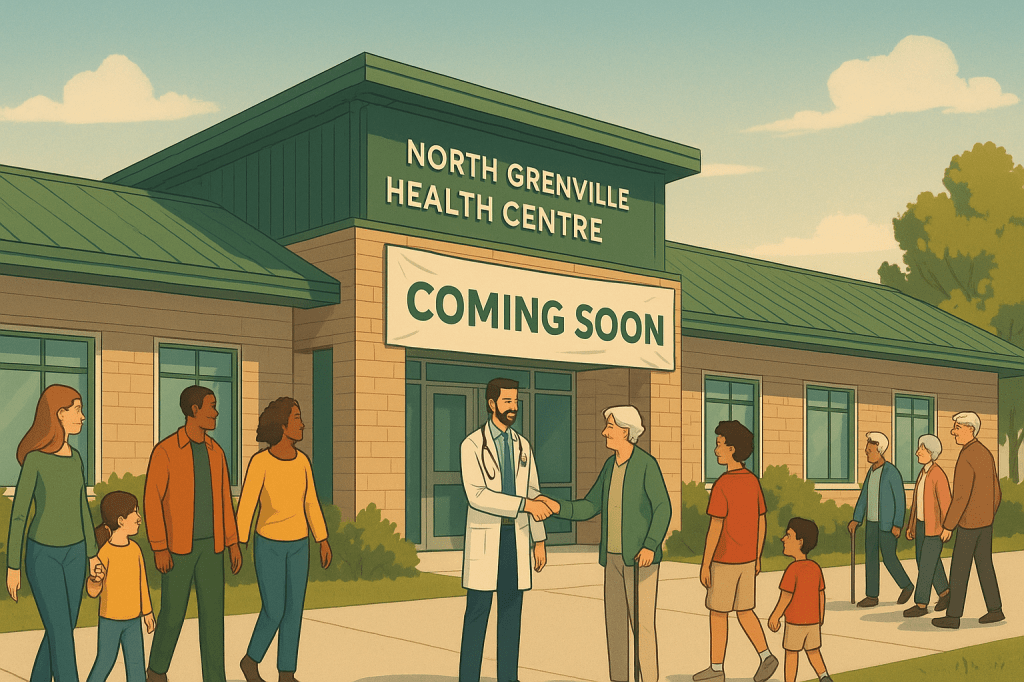
A Municipal Remedy: Why North Grenville Should Open Its Own Healthcare Centre

In North Grenville, the demand for primary healthcare has long outpaced the available supply. While the Rideau Crossing Family Health Clinic has served the community admirably, it seems to have reached its physical and staffing capacity. With a growing population, and increasing concerns over access to primary care, it’s time for the Township of North Grenville to consider a bold, but practical move: establish its own municipally-operated healthcare clinic.

This is not an untested idea. Across Canada, municipalities are taking healthcare into their own hands – literally. In Colwood, British Columbia, the city made headlines in 2023 when it became the first in the country to hire family physicians directly as municipal employees. Offering job stability, pensions, and administrative support, Colwood removed many of the barriers that deter physicians from entering or staying in primary care practice. It wasn’t about competing with existing private clinics, it was about ensuring no resident went without a family doctor.

Orillia, Ontario, is exploring a similar strategy. Recognizing that nearly 25% of the region lacks access to a primary care provider, city councillors there are considering opening a municipal clinic and hiring physicians as city staff. Their aim is to enhance, not undermine, the local healthcare network by filling a gap that traditional models are no longer meeting.

In Manitoba, rural communities like Killarney-Turtle Mountain are actively recruiting international physicians and managing their relocation as part of a municipally driven recruitment strategy. These towns have realized that waiting for provincial solutions is no longer viable. Meanwhile, in Huntsville, Ontario, a physician incentive program funded by the town is already yielding results, with new doctors signing on to help address longstanding shortages.

North Grenville has a chance to follow this growing municipal trend. Simply encouraging more physicians to join the private sector won’t be enough, there’s nowhere for them to go within the Township. A municipally-operated clinic, built with a collaborative mindset, and not as competition, can complement existing services while expanding capacity.

Such a clinic could offer a modern team-based care model that includes nurse practitioners, physician assistants, social workers, and administrative staff, all working under the umbrella of the municipality. With support from provincial and federal programs such as Ontario’s primary care transformation funds or the federal Foreign Credential Recognition Program, North Grenville could create a sustainable and forward-looking solution tailored to its own needs.

How to Move Forward: A Practical Path for the Township
To begin, North Grenville’s municipal council could establish a Healthcare Services Task Force to study local demand, identify gaps in coverage, and recommend a viable service delivery model. This task force should include community health experts, residents, and local politicians.

Next, the Township should apply for funding through Ontario Health’s community-based primary care programs, and the federal government’s health human resources strategy. Partnering with the local hospital, regional health teams, and post-secondary institutions could support the recruitment of new healthcare professionals, including recent graduates and internationally trained physicians.

Land acquisition or repurposing of an existing municipal facility could provide a location, with design input ensuring accessibility, environmental sustainability, and integrated team care. North Grenville does have the amazing resource of the Kemptville Campus, with one of its strategic pillars being “Health and Wellness”. The Township could also offer incentives such as relocation grants, housing support, and flexible hours to make municipal employment attractive to prospective staff.

Finally, a clear communications strategy should be launched to explain that the goal is not to replace or compete with existing providers, but to enhance and expand healthcare access in underserved areas and improve outcomes for all residents.

It’s time to stop waiting and start acting. Our citizens deserve timely, reliable healthcare. Let’s build it, right here at home.

Sources
https://tnc.news/2024/12/26/b-c-city-hiring-family-doctors-as-municipal-government-workers
https://barrie.ctvnews.ca/orillia-could-hire-family-doctors-to-create-municipal-clinic-1.7173907
https://www.winnipegfreepress.com/breakingnews/2024/04/19/diagnosis-critical-desperate-manitoba-municipalities-recruiting-doctors-on-their-own
https://barrie.ctvnews.ca/incentive-program-attracts-new-physicians-to-huntsville-to-address-shortage-in-primary-care-1.7093138
https://www.canada.ca/en/employment-social-development/news/2025/03/the-government-of-canada-is-investing-up-to-143-million-to-help-address-labour-shortages-in-the-health-sector.html

The Essequibo Equation: Venezuela’s Bid, Guyana’s Boom

The morning sun hangs low over the Atlantic, glinting off the towers rising in Georgetown, Guyana’s modest, but fast-transforming capital. A decade ago, few would have imagined this small South American nation, wedged between Brazil, Venezuela, and Suriname, would be at the center of a geopolitical and environmental drama with global stakes. Guyana is flush with oil – Black Gold. The kind that redraws maps, tilts economies, and ignites old rivalries. For Venezuela, long mired in economic freefall and domestic strife, it is an irresistible provocation.

Let’s be clear, what’s happening in Guyana is one of the most remarkable economic stories in the Western Hemisphere. Since ExxonMobil discovered vast offshore reserves in 2015, production has accelerated with almost reckless speed. By next year, output is projected to hit 900,000 barrels a day, and it could top 1.3 million before the end of the decade. For a country of under 800,000 people, that is transformative wealth, and unlike its oil-rich neighbours, some of whom squandered such windfalls, Guyana is making a bold promise; to become a net-zero emitter of greenhouse gases by 2050, even as it becomes a fossil fuel giant.

On the surface, this seems contradictory. How can you drill for oil while committing to climate leadership? Guyana’s government argues that its forest cover, nearly 85% of the national territory, is a massive carbon sink. It also claims that the revenues from oil will fund sustainable development, clean energy projects, and climate resilience. Whether this can be done without falling into the corruption, debt, and inequality traps that have cursed so many petro-states remains to be seen. So far, international financial institutions are cautiously optimistic. The government is under intense scrutiny, and the pressure to deliver transparency and social equity is mounting.

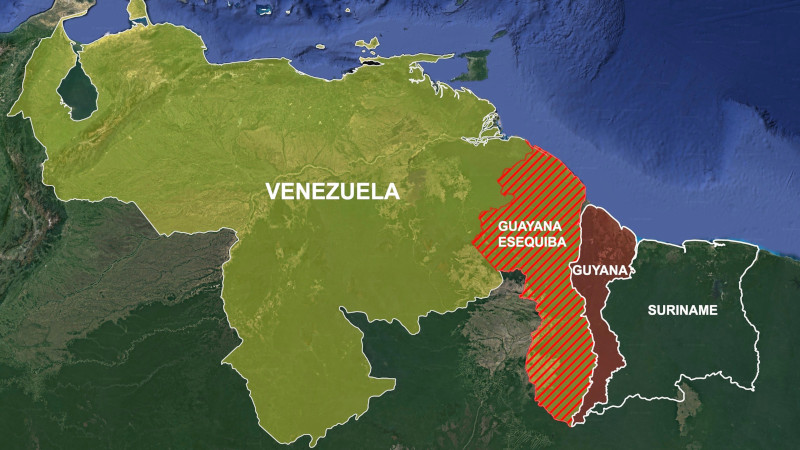
Guyana’s newfound wealth has stirred a long-simmering conflict with its neighbor to the west – Venezuela. The heart of the matter is the Essequibo region, a vast, resource-rich area that makes up nearly two-thirds of Guyana’s landmass. Venezuela has claimed it ever since the 1899 arbitration award, backed by the United States and Britain, granted the territory to what was then British Guiana. For over a century, the dispute remained largely symbolic, flaring up occasionally, but never seriously threatening borders.

Now, the stakes are very real. In 2023, Venezuela’s President Nicolás Maduro ramped up the rhetoric, holding a referendum in which voters overwhelmingly backed a proposal to annex Essequibo. Caracas argues that the arbitration was flawed and that the entire region was unlawfully taken. The timing, of course, is not coincidental. As Guyana’s oil fields, many lying off the Essequibo coastline, begin to pump billions into government coffers, Venezuela sees an opportunity to redirect domestic attention from its own failures, and tap into a nationalist cause with broad appeal.

Guyana, for its part, has responded not with sabre-rattling, but with legal precision. It brought the case before the International Court of Justice, which ruled in 2023 that it had jurisdiction. Earlier this year, in May 2025, the ICJ went further, ordering Venezuela to halt its plans to conduct elections in the disputed territory, a direct rebuke to Maduro’s annexation agenda. Venezuela has ignored the court, as it has ignored much of international law in recent years, and tensions are rising on the ground.

This is no longer a war of words. Just this month, Guyanese soldiers patrolling the border were attacked multiple times in under 24 hours. These were not large-scale military incursions, but they are warnings, probing gestures, testing the resolve of a much smaller neighbor. Guyana has responded by strengthening its military posture and drawing closer to its Western allies, including the United States and Brazil. The regional implications are grave: any escalation could destabilize the northern tier of South America, drag in other powers, and endanger vital shipping routes and energy flows.

As someone who has watched the ebb and flow of South American politics for decades, I see in this moment both peril and possibility. Guyana stands on a razor’s edge: it could become a model of how a small nation leverages its natural wealth responsibly, or it could descend into conflict, corruption, and dependence. Venezuela’s claim is, in essence a gamble, hoping that the world is too distracted to enforce international norms, and that might still makes right. Yet Guyana is not alone, and the legal, diplomatic, and moral momentum is on its side.

Whether that will be enough is another question entirely. Oil has always been more than a commodity in this region of the world. It is a force that reshapes nations and, sometimes, breaks them. For Guyana, the challenge now is not only to survive Venezuela’s ambitions, but to thrive in spite of them, and perhaps, just perhaps, to chart a new course for oil-rich states in the 21st century.