A Tale of Two Nations: Why Canada Celebrates Differences While America Seeks Sameness

For over a century, the United States has proudly embraced the metaphor of the “melting pot,” a vision in which immigrants from all over the world come together to form a singular American identity. This idea suggests that while people may arrive with distinct languages, customs, and traditions, they are expected to assimilate into a common culture; one that prioritizes English, democratic values, and a shared national ethos. The melting pot is often framed as a symbol of unity, a place where differences dissolve in the service of a greater whole. However, this model has its critics, who argue that it pressures immigrants to abandon their unique cultural heritage in order to conform.

The roots of the melting pot concept can be traced back to Israel Zangwill, a British playwright whose 1908 play The Melting Pot romanticized America as a land where old ethnic divisions would fade away, forging a new, united people. While Zangwill gave the concept its famous name, the push for assimilation had been shaping U.S. policy and attitudes long before. Theodore Roosevelt, the 26th president, was one of its most vocal proponents, arguing that immigrants must fully adopt American customs, language, and values to be considered truly American. The early 20th century saw the rise of the Americanization movement, which reinforced these ideas through public education, labor policies, and civic initiatives. By mid-century, the expectation of cultural conformity had become deeply embedded in American identity, influencing everything from language policies to popular media portrayals of immigrant life.

Canada, on the other hand, has cultivated a different metaphor, that of a “cultural mosaic.” Rather than seeking to merge all cultures into one, Canada actively encourages its people to maintain and celebrate their distinct identities. This approach is not just a social philosophy, but an official policy, first enshrined in 1971 with the introduction of the Multiculturalism Policy by Prime Minister Pierre Elliott Trudeau. Unlike the American melting pot, which emphasizes assimilation, Trudeau’s vision was one of inclusion without erasure. His government recognized that Canada’s growing diversity, particularly from non-European immigration, required a shift in how the country defined itself.

The passage of the Canadian Multiculturalism Act in 1988, under Prime Minister Brian Mulroney, further reinforced this philosophy by guaranteeing federal support for cultural communities, anti-discrimination measures, and the preservation of minority languages. Unlike the U.S., where English is seen as a central marker of national identity, Canada has long embraced bilingualism, officially recognizing both English and French. Additionally, Canada has extended support for Indigenous and immigrant languages in education and public services, further emphasizing its commitment to cultural pluralism.
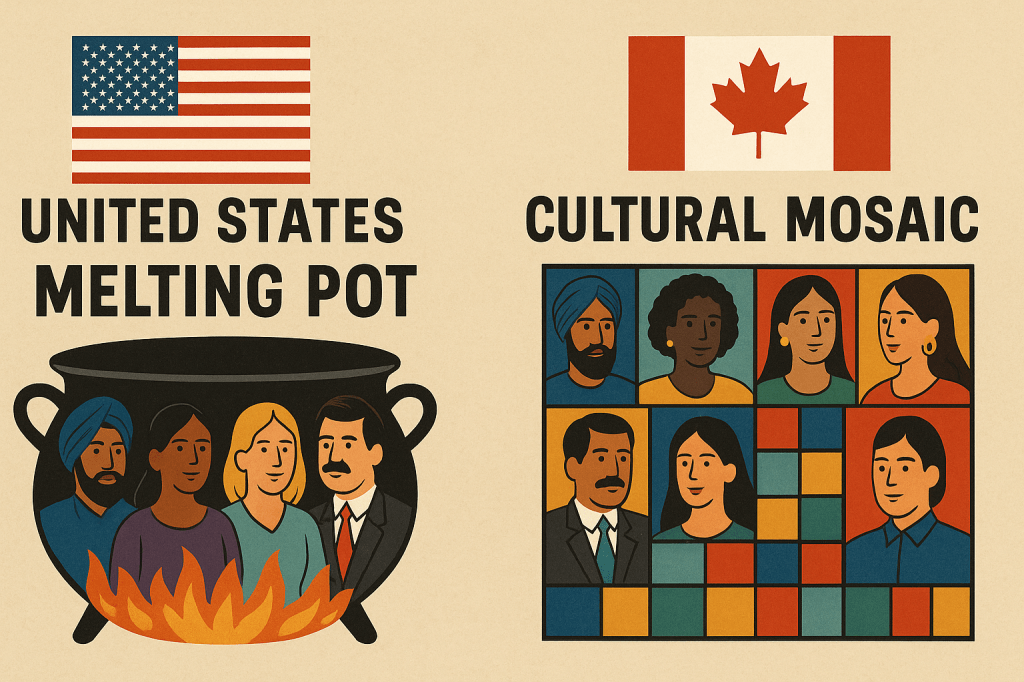
The differences between these two models of integration are profound. In the United States, the expectation is often that newcomers will embrace “Americanness” above all else, whether that means speaking only English, adopting mainstream American customs, or minimizing their ethnic identity in public life. While the U.S. does recognize and celebrate diversity in some respects; Black History Month, Indigenous Peoples’ Day, and the popularity of international cuisines all attest to this, there remains a strong undercurrent that to be truly American, one must fit within a specific cultural framework.

Canada’s approach, by contrast, views multiculturalism as a strength rather than a challenge to national unity. Cities like Toronto, Vancouver, and Montreal are known for their ethnic neighborhoods, where different cultures not only survive, but thrive. Unlike the American approach, which often treats diversity as something to be managed or assimilated, Canada has built institutions that actively encourage it. Government funding for cultural festivals, multilingual public services, and policies that allow dual citizenship all reflect a belief that preserving one’s cultural roots does not weaken Canadian identity, but enriches it.

This difference is especially clear in the way both countries handle language. In the U.S., English is often seen as the primary marker of integration, with political debates regularly emerging over whether Spanish speakers should make greater efforts to assimilate linguistically. Canada, meanwhile, has long recognized both English and French as official languages, and has even extended support for Indigenous and immigrant languages in education and public services.

Ultimately, the American melting pot and the Canadian cultural mosaic reflect two very different visions of national identity. While the U.S. values unity through assimilation, Canada finds strength in diversity itself. Neither model is without its challenges, but the contrast between them speaks to fundamental differences in how these two North American nations define what it means to belong.

Ottawa’s Quiet Revolution: The 15-Minute City and the Rise of Local Commerce on Residential Lots

The City of Ottawa is in the midst of a bold, transformative journey; one that’s reshaping how we live, move, and connect. It’s called the “15-minute neighbourhood,” a simple idea with radical potential.  What if everything you need; groceries, a decent cup of coffee, childcare, your barber, a pharmacy, were just a short walk from your front door? No car required. No long bus rides, just a neighbourhood that works for you.

Ottawa’s New Official Plan, approved in 2021, plants the seeds for this future. At its heart is a commitment to building inclusive, sustainable, and healthy communities. The plan explicitly prioritizes 15-minute neighbourhoods across urban areas, and even pushes for better access to local services in suburban and rural villages. That’s right, this isn’t just a downtown pipe dream. This is city-wide policy.

What’s especially exciting is the quiet, determined push to overhaul the zoning rules that have long governed what can (and can’t) exist in our neighbourhoods. The city is in the thick of writing a new Zoning By-law, and the early drafts reveal a big shift. Residents may soon be able to host small-scale businesses on their own properties. Imagine that, a ground-floor bakery under your neighbour’s apartment, a tiny yoga studio two blocks over, a tailor or vintage shop tucked into a backyard laneway suite. This is no longer just theoretical, it’s in the works.

Ottawa planners are calling these new “Neighbourhood Zones,” and they reflect a sea change in how we think about land use. Rather than rigidly separating residential, commercial, and institutional uses, the city is beginning to embrace a more flexible, mixed-use vision; one that makes space for life to happen more organically. And yes, that means you might be able to open that little business you’ve always dreamed of, without needing to rent expensive storefront space on a commercial strip.

It’s not all roses yet. The first draft of the new by-law has been published, and city staff are collecting public feedback. A second draft is expected in spring 2025, with final council approval tentatively set for fall of the same year. Until then, existing zoning remains in place, but if the final version holds true to its promise, we’ll see the biggest zoning reform Ottawa has seen in decades.

Of course, this kind of change raises questions. Will small businesses in residential zones create noise or traffic? How will parking be handled? Will local character be preserved or diluted? These are fair concerns—and ones the city must address carefully. But the potential benefits are enormous: stronger local economies, reduced car dependency, and vibrant, human-scaled communities.

My regular readers will know that I am a supporter of the 15-minute community. I grew up in NE England where nearly everything we needed on a daily basis was within a 15 min walk, and so I am happy to see that for Ottawa this isn’t just a slogan here, it’s becoming real. And if we get this zoning update right, we may just find ourselves living in a more neighbourly, resilient, and walkable city than we ever imagined.

Ontario’s Healthcare Evolution: From Health Links to Ontario Health Teams

Over the past decade, Ontario’s healthcare system has undergone a quiet, but profound transformation, one that started with a promising pilot, and has grown into a full-scale shift in how care is coordinated and delivered. For those of us watching the system evolve, it’s been a journey from Health Links to Ontario Health Teams (OHTs), with important lessons, growing pains, and renewed hope for more client-centered care.

Back in 2012, the province launched Health Links, a program designed to tackle one of our most pressing challenges: the care of patients with complex, multiple health conditions. These individuals, often seniors, frequently moved between hospitals, doctors’ offices, and community services, repeating their stories at every turn. Health Links aimed to change that by bringing local healthcare providers together to create a single, coordinated care plan for each patient. As part of this program, I co-chaired a Champlain Local Health Integration Network (LHIN) client committee for the region from Arnprior – Ottawa West & South – North Grenville, and we produced a number of strategic presentations, and patient-focused papers that were used to help transform healthcare delivery.  

The Health Links mandate was clear; improve the quality of care, reduce unnecessary hospital use, and make the system more efficient. It worked, at least in part. Coordinated Care Plans (CCPs) helped reduce emergency room visits and made transitions between care settings smoother. Patients reported feeling more supported, and providers began to see the value of collaboration, but as the program grew, so did its limitations. Implementation varied across regions, digital systems didn’t always connect, and Health Links lacked the scale or structure to truly transform the system.

The lessons from Health Links laid the foundation for something bigger. In 2019, Ontario began rolling out Ontario Health Teams, a bold reimagining of how care is delivered. OHTs bring together hospitals, family doctors, long-term care homes, mental health agencies, and other providers under one umbrella. They share budgets, goals, and responsibility for the health of their local populations, and they aim to do what Health Links started, only broader and more sustainably.

As of April 2025, there are 58 OHTs operating across Ontario, each tailored to the needs of its community. Their vision is simple, but ambitious; to offer fully integrated care, where patients don’t fall through the cracks, don’t have to chase paperwork, and don’t have to navigate a fragmented system alone.

Where does Home and Community Care Support Services (HCCSS) fit into all this? As the LHINs were dismantled, their care coordination functions transitioned to HCCSS, which continues to support patients, especially seniors, at home or after hospital discharge. For many, the face of home care hasn’t changed much, and that’s a good thing, as continuity matters.

For Ontarians, especially older adults or those caring for aging loved ones, these changes hold real promise. If your parent is discharged from hospital with a coordinated plan, supported by a team that talks to each other, that’s the system working. If you no longer have to explain your health history to five different providers, that’s integration in action.

Of course, not every region is there yet. Some OHTs are more advanced, some systems still don’t share data well, and some patients are still lost in the shuffle, but the trajectory is promising, and the intent is clear; a more connected, compassionate healthcare experience for everyone.

Ontario has moved from a patchwork of pilot projects, such as the one I was involved with, to a province-wide commitment to collaboration. As we look ahead, the hope is that we not only build on these reforms,but also hold the system accountable to the values that started it all; access, dignity, and care that truly wraps around the patient.

From Work Husbands to Instagram Crushes: Embracing the Messy Beauty of Human Bonds

There’s been a lot of talk lately about “microcheating”, that nebulous zone between platonic friendship and outright infidelity that’s often fueled by digital intimacy. You’ve probably seen the headlines or heard a podcast warn you about the dangers of liking your ex’s selfie or texting a coworker late at night. Critics point to social media as the villain, a tool for secret flirtations and emotional betrayal, but let’s take a breath and be honest; people have always had emotionally rich, complicated connections outside of their primary partnerships. We just used to call them something else.

Take, for example, the decades-old concept of the “work wife” or “work husband.” Long before we were DM’ing heart emojis or watching each other’s stories on Instagram, we were confiding in coworkers, sharing emotional labor, cracking inside jokes, and supporting each other through the grind of daily life. These relationships have always lived in a gray area, close enough to be intimate, but generally understood to stop short of romantic or sexual; and yet, we largely accepted them as harmless, even beneficial. We chuckled at the idea of having “two spouses”, one at home, and one who understands your work stress better than anyone else. No one called it microcheating back then, it was just life.

The moral panic around microcheating today says more about our evolving discomfort with complexity than it does about the relationships themselves. In a world that’s increasingly networked, emotionally porous, and socially dynamic, we are clinging to a monogamous template that often doesn’t serve how we actually live or love. When people form emotional attachments through social media, or deepen their connections with someone outside their marriage, the problem isn’t necessarily the connection, it’s the secrecy, the shame, the absence of clear agreements. If anything, these “infractions” point to a need for more openness, more dialogue, and more room for complexity in how we relate to each other.

As someone who supports and lives polyamory, believing that humans are naturally wired for multiple meaningful relationships, I find it fascinating how society polices these invisible lines. Why is it okay to rely on your “work husband” for emotional validation every day, but suspicious if you develop a deep bond with someone online? Why is one seen as harmless routine, and the other as emotional betrayal? It often comes down to how much control we believe we’re entitled to exert over our partners’ inner lives. Frankly, that control is rarely about love, it’s often more about fear.

The truth is, what is being called microcheating is a symptom of a culture that wants the emotional richness of multiple connections, but refuses to grant itself the language or permission to explore them consciously. People are starving for intimacy, for shared secrets, for someone who listens without judgment. They find it where they can, sometimes in a DM thread, sometimes across the break room coffee machine. Rather than pathologizing these relationships, we should be making space for them. We should be encouraging couples, and moresomes, to talk about what kinds of emotional connections they’re open to, what boundaries feel respectful, and how to share space without falling into surveillance or possessiveness.

In polyamorous circles, we understand that love and connection aren’t zero-sum. My emotional intimacy with one person doesn’t diminish what I share with another, rather it expands my capacity. So when I see the hysteria over someone maintaining a friendship that’s “too close,” I wonder, what would change if we trusted each other more? If we understood that our partners are complex, full-hearted beings who may love more than one person deeply, and that’s not a threat, but a gift?

The rise of microcheating discourse reflects a growing tension between our social conditioning, and our relational reality. Maybe instead of drawing stricter lines, we should be blurring them with intention. Naming the feelings! Creating agreements! Inviting more truth into the room, because whether it’s a work spouse, an online confidante, or someone you just really vibe with over coffee, there’s nothing inherently wrong with emotional closeness. What matters is the integrity with which we hold it.

Attachment Styles: A Pigeonhole for Every Relationship Problem

I wrote this piece in response to a comment from one of my readers.  I hope they like it; it’s a follow up on the post “A Pigeonhole for Every Personality” 

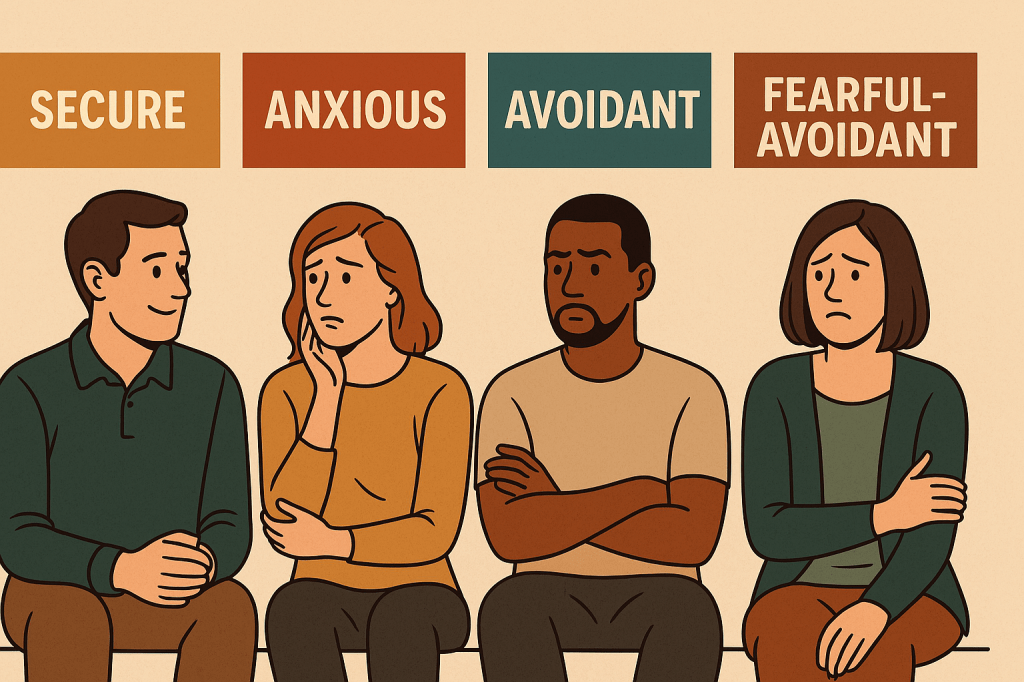
If there’s one thing western society loves almost as much as personality tests, it’s diagnosing relationship dynamics with attachment styles. Suddenly, every awkward text message delay, every weird argument over who forgot to buy oat milk, and every vague feeling of existential dread about love can be neatly categorized into one of four labels: SecureAnxiousAvoidant, or the truly thrilling combo package—Fearful-Avoidant.

It’s like the Myers-Briggs of romance, except instead of deciding whether you’re an introvert or extrovert, you get to figure out whether you cling to your partner like a koala in a windstorm, or bolt for the door the second someone gets emotionally vulnerable.

The concept of attachment styles comes from psychologist John Bowlby, who first theorized that the way we bonded with our caregivers as infants shapes how we approach relationships in adulthood. Sounds reasonable, right? But the internet has turned this into an all-consuming diagnostic tool, where every failed romance is either the fault of an anxious partner texting too much or an avoidant partner texting… never.

The Pigeonholes of Love
Let’s start with the holy grail: Secure Attachment. If you have this, congratulations! You are a unicorn. You text back promptly, communicate your needs like a functional adult, and somehow don’t panic when your partner asks, “Hey, can we talk?” You were probably raised by parents who hugged you at the right times, and never forgot to pick you up from soccer practice. The rest of us admire you, resent you a little, and assume you exist mostly in fiction.

Then there’s Anxious Attachment, a.k.a. the Overthinker’s Club. These are the people who send, “Hey, everything okay?” when you don’t respond within 15 minutes, then follow up with, “Sorry, never mind, ignore me,” followed by, “Actually, I just wanted to check in,” and finally, “I guess you hate me now.” They crave closeness, but also kind of expect to be abandoned at any moment, which makes dating them an emotional rollercoaster with no seatbelts.

On the flip side, we have Avoidant Attachment, the poster child for ghosting. These folks see a heartfelt emotional conversation the way most people see an unsolicited call from their car insurance provider: something to be avoided at all costs. Their love language is “mysterious silence” and they’d rather disappear into the woods than have a deep talk about feelings. Commitment feels suffocating, which is why they often end up dating people with anxious attachment, because nothing says “healthy relationship” like one person desperately clinging, and the other desperately pulling away.

And then, for the truly chaotic, we have Fearful-Avoidant Attachment, also known as “Anxious and Avoidant, Because Why Not?” These individuals desperately want connection but also deeply fear it, making every relationship a high-stakes game of emotional Jenga. They text “I miss you” and then immediately throw their phone into the sea. They want love, but also, love is terrifying. It’s exhausting for everyone involved.

Escaping the Labels
Like every other personality test, attachment styles are useful, until they become a life sentence. Sure, maybe your childhood shaped your relationship habits, but that doesn’t mean you’re doomed to spend eternity analyzing your texts like a forensic scientist. People can change, grow, and even, brace yourself, go to therapy.

So, the next time someone tells you they’re anxiously attached or avoidantly wired, smile, nod, and remember;  nobody fits neatly into a box. Except maybe Secure people. But honestly, who trusts them?

Building the Future: Kemptville’s Affordable Housing Vision

In communities across Canada, the housing crisis has become more than a policy debate, it’s a daily struggle. While costs rise and waitlists grow, the Municipality of North Grenville, just south of Ottawa, is offering a bold response. Its $25 million proposal to convert Bell Hall, a vacant dormitory on the Kemptville Campus, into more than 60 affordable rental units is both practical and symbolic, a microcosm of what’s possible when local governments lead.

The campus itself is a 630-acre hub of community, education, and sustainability activities. Once part of the University of Guelph’s agricultural network, it’s now owned by the municipality and governed by a 2021 master plan that prioritizes adaptive reuse, environmental responsibility, and deep community engagement. Bell Hall fits that vision precisely; a municipally owned, appropriately zoned, fully serviced building, already standing and waiting to be converted.

This is not a speculative plan. Developed over months with input from senior staff and not-for-profit partners, the Bell Hall project targets the real needs of North Grenville’s most vulnerable; seniors, veterans, and working families being priced out of their hometown. It offers not just housing, but stability, dignity, and a sense of belonging.

And yet, despite being shovel-ready, the proposal remains stalled in a growing backlog at the Canada Mortgage and Housing Corporation (CMHC). It’s a familiar story for municipalities across the country, many of whom are reporting delays due to limited federal processing capacity, particularly in underwriting. As federal priorities shift with the political winds, viable projects are left in limbo.

Mayor Nancy Peckford recently sounded the alarm in the Ottawa Citizen, arguing that the issue is not preferential treatment, but systemic inefficiency. Her call for transparency and faster turnaround is resonating with other small communities also ready to build. In an age where housing need is immediate, the logic is simple: when a plan meets all the criteria, and the groundwork is laid, it should move forward.

Some critics are suggesting that municipalities are just now “stepping up” on housing, but local governments have long managed zoning and development approvals. What’s new is the scale and pace of their engagement, assembling land, forming partnerships, applying for federal tools, and leading where senior governments lag.

North Grenville’s approach is part of a broader shift in small-town Canada, where pressures once confined to major cities are now spreading. The housing crisis isn’t urban anymore, it’s national. In this context, Bell Hall becomes more than a local project. It’s a test of the federal-municipal partnership that modern housing policy demands.

There’s also economic logic behind the urgency. A 2023 Deloitte report estimated that expanding community housing could add $70 billion to Canada’s GDP over five years. In places like Kemptville, where growth is manageable and materials can be sourced locally, the multiplier effects are significant with jobs, procurement, community stabilization, and reduced strain on health and social services.

And this is just one community. Rural municipalities across Eastern Ontario are facing similar challenges – aging populations, limited rental stock, and infrastructure that hasn’t kept pace. A regional alliance, or even a coordinated appeal, could elevate the urgency of rural housing and draw more attention to what’s at stake.

North Grenville is ready. Bell Hall is ready. The question is whether the federal system is ready to respond with the speed and seriousness the moment demands. If the next government wants to prove its commitment to housing, here is the perfect place to start.

Identity, Governance, and Privacy: The Controversy Over National IDs

The question of whether governments should mandate compulsory citizen photo identification is a complex one, balancing concerns over security, efficiency, privacy, and civil liberties. Proponents argue that such a system strengthens national security by reducing identity fraud, streamlining public services, and ensuring greater integrity in processes such as voting and law enforcement. Opponents, however, raise concerns about privacy risks, potential discrimination, and the financial and administrative burdens associated with implementation.

One of the strongest arguments in favor of compulsory identification is its role in preventing fraud and enhancing security. A standardized ID system makes it easier to verify identities in a wide range of scenarios, from accessing government benefits to conducting financial transactions. Proponents argue that this not only reduces the risk of identity theft but also ensures that public services reach their intended recipients without duplication or misuse. In the realm of law enforcement, such a system can help police quickly verify identities, track criminals, and even assist in locating missing persons. A national ID could also facilitate international travel within certain regions and improve border security by preventing unauthorized entries.

From a governance perspective, a universal identification system can improve the efficiency of public administration. Countries with well-integrated ID systems often experience fewer bureaucratic hurdles in service delivery, whether in healthcare, taxation, or social welfare. Standardizing identity verification can also strengthen the electoral process by reducing the potential for voter fraud and ensuring that only eligible citizens participate. Advocates suggest that, in an increasingly digital world, a government-issued ID could serve as a foundational tool for secure online verification, further modernizing access to services.

Concerns about privacy and government overreach remain central to opposition arguments. Critics warn that a compulsory ID system could expand state surveillance, allowing authorities to track individuals in ways that may infringe on civil liberties. The centralization of personal data also raises the risk of misuse, whether through state overreach or cyberattacks that compromise sensitive information. Given the increasing sophistication of cyber threats, a national ID database could become a high-value target for hackers, putting millions of people at risk of identity fraud.

Social equity is another significant concern. Some populations, including the homeless, elderly, and marginalized communities, may face barriers in obtaining and maintaining identification, potentially excluding them from essential services. If not carefully designed, an ID requirement could reinforce systemic inequities, disproportionately affecting those who already struggle with bureaucratic processes. Additionally, there is a risk of such a system being used to justify racial profiling or discrimination, particularly in law enforcement contexts.

Beyond ethical considerations, the financial cost of implementing and maintaining a compulsory ID program is substantial. Governments would need to invest in secure infrastructure, database management, and ongoing monitoring to prevent fraud or duplication. Citizens might also bear financial burdens in obtaining and renewing their identification, making it a potential source of economic hardship for some. Critics argue that as digital identification methods become more sophisticated, traditional photo IDs may soon become obsolete, making such an investment unnecessary.

The debate over compulsory citizen photo identification ultimately hinges on whether the benefits of security and efficiency outweigh the risks to privacy, civil liberties, and social equity. Any government considering such a system would need to address these concerns through clear legal safeguards, accessible implementation strategies, and a careful assessment of technological advancements. While a well-designed ID system could offer significant advantages, it must be developed in a way that protects citizens’ rights and ensures broad inclusivity.

North of North – Come for the Seal Meat, Stay for the Sass

Let’s get one thing straight: “North of North” isn’t trying to be flashy. It’s not here for your big-budget drama tropes or your high-speed plot twists. This show rolls in on a Ski-Doo, offers you a cup of tea, and gently roasts you for not wearing the proper boots. And honestly? It’s perfect.

Set in the fictional Arctic community of Ice Cove, the show gives us radio gossip, community tensions, teenage awkwardness, and the kind of aunties who’ll roast you lovingly while handing you leftover caribou stew. The comedy sneaks up on you; dry, sharp, and sometimes so absurdly specific you’ll wonder how they knew about your cousin’s snowmobile getting stuck that one time.

At the heart of it all is Anna Lambe as Siaja, a young Inuk woman who’s back in her hometown trying to figure out life, love, and how not to lose her mind when your ex, your mother, and your new boss are all up in your business. Lambe delivers a performance full of charm, wit, and those subtle eye-rolls that speak louder than words. You root for her even when she’s screwing things up (which she does, delightfully often).

Backing her up is Maika Harper as Neevee, Siaja’s mother and the community’s unofficial Minister of Telling It Like It Is. Harper brings a perfect mix of heart and “don’t test me” energy that makes you want her on your side in any northern showdown, be it over land, love, or the last piece of bannock.

The rest of the cast (many of them fresh faces) bring the town to life in all its glorious, stubborn, sarcastic glory. From ambitious teens and well-meaning radio hosts to gruff mechanics and nosy neighbours, each character feels like someone you want to know. The writing is sharp, but never mean, the jokes land with the weight of a well-thrown snowball, and the community feels real enough that you’ll be checking flights to Nunavut “just to visit.”

And sure, it’s a little rough around the edges. The budget isn’t flashy, the sets are cozy, and the weather never takes a day off, but that’s kind of the point. This is a show that wears its sealskin parka with pride, and isn’t trying to impress you with glitz! It wants to make you laugh, maybe cry a little, and remind you that northern life is full of stories worth telling.

Bottom line? North of North is like a cup of tea after a blizzard; simple, satisfying, and a little bit magic. Watch it for the vibes, stay for the feels, and maybe learn how to make muktuk while you’re at it.

And the good news is that Netflix just announced that they are picking up the second season, while making the first amazing season available this month. 

The Prime Minister’s New Home: A National Symbol Reimagined

For nearly a decade, 24 Sussex Drive has sat in dignified decay; its halls silent, its windows dark. Once the official residence of Canada’s Prime Ministers, it has become a symbol not of leadership, but of limbo. The questions of what to do with 24 Sussex, renovate, rebuild, repurpose, have lingered without resolution, weighed down by political caution and public ambivalence. But perhaps we’ve been asking the wrong question. Instead of struggling to salvage a mid-century home with outdated systems and looming asbestos, it’s time we recognized that this moment calls for vision, not nostalgia. Canada deserves not only a new residence for its Prime Minister, but a bold reimagining of what leadership looks like, and where it lives.

Imagine this, a purpose-built complex that serves as both the official residence and the working headquarters of the Prime Minister of Canada, located on the sprawling grounds of Rideau Hall. This would not be a fortress, nor a vanity project. It would be a national institution, designed for transparency, diplomacy, and sustainability. It would reflect not just the occupant of the office, but the country they serve. Here is a rare opportunity to commission a project that shows the world who we are: a country of bold ideas, architectural excellence, Indigenous respect, recognition of the provinces and territories, and ecological consciousness.

Placing the Prime Minister’s residence and office at Rideau Hall makes both symbolic and logistical sense. It is already the site of Canada’s vice-regal presence and home to state ceremonies, visiting dignitaries, and national celebrations. Integrating the Prime Minister’s quarters into this historic landscape would bring coherence to the ceremonial heart of the nation. It would also enhance security, reduce inefficiencies, and allow for shared infrastructure between the Governor General’s operations and the Prime Minister’s Office. More than that, it would physically express Canada’s model of constitutional democracy: a Prime Minister, not as a distant executive, but as a visible, engaged steward of public trust.

This would be no private enclave. The new complex could feature public spaces: gardens, galleries, viewing areas, where Canadians and visitors could witness history in the making. Designed through an open national competition, the project would draw upon the talents of Canadian architects, builders, and artists. It would foreground Indigenous perspectives, perhaps through partnerships with First Nations designers and knowledge keepers, making reconciliation a structural and aesthetic principle. It could be built to the highest environmental standards, net-zero energy, carbon neutral, and climate resilient, setting a global benchmark for how democratic institutions can lead by example in a warming world.

As for 24 Sussex, it too deserves a future, not as a personal residence, but as a public place. Rather than disappearing behind construction tarps or bureaucratic indecision, it could be reborn as The Museum of Canadian Prime Ministers. There, the lives and legacies of the country’s leaders, visionary and flawed alike, could be explored with nuance and depth. Imagine rooms restored to reflect different eras, immersive exhibits about the crises and triumphs that unfolded within its walls, and interactive installations that encourage civic learning and debate. It would be a museum not of personalities alone, but of ideas and institutions, a place where Canadians could come to better understand the machinery of government, and their role in shaping it.

The cost of doing nothing is not zero. Every year we stall, the price of restoring 24 Sussex climbs, while the image of our national leadership suffers from association with crumbling plaster and political fearfulness. This isn’t about extravagance. It’s about pride, coherence, and nation-building. Other countries, Australia, Germany, the Nordic nations, have constructed modern official residences that reflect their identity and values. Canada can and should do the same.

We’re standing at the threshold of a generational opportunity. Let’s stop asking whether we can afford to build something worthy of our Prime Minister, and start asking what kind of country we want to present, to ourselves and the world. A new residence and office at Rideau Hall, paired with a museum at 24 Sussex, would tell a story of continuity and progress, of humility and ambition. It would turn a political liability into a cultural legacy. And it would say, without apology: this is Canada, and this is what we stand for.

Your Anti-Vax Opinion Is a Public Health Threat

It’s astonishing, and frankly infuriating, that in 2025 we’re still arguing about the value of the measles vaccine. The data is clear, the science is airtight, and yet somehow, vaccine hesitancy continues to chip away at public health. Let me be blunt: the risk of a vaccine like the MMR is vanishingly small compared to the catastrophic potential of a disease like measles. And if you don’t believe that, then you’re either ignoring the data or falling for misinformation. Either way, lives are at risk.

Measles isn’t just a “harmless childhood illness.” That’s a dangerous myth. Measles is one of the most contagious viruses we know, spread through the air, able to linger for hours, and capable of infecting up to 90% of unvaccinated people exposed to it. In well-resourced countries, about 1 or 2 out of every 1,000 children who get measles will die. That’s not a rounding error. That’s a funeral. And it gets worse in poorer regions where malnutrition and limited healthcare access make mortality rates even higher.

And for the kids who survive? About 1 in 20 ends up with pneumonia, 1 in 10 gets a potentially permanent ear infection, and roughly 1 in 1,000 develops encephalitis, a dangerous brain swelling that can cause lifelong disability. Years later, a rare but fatal condition called SSPE can develop from a childhood measles infection, slowly destroying the brain. No cure. No mercy.

Now contrast that with the MMR vaccine. It has been used globally for decades, and it works. Two doses give you about 97% protection. Most people have no side effects at all. At worst, maybe a fever or a mild rash. Some kids, about 1 in 3,000 to 4,000, might experience a febrile seizure, which is scary for parents, but causes no long-term harm. And the odds of a life-threatening allergic reaction? Less than one in a million. In other words, you’re more likely to be struck by lightning. Twice! 

And we’ve seen what happens when vaccine coverage drops. Samoa in 2019 is a tragic case study. After a decline in vaccine confidence, a measles outbreak swept the islands. Eighty-three people died, mostly young children. In Europe that same year, measles cases exploded. More than 82,000 in the WHO European Region, and 72 people dead. In the U.S., the 2019 outbreak saw over 1,200 cases, largely among unvaccinated individuals, threatening the country’s measles elimination status. This isn’t theoretical. This isn’t debatable. It’s what happens when people stop vaccinating.

It’s no surprise that the World Health Organization named vaccine hesitancy one of the top ten global health threats. And it should be, because when you refuse a vaccine, you’re not just making a decision for yourself, you’re putting babies, cancer patients, and immunocompromised people at risk. You’re weakening herd immunity, which is the only thing standing between them and a virus that doesn’t care about your opinions or your YouTube rabbit holes.

Let’s stop sugarcoating it. Vaccines are safe. Measles is deadly. Choosing not to vaccinate isn’t a personal health decision, it’s a public health threat. We’re not debating anymore. We’re fighting ignorance with facts, and if that offends you, maybe it should.