The Quiet Leader: Alberta’s Hidden Role in North America’s Prosperity

In an era of mounting economic uncertainty, geopolitical tension, and post-pandemic recovery, Alberta has quietly emerged as North America’s top subnational performer in a critical and often overlooked metric: the Human Development Index (HDI). For policy watchers and socio-economic analysts, this isn’t just a number to file under “interesting trivia.” Alberta’s position at the top of the HDI rankings among all Canadian provinces, American states, and Mexican territories marks a significant case study in the relationship between natural resource wealth, public policy, and long-term human development outcomes.

As of the most recent figures, Alberta boasts an HDI score of 0.947, narrowly edging out perennial Canadian leaders like British Columbia and Ontario, and standing shoulder to shoulder with wealthy U.S. states like Massachusetts (0.956). The HDI, developed by the United Nations, is a composite measure of life expectancy, education, and per capita income. It is often used as a more holistic gauge of prosperity than GDP alone, as it reflects not only how much wealth a region generates, but how that wealth translates into actual well-being.

Alberta’s strong showing may come as a surprise to some, especially given the narrative often pushed about the province being overly reliant on fossil fuels or politically out of step with the rest of the country, but the truth is more nuanced. Alberta’s prosperity, particularly in the past two decades, has allowed it to make significant investments in healthcare, education, and infrastructure. Its high-income levels have supported strong public services, when policy has aligned with long-term development goals, and its young, well-educated workforce has given the province a demographic advantage. This is not to ignore Alberta’s volatility or the challenges of a boom-and-bust economy, but rather to acknowledge that, when things align, the outcomes can be extraordinary.

Education is a particular strength. Alberta consistently ranks among the top in Canada, and even internationally, in literacy, math, and science scores, according to the OECD’s PISA results. Its public healthcare system, while strained like others across Canada, remains broadly effective and accessible. Meanwhile, high wages, especially in the energy and trades sectors, boost the per capita income metric significantly, even when adjusted for cost of living.

Of course, HDI doesn’t capture everything. Alberta’s Indigenous communities, rural populations, and recent immigrants often experience very different outcomes than the provincial average. Income inequality, climate vulnerability, and questions around economic diversification remain pressing concerns, but as an overall measure of human potential realized, Alberta’s HDI score offers a compelling counter-narrative to those who dismiss it as a one-note petro-state.

The implications of Alberta’s top-tier HDI rating should not be understated. For federal policymakers, it underscores the importance of regional economic engines in lifting national development indicators. For other provinces and territories, it poses a question: what mix of resources, governance, and vision leads to sustained human flourishing? And for Alberta itself, it’s a reminder that the province’s legacy need not be only pipelines and politics, it can also be about how to build a society where people truly thrive.

Mark Carney’s Canada: One Economy, Thirteen Obstacles

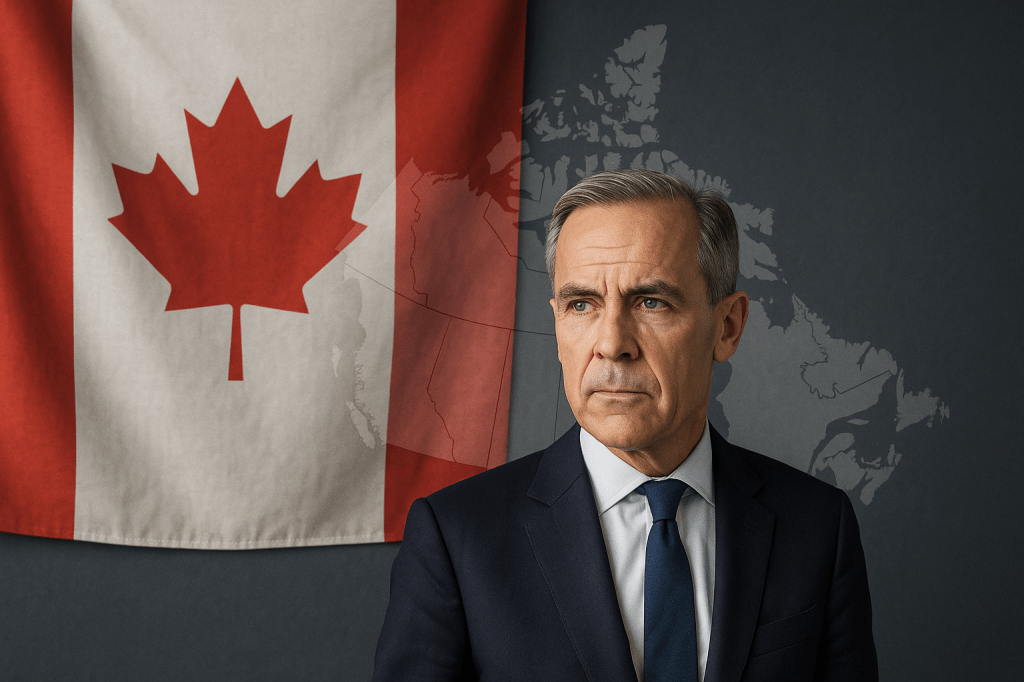
Mark Carney’s call for “one Canadian economy, not thirteen” isn’t just the idle musing of a former central banker with time on his hands, it’s the warning shot of a man who has sat at the helm of two of the world’s most powerful financial institutions and seen, up close, how countries succeed and fail. Carney’s frustration with Canada’s fragmented economic landscape is both practical and philosophical. He knows the potential this country holds – vast natural resources, educated people, global ties, but he also sees how much of it is squandered by a patchwork system where ten provinces and three territories act like neighbouring fiefdoms instead of building blocks of a common national purpose.

The problem, as Carney lays it out, is that Canada often behaves more like a loose confederation of mini-economies, than a modern unified state. Each region guards its turf: labour standards vary wildly, professional credentials don’t always carry across provincial lines, and tax regimes are a bureaucratic maze. Even something as basic as securities regulation, the rules that govern how companies raise money and protect investors, is balkanized, with no single national regulator, making Canada unique among developed nations in all the wrong ways. This isn’t just inefficiency; it’s economic self-sabotage.

Carney has always had a policy wonk’s precision, but in recent years he’s added the rhetorical flair of someone preparing to step onto the political stage. When he talks about the climate transition, for example, he doesn’t mince words: Canada will fail to meet its emissions targets if each province charts its own course. British Columbia might be ahead on carbon pricing, while Alberta and Saskatchewan cling to fossil fuels, and Quebec stands off in its own hydro-powered world. Without a shared strategy, Carney argues, we’re running thirteen separate races instead of pulling together in the global marathon toward sustainability.

Underlying Carney’s vision is a call for greater productivity and global competitiveness. He sees a Canada that could lead in clean energy, advanced manufacturing, digital innovation, but only if it acts in concert. That means building national infrastructure, fixing interprovincial trade barriers (which some federal estimates say cost the economy up to $130 billion a year), and aligning provincial policies on education, investment, and labour force development. It’s not just about growing the economy, it’s about making sure that growth is fair, inclusive, and forward-looking.

Of course, Carney knows the hurdles. This is Canada, after all. The constitution gives provinces enormous authority over key economic levers like natural resources and education. Regionalism runs deep, from the grievances of Western alienation to the distinct society of Quebec. Even the idea of a national strategy can provoke suspicion, seen less as vision and more as Ottawa’s overreach. And the political will to forge consensus is in short supply, especially in an age where short-term gains too often outweigh long-term planning.

Still, Carney keeps beating the drum. His is a voice urging Canada to get serious about itself. To stop coasting on inherited wealth and institutional stability, and start acting like a country that actually wants to lead in the 21st century. Whether as a private citizen, a public thinker, or elected Prime Minister, Carney is pushing us to imagine what Canada could become if it truly operated as one economy, not thirteen.

Sources:
Mark Carney, Value(s): Building a Better World for All (Knopf Canada, 2021)
Government of Canada – Interprovincial Trade Barriers: https://www.canada.ca/en/intergovernmental-affairs/services/barriers-interprovincial-trade.html
Canadian Securities Administrators: https://www.securities-administrators.ca/

Five Things We Learned This Week for April 12 – 18th, 2025

Here’s the inaugural edition of my new weekly segment, “Five Things We Learned This Week,” highlighting significant global events and discoveries from April 12–18, 2025.

🌍 1. Travel Disruptions Across Europe

Travelers in Europe faced significant disruptions due to widespread strikes. In France, the Sud Rail union initiated strikes affecting SNCF train controllers, with potential weekend service interruptions extending through June 2. In the UK, over 100 ground handling staff at Gatwick Airport began a strike on April 18, impacting airlines like Norwegian and Delta. Additionally, approximately 80,000 hospitality workers in Spain’s Canary Islands staged a two-day strike over pay disputes, affecting popular tourist destinations.  

🧬 2. Potential Signs of Life on Exoplanet K2-18b

Astronomers detected large quantities of dimethyl sulfide and dimethyl disulfide in the atmosphere of K2-18b, a planet located 124 light-years away. On Earth, these compounds are typically produced by biological processes, making this the strongest evidence to date suggesting potential life beyond our solar system.  

📉 3. Global Economic Concerns Amid Tariff Tensions

The International Monetary Fund (IMF) and the European Central Bank (ECB) warned of a slowdown in global economic growth due to escalating trade tensions, particularly from recent U.S. tariffs. The ECB responded by reducing its main interest rate for the seventh time this year, citing “exceptional uncertainty.” U.S. markets remain volatile, with the S&P 500 down 14% from February highs.   

🌱 4. Earth Day 2025: “Our Power, Our Planet”

Earth Day on April 22 will spotlight the theme “Our Power, Our Planet,” emphasizing the push for renewable energy to triple clean electricity by 2030. Events worldwide aim to educate and mobilize communities toward sustainable practices and climate action.  

🐺 5. Genetic Revival of Dire Wolf Traits

Colossal Biosciences announced the birth of genetically modified grey wolves named Romulus, Remus, and Khaleesi. These wolves exhibit characteristics of the extinct dire wolf, marking a significant step in de-extinction science and raising discussions about the ethical implications of such genetic endeavors.  

Stay tuned for next week’s edition as we continue to explore pivotal global developments. Question – Should I include a link to some source material with each item or is the summary what you are looking for? 

The Dragon at the Gate: China’s Quiet Reversal of the Peking Accord

It’s a strange sight to behold – the old bear, once feared across continents, now leaning heavily on the dragon, who circles with a slow, calculating grace. Russia, once the hammer of the East, has been brought to heel by a grinding war in Ukraine, and while the West cuts ties and imposes sanctions, China, with the patience of a millennia-old civilization, sees opportunity, not just to profit, but perhaps to reshape history.

There’s a sense of irony that hangs over this moment. In 1860, the Qing dynasty signed the Peking Accord under duress, ceding vast swathes of land to the Russian Empire. That territory, now known as the Russian Far East, includes strategic regions like Vladivostok and the Amur Basin, lands that had once been part of China’s imperial periphery. The Chinese state, pragmatic in diplomacy, but deeply historical in self-conception, has never fully forgotten these losses. While official maps no longer lay claim to those regions, nationalist narratives in China occasionally whisper about redrawing what was once erased.

Fast forward to today, and the tables have turned. The war in Ukraine has battered Russia’s economy, and severed its connections to Europe. In desperation, Moscow has tilted eastward, selling gas, oil, and influence to Beijing at discount prices. This is not a partnership of equals. Russia needs Chinese markets, Chinese currency, and Chinese technology. China, meanwhile, gains leverage with every shipment of discounted crude, and every signed memorandum that ties the Russian economy tighter to the yuan. Where once they competed in Central Asia and the Arctic, now Russia finds itself the junior partner in a relationship it once dominated.

But China’s strategy isn’t conquest, it’s saturation. In the underpopulated stretches of Siberia and the Russian Far East, Chinese traders, laborers, and companies are embedding themselves quietly, but firmly. Towns along the border increasingly do their business in yuan, and many look more to Harbin or Heihe, cities in China’s Heilongjiang Province, than to Moscow. Infrastructure projects, often funded with Chinese capital, and executed by Chinese firms, are weaving a new economic fabric, one that binds these regions more to Beijing than to the Kremlin.

This isn’t a territorial war. China doesn’t need tanks to reverse the Peking Accord. It just needs time, capital, and a weakened Russia with few other friends. What we may be witnessing is not the formal return of lost lands, but something more subtle and enduring; a slow-motion annexation by way of economy, trade, and cultural seepage. A kind of imperial inversion, done not with gunboats, but with invoices and supply chains.

In geopolitics, history never dies, it just waits for the moment when the balance tilts. With every sanctioned ruble, and every Chinese-funded deal, the echoes of the 19th century grow louder. Russia may not yet realize it, but the dragon is already at the gates. Not to conquer, but to reclaim, softly, surely, and without ever having to fire a shot.

A Tale of Two Nations: Why Canada Celebrates Differences While America Seeks Sameness

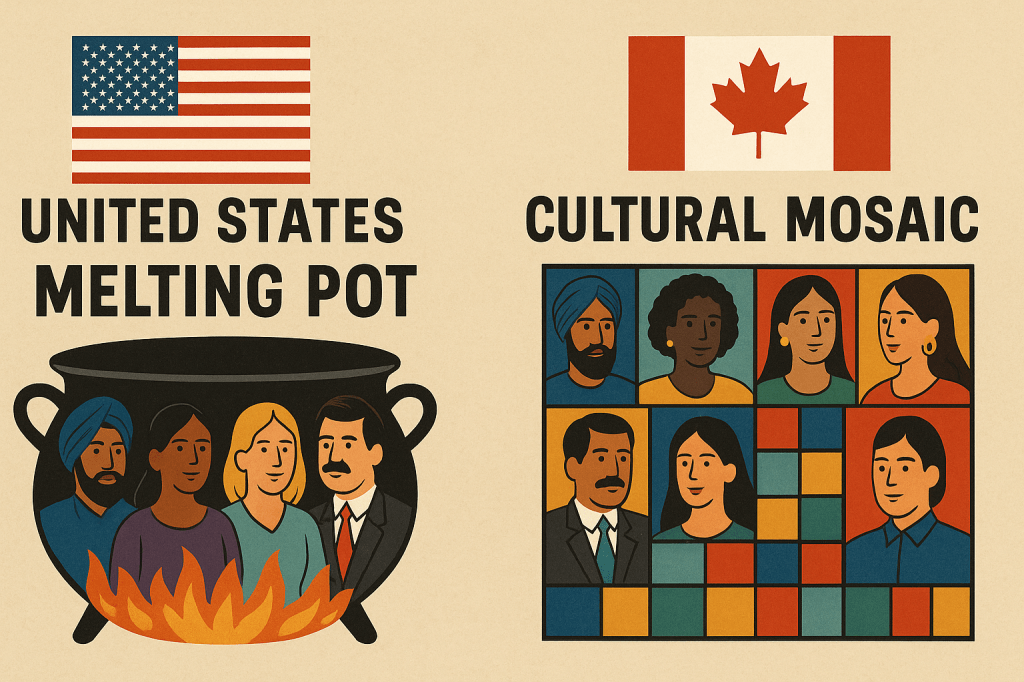
For over a century, the United States has proudly embraced the metaphor of the “melting pot,” a vision in which immigrants from all over the world come together to form a singular American identity. This idea suggests that while people may arrive with distinct languages, customs, and traditions, they are expected to assimilate into a common culture; one that prioritizes English, democratic values, and a shared national ethos. The melting pot is often framed as a symbol of unity, a place where differences dissolve in the service of a greater whole. However, this model has its critics, who argue that it pressures immigrants to abandon their unique cultural heritage in order to conform.

The roots of the melting pot concept can be traced back to Israel Zangwill, a British playwright whose 1908 play The Melting Pot romanticized America as a land where old ethnic divisions would fade away, forging a new, united people. While Zangwill gave the concept its famous name, the push for assimilation had been shaping U.S. policy and attitudes long before. Theodore Roosevelt, the 26th president, was one of its most vocal proponents, arguing that immigrants must fully adopt American customs, language, and values to be considered truly American. The early 20th century saw the rise of the Americanization movement, which reinforced these ideas through public education, labor policies, and civic initiatives. By mid-century, the expectation of cultural conformity had become deeply embedded in American identity, influencing everything from language policies to popular media portrayals of immigrant life.

Canada, on the other hand, has cultivated a different metaphor, that of a “cultural mosaic.” Rather than seeking to merge all cultures into one, Canada actively encourages its people to maintain and celebrate their distinct identities. This approach is not just a social philosophy, but an official policy, first enshrined in 1971 with the introduction of the Multiculturalism Policy by Prime Minister Pierre Elliott Trudeau. Unlike the American melting pot, which emphasizes assimilation, Trudeau’s vision was one of inclusion without erasure. His government recognized that Canada’s growing diversity, particularly from non-European immigration, required a shift in how the country defined itself.

The passage of the Canadian Multiculturalism Act in 1988, under Prime Minister Brian Mulroney, further reinforced this philosophy by guaranteeing federal support for cultural communities, anti-discrimination measures, and the preservation of minority languages. Unlike the U.S., where English is seen as a central marker of national identity, Canada has long embraced bilingualism, officially recognizing both English and French. Additionally, Canada has extended support for Indigenous and immigrant languages in education and public services, further emphasizing its commitment to cultural pluralism.

The differences between these two models of integration are profound. In the United States, the expectation is often that newcomers will embrace “Americanness” above all else, whether that means speaking only English, adopting mainstream American customs, or minimizing their ethnic identity in public life. While the U.S. does recognize and celebrate diversity in some respects; Black History Month, Indigenous Peoples’ Day, and the popularity of international cuisines all attest to this, there remains a strong undercurrent that to be truly American, one must fit within a specific cultural framework.

Canada’s approach, by contrast, views multiculturalism as a strength rather than a challenge to national unity. Cities like Toronto, Vancouver, and Montreal are known for their ethnic neighborhoods, where different cultures not only survive, but thrive. Unlike the American approach, which often treats diversity as something to be managed or assimilated, Canada has built institutions that actively encourage it. Government funding for cultural festivals, multilingual public services, and policies that allow dual citizenship all reflect a belief that preserving one’s cultural roots does not weaken Canadian identity, but enriches it.

This difference is especially clear in the way both countries handle language. In the U.S., English is often seen as the primary marker of integration, with political debates regularly emerging over whether Spanish speakers should make greater efforts to assimilate linguistically. Canada, meanwhile, has long recognized both English and French as official languages, and has even extended support for Indigenous and immigrant languages in education and public services.

Ultimately, the American melting pot and the Canadian cultural mosaic reflect two very different visions of national identity. While the U.S. values unity through assimilation, Canada finds strength in diversity itself. Neither model is without its challenges, but the contrast between them speaks to fundamental differences in how these two North American nations define what it means to belong.

Ottawa’s Quiet Revolution: The 15-Minute City and the Rise of Local Commerce on Residential Lots

The City of Ottawa is in the midst of a bold, transformative journey; one that’s reshaping how we live, move, and connect. It’s called the “15-minute neighbourhood,” a simple idea with radical potential.  What if everything you need; groceries, a decent cup of coffee, childcare, your barber, a pharmacy, were just a short walk from your front door? No car required. No long bus rides, just a neighbourhood that works for you.

Ottawa’s New Official Plan, approved in 2021, plants the seeds for this future. At its heart is a commitment to building inclusive, sustainable, and healthy communities. The plan explicitly prioritizes 15-minute neighbourhoods across urban areas, and even pushes for better access to local services in suburban and rural villages. That’s right, this isn’t just a downtown pipe dream. This is city-wide policy.

What’s especially exciting is the quiet, determined push to overhaul the zoning rules that have long governed what can (and can’t) exist in our neighbourhoods. The city is in the thick of writing a new Zoning By-law, and the early drafts reveal a big shift. Residents may soon be able to host small-scale businesses on their own properties. Imagine that, a ground-floor bakery under your neighbour’s apartment, a tiny yoga studio two blocks over, a tailor or vintage shop tucked into a backyard laneway suite. This is no longer just theoretical, it’s in the works.

Ottawa planners are calling these new “Neighbourhood Zones,” and they reflect a sea change in how we think about land use. Rather than rigidly separating residential, commercial, and institutional uses, the city is beginning to embrace a more flexible, mixed-use vision; one that makes space for life to happen more organically. And yes, that means you might be able to open that little business you’ve always dreamed of, without needing to rent expensive storefront space on a commercial strip.

It’s not all roses yet. The first draft of the new by-law has been published, and city staff are collecting public feedback. A second draft is expected in spring 2025, with final council approval tentatively set for fall of the same year. Until then, existing zoning remains in place, but if the final version holds true to its promise, we’ll see the biggest zoning reform Ottawa has seen in decades.

Of course, this kind of change raises questions. Will small businesses in residential zones create noise or traffic? How will parking be handled? Will local character be preserved or diluted? These are fair concerns—and ones the city must address carefully. But the potential benefits are enormous: stronger local economies, reduced car dependency, and vibrant, human-scaled communities.

My regular readers will know that I am a supporter of the 15-minute community. I grew up in NE England where nearly everything we needed on a daily basis was within a 15 min walk, and so I am happy to see that for Ottawa this isn’t just a slogan here, it’s becoming real. And if we get this zoning update right, we may just find ourselves living in a more neighbourly, resilient, and walkable city than we ever imagined.

Ontario’s Healthcare Evolution: From Health Links to Ontario Health Teams

Over the past decade, Ontario’s healthcare system has undergone a quiet, but profound transformation, one that started with a promising pilot, and has grown into a full-scale shift in how care is coordinated and delivered. For those of us watching the system evolve, it’s been a journey from Health Links to Ontario Health Teams (OHTs), with important lessons, growing pains, and renewed hope for more client-centered care.

Back in 2012, the province launched Health Links, a program designed to tackle one of our most pressing challenges: the care of patients with complex, multiple health conditions. These individuals, often seniors, frequently moved between hospitals, doctors’ offices, and community services, repeating their stories at every turn. Health Links aimed to change that by bringing local healthcare providers together to create a single, coordinated care plan for each patient. As part of this program, I co-chaired a Champlain Local Health Integration Network (LHIN) client committee for the region from Arnprior – Ottawa West & South – North Grenville, and we produced a number of strategic presentations, and patient-focused papers that were used to help transform healthcare delivery.  

The Health Links mandate was clear; improve the quality of care, reduce unnecessary hospital use, and make the system more efficient. It worked, at least in part. Coordinated Care Plans (CCPs) helped reduce emergency room visits and made transitions between care settings smoother. Patients reported feeling more supported, and providers began to see the value of collaboration, but as the program grew, so did its limitations. Implementation varied across regions, digital systems didn’t always connect, and Health Links lacked the scale or structure to truly transform the system.

The lessons from Health Links laid the foundation for something bigger. In 2019, Ontario began rolling out Ontario Health Teams, a bold reimagining of how care is delivered. OHTs bring together hospitals, family doctors, long-term care homes, mental health agencies, and other providers under one umbrella. They share budgets, goals, and responsibility for the health of their local populations, and they aim to do what Health Links started, only broader and more sustainably.

As of April 2025, there are 58 OHTs operating across Ontario, each tailored to the needs of its community. Their vision is simple, but ambitious; to offer fully integrated care, where patients don’t fall through the cracks, don’t have to chase paperwork, and don’t have to navigate a fragmented system alone.

Where does Home and Community Care Support Services (HCCSS) fit into all this? As the LHINs were dismantled, their care coordination functions transitioned to HCCSS, which continues to support patients, especially seniors, at home or after hospital discharge. For many, the face of home care hasn’t changed much, and that’s a good thing, as continuity matters.

For Ontarians, especially older adults or those caring for aging loved ones, these changes hold real promise. If your parent is discharged from hospital with a coordinated plan, supported by a team that talks to each other, that’s the system working. If you no longer have to explain your health history to five different providers, that’s integration in action.

Of course, not every region is there yet. Some OHTs are more advanced, some systems still don’t share data well, and some patients are still lost in the shuffle, but the trajectory is promising, and the intent is clear; a more connected, compassionate healthcare experience for everyone.

Ontario has moved from a patchwork of pilot projects, such as the one I was involved with, to a province-wide commitment to collaboration. As we look ahead, the hope is that we not only build on these reforms,but also hold the system accountable to the values that started it all; access, dignity, and care that truly wraps around the patient.

From Work Husbands to Instagram Crushes: Embracing the Messy Beauty of Human Bonds

There’s been a lot of talk lately about “microcheating”, that nebulous zone between platonic friendship and outright infidelity that’s often fueled by digital intimacy. You’ve probably seen the headlines or heard a podcast warn you about the dangers of liking your ex’s selfie or texting a coworker late at night. Critics point to social media as the villain, a tool for secret flirtations and emotional betrayal, but let’s take a breath and be honest; people have always had emotionally rich, complicated connections outside of their primary partnerships. We just used to call them something else.

Take, for example, the decades-old concept of the “work wife” or “work husband.” Long before we were DM’ing heart emojis or watching each other’s stories on Instagram, we were confiding in coworkers, sharing emotional labor, cracking inside jokes, and supporting each other through the grind of daily life. These relationships have always lived in a gray area, close enough to be intimate, but generally understood to stop short of romantic or sexual; and yet, we largely accepted them as harmless, even beneficial. We chuckled at the idea of having “two spouses”, one at home, and one who understands your work stress better than anyone else. No one called it microcheating back then, it was just life.

The moral panic around microcheating today says more about our evolving discomfort with complexity than it does about the relationships themselves. In a world that’s increasingly networked, emotionally porous, and socially dynamic, we are clinging to a monogamous template that often doesn’t serve how we actually live or love. When people form emotional attachments through social media, or deepen their connections with someone outside their marriage, the problem isn’t necessarily the connection, it’s the secrecy, the shame, the absence of clear agreements. If anything, these “infractions” point to a need for more openness, more dialogue, and more room for complexity in how we relate to each other.

As someone who supports and lives polyamory, believing that humans are naturally wired for multiple meaningful relationships, I find it fascinating how society polices these invisible lines. Why is it okay to rely on your “work husband” for emotional validation every day, but suspicious if you develop a deep bond with someone online? Why is one seen as harmless routine, and the other as emotional betrayal? It often comes down to how much control we believe we’re entitled to exert over our partners’ inner lives. Frankly, that control is rarely about love, it’s often more about fear.

The truth is, what is being called microcheating is a symptom of a culture that wants the emotional richness of multiple connections, but refuses to grant itself the language or permission to explore them consciously. People are starving for intimacy, for shared secrets, for someone who listens without judgment. They find it where they can, sometimes in a DM thread, sometimes across the break room coffee machine. Rather than pathologizing these relationships, we should be making space for them. We should be encouraging couples, and moresomes, to talk about what kinds of emotional connections they’re open to, what boundaries feel respectful, and how to share space without falling into surveillance or possessiveness.

In polyamorous circles, we understand that love and connection aren’t zero-sum. My emotional intimacy with one person doesn’t diminish what I share with another, rather it expands my capacity. So when I see the hysteria over someone maintaining a friendship that’s “too close,” I wonder, what would change if we trusted each other more? If we understood that our partners are complex, full-hearted beings who may love more than one person deeply, and that’s not a threat, but a gift?

The rise of microcheating discourse reflects a growing tension between our social conditioning, and our relational reality. Maybe instead of drawing stricter lines, we should be blurring them with intention. Naming the feelings! Creating agreements! Inviting more truth into the room, because whether it’s a work spouse, an online confidante, or someone you just really vibe with over coffee, there’s nothing inherently wrong with emotional closeness. What matters is the integrity with which we hold it.

Attachment Styles: A Pigeonhole for Every Relationship Problem

I wrote this piece in response to a comment from one of my readers.  I hope they like it; it’s a follow up on the post “A Pigeonhole for Every Personality” 

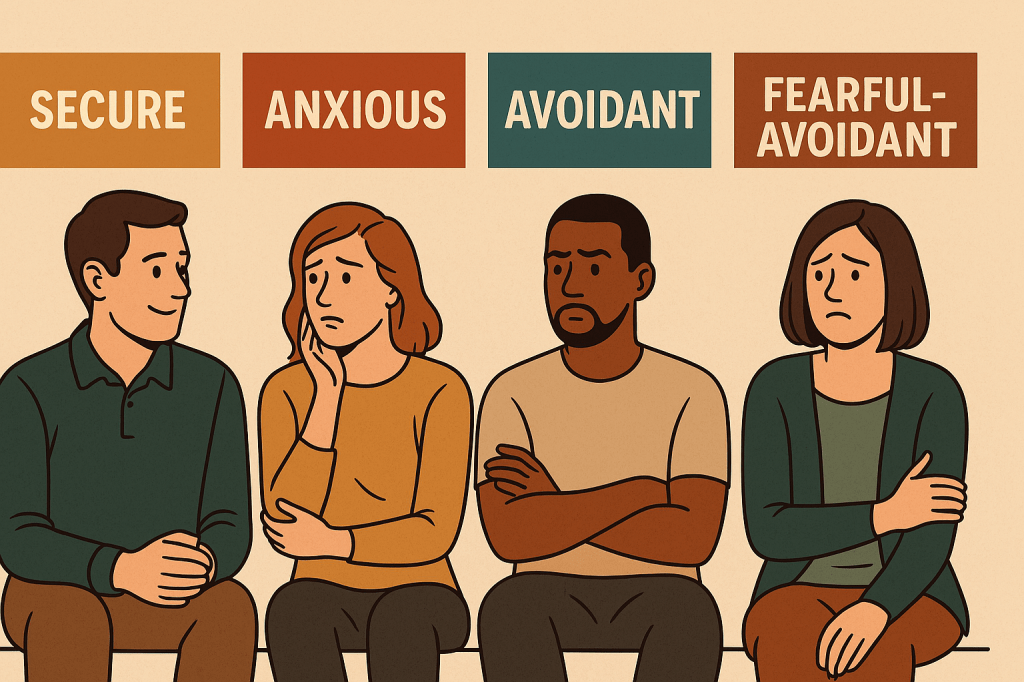
If there’s one thing western society loves almost as much as personality tests, it’s diagnosing relationship dynamics with attachment styles. Suddenly, every awkward text message delay, every weird argument over who forgot to buy oat milk, and every vague feeling of existential dread about love can be neatly categorized into one of four labels: SecureAnxiousAvoidant, or the truly thrilling combo package—Fearful-Avoidant.

It’s like the Myers-Briggs of romance, except instead of deciding whether you’re an introvert or extrovert, you get to figure out whether you cling to your partner like a koala in a windstorm, or bolt for the door the second someone gets emotionally vulnerable.

The concept of attachment styles comes from psychologist John Bowlby, who first theorized that the way we bonded with our caregivers as infants shapes how we approach relationships in adulthood. Sounds reasonable, right? But the internet has turned this into an all-consuming diagnostic tool, where every failed romance is either the fault of an anxious partner texting too much or an avoidant partner texting… never.

The Pigeonholes of Love
Let’s start with the holy grail: Secure Attachment. If you have this, congratulations! You are a unicorn. You text back promptly, communicate your needs like a functional adult, and somehow don’t panic when your partner asks, “Hey, can we talk?” You were probably raised by parents who hugged you at the right times, and never forgot to pick you up from soccer practice. The rest of us admire you, resent you a little, and assume you exist mostly in fiction.

Then there’s Anxious Attachment, a.k.a. the Overthinker’s Club. These are the people who send, “Hey, everything okay?” when you don’t respond within 15 minutes, then follow up with, “Sorry, never mind, ignore me,” followed by, “Actually, I just wanted to check in,” and finally, “I guess you hate me now.” They crave closeness, but also kind of expect to be abandoned at any moment, which makes dating them an emotional rollercoaster with no seatbelts.

On the flip side, we have Avoidant Attachment, the poster child for ghosting. These folks see a heartfelt emotional conversation the way most people see an unsolicited call from their car insurance provider: something to be avoided at all costs. Their love language is “mysterious silence” and they’d rather disappear into the woods than have a deep talk about feelings. Commitment feels suffocating, which is why they often end up dating people with anxious attachment, because nothing says “healthy relationship” like one person desperately clinging, and the other desperately pulling away.

And then, for the truly chaotic, we have Fearful-Avoidant Attachment, also known as “Anxious and Avoidant, Because Why Not?” These individuals desperately want connection but also deeply fear it, making every relationship a high-stakes game of emotional Jenga. They text “I miss you” and then immediately throw their phone into the sea. They want love, but also, love is terrifying. It’s exhausting for everyone involved.

Escaping the Labels
Like every other personality test, attachment styles are useful, until they become a life sentence. Sure, maybe your childhood shaped your relationship habits, but that doesn’t mean you’re doomed to spend eternity analyzing your texts like a forensic scientist. People can change, grow, and even, brace yourself, go to therapy.

So, the next time someone tells you they’re anxiously attached or avoidantly wired, smile, nod, and remember;  nobody fits neatly into a box. Except maybe Secure people. But honestly, who trusts them?

Building the Future: Kemptville’s Affordable Housing Vision

In communities across Canada, the housing crisis has become more than a policy debate, it’s a daily struggle. While costs rise and waitlists grow, the Municipality of North Grenville, just south of Ottawa, is offering a bold response. Its $25 million proposal to convert Bell Hall, a vacant dormitory on the Kemptville Campus, into more than 60 affordable rental units is both practical and symbolic, a microcosm of what’s possible when local governments lead.

The campus itself is a 630-acre hub of community, education, and sustainability activities. Once part of the University of Guelph’s agricultural network, it’s now owned by the municipality and governed by a 2021 master plan that prioritizes adaptive reuse, environmental responsibility, and deep community engagement. Bell Hall fits that vision precisely; a municipally owned, appropriately zoned, fully serviced building, already standing and waiting to be converted.

This is not a speculative plan. Developed over months with input from senior staff and not-for-profit partners, the Bell Hall project targets the real needs of North Grenville’s most vulnerable; seniors, veterans, and working families being priced out of their hometown. It offers not just housing, but stability, dignity, and a sense of belonging.

And yet, despite being shovel-ready, the proposal remains stalled in a growing backlog at the Canada Mortgage and Housing Corporation (CMHC). It’s a familiar story for municipalities across the country, many of whom are reporting delays due to limited federal processing capacity, particularly in underwriting. As federal priorities shift with the political winds, viable projects are left in limbo.

Mayor Nancy Peckford recently sounded the alarm in the Ottawa Citizen, arguing that the issue is not preferential treatment, but systemic inefficiency. Her call for transparency and faster turnaround is resonating with other small communities also ready to build. In an age where housing need is immediate, the logic is simple: when a plan meets all the criteria, and the groundwork is laid, it should move forward.

Some critics are suggesting that municipalities are just now “stepping up” on housing, but local governments have long managed zoning and development approvals. What’s new is the scale and pace of their engagement, assembling land, forming partnerships, applying for federal tools, and leading where senior governments lag.

North Grenville’s approach is part of a broader shift in small-town Canada, where pressures once confined to major cities are now spreading. The housing crisis isn’t urban anymore, it’s national. In this context, Bell Hall becomes more than a local project. It’s a test of the federal-municipal partnership that modern housing policy demands.

There’s also economic logic behind the urgency. A 2023 Deloitte report estimated that expanding community housing could add $70 billion to Canada’s GDP over five years. In places like Kemptville, where growth is manageable and materials can be sourced locally, the multiplier effects are significant with jobs, procurement, community stabilization, and reduced strain on health and social services.

And this is just one community. Rural municipalities across Eastern Ontario are facing similar challenges – aging populations, limited rental stock, and infrastructure that hasn’t kept pace. A regional alliance, or even a coordinated appeal, could elevate the urgency of rural housing and draw more attention to what’s at stake.

North Grenville is ready. Bell Hall is ready. The question is whether the federal system is ready to respond with the speed and seriousness the moment demands. If the next government wants to prove its commitment to housing, here is the perfect place to start.