This is the first in a series of articles on freshwater—our most essential and increasingly fragile resource. Potable water is the foundation of any thriving community, yet it faces mounting threats from rising demand, population growth, mismanagement, and climate change. Water scarcity is no longer a distant concern; it is a present reality affecting billions worldwide, including regions of the United States. The urgent challenge is to adopt sustainable practices and modern infrastructure to ensure long-term water security.
The widening gap between supply and demand is at the heart of the global water crisis. Expanding urban populations and agriculture—by far the largest consumer of freshwater—are pushing resources to their limits. This strain is worsened by inefficiencies such as outdated irrigation techniques and aging, leaky infrastructure that wastes millions of gallons daily. Industrial and domestic waste further degrade freshwater sources, as pollutants like heavy metals, pesticides, hydrocarbons, and microplastics seep into rivers and lakes, transforming them from lifelines into health hazards.
Groundwater depletion is an equally pressing concern. Aquifers, the vast underground reserves that sustain millions, are being extracted at unsustainable rates, often faster than they can naturally recharge. In many regions, these reserves are the sole source of drinking water, making their preservation critical. Overpumping leads to land subsidence, ecosystem damage, and in coastal areas, saltwater intrusion, rendering once-pure water undrinkable. Without intervention, many communities risk losing their most reliable water source.
Climate change amplifies these threats. Shifting precipitation patterns disrupt the natural replenishment of freshwater supplies, while glacier retreat and prolonged droughts further reduce available water. The consequences are most severe in arid and semi-arid regions, where communities already struggle with limited access to clean water. Extreme weather events, such as hurricanes and floods, can also overwhelm infrastructure, contaminating water supplies with pollutants and pathogens.
Addressing these challenges requires a fundamental shift in water management. Advanced technologies such as drip irrigation, wastewater recycling, and desalination offer viable solutions to improve efficiency and expand supply. Equally important is public engagement—education and incentives can promote conservation at the household and community levels. Governments, industries, and local communities must work together to develop policies that prioritize equitable water distribution, pollution control, and long-term sustainability.
Freshwater is our most valuable natural resource, yet it is treated as an afterthought. Without immediate action, shortages will become more frequent and severe, threatening food production, public health, and economic stability. In the coming articles, we will explore the key dimensions of this crisis in greater depth, examining solutions that can secure a sustainable water future.
As our understanding of love and relationships evolves, so too does the way we define intimacy. A concept that’s starting to catch the attention of both relationship experts and storytellers alike is symbiosexuality. While it may not yet be a household term, it offers a new way of thinking about emotional connection, rooted in the biological principle of symbiosis—the mutually beneficial relationship between different organisms. In the realm of love, symbiosexuality suggests that relationships should be rooted in harmony, interdependence, and growth, not just between people, but also between humans and nature, and even between humans and technology.
In today’s dating world, where people are increasingly searching for more meaningful, emotionally fulfilling connections, symbiosexuality offers a model that reflects these desires. Gone are the days of relationships based solely on attraction or shared interests. Today’s singles are looking for something deeper: a connection that nurtures both partners, encouraging emotional and intellectual growth. Symbiosexuality embraces this shift, proposing that love can thrive when both individuals contribute to each other’s flourishing. It’s not about one person being “the other half” of the other, but about both people being whole in their own right, yet stronger together.
Technology has also played a significant role in changing how we form relationships, expanding the boundaries of intimacy far beyond physical presence. The rise of virtual dating, AI companions, and even relationships formed in virtual reality all reflect the growing need for connection that goes beyond the tangible. In this new world of digital love, symbiosexuality takes on a unique form—relationships with AI or virtual partners that are based on mutual emotional fulfillment and support. These connections might seem like something out of science fiction, but they’re becoming more real as technology advances. In some ways, they embody the symbiosexual model by providing companionship that nurtures the emotional well-being of the person, even when it’s not with another human.
At the same time, there’s a growing movement toward non-traditional relationship structures, like polyamory, where people cultivate multiple relationships that meet different needs. This, too, aligns with the idea of symbiosexuality—relationships that form a web of interdependence rather than a single, dependent bond. In polyamory, partners take on different roles, offering everything from emotional support to intellectual stimulation, and in doing so, they create a balanced, symbiotic ecosystem of connection.
Another fascinating aspect of symbiosexuality is how it dovetails with the eco-sexuality movement, which celebrates intimacy with nature itself. As environmental concerns become more urgent, many people are seeking to reconnect with the Earth in a deeply personal way. This trend goes beyond the idea of environmental activism; it’s about seeing nature as a partner, one that sustains and nurtures us. Whether it’s through ritual, activism, or simple acts of mindfulness, eco-sexuality offers a way to deepen our relationship with the planet—a form of love that acknowledges the symbiotic relationship between humanity and the Earth.
The idea of symbiosexuality isn’t just shaping how we date—it’s also influencing how we tell stories. Literature, especially science fiction, is filled with depictions of relationships that challenge traditional ideas of intimacy. In Dune, for example, the relationship between humans and the sandworms is symbiotic—both species rely on each other for survival. Similarly, Octavia Butler’s Xenogenesis Trilogy takes the concept of symbiosis even further, exploring how humans might merge with aliens to create a new, interdependent species. These narratives present love not as something confined to humans but as something that can span species, challenging our conventional boundaries of what intimacy means.
In modern fiction, the relationship between humans and AI also provides fertile ground for exploring symbiosexuality. Kazuo Ishiguro’s Klara and the Sun and Ian McEwan’s Machines Like Me both examine the emotional depth of human-AI relationships. In these stories, AI characters offer a form of emotional companionship that mirrors the symbiotic dynamics of human relationships. This opens up new ways of thinking about intimacy—what if the emotional support we need can come not from another human, but from a machine? These books raise fascinating questions about what it means to connect on a deep, emotional level and whether true symbiosis is possible between human and artificial beings.
But symbiosexuality isn’t confined to speculative fiction; it also appears in the real world. Novels like The Overstory by Richard Powers and Oryx and Crake by Margaret Atwood examine the relationships humans have with the natural world, urging us to rethink our connection with the Earth. These stories echo the central message of symbiosexuality—that love and intimacy can transcend human relationships, extending into our interactions with the environment. In these works, the survival of both humanity and nature depends on a mutually supportive, symbiotic relationship.
As we look to the future of relationships, symbiosexuality provides a fresh perspective on love. It’s no longer just about finding someone who completes us; it’s about forging relationships that allow both partners to grow, thrive, and evolve together. Whether it’s in human relationships, connections with the natural world, or bonds with technology, symbiosexuality challenges us to think beyond traditional ideas of love and intimacy. It asks us to consider how we can build relationships that are not only fulfilling on an individual level but that also contribute to the collective well-being of all involved.
In a world where connection is more important than ever, symbiosexuality offers a model for love that is as dynamic and interconnected as the world we live in. The question now is, as we look ahead, how will we embrace this new vision of intimacy? Will we be open to forging bonds that are less about ownership and more about mutual growth, balance, and care? That’s the essence of symbiosexuality, and it may just be the future of love.
As you reflect on your own relationships, consider this: Who or what in your life helps you grow, and how can you reciprocate that care? In a world that’s constantly evolving, perhaps the key to love lies not in searching for perfection, but in creating a mutually supportive, flourishing connection.
Update When discussing this piece with a partner, apart from it being too long, they felt that the focus on a sexual connection in the term might be limiting. Researchers have a history of mixing up labels for physical sexuality with intimacy and/or romance, and so the term “symbioromantic” or “symbiointimate” may be a more fitting descriptor than “symbiosexual” for relationships where intimacy is deeply rooted in emotional, intellectual, or spiritual connections rather than physical acts. While “symbiosexual” implies a focus on sexual interaction, “symbioromantic” emphasizes the shared emotional growth and interdependence that defines the bond. Romantic intimacy often transcends physicality, centering instead on mutual understanding, care, and the blending of lives in a way that nurtures both individuals. By shifting the focus to the romantic aspect, “symbioromantic” acknowledges that fulfilling, profound connections can thrive even in the absence of physical intimacy, making it a more inclusive term.
Managing both the supply and demand sides of the economy is critical when considering the implementation of a Universal Basic Income (UBI). A well-structured UBI program has the potential to stimulate economic growth and reduce poverty but requires careful planning to avoid inflationary pressures or supply shortages that could undermine its benefits.
On the demand side, UBI directly increases people’s purchasing power by providing a fixed income, thereby boosting consumer spending. Households are better able to meet their basic needs, such as food, housing, and healthcare, while also increasing discretionary spending on non-essential goods and services, including entertainment, travel, and retail. This injection of purchasing power can invigorate various sectors of the economy and drive broader economic activity. However, this surge in demand poses risks. If supply chains cannot adjust to meet the increased demand, inflationary pressures may emerge, especially in sectors with limited capacity, such as housing. For example, stagnant housing supply coupled with heightened demand could lead to skyrocketing rents and property prices. Similarly, inadequate production in critical areas like groceries or energy could result in shortages, exacerbating economic instability. Without safeguards, landlords or businesses may exploit increased consumer spending by raising rents or essential costs like transportation, effectively eroding the benefits of UBI. Rental controls and stable public transportation costs are therefore essential to prevent the market from absorbing the additional income without improving overall living standards.
The supply side of the economy, therefore, plays a pivotal role in determining the success of UBI. Policies must be implemented to ensure that businesses and industries can scale up production to meet heightened demand. Investments in infrastructure, energy production, and manufacturing are necessary to expand capacity and prevent bottlenecks. Labor market dynamics must also be addressed, as UBI may lead some workers to leave low-paying or undesirable jobs, potentially causing shortages in essential industries. To counteract this, governments can support workforce adaptation through investments in automation, technological innovation, and targeted training programs. Additionally, UBI may encourage individuals to pursue entrepreneurial ventures or invest in their education, potentially fostering long-term productivity and economic growth.
Balancing these dynamics requires deliberate strategies. Sustainable funding mechanisms, such as taxes on wealth, corporate profits, or consumption, are essential to finance UBI without undermining fiscal stability. These taxation strategies can also help mitigate inequality by discouraging excessive accumulation or speculative practices that drive economic disparities. To address potential price spikes, temporary measures such as subsidies or price controls on essential goods may be necessary, particularly during the initial rollout of UBI. A phased introduction of UBI, starting with smaller-scale trials, allows supply chains and industries time to adjust, minimizing the risk of economic shocks.
Ultimately, a successful UBI policy requires coordination between the demand and supply sides of the economy. On the demand side, increased consumer spending has the potential to stimulate growth and alleviate poverty. On the supply side, proactive measures must ensure that production and labor markets can adapt to meet the new economic realities without triggering inflation or shortages. By managing these elements in tandem, and by instituting measures like rental control and stable transportation costs to protect consumers, UBI can create a more balanced and inclusive economy, fostering resilience and shared prosperity.
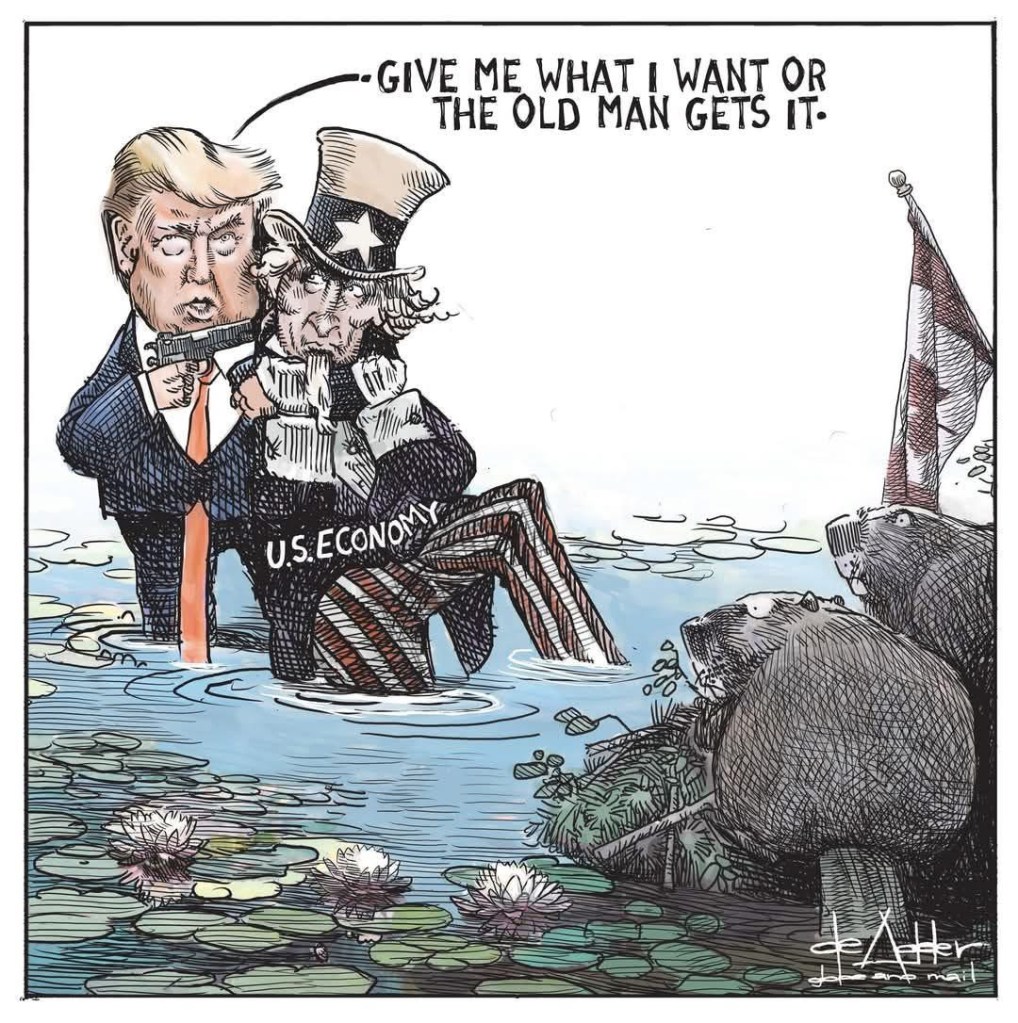
The idea of the United States invading Canada is pure fantasy – fiction that resurfaces when political tensions rise. History has seen conflict between the two nations, notably the War of 1812, but in modern times, such an invasion is not just improbable – it’s impossible. The recent escalation of trade tensions, triggered by the U.S. threat of 25% tariffs on Canadian imports in February 2025, has renewed debate over the state of relations. But let’s be clear: trade disputes don’t lead to tanks rolling across borders.
Canada and the U.S. share the world’s longest peaceful border (8,890 km) and a deeply intertwined economy. Canada is the U.S.’s second-largest trading partner, with trade worth hundreds of billions annually. A military invasion would shatter this economic relationship, triggering global market chaos, retaliatory tariffs, and crippling sanctions. The U.S.-Mexico-Canada Agreement (USMCA) would collapse, devastating American industries and consumers. Even the mere suggestion of aggression would spook markets and alienate key allies, making it a non-starter for even the most hardline economic nationalists.
Yes, the U.S. has the world’s most powerful military. No, that doesn’t mean invading Canada is feasible. Geography alone makes occupation nearly impossible. Vast forests, prairies, and the Rocky Mountains would bog down any invading force. Even during the War of 1812, when Canada was smaller and less industrialized, American forces struggled to maintain supply lines. Today, with modern infrastructure and a well-equipped Canadian military, the challenge would be exponentially greater.
Canada’s armed forces, though smaller than the U.S. military, are highly professional, technologically advanced, and well-integrated into NATO. The moment American troops crossed the border, global condemnation would be swift, and allies, including European powers, would not tolerate such an egregious violation of international law. The U.S. would find itself isolated and facing retaliatory action.
Invading Canada wouldn’t just be a military disaster, it would make the U.S. a global pariah. Canada is one of the world’s most respected nations, known for diplomacy, peacekeeping, and strong alliances. An unprovoked attack would trigger severe sanctions from the EU, UK, and other key trading partners, crippling U.S. banks and multinational corporations. The diplomatic fallout could even fracture NATO.
At home, the American public would reject such a reckless move. Canadians, fiercely proud of their independence, would mount an unyielding resistance. Any occupying force would face guerrilla warfare, sabotage, and mass civil disobedience – turning Canada into another unwinnable quagmire, like Vietnam or Iraq. The political backlash within the U.S. would be massive, with protests and upheaval against a war that serves no legitimate purpose.
Beyond all this, a war with Canada would be a direct threat to North American security. The U.S. and Canada work together through NORAD, jointly protecting the continent. Disrupting this alliance would leave both nations vulnerable to adversaries like China and Russia. In today’s world, power is determined by cybersecurity, economic influence, and technological dominance – not outdated military conquest.
Even in the heat of a 2025 trade war, where tensions are high, the leap from tariffs to military action is absurd. Trade disputes are fought with economic measures, not invasions. The fact that some even entertain this notion is more a reflection of political hyperbole than any serious strategic consideration.
A U.S. invasion of Canada isn’t just impractical – it’s impossible. The economic fallout, military challenges, guaranteed international backlash, and fierce Canadian resistance make it a non-option. The U.S. and Canada have their disagreements, but history has shown that their relationship is built on cooperation, shared values, and mutual benefit. The current trade war will eventually be resolved through negotiation, not war.
So, let’s put this nonsense to rest. Canada isn’t going anywhere. And if anyone thinks otherwise – think again.
I try to live my life grounded in the teachings of Taoism and Zen Buddhism, seeking balance, simplicity, and a deep connection to the present moment. These philosophies shape my approach to the world, helping me navigate life’s uncertainties with grace and mindfulness.
One of the central teachings of Taoism that I try to embody is “wu wei,” which means “non-doing” or “effortless action.” This doesn’t mean passivity, but rather allowing things to happen naturally without forcing or resisting them – or as I like to say “going with the flow”. Lao Tzu wrote in the Tao Te Ching, “The wise man is one who knows what he does not know”. This encourages humility and acceptance, which help me understand that I cannot control everything. For example, when faced with difficult situations—whether it’s a work-related challenge or a personal issue—I remind myself not to overthink or act in haste. By allowing things to unfold and responding with calm, I find that solutions often present themselves more clearly than if I had rushed in with anxiety.
Zen Buddhism, too, plays a crucial role in how I live. One of its core principles is mindfulness, or being fully present in each moment. This has become a daily practice for me, whether I am meditating, walking, or even doing mundane tasks like washing dishes. Zen master Thich Nhat Hanh once said, “When you wash the dishes, wash the dishes,” meaning that in every activity, there’s an opportunity to be mindful. This philosophy encourages me to engage with whatever I am doing, without distraction or impatience. By doing so, I am able to experience even the smallest moments with clarity and peace, rather than letting my mind drift toward the past or future.
Another key lesson from Zen is the idea of “beginner’s mind“. As Shunryu Suzuki explained, “In the beginner’s mind, there are many possibilities; in the expert’s mind, there are few.” I approach life with curiosity and openness, shedding preconceived notions or rigid expectations. For instance, when starting a new project or learning a new skill, I remind myself not to cling to past experiences or compare myself to others. This mindset helps me see each moment as fresh, filled with new opportunities and potential, rather than clouded by fear of failure or attachment to specific outcomes.
These teachings also extend to how I maintain relationships. Taoism teaches harmony with nature and others, while Zen promotes compassion. I strive to let go of judgments—whether of myself or those around me—and instead respond with understanding. As Lao Tzu said, “He who is contented is rich.” By cultivating contentment within, I don’t feel the need to compete with or compare myself to others. I practice empathy, knowing that everyone is walking their own path.
When challenges arise, these philosophies help me embrace change rather than resist it. Both Taoism and Zen emphasize the impermanence of life; everything is in constant flux. This understanding allows me to accept difficult times as part of a larger cycle, trusting that they too will pass.
In living my life through the lens of Taoism and Zen, I find balance, peace, and clarity. By accepting the flow of life and being present in each moment, I cultivate a deeper connection with myself and the world around me. Through simplicity and mindful action, I move through life with a sense of ease and fulfillment.
“The Master in the art of living makes little distinction between his work and his play, his labour and his leisure, his mind and his body, his education and his recreation, his love and his religion. He hardly knows which is which. He simply pursues his vision of excellence in whatever he does, leaving others to decide whether he is working or playing. To him he is always doing both.” – Zen Buddhist Text
Ah, online dating—a wondrous digital land where love blossoms, hearts are broken, and oh no, not another dead fish photo. If you’re dipping your toe into the wild waters of matchmaking apps, let me help you avoid the missteps that send people running for the hills (or just swiping left faster than you can say, “partner in crime”).
Your Kids: The Little Darlings Who Don’t Belong in Your Profile Look, I’m sure your children and dare I say grandchildren are angels (or at least occasionally). But posting their photos in your dating profile—especially as your main picture—can make a potential match think, “Am I auditioning to be a romantic partner or a nanny?” Keep your kids out of the spotlight for now. This is your moment to shine, not theirs.
And while we’re on the topic: if your bio starts with “My kids are the loves of my life,” it’s sweet… but also a bit of a mood-killer. Potential partners might wonder, “Where does that leave room for me?” Save the love declarations for the people swiping right on you.
Stop Copy-Pasting “Hey Beautiful” When someone receives “Hey beautiful” for the 47th time that day, it doesn’t feel special—it feels like a generic coupon for romance. Try something more creative, like referencing their profile. Trust me, “Hey, I see you’re into paddleboarding—do you have a shark-escape plan?” will get you further than bland flattery.
Let Go of the Clichés Speaking of originality, if your bio includes “looking for a partner in crime,” you may as well add, “and I moonlight as a walking, talking dating stereotype.” Everyone’s seen it. Everyone’s rolled their eyes. Be specific about what you want—something that feels uniquely you.
Negativity Is a Buzzkill “Drama-free.” “No toxic baggage.” “Sick of games.” Okay, we get it, you’ve been hurt—join the club! But plastering this all over your profile reads like a giant neon sign flashing BITTER, PARTY OF ONE. Instead, focus on the positives: what you’re looking forward to, what you value, what excites you about the idea of meeting someone new. Optimism is sexy.
“A Nice Lady” (or Gentleman) Requesting a “nice lady” makes you sound like you’re ordering at a diner: “I’ll have the nice lady with a side of vanilla, please.” Instead, describe the qualities that light you up—compassion, humor, confidence, whatever it is. Trust me, nobody’s pining to be described as “nice.”
Let’s Talk About That Fish Unless you’re starring in a reality show called The Bait Whisperer, it’s time to put the bass down and back away slowly. Dead fish photos are a universal “ugh” moment. If you love fishing, mention it in your profile, but swap the fish for a photo of you looking happy and rugged by a lake.
“I’m an Open Book, Just Ask” This one screams lazy. A dating profile is your chance to give people a taste of who you are—not to set them up for a pop quiz. Share a few fun tidbits about yourself. Think of it like leaving breadcrumbs, not a scavenger hunt.
Your Pets Are Cute, But… We all love a good dog or cat pic (seriously, who doesn’t?), but if your entire bio reads like an ode to Fluffy, potential matches may think they’re competing with your fur baby. Keep it balanced—show you have room in your life for both your beloved pets and a partner.
Your Photos Need to Spark Joy If your profile photos include frowning selfies, dimly lit shots, or your ex cropped out of the frame (we can tell, by the way), it’s time for a refresh. Aim for friendly, well-lit, and authentic photos that make people want to grab a coffee with you—or at least swipe right.
Friends or Lovers? Pick a Lane “Looking for friendship first” is like saying, “I’m browsing, not buying.” It’s fine to want to take things slow, but if romance is on the table, don’t bury it under disclaimers. Be clear about your intentions.
Avoid the Pitfalls, Embrace the Possibilities Your online dating profile should feel like a teaser trailer to a movie people actually want to see. Be authentic, positive, and approachable. And above all, remember: the goal is to attract the right match, not scare them off with fish, frowns, or fatal clichés. Now, go forth and swipe wisely!
As we are deep into the February 2025 Ontario election, I thought I might share my vision for the province, which might just be a little wide of traditional thinking for this part of North America, but would help rebalance the out of control neoliberal free-market capitalism we have today.
I personally don’t feel that the New Democratic Party (NDP) is far enough to the left, as it makes too many compromises in order to attract centralist voters, whereas the Democratic Socialists of Canada (DSC) are uncompromising idealists, and politically ineffective. I fall somewhere in between these two parties, taking the best of both, and hopefully crafting a strategic message that’s attractive to others.
Vision The vision for Ontario is one of prosperity and equity, placing the well-being of its citizens at the forefront. This vision emphasizes robust investments in education, social programs, healthcare, and economic infrastructure to foster sustainable growth. The goal is to empower small and medium-sized communities, easing the burden on overpopulated urban centers and promoting regional equity, ensuring that all Ontarians benefit from the province’s future.
Core Pillars of the Mandate The mandate is built upon five core pillars, each aimed at creating a more inclusive, prosperous Ontario. These pillars are focused on empowering citizens through education, improving community well-being, ensuring healthcare accessibility, fostering economic resilience, and promoting decentralized urban planning.
Education for Empowerment A commitment to universal access to high-quality education is foundational. The focus will be on equipping Ontarians with the skills necessary for a modern, equitable economy. This will be achieved by expanding public education funding, particularly in smaller and medium-sized communities, ensuring that schools have access to modern facilities, resources, and technology. To make post-secondary education more accessible, tuition fees will be capped, grants increased, and debt forgiveness programs introduced for students who work in underserved areas. Moreover, lifelong learning programs will be developed to offer free or subsidized adult education and skills-training in emerging industries such as green energy and trades.
Social Equity and Community Well-Being The goal is to build a society that is inclusive and supportive of its most vulnerable populations. Prioritizing affordable housing development in smaller communities will ensure that these areas remain accessible and livable. In addition, social safety nets such as universal childcare, guaranteed basic income pilots, and targeted support for Indigenous, rural, and marginalized communities will be strengthened. Public transit systems will also be expanded in smaller communities to reduce isolation and promote economic integration, ensuring better access to resources and opportunities for all.
Healthcare Accessibility and Innovation Comprehensive healthcare that is accessible to all Ontarians is central to the mandate. Efforts will focus on strengthening local healthcare systems, particularly in smaller communities. By decentralizing healthcare services, the government will build and expand hospitals, clinics, and mental health centers, ensuring that these communities are well-served. Recruitment incentives for healthcare professionals will encourage doctors, nurses, and allied health workers to settle in underserved areas. Additionally, long-term care will be reformed, transitioning to fully public and community-centered models to ensure seniors receive care with dignity.
Economic Resilience and Green Growth The mandate aims to promote sustainable economic growth through targeted investments in local industries and green initiatives. Creating tax incentives and grants for businesses to establish operations in smaller communities will be key to developing these regions economically. Expanding rural broadband to guarantee high-speed internet access will empower remote work, education, and commerce. Support for green industries, including renewable energy, sustainable agriculture, and low-emission manufacturing, will help these smaller regions thrive while contributing to environmental sustainability. Furthermore, worker-focused policies such as a $20/hour minimum wage, strong union protections, and expanded benefits like paid sick leave will ensure fair wages and working conditions across Ontario.
Decentralized Urban Planning Shifting the focus from overburdened urban centers to smaller communities is a central part of the vision. Population redistribution strategies will provide tax benefits and relocation assistance for families and businesses moving to smaller towns. This will be complemented by investments in local infrastructure to improve water, energy, and transportation systems, making these communities more attractive for growth. Moreover, smart city planning will prioritize environmentally conscious and community-driven urban development, curbing urban sprawl and preserving green spaces.
Accountability Framework To ensure the success of these initiatives, an accountability framework will be established. Regional citizens’ assemblies will guide local development, providing a channel for community input and ensuring government responsiveness. Transparent reporting will be maintained, with annual progress reports on education, healthcare, and economic initiatives. Regular equity audits will be conducted to ensure that the benefits of these programs are distributed fairly across rural, Indigenous, and urban populations.
Conclusion The transformative changes outlined in this mandate will be funded through a progressive taxation system. The wealthiest individuals and corporations will contribute their fair share, while tax loopholes and corporate subsidies will be minimized, redirecting billions toward public investments. A modest increase in taxes on luxury goods, high-value real estate, and environmentally harmful industries will also generate revenue while promoting sustainability. Additionally, funding from inefficient urban sprawl projects will be reallocated to support investments in smaller communities. By partnering with federal programs and green investment funds, the province will secure additional resources for vital infrastructure, education, and healthcare reforms, ensuring fiscal responsibility while driving long-term economic growth.
This vision for Ontario is rooted in social democracy, seeking to build a fair, inclusive, and sustainable province by addressing the needs of all its citizens. By prioritizing smaller communities and strengthening public infrastructure, it aims to balance equity with opportunity, ensuring that no one is left behind in Ontario’s future.
I wrote this piece a while back when it became clear that the Labour government wasn’t going to acknowledge the mess that Brexit has left the country, and then planning on doing something about it.
It’s been more than eight years since the UK voted to leave the European Union, and the country remains tangled in the wreckage of that decision. Those who championed Brexit—promising economic renewal, restored sovereignty, and an end to Brussels’ supposed meddling—have either slunk away from public life or now conveniently blame everything, but Brexit itself, for the country’s dismal state. Meanwhile, the UK economy limps along, its political class is in shambles, and its global standing is diminished.
Let’s start with the economy. The Office for Budget Responsibility (OBR) has repeatedly confirmed that Brexit has shaved at least 4% off the UK’s GDP—a staggering hit equivalent to the cost of COVID-19, but without the excuse of a global pandemic. Investment has stalled, businesses struggle with trade barriers, and the labour market is in disarray. The much-touted trade deals—supposedly the jewels of an independent Britain—have been underwhelming at best. The Australia deal, for example, was so lopsided that even its Conservative architect, George Eustice, admitted it was a mistake.
Meanwhile, Britain’s political leadership is paralysed by the Brexit-induced culture war that still defines Tory policy. Rishi Sunak, the latest in a conveyor belt of weak Conservative prime ministers, finds himself hostage to the hard-right fringes of his party, who still cling to Brexit as a nationalist totem. Labour, under Keir Starmer, tiptoes around the issue, unwilling to reopen old wounds but acutely aware that Brexit is a disaster.
And then there’s Northern Ireland. The supposed “solution” to the Brexit border dilemma—the Windsor Framework—hasn’t ended unionist resentment or calmed the waters. Businesses in Northern Ireland enjoy a unique advantage of dual access to UK and EU markets, but politically, the province remains deeply fractured. The Democratic Unionist Party (DUP) continues to throw tantrums over Brexit’s impact, while the broader UK-EU relationship remains one of managed hostility rather than genuine partnership.
In short, Britain is poorer, politically broken, and increasingly irrelevant on the world stage. The great post-Brexit “Global Britain” experiment has failed, leaving a country adrift, governed by a party unable to admit its mistakes and an opposition too cautious to offer real alternatives. And yet, despite mounting evidence of economic self-harm, Brexit remains a political third rail. No major party dares to say what most people now quietly accept: Brexit was a colossal error, and the UK is paying the price.
Winterlude is here, and Ottawans, along with the tourists are really getting their money’s worth this year, with consistent sub-zero temperatures, smooth ice, and new food franchises. This season’s festival clearly demonstrates that Ottawans would rather be out participating in activities, than sitting on uncomfortable plastic seats watching sports.
Ottawa has plenty of things going for it—picturesque scenery, a high quality of life, and more civil servants per capita than just about anywhere else on the continent. But when it comes to sports culture, the capital falls a little flat. Yes, we have professional teams. We have the Senators in the NHL, the Redblacks in the CFL, and a handful of smaller franchises that do their best to keep the local sports scene lively. But despite all this, Ottawa just doesn’t have the rabid, all-consuming sports identity you find in places like Montreal or Toronto.
For starters, the fan engagement here is… conditional. When a team is winning, Ottawa can look like a real sports city. Remember the 2017 Senators playoff run? The entire town briefly got swept up in the excitement—until, of course, the next season, when attendance dropped faster than the team’s fortunes. This isn’t unique to hockey. The Redblacks won a Grey Cup in 2016, and for a brief, shining moment, the city actually seemed to care about the CFL. But before that? The league had already folded two Ottawa franchises due to lack of interest. If your city keeps losing football teams the way most people lose toques, it might not be a sports town.
Hockey is supposed to be the exception, but even that’s complicated here. The Senators have always struggled to build a truly devoted fanbase, and a big reason for that is simple—Ottawa is filled with Leafs and Habs fans. On any given game night at the Canadian Tire Centre, when Toronto or Montreal is in town, it’s just as likely to sound like an away game as a home one. There’s no other NHL city in Canada where this happens. Imagine walking into a Flames game in Calgary and seeing half the crowd decked out in Oilers jerseys. It would be unthinkable. In Ottawa, it’s just another Tuesday.
Part of the problem is that this is a government town. People move here for work, not because their great-grandfather was a Sens fan, and they were born to suffer through rebuilding seasons. There’s no blue-collar sports culture, no generational loyalty to a single team. The fanbase is a mixed bag, and when teams start to lose, the casual supporters disappear.
And if we’re being completely honest, Ottawans are more likely to be playing sports than watching them. Why sit in a half-empty stadium when you could be skating on the Rideau Canal, cross-country skiing in Gatineau Park, or cycling along the Ottawa River? The city’s recreational culture is strong—its spectator culture, not so much.
So yes, Ottawa has sports teams. But is it a sports town? Not really. It’s a town that tolerates sports, one that occasionally gets excited when a team does well, but quickly moves on when they don’t. The real energy here isn’t in the arenas or stadiums—it’s in the coffee shops, the outdoor trails, and, of course, in the never-ending debates over LRT failures and public service policies. And maybe that’s fine. Not every city needs to be a die-hard sports town. But let’s not pretend Ottawa is something it’s not.
Those of you who regularly read my blog, know that I am a huge advocate of public transport, and a critic of the Public Private Partnership developing and operating the capital’s Light Rail Transit (LRT).
Ottawa’s LRT system has been a profound disappointment, a fiasco of engineering failures, political mismanagement, and corporate negligence. Years after its launch, the system remains unreliable, its reputation tarnished by derailments, service disruptions, and public distrust. City officials, despite their best efforts, have failed to restore confidence or implement meaningful reforms. Given this ongoing dysfunction, it is time to consider a serious alternative: uploading the LRT to Metrolinx. A provincial takeover would bring in the expertise, resources, and oversight that Ottawa desperately needs while alleviating the financial strain on local taxpayers.
Metrolinx, despite its own challenges, has experience managing large-scale transit projects across Ontario. The agency has delivered rapid transit systems, expanded GO Transit, and led infrastructure projects that dwarf Ottawa’s troubled LRT. Unlike the City of Ottawa, which has been hamstrung by political infighting and bureaucratic inertia, Metrolinx operates with a broader provincial mandate and access to significantly greater funding. The province already has an interest in ensuring that Ottawa’s transit system is functional—after all, a well-run capital city benefits all Ontarians. Entrusting the LRT to Metrolinx would align Ottawa’s transit with the province’s long-term infrastructure planning, creating opportunities for better integration with intercity rail and bus services.
Financially, the benefits of provincial control are obvious. The LRT has drained Ottawa’s municipal budget, diverting funds away from other pressing priorities such as road maintenance, affordable housing, and social services. The city cannot afford to keep throwing money at a broken system while simultaneously planning for future expansions. If Metrolinx were to assume responsibility, the province would take on a greater share of the financial burden, allowing Ottawa to focus on local transit improvements that fall outside the LRT’s scope. This would not be an unprecedented move—Queen’s Park has already taken over major transit infrastructure in Toronto, such as the subway expansion projects, recognizing that municipal governments simply do not have the fiscal capacity to manage billion-dollar projects alone.
Of course, critics will argue that surrendering local control means sacrificing accountability. But let’s be honest: Ottawa’s local control has not served residents well. The city’s handling of the LRT has been defined by secrecy, questionable decision-making, and a lack of transparency. The provincial government, for all its faults, at least has the ability to intervene decisively when things go wrong. Under Metrolinx, operational standards would be enforced with greater rigor, and the pressure to deliver a functional transit system would be far greater than what we’ve seen from Ottawa City Hall. The public inquiry into the LRT debacle revealed a municipal government that was overwhelmed and, at times, complicit in its own failures. Perhaps it is time to let a more competent player take the lead.
This is not to say that Metrolinx is perfect. The agency has faced its own share of controversies, from cost overruns to delayed projects. But at least it has experience dealing with transit systems on a scale far larger than Ottawa’s. Unlike Ottawa’s municipal government, Metrolinx has the ability to negotiate directly with major infrastructure firms, access provincial funding streams, and bring in technical expertise that the city simply lacks. A takeover would not magically fix everything overnight, but it would place the LRT in the hands of those who at least know how to run a transit system.
The reality is that Ottawa’s LRT is beyond the city’s ability to fix on its own. Metrolinx, with its provincial backing and infrastructure expertise, offers the best hope for a reliable and efficient transit system. Ottawa residents deserve better than what they’ve been given. If that means surrendering local control to get a working train system, then so be it. The LRT was meant to be a transformative project for the city. If Ottawa cannot deliver on that promise, then it’s time to let Queen’s Park step in and do the job properly.