
For most of the postwar era, Canada treated defence dependence on the United States not as a vulnerability but as a convenience. Geography, shared language, integrated command structures, and the comforting mythology of permanent alignment made it easy to believe that continental security was a solved problem. The bill would always be paid in Washington. The industrial base would always be American. Canadian sovereignty, in practical terms, would be exercised mainly through polite consultation. That arrangement delivered peace dividends, but it also produced a quiet atrophy of national capability.
The emerging shift associated with Mark Carney signals a different mood. Not anti-American, not theatrical, simply overdue. Strategic adulthood rarely arrives with fanfare. It arrives when a country realizes that dependence is not the same thing as partnership, and that insurance policies only work if one can pay the premium personally when required.
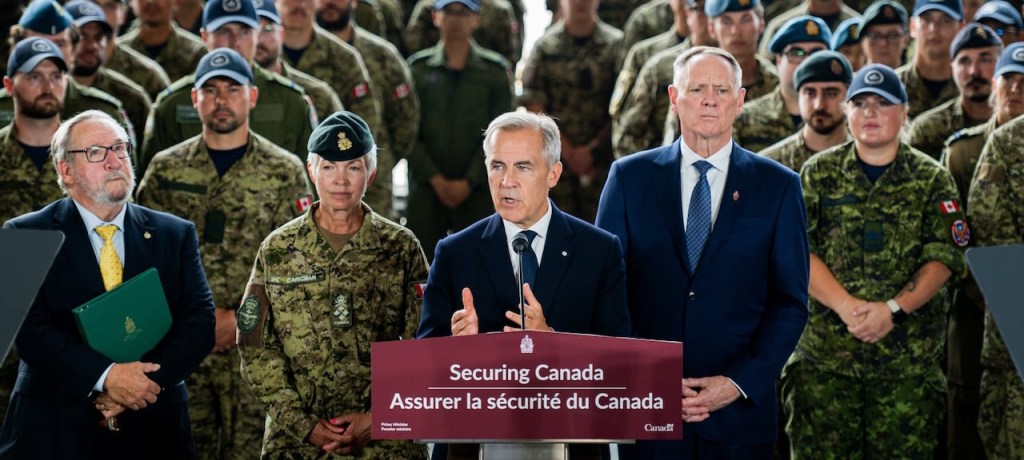
Canada is not uniquely weak, nor uniquely trapped. It is simply a medium-sized power that spent three decades optimizing for efficiency instead of resilience. Defence procurement favored off-the-shelf purchases from the largest supplier. Supply chains stretched across borders because accountants, not strategists, set the terms. Domestic production became episodic, revived only when a crisis or regional jobs program demanded it, then allowed to fade again. None of this was irrational. It was merely short-sighted.
Yet history offers a reminder that capability can be rebuilt when a state decides it matters. During the Second World War, Canada transformed itself into one of the world’s major industrial producers almost overnight, constructing ships, aircraft, vehicles, and munitions at a scale wildly disproportionate to its population. The lesson is not that such mobilization should be repeated, but that industrial capacity is not a natural resource. It is a political decision sustained over time.
Aerospace as Proof of Latent Capacity
Canada’s aerospace sector demonstrates what consistent investment can achieve. Firms such as Bombardier, Pratt & Whitney Canada, Bell Textron Canada, and CAE occupy world-class positions in their niches. Engines designed in Quebec power aircraft on every continent. Flight simulators built in Montreal train pilots from dozens of air forces. These are not symbolic achievements. They are the infrastructure of modern military power, even when marketed as civilian products.
What is striking is not that Canada lacks expertise, but that it rarely organizes this expertise toward sovereign capability. The country produces components for other nations’ systems while importing finished platforms for its own forces. It is the industrial equivalent of exporting lumber and importing furniture. Economically sensible in peacetime, strategically questionable in an era defined by contested supply chains.
Shipbuilding and the Slow Return of Patience
Naval construction tells a similar story. After decades of decline, Canada chose to rebuild shipyards through long-term programs rather than one-off contracts. Irving Shipbuilding and Seaspan are now producing vessels again, slowly reconstituting skills that had nearly vanished. The process has been expensive, imperfect, and frequently criticized. It is also precisely how industrial capacity is restored: by accepting that competence cannot be purchased instantly from abroad.
The deeper lesson is psychological. A country accustomed to buying finished products must relearn how to tolerate development risk, schedule overruns, and the political discomfort of long timelines. Sovereignty is not a subscription service with monthly billing. It is capital expenditure.
None of this implies a clean break from the United States, nor should it. The continental defense relationship is anchored in geography and mutual interest, not sentimentality. Integrated warning systems, intelligence sharing, and joint planning are rational responses to a shared landmass facing the Arctic. What changes is the assumption that Canada must therefore remain permanently industrially subordinate. Allies can cooperate without one being structurally dependent on the other’s factories.
Critics often argue that Canada lacks the scale to sustain a full defense industry. The argument is only half true. No middle power produces everything domestically, including the United States, which relies on global supply chains despite its rhetoric of self-reliance. The real question is not whether Canada can be fully independent. It is which capabilities are too important to outsource indefinitely. Ammunition, surveillance systems, cyber tools, Arctic infrastructure, and logistics resilience fall into that category far more than prestige platforms designed primarily for alliance interoperability.
Economic logic alone will never justify these investments. Autonomy is inefficient by design. Domestic production costs more than bulk purchasing from a superpower. Redundant supply chains look wasteful until the moment they become essential. The decision to proceed anyway reflects a shift from peacetime accounting to strategic accounting, where resilience has value even when it sits idle.
There is also a quiet geopolitical realism behind the change. The United States itself has become less predictable, not necessarily hostile, but increasingly focused on internal priorities and great-power competition elsewhere. Allies are being encouraged, sometimes bluntly, to shoulder more responsibility. Taking that message seriously is not disloyalty. It is compliance.
From this perspective, the move toward greater Canadian defence autonomy feels less like a bold new doctrine and more like catching up with the obvious. A wealthy G7 country with vast territory, critical resources, and Arctic frontage should not rely on external production for core security needs. That it has done so for so long reflects historical good fortune as much as strategic wisdom.
The transition will be slow, uneven, and occasionally frustrating. Procurement systems will resist change. Budgets will provoke domestic debate. Some projects will fail. Others will succeed quietly and receive little attention because resilience rarely makes headlines. Over time, however, a more balanced posture can emerge: one in which Canada remains a committed ally while also possessing the means to act when alliance consensus falters.
In that sense, the prevailing attitude of “about time” is not triumphalism but relief. A mature state does not measure sovereignty by how loudly it proclaims independence, but by how calmly it prepares for the possibility of standing on its own. Moving in that direction now, before necessity turns into crisis, is not alarmism. It is prudence finally outrunning complacency.




 The Rowanwood Chronicles