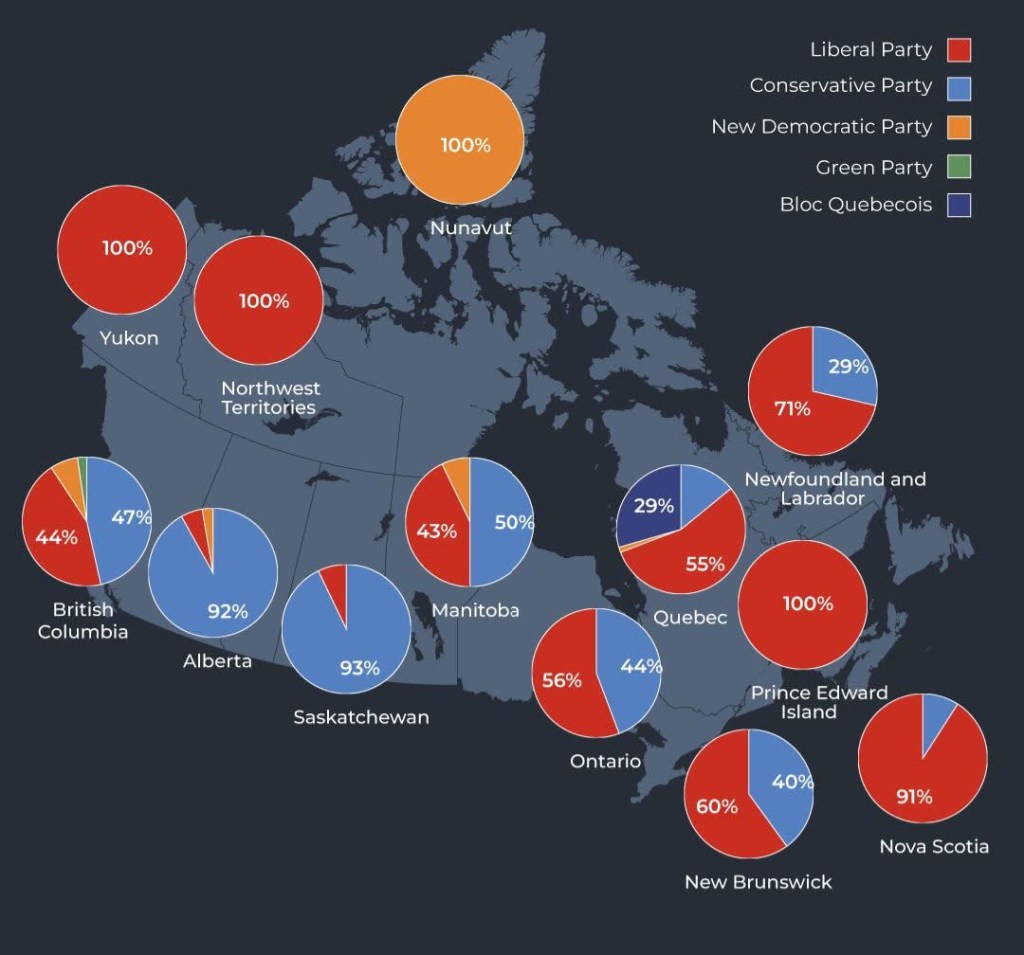
Can the NDP Reclaim Its Socialist Roots?

With the Carney Liberals taking their traditional centralist policy approach to government, is there an opening on the left of the Canadian political spectrum for a truly socialist-leaning party?

The New Democratic Party (NDP) of Canada stands at a defining moment in its history. After years of struggling to maintain relevance in a political landscape increasingly polarized between the Liberals and Conservatives, the party finds itself adrift. The September 2024 decision to terminate its confidence-and-supply agreement with the Liberals was a tacit admission that its previous strategy had failed. Jagmeet Singh justified the move by accusing the Liberals of being “too weak, too selfish, and too beholden to corporate interests.” However, this abrupt shift, triggered by a labor dispute the Liberals chose to override, was as much about salvaging the NDP’s identity as it was about standing up for workers.

This is not the first time the NDP has faced an existential crisis. The party has long struggled to balance its socialist roots with the political realities of an electorate wary of radical change. In the late 1960s, the Waffle movement sought to push the party toward a more explicitly socialist and nationalist platform, only to be exiled from the mainstream. The early 2000s saw a similar push from the New Politics Initiative, which argued the party had strayed too far from its progressive ideals. Both movements failed, and the NDP continued its slow drift toward the center. That drift culminated in Singh’s decision to prop up Trudeau’s minority government; a decision that, while pragmatic, blurred the lines between the two parties and left voters questioning what the NDP actually stood for.

Yet, within living memory, the NDP has proven that it can be more than a third-place protest party. Jack Layton’s leadership from 2003 until his untimely death in 2011 remains the party’s high-water mark, a period when the NDP not only influenced policy, but commanded real electoral momentum. Layton took a party often dismissed as an afterthought and transformed it into the Official Opposition, securing a historic 103 seats in the 2011 federal election. His ability to connect with voters, offering a vision of pragmatic yet principled social democracy, resonated across generational and regional divides. Layton’s optimism, grassroots engagement, and unshakable commitment to progressive values energized Canadians in a way no NDP leader has managed since. His death left the party without a unifying figure, and in the years that followed, the NDP failed to maintain his momentum, squandering what should have been a launching point for greater electoral success.

With the collapse of the Liberal-NDP pact, the party now has a rare opportunity to redefine itself. If the NDP wishes to survive as more than just an opposition voice, it must embrace a bold, distinct platform that prioritizes social justice, labor rights, and public ownership. A genuine return to socialist principles could galvanize its base and attract disillusioned voters from both the Liberals and Greens. However, this transformation cannot be achieved with tired leadership.

Jagmeet Singh, once an energetic and charismatic leader, increasingly appears exhausted and frustrated. His declining support within the party, dropping to 81% in his last leadership review, the lowest for an NDP leader since 2016, signals growing dissatisfaction. If the party is serious about reinvention, it needs new leadership capable of articulating a compelling vision for the future.

Enter Wab Kinew, the newly elected Premier of Manitoba and leader of the Manitoba NDP. Kinew has demonstrated an ability to win elections in difficult political terrain while championing progressive policies. His emphasis on social justice, economic equity, and reconciliation has resonated deeply with voters. More importantly, he has something Singh now lacks: momentum.

But would Kinew be willing to make the jump to federal politics? His recent victory in Manitoba suggests he is invested in provincial leadership for the foreseeable future. Nevertheless, his name is already circulating in discussions about the NDP’s future. If not Kinew, the party must at least look for someone with his level of dynamism and credibility.

With the 2025 federal election results now in, and the party must decide: does it want to be a serious political force, or just a historical footnote? If the NDP is to survive, it must remember what Layton taught it, bold leadership, a clear progressive message, and the courage to fight for real change. Without these, the party’s future will remain uncertain, its best days forever in the past.

Cameron Davies and the Rise of Alberta’s Republican Right: An American Echo in Western Canada

The emergence of the Republican Party of Alberta (RPA) on the political stage is more than just another footnote in the long tale of Western alienation, it’s a calculated, ideologically driven attempt to redefine Alberta’s place not just within Canada, but in the broader North American political culture. At its centre stands Cameron Davies, a seasoned conservative strategist whose own political evolution mirrors the rightward lurch of the party he now leads.

The RPA was officially registered with Elections Alberta in January 2024, marking the latest effort to unite various hard-right and sovereigntist factions that have cycled through Alberta politics over the past decade. It inherited the legacy of groups like the Wildrose Independence Party and Wexit Alberta, which had captured the imagination of disillusioned voters but failed to sustain momentum. The new branding, “Republican” in name and nature, signals a stark ideological shift. It’s not just about independence anymore; it’s about importing the ethos of American-style conservatism, down to the MAGA-hued slogans and policy choices.

When Cameron Davies was acclaimed as leader in April 2025, the party’s intentions crystallized. Davies, a former backroom operator for the Wildrose and United Conservative Party (UCP), is best known for his role in the controversial “kamikaze” campaign during the 2017 UCP leadership race. That episode, which sought to undermine Brian Jean in favour of Jason Kenney, resulted in Davies being fined $15,000 for obstructing an election investigation. Though bruised by scandal, he remained a prominent figure in conservative circles until he publicly resigned from the UCP in 2025, accusing it of corruption, entitlement, and ideological betrayal.

His resignation letter read like a manifesto, a rejection of institutional politics in favour of what he described as grassroots conservatism, though critics might call it a hard-right insurgency. Davies’ departure was both strategic and symbolic. He positioned himself as the torchbearer of the “real right” in Alberta, unencumbered by the compromises of power that had come to define Danielle Smith’s increasingly centrist UCP government.

Under Davies’ leadership, the RPA has embraced a platform that reads like it was drafted in a red-state Republican think tank. There’s the call for a binding referendum on Alberta independence, followed by a non-binding vote on joining the United States. There’s strong rhetoric about parental rightsreligious freedom, and gun ownership, coupled with opposition to “woke” policies like diversity, equity, and inclusion (DEI) programs. Carbon taxes, public healthcare, federal immigration policies—these are all painted as signs of moral and fiscal decline, to be swept away by a new order rooted in faith, family, and “freedom.”

If this sounds familiar, it’s because it is. Davies has openly fashioned himself in the mold of American populist leaders. His social media presence references his military background (“Marine”), his patriotism, and his adherence to traditional values. He speaks of Canada, especially under Liberal governments, in the kind of dire terms more commonly heard on Fox News than in Canadian legislatures. For Davies, Ottawa is not just a political rival; it is a moral adversary, and Alberta must be rescued from its grasp.

There is no hard evidence yet of direct ties between Davies and the machinery of the American right, no funding pipelines, no visits to CPAC (yet), no endorsements from U.S. figures. But the ideological alignment is unmistakable. The RPA’s aesthetics, policy priorities, and culture-war messaging are all deeply influenced by the Make America Great Again (MAGA) movement. It is a party that sees itself less as a provincial player and more as a cultural movement, seeking to spark a broader populist awakening.

Davies’ recent moves show that this isn’t just rhetorical posturing. In May 2025, the RPA signed a Memorandum of Understanding with The Independence Party of Alberta, forming a loose coalition aimed at consolidating the separatist vote. The message is clear: there is no room anymore for fragmented protest parties. To mount a serious challenge to the UCP and, by extension, the federal order, the independence movement must speak with one voice, and Davies intends to be that voice.

The question now is whether the Republican Party of Alberta will become a formidable political force, or simply another flare in Alberta’s long-burning bonfire of right-wing discontent. The UCP has already learned, painfully, what happens when the right fractures. The Wildrose-PC split in the early 2010s handed the NDP a surprise victory in 2015. That memory is still fresh, and it was precisely what motivated the formation of the UCP as a big-tent conservative party in 2017.

Yet that tent is fraying. Many rural voters feel the UCP has compromised too much on issues like education, healthcare privatization, and provincial sovereignty. The RPA, with its unapologetically radical platform, offers them an alternative, a place where the message isn’t diluted by political pragmatism. Davies has a keen understanding of this tension, and he’s betting that enough Albertans are tired of half-measures and ready to blow the whole system up.

But winning a few headlines and gaining traction in the echo chamber of social media is one thing; winning seats is another. The RPA currently has no MLAs. Its organizational infrastructure is limited. Unless a high-profile defection occurs or it pulls off an upset in a by-election, the party remains on the fringe. Moreover, its overtly American positioning, especially the proposal to join the U.S., may strike even sympathetic voters as unserious or dangerously naive.

Canadians, after all, are not Americans. While cultural conservatism resonates in parts of Alberta, many still value universal healthcare, peacekeeping diplomacy, and the Charter of Rights and Freedoms. The RPA’s invocation of U.S.-style populism could ultimately alienate more voters than it attracts, especially if it becomes associated with the chaos and polarization of American politics.

Still, it would be unwise to dismiss Cameron Davies and the RPA out of hand. They are tapping into something very real: a deep and growing disillusionment with traditional politics, a sense of cultural siege, and a yearning for bold, even revolutionary change. Whether that can be translated into electoral success remains uncertain, but the message is loud and clear: the populist right in Alberta is no longer content to sit on the sidelines. And under Davies’ leadership, it’s ready to speak with an American accent.

The Liberal Party’s New Power Struggle: Carney vs The Old Guard

Now that Mark Carney has won the 2025 federal election, and as Prime Minister, named his new cabinet, his ability to navigate the internal politics of the Liberal Party will be just as crucial as his capacity to govern the country. While Carney’s experience as Governor of the Bank of Canada and later the Bank of England gives him credibility as a skilled economic manager, political leadership is an entirely different challenge. Government is not just about making rational policy decisions; it is about managing competing egos, regional interests, and the internal factionalism that defines any major political party. The question is whether Carney, a newcomer to elected politics, can withstand the pressures of a party where everyone wants a piece of the action.

One of Carney’s greatest strengths is his ability to operate within complex institutions, where navigating bureaucracy and political sensitivities is essential. However, the Liberal Party is not a technocratic body, it is an organization with entrenched factions, long-standing rivalries, and individuals who expect rewards for their loyalty. A Prime Minister must act as both leader and power broker, ensuring that key players feel valued while still asserting control over the direction of the government. If Carney fails to grasp this dynamic early on, he risks being seen as an outsider unable to command the loyalty of his own caucus.

A major test will be how he handles the various factions within the party. The Liberals are not a monolithic entity; they consist of a progressive wing that leans heavily on social justice issues and a centrist bloc that prioritizes economic pragmatism. There are also strong regional interests at play, particularly from Ontario and Quebec, where powerful party figures hold significant influence. A successful leader must strike a balance, ensuring that no single faction feels alienated while maintaining a clear sense of direction. If Carney leans too heavily into one camp, especially if he is seen as overly technocratic at the expense of political instinct, he risks internal dissent.

Another potential challenge is dealing with the remnants of Trudeau’s inner circle. If Carney takes the leadership, it will not necessarily mean the party’s Trudeau-era power structure disappears overnight. There will be long-time MPs and advisers who built their careers under Trudeau’s leadership and may not be quick to embrace Carney’s vision. Some may resist his authority outright, while others could quietly work against him if they feel sidelined. Managing this transition will require careful maneuvering, if Carney fails to integrate these figures into his team in a way that acknowledges their influence, he could find himself facing internal power struggles before he even settles into office.

Cabinet appointments announced today will be an early indicator of whether Carney understands the importance of political management. Every successful leader knows that forming a cabinet is not just about qualifications; it is about rewarding allies, neutralizing threats, and ensuring regional representation. If Carney takes a purely meritocratic approach, appointing ministers based solely on expertise rather than political necessity, he could alienate those who expect a return on their loyalty. The most effective prime ministers understand that governing is about both competence and coalition-building; failing to strike that balance can quickly lead to discontent within caucus.

Beyond Parliament Hill, Carney will also need to connect with the party’s grassroots. The Liberal base consists of volunteers, donors, and riding association leaders who expect their voices to be heard. Carney’s reputation as an elite, internationalist figure could work against him if he does not make a concerted effort to engage directly with these groups. If he is perceived as distant or disconnected from the party’s rank and file, he could struggle to maintain cohesion within the Liberal movement. Trudeau, for all his faults, had a deep personal connection with the party’s grassroots, something that sustained him through difficult periods. Carney will need to build that relationship from scratch.

Like any new leader, Carney will face an early test, a moment that defines his ability to command respect and authority within his party. Whether it is a scandal, an economic crisis, or a policy misstep, how he handles that first major challenge will set the tone for his leadership. If he shows strength and decisiveness, he could solidify his position within the party. But if he falters, doubts about his leadership will begin to fester, potentially leading to deeper internal divisions.

Ultimately, Carney’s success will hinge on his ability to adapt. He has the intellectual firepower and the institutional experience, but politics is a game of relationships, instincts, and survival. If he can master that side of the job, he could thrive. If not, he risks becoming yet another promising leader undone by the very party that brought him to power.

AUKUS: Australia’s Submarine Mirage and the Real Estate Windfall for the US and UK

This is the third in a series of posts discussing U.S. military strategic overreach. 

By any sober assessment, the AUKUS agreement is fast revealing itself not as a bold leap forward for Australian sovereignty or security, but rather as a strategic sleight of hand that gifts the United States and United Kingdom a plum prize: a deep-water Pacific base on a silver platter, without any credible assurance that Australia will ever take possession of a single operational nuclear-powered submarine.

At the heart of the matter is the glaring asymmetry in commitments. Australia is shoveling billions of taxpayer dollars, $4.6 billion and counting, into American shipyards and infrastructure while simultaneously preparing HMAS Stirling to host a rotating force of U.S. and British attack submarines as early as 2027. This “Submarine Rotational Force West” isn’t a sovereign fleet, it’s a permanent allied presence on Australian soil, marketed as “partnership,” but shaped overwhelmingly to suit U.S. Pacific ambitions.

Meanwhile, the so-called promise that Australia will receive at least three Virginia-class submarines from the United States remains riddled with legal escape hatches. Congressional legislation passed in 2023 mandates that the U.S. President must provide certification, a full nine months in advance of any transfer, that the move won’t compromise American naval readiness or foreign policy interests. Let’s be clear: this is not a contractual obligation; it’s a political permission slip, one that can be revoked, postponed, or buried under the weight of domestic American priorities at any time. With the U.S. submarine industrial base already overstretched and multiple U.S. senators flagging their concern that sending boats to Australia would weaken the American fleet, the odds are increasingly stacked against Canberra ever seeing these vessels.

Even former Australian Prime Minister Malcolm Turnbull has voiced sharp criticism of the deal, warning that it hands over operational control and strategic autonomy without receiving tangible capability in return. He’s right. As it stands, Australia’s “fleet of the future” is a geopolitical ghost, plausible on paper, dependent on Washington’s whim, and potentially decades away from delivery, if ever.

What Australia is getting, whether it asked for it or not, is an expanding foreign military footprint. The infrastructure being developed in Western Australia will support not Australian submarines, but American and British ones. It’s a curious form of defense procurement when the hardware arrives with foreign flags, foreign crews, and foreign command structures.

And let’s not forget the strategic optics: the U.S. has long wanted a more secure western Pacific presence, particularly as tensions with China escalate. With AUKUS, Washington gets a fortified naval hub in the Indian Ocean gateway without needing to build one from scratch or navigate the domestic pushback that would come with establishing such a base on U.S. territory.

In effect, Australia is underwriting the expansion of U.S. power projection in the Indo-Pacific while receiving, in return, little more than a handshake and a set of talking points about “interoperability” and “shared values.” This is not sovereign defense policy, it’s strategic dependency by design.

Until firm, non-revocable delivery timelines and control guarantees are put in place, AUKUS remains a masterclass in one-sided alliance politics. And unless Canberra wakes up to the hard truths of this arrangement, we may look back on this as the moment Australia paid handsomely to give away a base and got nothing but promises in return.

Sources
• ABC News Australia. “AUKUS legislation passes US Congress.” https://www.abc.net.au/news/2023-12-15/aukus-legislation-passes-us-congress-house-senate/103232048
• PS News. “US Congress approves AUKUS submarine technology transfer.” https://psnews.com.au/us-congress-approves-transfer-of-aukus-submarine-technology-to-australia/124954
• Sky News. “US Senators warn AUKUS deal is zero-sum game for US Navy.” https://www.skynews.com.au/world-news/us-senators-warn-joe-biden-that-submarine-aukus-deal-is-zerosum-game-for-us-navy/news-story/d74767e519b13602bc35d5a0717f2704
• Reuters. “US starts to build submarine presence on strategic Australian coast.” https://www.reuters.com/business/aerospace-defense/us-starts-build-submarine-presence-strategic-australian-coast-under-aukus-2025-03-16/
• News.com.au. “Malcolm Turnbull’s savage AUKUS takedown.” https://www.news.com.au/national/politics/former-prime-minister-malcolm-turnbull-says-aukus-deal-unfair-to-australia/news-story/6c3dcce602bb751fece0f8e4ef856054

The Shifting Dream: White Masculinity and their Receding Grip on North America’s Future

For centuries, the mythology of the “American Dream” (and its Canadian cousin) was powered by the image of the self-made white man; rugged, determined, and in control. From the frontier and the factory floor to the boardroom and ballot box, the narrative of national progress was long centered on white male ambition, but in the 21st century, that dominance is waning. Not because others are taking what doesn’t belong to them, but because they are finally accessing what always should have been shared.

Demographically, socially, and economically, North America is being reshaped by waves of migration, changing gender roles, Indigenous resurgence, and increasing racial and cultural diversity. Women, racialized people, queer folks, and immigrants are not just contributing, they are leading. From startup culture and environmental activism to political office and artistic innovation, the stories being told and the power being wielded are increasingly non-white and non-male.

Yet, as these shifts accelerate, many white men are experiencing something they have rarely encountered at a cultural level: loss of centrality. For generations, society reinforced that whiteness and maleness were the default, everything else was “other.” Now, with those defaults being questioned and dismantled, entitlement is showing its teeth. There is a growing chorus of grievance, often manifesting in reactionary politics, internet subcultures, and movements that call for a return to a mythical past when “men were men” and “America was great.”

The trouble is that entitlement doesn’t vanish when equity rises. Many white men have come to see fairness as persecution, mistaking equality for displacement. They are not just angry at being excluded, they are angry that inclusion requires them to share space, status, and resources. This is especially evident in education, employment, and media representation, where more equitable hiring practices, affirmative action, and inclusive storytelling are viewed not as progress but as threats to traditional dominance.

Some of this backlash is economic. Working-class white men, especially those displaced by globalization and automation, have seen their livelihoods and identities eroded. But the narrative they are often sold isn’t one of class solidarity, it’s one of racial and gender resentment. Politicians and pundits have weaponized their frustration, redirecting legitimate grievances toward scapegoats rather than structural inequity.

Still, the future is not about erasure. It is about redefinition. White men, like everyone else, have the opportunity to take part in a broader, more inclusive vision of what it means to thrive in North America. But it requires humility, self-reflection, and a willingness to let go of inherited privilege. The dream hasn’t died, it’s just no longer theirs alone.

If white men can move from entitlement to empathy, from dominance to solidarity, they can be part of a future that is richer, fairer, and more sustainable. If they cling to the fading illusion of supremacy, they will find themselves shouting from the sidelines of a dream that has moved on without them.

Unforced Errors: How the Conservatives Undermined Their Own Campaign

The Conservative Party of Canada (CPC) faced a significant defeat in the 2025 federal election, despite early leads in the polls. Several factors related to their platform and campaign strategy contributed to this outcome.

Ideological Ambiguity and Policy Reversals
Under Pierre Poilievre’s leadership, the CPC attempted to broaden its appeal by moderating positions on key issues. This included adopting a more serious stance on climate change and proposing policies aimed at working-class Canadians. However, these shifts led to confusion among voters about the party’s core principles. The rapid policy changes, especially during the short campaign period, made the party appear opportunistic and inconsistent.  

Alienation of the Conservative Base
The CPC’s move towards the center alienated a portion of its traditional base. This disaffection contributed to the rise of the People’s Party of Canada (PPC), which saw its vote share increase significantly. Many former CPC supporters shifted to the PPC, attracted by its clear stance on issues like vaccine mandates and opposition to carbon taxes. This vote splitting weakened the CPC’s position in several ridings.    

Controversial Associations and Rhetoric
Poilievre’s perceived alignment with hard-right elements and reluctance to distance himself from controversial figures, including former U.S. President Donald Trump, raised concerns among moderate voters. Trump’s antagonistic stance towards Canada, including economic threats and inflammatory rhetoric, made the election a referendum on Canadian sovereignty for many voters, pushing them towards the Liberals.   

Ineffective Communication and Messaging
The CPC’s campaign suffered from inconsistent messaging. While initially focusing on pressing issues like housing, the campaign later shifted to a more negative tone, attacking Liberal policies without offering clear alternatives. This lack of a cohesive and positive message failed to inspire confidence among undecided voters.  

Structural and Demographic Challenges
The CPC continued to struggle with regional disparities, particularly between conservative-leaning western provinces and liberal-dominated urban centers in the east. The party’s inability to appeal to urban and suburban voters, coupled with changing demographics, hindered its ability to secure a national majority.  

Foreign Interference Concerns
Post-election analyses indicated that foreign interference, particularly from Chinese government-linked entities, may have influenced the election outcome. Disinformation campaigns targeted CPC candidates, especially in ridings with significant Chinese-Canadian populations, potentially costing the party several seats.  

The CPC’s defeat in the 2025 federal election can be attributed to a combination of ideological shifts that alienated core supporters, associations with controversial figures, inconsistent messaging, structural challenges, and external interference. These factors undermined the party’s ability to present a compelling and cohesive alternative to the electorate.

Resetting the Relationship: A Vision for a True Indigenous Partnership

As the dust settles from the recent election, there’s a palpable sense that the Liberal Party has been handed not just another mandate, but a historic opportunity; to begin building a new Canadian future rooted in respect, renewal, and real partnership with Indigenous peoples.

This isn’t merely an electoral moment. It’s a constitutional and moral one, and with the planned visit of King Charles III, it’s time to reset the relationship. 

The last decade saw growing national awareness around reconciliation, but also hard truths: court rulings reminding us of Canada’s obligations, tragedies like unmarked graves that brought history into the present, and persistent gaps in housing, healthcare, and infrastructure that continue to shape the daily lives of Indigenous families. The incoming government must now shift the conversation from acknowledgment to architecture. From reconciliation as sentiment to reconciliation as structure.

And that starts with one fundamental premise: Indigenous peoples are not stakeholders. They are nations, governments, and partners. That means our approach must be built not on program delivery, but on rights recognition, not on federal paternalism, but on Indigenous self-determination.

At the core of the Liberal government’s first steps should be a legislative framework for implementing the United Nations Declaration on the Rights of Indigenous Peoples (UNDRIP). While Bill C-15 laid important groundwork, it must now be operationalized across the federal system, with Indigenous consent and co-development embedded in environmental regulation, resource management, and national law. A new generation of legal pluralism is needed, one that supports Indigenous legal systems in areas like child welfare and justice, alongside Canadian institutions.

Health care is another frontline. The federal government has made strides, but now must go further by supporting the creation of a fully Indigenous-governed national health authority. The British Columbia model has shown us what’s possible. Culturally grounded, community-run care is not a luxury, it’s a human right. This includes mental health programs rooted in ceremony and land-based healing, supported through sustained federal investment.

Education is likewise a transformative space. Indigenous-run schools, immersion language programs, and universal post-secondary supports aren’t just policies, they are acts of resurgence. They offer a way forward not just for Indigenous youth, but for Canada itself, by rebuilding cultural foundations dismantled through generations of colonial education.

Meanwhile, the housing and infrastructure crisis in Indigenous communities must be treated with the urgency of a national emergency. No government can speak of reconciliation while children live in overcrowded homes, and communities boil their water for decades. The incoming government must move quickly to fund 25,000 new homes and eliminate every long-term boil water advisory, with planning and implementation led by Indigenous governments themselves.

Yet, reconciliation isn’t only rural. More than half of Indigenous people now live in urban centres. Yet their voices are often excluded from nation-to-nation dialogues. That has to change. The new Liberal government should support Indigenous-led urban governance models, recognizing urban Indigenous peoples not as dislocated citizens but as rightful partners in policy design and delivery.

The question of representation also looms large. If we’re serious about nation-to-nation relationships, then Indigenous peoples must have permanent seats at the table, literally. That could mean Indigenous representation in Parliament or the establishment of a Council of Indigenous Nations with the authority to review federal legislation. Either way, the message must be clear: the age of unilateralism is over. Perhaps a dedicated number of seats in the House of Commons and Senate, similar to the New Zealand system, might see Indigenous voices heard in the legislative process? 

This is the path toward a new Canadian approach, one that accepts the truth of the past but refuses to be limited by it. The Liberal Party has long seen itself as a nation-building force. Reconciliation must be at the center of that vision now. Not as a political issue, not as a file on a minister’s desk, but as the defining project of a generation.

We have the ideas. We have the frameworks. What we need now is the political will to turn commitments into laws, pilot projects into national systems, and partnerships into power-sharing. If we get this right, Canada will not only be more just, it will be stronger, more resilient, and more united than ever before.

The Hidden Cost of the F-35: Sovereignty on a Leash

This is the second in a series of posts discussing U.S. military strategic overreach. 

By any reasonable metric, the F-35 fighter is an impressive piece of military engineering. It boasts stealth capabilities, sensor fusion, and interoperable systems that promise to keep Canada in the front ranks of allied air power. Yet, beneath the glossy marketing and Lockheed Martin hype lies a truth so quietly alarming that it should give every Canadian policymaker pause: Canada does not fully control its own F-35s, not even the spare parts sitting on its own soil.

A recent Ottawa Citizen article revealed a startling fact: all spare parts for Canada’s F-35 fleet remain the legal property of the United States government until they are installed into an aircraft. Even parts that Canada has paid for, warehoused, and stored at Canadian bases are subject to U.S. control. The implications for sovereignty are both profound and disturbing.

This is not a bug in the system, it is a feature. The F-35 program operates under a U.S.-controlled global logistics system, originally known as ALIS (Autonomic Logistics Information System) and now being transitioned to ODIN (Operational Data Integrated Network). This system governs not only parts distribution, but also mission data, performance diagnostics, and maintenance schedules. In short, Canada cannot operate or maintain its F-35s without ongoing U.S. authorization.

What does this mean in practice? It means that in any scenario, be it a geopolitical crisis, a domestic emergency, or even a diplomatic spat, Canada’s operational readiness is beholden to U.S. goodwill. If Ottawa wanted to deploy its F-35s in a mission that Washington disapproved of, access to critical spare parts could be curtailed or denied. Even worse, Canada wouldn’t have a legal leg to stand on. That’s not interoperability, that’s dependency.

The Trudeau government, and now the Department of National Defence under Minister Bill Blair, has justified the F-35 purchase on the grounds of performance and alliance coherence, but this latest revelation should force a hard rethink. The fighter itself may fly, but Canadian sovereignty is grounded every time we accept conditions that limit our own use of military equipment.

This is not just a theoretical concern. Recent U.S. behaviour, whether through protectionist trade moves, political instability, or withholding of military assistance to allies, underscores the risk of over-reliance on a single partner, even one as historically close as the United States.

To be clear, this is not an anti-American stance. Cooperation with the U.S. remains vital to Canada’s defense posture. But there is a stark difference between cooperation and concession of control. The F-35 deal, as it stands, crosses that line.

Ottawa should demand contractual clarity and sovereign guarantees, including ownership and full control of spare parts. If that’s not possible within the F-35 framework, then we must have the courage to explore alternatives, however inconvenient or politically difficult they may be.

Because no matter how advanced the aircraft, a fighter jet that can’t be flown without permission isn’t a tool of national defence, it’s a symbol of diminished independence.

Sources
Ottawa Citizen F-35 fighter jet spare parts remain U.S. property until installed in Canadian aircraft https://ottawacitizen.com/public-service/defence-watch/f-35-fighter-jet-spare-parts-u-s-canada

Five Things We Learned This Week

Here is the latest edition of “Five Things We Learned This Week” for May 3–9, 2025, highlighting significant global developments across various sectors.

🌋 1. Volcanic Eruption in Iceland Disrupts Tourism

The Sundhnúkur volcanic system in Iceland erupted this week, leading to increased seismic activity near Grindavík. The Icelandic Meteorological Office reported the eruption and registered accompanying earthquakes. As a precaution, popular tourist destinations like the Blue Lagoon were evacuated, impacting the country’s tourism sector.  

💰 2. India’s Forex Reserves Decline After Eight Weeks of Gains

India’s foreign exchange reserves fell by $2.07 billion to $686.06 billion as of May 2, 2025, ending an eight-week streak of gains. The decline was primarily due to a decrease in gold reserves, which dropped from $84.37 billion to $81.82 billion. During the same week, the Indian rupee experienced volatility, appreciating by about 1% due to increased foreign inflows and optimism surrounding a potential U.S.-India trade agreement, but later depreciated by 0.9% amid geopolitical tensions between India and Pakistan.  

🧪 3. Scientists Develop Method to Generate Electricity from Rainwater

Researchers have reported a new method of generating electricity from falling rainwater using plug flow in vertical tubes. This technique converts over 10% of the water’s energy into electricity, producing enough power to light 12 LEDs. The innovation holds promise for sustainable energy solutions, especially in regions with high rainfall.  

📉 4. Consumer Goods Prices Expected to Rise Amid Tariff Pressures

Following President Trump’s introduction of steep tariffs on imports, notably a 145% tariff on Chinese goods, major consumer goods companies like Procter & Gamble, Nestlé, and Unilever anticipate raising prices. These increases add to consumer strain after three years of inflation and declining confidence, especially in the U.S., where shoppers face job uncertainty and potential recession. While some companies are attempting to pass costs to consumers, retailers and supermarkets are pushing back, warning that consumers are reaching their financial limits.  

⚔️ 5. Escalation in South China Sea Territorial Disputes

China has seized the disputed Sandy Cay Reef in the Spratly Islands of the South China Sea, intensifying territorial disputes in the region. The move has raised concerns among neighboring countries and the international community about escalating tensions and the potential for conflict in the strategically important area.  

Stay tuned for next week’s edition as we continue to explore pivotal global developments.

The Cameron Comparison: Will Danielle Smith Trigger Her Own Political Exit?

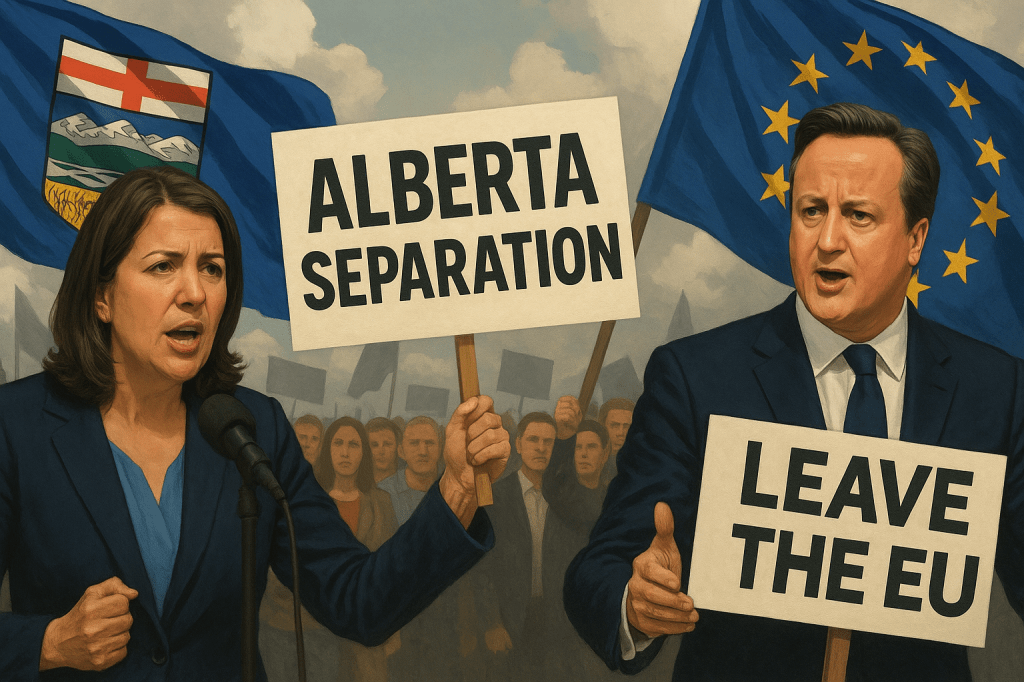
Danielle Smith’s political gambit with Alberta sovereignty bears an uncanny resemblance to David Cameron’s fateful decision to call a referendum on the United Kingdom’s membership in the European Union. Both leaders, faced with mounting internal pressures and populist insurgencies, sought to contain nationalist sentiment by giving it a structured outlet. In so doing, each gambled with the stability of their broader political project. Cameron, convinced that a plebiscite would put the Brexit question to bed and silence his party’s right-wing flank, ended up catalyzing the very crisis he had hoped to avoid, leading to his own political demise. Smith may be following the same treacherous path.

At the heart of both movements is the seductive notion of “taking back control”, from Brussels in the case of Brexit, and from Ottawa in Smith’s Alberta. The appeal is emotional and immediate: a narrative of betrayal by distant elites, a promise of restored autonomy, and the fantasy of economic self-sufficiency. Cameron allowed that narrative to play out on a national stage, legitimizing it with a referendum. Smith is doing something similar through legislation and rhetoric, invoking Alberta’s right to ignore or nullify federal laws under the guise of defending provincial jurisdiction.

Yet here lies the danger. Like Cameron, Smith has chosen to weaponize the language of sovereignty without a clear or viable endpoint. Her Alberta Sovereignty Within a United Canada Act is not a roadmap to secession, but it flirts with the logic of separation. The very act of mobilizing this discourse strengthens the hand of more radical forces in the province; those who see confederation not as a partnership, but as a prison. If Smith cannot deliver meaningful change within the framework of the Canadian constitution, and she likely cannot, she risks being outflanked by the separatists she once sought to co-opt. Just as UKIP’s rise drove Cameron’s decisions, the Maverick Party and other Alberta-first voices are shaping Smith’s hand, perhaps more than she realizes.

Politically, the parallels are striking and cautionary. Cameron misread the electorate and overestimated his ability to control the narrative. He expected the rational case for Remain to win out but failed to grasp the emotional and symbolic power of “Leave.” When the vote went against him, he resigned, leaving his party and country in turmoil. Smith may also be underestimating the Pandora’s box she is prying open. If public expectations are raised for a decisive break with Ottawa, one that cannot be delivered through mere provincial legislation, she may find herself either forced to escalate into unconstitutional territory or retreat in humiliation.

Moreover, Smith’s strategy could fracture the broader conservative coalition in Alberta. Urban moderates and business conservatives, critical to her electoral base, may grow weary of perpetual constitutional conflict, especially if it begins to affect investment, interprovincial relations, or federal funding. Meanwhile, the more extreme nationalist voices she has tried to placate will grow disillusioned if her sovereignty agenda produces no tangible results. Like Cameron, Smith is dancing between factions with incompatible goals, and she may end up satisfying none.

The tragedy of Cameron’s Brexit lies not just in the decision itself, but in the hubris that preceded it; the belief that one could flirt with nationalist fire and not get burned. Smith now faces a similar moment. In reaching for short-term political gain through an aggressive assertion of provincial autonomy, she may be sacrificing long-term credibility and coherence. The lesson from Brexit is not just about consequences, it’s about the limits of strategic populism. Smith, like Cameron, could soon discover that once sovereignty becomes the language of politics, it is no longer possible to control who speaks it, or how far they want to go.