
Britain’s Return to Europe: A Vision Rooted in Purpose, Not Nostalgia

Across the United Kingdom, a quiet reckoning is underway. Eight years after the Brexit referendum, the promise of a bold new chapter outside the European Union lies in tatters. Instead of renewed sovereignty and global resurgence, the country finds itself diminished: economically weaker, diplomatically isolated, and socially fragmented. For many, it is no longer a question of whether we should rejoin the EU, but how, and when.

Yet to speak of rejoining is to confront difficult truths. The journey back will not be quick. It will demand political leadership, public engagement, and diplomatic humility. But for a nation with Britain’s history, talents, and spirit, the path, though long, is both viable and vital. What lies at the end of that path is not simply a restoration of past privileges, but a reclaiming of our rightful place among Europe’s community of nations.

The first step must be political courage. While public opinion is shifting, particularly among younger generations and those long unconvinced by the false dawn of Brexit, the political establishment remains hesitant. The shadow of the 2016 referendum still looms large. Yet true leadership does not bow to ghosts; it charts a course forward. A future government must be willing to speak frankly to the British people: about the costs of Brexit, about the realities of international cooperation, and about the immense benefits of restoring our partnership with Europe.

Equally crucial is the task of restoring trust, both at home and abroad. The manner in which the UK left the EU, marked by bluster and broken commitments, left scars in Brussels and beyond. If Britain is to re-enter the fold, it must do so not as a reluctant exception-seeker, but as a committed and respectful partner. There can be no return to the days of opt-outs and special deals. We must approach accession not with entitlement, but with earnest intent, ready to meet the responsibilities of membership and contribute fully to the shared European project.

Legally and procedurally, rejoining would require a formal application under Article 49 of the Treaty on European Union. This would involve, in principle, a willingness to engage with all facets of membership, including the euro and Schengen, even if transitional arrangements are negotiated. There can be no illusions of a “lite” version of membership. The EU today is not the same bloc we left, it is more integrated, more self-assured. Britain must return on terms of mutual respect, not exception.

But if the process is demanding, the rewards are profound. Economically, the toll of Brexit is undeniable. The Office for Budget Responsibility estimates a 4% permanent reduction in GDP, an astonishing figure that translates into stagnating wages, struggling businesses, and faltering public services. Rejoining the Single Market would ease the friction that now stifles trade; full membership would restore investor confidence, supply chain resilience, and long-term economic momentum.

The argument is not merely about pounds and pence. On the world stage, Britain has not become more powerful post-Brexit, it has become peripheral. While we remain a respected military ally through NATO, our absence from the EU’s decision-making tables has cost us influence on climate policy, digital regulation, and global standards. In an era defined by democratic backsliding and geopolitical rivalry, our values: openness, rule of law, multilateralism, are best defended as part of a European alliance, not apart from it.

There is also a human dimension to this story, one often lost in policy debates. Brexit severed the everyday connections that bound us to our neighbours: the right to study in Paris, to work in Berlin, to fall in love in Lisbon without visas or barriers. Young Britons have had opportunities stripped from them. Scientists and artists find collaboration curtailed. Rejoining is not just an economic necessity, it is a moral obligation to restore the freedoms our citizens once took for granted.

And we cannot overlook the unity of the United Kingdom itself. Brexit has aggravated constitutional fault lines. Scotland and Northern Ireland voted to remain. The subsequent fallout, particularly around the Northern Ireland Protocol, has exposed the fragility of our Union. A return to the EU would not solve every issue, but it would provide a stable framework in which our nations might rediscover common cause, rather than drift further apart.

This journey will take time. It may begin with small, confident steps: rejoining Erasmus, aligning regulatory frameworks, re-entering common programmes. But these must be steps along a clearly signposted road, not gestures to nowhere. The destination, full EU membership, must be embraced not as a retreat to the past, but as a leap toward the future.

Britain belongs in Europe. Not just because of shared geography, but because of shared values: democracy, dignity, justice, and peace. We left on the back of a broken promise. We can return with purpose. And when we do, it will not be as the Britain that left, but as a Britain renewed, ready to lead once more, not from the sidelines, but from the heart of Europe.

Why Canada Needs Scandinavian-Style Healthcare

Canada stands at a crossroads. After decades of underfunding, patchwork reforms, and increasing pressure on provincial systems, it has become clear that tinkering around the edges will not save our healthcare. The discussion is no longer about marginal policy adjustments. It is about fundamental structure, equity, and national priorities.

The emergence of more private clinics across the provinces signals a shift that should alarm anyone who believes healthcare is a public good rather than a marketplace. These clinics, often operating in legal grey areas, effectively allow those with means to bypass wait times. Whenever that happens, the wealthy exit the shared system and the political incentive to invest in the public infrastructure weakens. The logic is simple. When elites can buy their way into faster care, they stop fighting for the kind of universal system that benefits everyone.

If Canada wants the best possible healthcare, the solution is not more private clinics. It is adopting the guiding principles of the Scandinavian model. Denmark, Norway, Sweden, Finland, and Iceland have built systems where high-quality care is universal, publicly funded, and delivered within a single unified framework. These countries consistently outperform Canada in access, outcomes, preventative care, and equity. Their success is not accidental. It comes from three structural principles that Canada must embrace if it wants to lead the world rather than trail behind it:

  1. A single-tier system with no private escape hatch. Everyone, including the wealthy, participates in the same system, which creates constant political pressure to maintain high quality. You get better healthcare when everyone — especially the most influential — depends on the same hospitals and clinics.
  2. High and stable public investment. Scandinavian countries fund healthcare at levels that match the real needs of their populations. Healthcare workers, equipment, and facilities are not considered costs to minimize but critical infrastructure, as essential as clean water or transportation.
  3. Integrated national planning. Instead of fragmented provincial systems, Scandinavian countries operate with cohesive national strategies. Canada’s provincial patchwork creates duplication, competition for resources, and wildly inconsistent service quality. A national framework would produce unified standards, better resource allocation, and greater accountability.

Canada can choose this path. It can reaffirm that healthcare is a public good, not a commodity. But doing so requires political courage and a public willingness to reject the slow creep of privatization. Allowing a private system to grow alongside the public system is not harmless. It undermines the very foundation of universal care.

If Canada truly wants world-class healthcare, the answer is not creating more private lanes. It is building a system where private lanes are unnecessary because the public system is so strong, so well-funded, and so well-managed that everyone is treated with the same quality and dignity. The Scandinavian model proves that this is both possible and sustainable.

To protect universal healthcare, Canada must follow those lessons. We need a single, high-functioning system that everyone pays into and everyone relies on. Only then will the political will align with the real needs of Canadians. Only then can we build the best healthcare system in the world.


Sources and Studies

  • Canadian Institute for Health Information. “Health Spending in Canada.”
  • OECD Health Statistics. “Health at a Glance” reports.
  • World Health Organization. “Universal Health Coverage: Evidence from Nordic Countries.”
  • European Observatory on Health Systems and Policies. “Nordic Health System Profiles.”
  • Commonwealth Fund. “International Health Policy Survey” annual comparative studies.
  • Government of Canada. “Canada Health Act Annual Report.”
  • University of Toronto Institute of Health Policy. “Public vs Private Delivery: Impacts on Wait Times and Equity.”
  • Fraser Institute critique reports on privatization proposals, for contrast and analysis.
  • Norwegian Ministry of Health. “Organisation of the Norwegian Health Services.”
  • Swedish National Board of Health and Welfare. “Equity and Quality in the Swedish Health System.”
  • Danish Ministry of Health. “Health System Performance and Financing.”

Yesterday in Washington

Washington likes to believe it understands itself. Staffers stride through hallways with the old confidence that policy, power, and predictable alliances still define the town. But yesterday the city felt like it had been tipped on its side. The familiar landmarks were still there, the marble still gleaming, the security lines still long, yet the political gravity had shifted. Something in the air made even the most seasoned observers pause. The rhythms were off. The choreography was wrong. The script had been changed without warning.

It began with the House vote. A resolution denouncing the supposed horrors of socialism sailed through with 285 votes. Eighty-six Democrats joined Republicans in an act that looked, to many, like a public renunciation of their own party’s progressive wing. Senior Democrats who had once embraced the energy of their younger socialists suddenly stood at the podium to praise a line of rhetoric that could have been lifted from a mid-century anticommunist tract. It was symbolic and it was safe, yet it carried the unmistakable sting of disloyalty. In a political moment defined by economic anxiety, this vote felt like an attempt to distance the party from the very language that had helped fuel its grassroots revival.

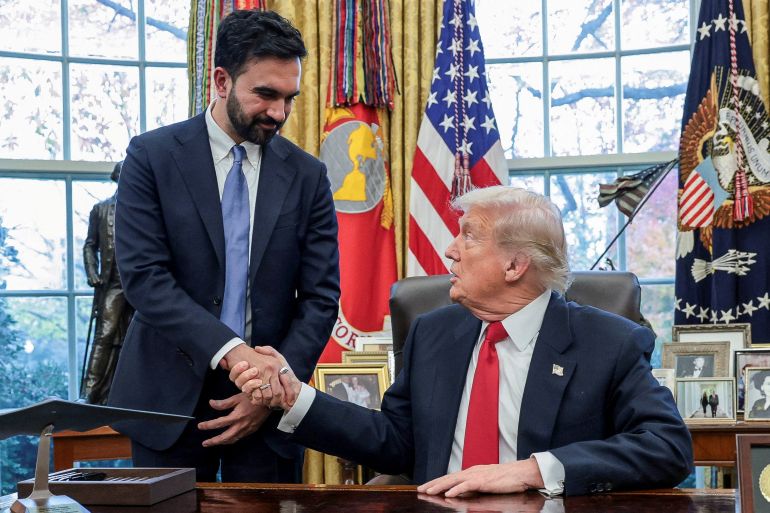
Then came the Oval Office.

Within hours of the anti-socialism vote, Zohran Mamdani, the democratic socialist mayor-elect of New York City, walked through the gates of the White House. Cameras rolled as Donald Trump, the man who had built years of rallies on the promise of defeating socialism, suddenly praised Mamdani as rational and pragmatic. The same leader who had weaponized the word socialism now spoke about affordability, collaboration, and even the possibility of making a life in Mamdani’s New York. Reporters searched for context, staffers searched for talking points, and the city searched for its footing.

It was the kind of contradiction Washington hates because it cannot be easily spun. Democrats had voted to distance themselves from socialism while Trump offered the socialist of the hour a political embrace. Progressives stared at their own leadership in disbelief. Conservatives stared at Trump in confusion. Centrists stared at both sides and wondered whether anyone was still playing by recognizable rules. By late afternoon, Washington felt like it had been rewritten by a novelist with a sense of humor and a taste for irony.

Meanwhile Mamdani himself appeared untouched by the chaos swirling around him. He brushed off the congressional vote and spoke instead about affordability and governance. He treated the Oval Office meeting not as a political earthquake but as a practical encounter with a president who happened, on this particular day, to be in a generous mood. His calmness only amplified the surreal tone of the day. The city was upside down. The socialist was steady. The partisans were unmoored.

By evening, analysts were already scrambling to interpret the meaning of it all. Was Trump repositioning himself. Were Democrats attempting to signal caution to suburban voters. Was this simply political theater without consequence. Or had Washington revealed something deeper. The sense of an old order losing its predictability. The sense that ideological labels no longer behave as they are expected to. The sense that alliances can flip in the space of an afternoon.

For a brief moment, the capital looked like a place where the usual logic had cracked. The marble buildings and polished floors remained, but the stories being told within them no longer lined up with the roles each character was supposed to play. It was a day that left Washington blinking in the light, unsure of whether it had witnessed a temporary disruption or an early sign that the political axis itself is beginning to tilt.

Five Things We Learned This Week

Week of November 15–21, 2025

⚖️ 1. EU Moves to Limit Big Tech Power

European regulators proposed sweeping rules on Nov 18 to curb dominant tech companies, including stricter data-sharing requirements and restrictions on self-preferencing.

Why it matters: This could reshape how major platforms operate across Europe and force Big Tech to open up more, potentially leveling the playing field for smaller competitors.

🌍 2. COP30 Leaders Agree on New Climate Finance Pledge

On Nov 19, world leaders at COP30 committed to a $150 billion fund over the next five years aimed at helping vulnerable developing nations adapt to climate change.

Why it matters: This may mark a turning point for climate justice by providing crucial resources for countries facing rising seas, extreme weather, and food insecurity.

🔬 3. University Scientists Create Recyclable Batteries with 90% Efficiency

A European research team announced on Nov 20 the development of a new battery design that is both high-efficiency (approximately 90 percent) and made from fully recyclable materials.

Why it matters: If scalable, this could dramatically cut the environmental impact of batteries for electric vehicles and energy storage.

🧠 4. Breakthrough in Early Alzheimer’s Detection

On Nov 21, a biotech company revealed a blood test that can predict early Alzheimer’s disease with over 85 percent accuracy, even before symptoms appear.

Why it matters: Early detection enables earlier interventions, potentially slowing disease progression and improving long-term outcomes.

🛢️ 5. Iran and Saudi Arabia Sign Oil-Export Infrastructure Deal

On Nov 17, Iran and Saudi Arabia signed a historic agreement to jointly develop pipeline and export infrastructure after years of strained relations.

Why it matters: The deal could reshape energy dynamics in the region, ease geopolitical tensions, and potentially affect global oil prices.

This week delivered a rare mix of scientific breakthroughs, political shifts, and geopolitical surprises. Each event hints at broader changes taking shape across the world. As always, the Rowanwood Chronicles will keep watching how these threads unfold in the weeks ahead.

Carriers, Claims, and Crude: Why the Caribbean Is Becoming 2025’s Most Dangerous Flashpoint

In the windswept corridors of Latin American geopolitics, the tensions between the United States and Venezuela have quietly transformed into something far more consequential than a mere counternarcotics campaign. As of late 2025, the scale of U.S. military deployment in the Caribbean, centered around the gargantuan USS Gerald R. Ford carrier strike group, marks not just a show of force, but a deeply calculated exertion of power.   Beyond the stated mission of interdiction of drug trafficking, this posture suggests a layered strategy: pressuring Maduro, reasserting Washington’s influence in the region, and signaling to Latin American capitals that the era of passive U.S. tolerance may be drawing to a close.

From Caracas’s perspective, this is viewed not as a benign counternarcotics mission but as a direct existential threat. The Venezuelan leadership has responded by mobilizing broadly; ground, riverine, naval, aerial, missile, and militia forces have reportedly been readied for “maximum operational readiness.” Estimates suggest on the order of 200,000 troops could be involved, underscoring how deeply Maduro’s government perceives the risk. In public discourse, the Venezuelan regime frames this as defending sovereignty, not only against cartel-linked accusations but also against what it claims is a looming imperial design.

This confrontation cannot be fully understood, however, without examining Guyana and the long-running territorial dispute over the Essequibo region. Essequibo is no trivial piece of geography: historically claimed by Venezuela, it comprises more than two-thirds of Guyana’s land mass and borders rich offshore blocks. In recent years, ExxonMobil, Hess, CNOOC, and others have developed significant oil infrastructure just off Guyana’s coast, especially in the Stabroek Block.  

Tensions flared visibly in March 2025, when a Venezuelan coast guard vessel sailed deep into waters claimed by Guyana, radioed warnings to floating production storage and offloading (FPSO) platforms, and asserted those vessels were operating in “Venezuelan” maritime territory. Guyana’s foreign ministry publicly protested, noting that the incursion violated not only its sovereign economic zone, but also a 2023 International Court of Justice order that prohibited Venezuela from taking actions that might change the status quo. Guyana also emphasized that its exploration and production activities are lawful under international law, and referenced its rights under the 1899 arbitral award.  

From a strategic lens, Venezuela’s behavior in Essequibo aligns too neatly with its military mobilization against the U.S. The annexation drive, or at least the territorial claim, is not ideological romanticism, but realpolitik rooted in energy security. On multiple occasions, President Maduro has authorized Venezuelan companies, including PDVSA, to prepare for fossil fuel and mineral extraction in the disputed Essequibo territory. In Caracas’ calculus, asserting control over Essequibo could transform its geopolitical position: it reclaims a historical claim, undermines Guyana’s sovereignty, and potentially gives Venezuela leverage over lucrative offshore oil fields.

The U.S. is not blind to this. Washington’s backing of Guyana is deliberate and multilayered. Secretary of State Marco Rubio’s warnings to Maduro, at a joint press conference with Guyanese President Irfaan Ali, make clear that the U.S. considers any Venezuelan aggression against Guyana, especially against ExxonMobil-supported oil platforms, as a red line. For Guyana, which has very limited military capacity, the American presence is both a shield, and a bargaining chip; for the U.S., it’s a way to protect strategic investments, ensure energy flows, and project influence in a region increasingly contested by non-Western actors.

Yet, this is not a zero-sum game with only force on the table. Venezuela’s framing of U.S. activity as an imperial threat resonates powerfully with its domestic base, allowing Maduro to marshal nationalist sentiment and justify radical mobilization measures. The Bolivarian militias, riverine units, and civilian enlistment signal a willingness to wage not just conventional defense, but also hybrid and asymmetric warfare. The mobilization is as symbolic as it is practical.

At the same time, Guyana is investing in a diplomatic-legal offensive. The Guyanese government has formally protested Venezuelan naval incursions and made repeated appeals to the ICJ. International support for Guyana is gathering pace: the Organization of American States and other regional bodies have backed its territorial integrity. In parallel, Washington’s military buildup, dressed as counternarcotics, is likely calculated to saturate the region with deterrence against both terrorist/criminal maritime networks and more ambitious Venezuelan designs.

The risk now is of miscalculation. If Caracas underestimates Washington’s resolve, or if Guyana feels compelled to resist more aggressively, escalation could spiral. But equally, if the U.S. overplays its hand, moving from deterrence to coercion, it risks pushing Venezuela further into isolation or desperation, which could destabilize not only Caracas, but the broader region.

In the broader sweep of history, this crisis may well mark a turning point. Venezuela’s push into Guyana is not just about land; it’s about energy, influence, and the assertion of sovereignty in a global order where resources still drive power. For the U.S., the operation may begin as counternarcotics, but the strategic subtext is unmistakable: protecting American economic interests, reestablishing hemispheric primacy, and shaping the future of Latin America in an era of renewed geopolitical competition.

At Rowanwood, we often say that old maps matter: not just for their lines, but for what those lines mean when power shifts. Here, in the tropical currents of the Caribbean and the oil-laden jungles of Essequibo, the maps are being redrawn – quietly, dangerously, and with very real stakes for the future.

From Grief to Grievance: The Right’s Free Speech Double Standard After Charlie Kirk

Charlie Kirk’s killing has done what violent spectacles always do in a polarized media environment. It ripped open a raw nerve and revealed, less a spontaneous national reckoning, and more a preexisting playbook. Within hours conservative leaders and right wing media shifted from grief to grievance, recasting the tragedy as proof of a civilizational siege against their side. That rhetorical pivot matters because it treats a criminal act as a political weapon, and because the responses have been strikingly unbalanced.  

The Trump administration leaned into that weaponization almost immediately. Officials framed the episode as part of a larger pattern of politically motivated hostility and promised legal and regulatory responses aimed at what they call “hate speech.” Attorney General Bondi’s vow to pursue people and platforms, and suggestions from some administration figures of sanctions for media outlets that publish allegedly toxic commentary, are being sold as accountability. They are also being advertised as revenge. That framing collapses the line between criminal investigation and political censorship. It substitutes broad punitive tools for careful public conversation and due process.  

Many conservative commentators followed. A sizeable portion of right wing media has demanded firings, suspensions, and even legal penalties for journalists, professors, and entertainers who made provocative remarks after the shooting. At the same time other conservative voices warned that such a purge of speech would be exactly the kind of “cancel culture” conservatives used to denounce. The incoherence here is revealing. It shows that principles about free expression are now conditional. When the target is a conservative martyr these principles bend toward power rather than protect speech. That inconsistency is political opportunism masquerading as moral clarity.  

Compounding the problem is the tsunami of misinformation and performative outrage the incident produced. Deepfakes, AI-written books, phony social posts, and manufactured timelines proliferated across platforms, turning grief into a market for grievance. False claims about who said what and when were weaponized to inflame local communities, to harass school staff, and to pressure employers to fire people on the basis of forged complaints. That cascade made reasoned responses harder and fed the very narrative of existential threat that political actors exploited. It also exposed how easily modern information ecosystems can be gamed to stoke revenge politics.  

If anything constructive is to come from this episode it should start with separating three things that have been conflated in the immediate aftermath. We must distinguish legitimate accountability for threats and violent rhetoric from blunt campaigns to suppress dissent. We must police misinformation without turning government power into an instrument of partisan retribution. And we must refuse the transactional logic that converts every tragedy into political currency. Conservatives who genuinely care about free speech should be the loudest critics of the punitive measures now being proposed in their name. The test of principle is not convenience. It is consistency.  

Sources
• Reuters, Charlie Kirk’s death ignites free speech fire storm among Trump supporters.
• The Guardian, The US right claimed free speech was sacred – until the Charlie Kirk killing.
• Reuters, Rumors and misinformation about Charlie Kirk killing rampant on social media.
• Techdirt, Facebook flooded with AI grief farming about Charlie Kirk.
• Snopes, Charlie Kirk is dead after shooting at Utah college event.  

North America’s Strategic Choice: Integration or Irrelevance in a Multipolar World

As the global trade landscape shifts, alliances such as BRICS and infrastructure developments like the International North-South Transport Corridor (INSTC) are redrawing the map of commerce. These projects are not just economic arrangements, they are strategic assertions of a multipolar world, where emerging economies are building financial systems and trade networks that bypass traditional Western-dominated institutions. In this changing environment, deeper integration across North America is no longer just desirable, it is essential. The United States, Canada, and Mexico share geography, economic interdependence, and complementary strengths. But instead of leaning into this partnership, the U.S. has at times acted in ways that undermine its closest allies, and in doing so, it is undercutting its own long-term strategic interests.

BRICS, now expanded to include nations like Egypt and the UAE, is working toward reducing reliance on the U.S. dollar and building alternative financial infrastructure. Simultaneously, the INSTC, a 7,200-kilometre multimodal corridor linking India, Iran, Russia, and Europe, offers a faster and cheaper trade route than the Suez Canal. These shifts are enabling new alignments between Asian, Eurasian, and Global South nations. In contrast, the U.S. risks being left behind unless it reinvests in its regional relationships. North America, bound by the Canada-United States-Mexico Agreement (CUSMA), already possesses a solid legal and regulatory foundation. What is missing is the political will to push that foundation into a fully integrated economic zone.

Closer North American integration could strengthen supply chains, enhance competitiveness, and boost regional innovation. Mexico’s manufacturing power, Canada’s resource wealth and technological expertise, and the U.S.’s financial and consumer might together could create a resilient and globally influential economic bloc. However, protectionist impulses from Washington, such as tariffs on Canadian aluminum, trade disputes over softwood lumber, and threats against Mexican imports, erode trust. These actions push Canada and Mexico to expand trade elsewhere, increasing their engagement with China, the EU, and the Asia-Pacific. While diversification is strategically wise, a fragmented North America plays directly into the hands of BRICS and INSTC-aligned actors.

Still, for Canada and Mexico, investing further in North American integration remains the most strategically sound choice. Despite political turbulence, the U.S. offers unmatched access to capital, consumer markets, and legal protections. CUSMA provides a rules-based framework that supports long-term stability more effectively than newer or looser trade deals. And while deeper trade ties with China or Europe may offer short-term gains, they cannot replicate the geographic, cultural, and logistical synergies of the North American relationship. Rather than turning outward in frustration, Canada and Mexico can use their economic leverage to influence U.S. trade policy from within, helping to shape a trilateral vision rooted in shared democratic values and mutual prosperity.

The U.S., for its part, must recognize that its global position depends not just on military strength or Silicon Valley innovation, but on the strength of its closest partnerships. The path forward lies not in undermining allies, but in building with them a regional powerhouse capable of competing with the rising multipolar world. Failing to do so means ceding both economic and geopolitical ground – to rivals who are already moving with speed and purpose.

Rethinking “Developing Countries” and Embracing the Majority World

When we talk about developing countries, we rarely stop to ask what the phrase actually means. It slips off the tongue so easily, a piece of polite shorthand meant to distinguish between rich and poor, industrial and agrarian, modern and traditional. But behind that convenience hides a great deal of inherited hierarchy. Calling one part of the planet “developing” assumes there is a finish line defined elsewhere; that a good society looks like a Western one, with high GDP, gleaming infrastructure, and endless economic growth.

In recent years, many writers and thinkers have begun to push back on that language, arguing that it keeps us trapped in a colonial frame of mind. Arturo Escobar, in his landmark Encountering Development, described “development” as one of the most powerful cultural projects of the twentieth century, a system of ideas that reshaped the world to fit Western priorities. The word itself became a quiet command: grow like us, consume like us, measure like us.

Where the Language Came From
The phrase Third World first appeared during the Cold War, used to describe nations that aligned with neither the capitalist West nor the communist East. Soon it came to mean “poor countries”;  those still struggling with the legacies of colonialism, low industrial output, or weak infrastructure. By the 1980s, the term had begun to sound uncomfortable, and developing world emerged as its polite successor. Yet the underlying assumptions didn’t change. To be “developing” was to be “not yet there.”

The problem isn’t just historical accuracy; it’s the moral geometry of the words. They draw the map as a staircase, with the G7 at the top and everyone else climbing, slowly or not at all. They suggest that the proper destiny of the planet is to become more like the already-industrialised nations, despite the ecological and social costs that model now reveals.

Why Words Matter
Language shapes policy, and policy shapes lives. When international agencies use developing, they often frame assistance, trade, and climate policy around the assumption that economic growth is the central measure of progress; but GDP tells us nothing about clean water, community cohesion, or cultural vitality. It counts bombs and hospital beds the same way, as “economic activity.”

When we say “developing,” we subtly affirm that Western modernity is the gold standard. That is not only inaccurate but increasingly unwise in an age of ecological constraint and social fragmentation. There are other ways to live well on this planet, and many of them are already being practiced by the people our old vocabulary patronizes.

The Rise of the Majority World
One alternative that resonates deeply is Majority World. The term flips the script: most of humanity lives outside the wealthy industrialized nations. To call those countries “developing” is not only condescending, it’s mathematically absurd. As development writer Sadaf Shallwani notes, “The terms ‘developing world’ and ‘Third World’ imply that development is a linear process, and that certain ‘developed’ countries have finished developing and are the norm towards which all countries should strive.”

The phrase Majority World reframes the global conversation. Instead of a minority of wealthy states defining progress, it recognizes that the majority of the planet’s population, and its cultural, ecological, and creative wealth, resides elsewhere. It’s not a euphemism; it’s a shift in perspective.

Calling Africa, Asia, Latin America, and the Pacific the Majority World centres humanity, not hierarchy. It invites curiosity instead of comparison. It allows us to speak about global issues: climate, migration, food security, health, as shared human challenges rather than one-way rescue missions.

Beyond Renaming: Rethinking Progress
Of course, simply changing labels isn’t enough. The deeper challenge is to redefine what progress itself means. For decades, “development” has equated to industrialization, export-driven growth, and consumer expansion. But that model has left deep scars on both people and planet.

Around the world, alternative visions of well-being are emerging. Bhutan measures Gross National Happiness. New Zealand’s Wellbeing Budgetprioritizes mental health, environment, and equity alongside economic performance. In Latin America, the Andean philosophy of Buen Vivir, “good living”, emphasizes balance with nature and community rather than domination or accumulation.

Each of these ideas challenges the unspoken assumption that there is a single road to modernity. They remind us that prosperity can mean dignity, education, safety, and belonging, not necessarily industrial sprawl and high consumption.

The term Majority World aligns beautifully with this plural understanding. It carries a quiet humility, an admission that the Western model is not universal, and that many societies are rich in social capital, resilience, and wisdom even without high per-capita income.

A Linguistic Act of Respect
For writers, journalists, and policymakers, choosing our words carefully is a small but vital act of respect. Before typing “developing country,” we might pause to ask: developing by whose standards? Toward what end? Whose story does this phrase tell, and whose does it erase?

When we speak instead of the Majority World, we acknowledge shared humanity and diversity of experience. It invites us to listen rather than prescribe, to recognize that there are as many definitions of progress as there are landscapes and languages.

This linguistic shift is also emotionally honest. It reminds those of us in the so-called “developed” world that we are the minority, not the model, and that our own path is far from sustainable. The future will depend not on teaching others to emulate us, but on learning together how to live well within planetary boundaries.

A More Honest Vocabulary
The phrase Majority World is not perfect, but it moves us closer to linguistic integrity. It removes the hierarchy, restores proportion, and invites humility. It replaces the idea of a “developing world” that needs guidance with a mosaic of societies co-creating their futures on equal moral footing.

Language is never neutral. The words we choose reveal the maps in our minds, who we see at the center, who we see at the margins. Changing those words changes the map.

Perhaps, in time, “development” itself will fade as a global organizing idea, replaced by something more ecological, more plural, and more just. Until then, we can begin with something simple and powerful: calling the world as it is, in its vastness and complexity, a Majority World that has always been, in truth, the heart of humanity.

References:
• Escobar, Arturo. Encountering Development: The Making and Unmaking of the Third World. Princeton University Press, 1995.
• Ziai, Aram. “The Discourse of ‘Development’ and Why the Concept Still Matters.” Third World Quarterly, 2013.
• Trainer, Ted. “Third World Development: The Simpler Way Critique of Conventional Theory and Practice.” Real-World Economics Review 95 (2021).
• Shallwani, Sadaf. “Why I Use the Term ‘Majority World’ Instead of ‘Developing Countries’ or ‘Third World.’” sadafshallwani.net, 2015.
• Wellbeing Economy Alliance. “What Is a Wellbeing Economy?” 2023.

Alberta, Natural Resources, and the Challenge of Federal Cohesion

I am starting a series of articles on Canada, its provinces, territories and confederation for the purpose of exploring a vision for the future. Let’s begin at the currently obvious place – Alberta. 

Alberta’s economic model is deeply tied to its resource wealth, particularly oil and gas, and its assertive stance on resource control has generated ongoing tensions with federal environmental and regulatory policy. While constitutionally grounded in provincial ownership rights, Alberta’s insistence on autonomy often clashes with the cooperative principles necessary in a federal system. This commentary explores the roots of this conflict and offers pathways toward a more collaborative and constructive intergovernmental relationship.

Constitutional Foundations and Ownership of Resources
Section 92A of the Constitution Act, 1982 affirms that Canadian provinces have the exclusive right to manage and develop their natural resources. Alberta has used this authority to shape its energy policy and economic strategy, which remain heavily reliant on oil and gas extraction.

However, under Section 91 of the Constitution Act, 1867, the federal government retains authority over matters of national and international trade, environmental protection, and interprovincial infrastructure. These overlapping jurisdictions mean that large-scale energy projects—such as pipelines—often require federal approval and regulation, leading to friction between provincial ambitions and federal oversight.

Fiscal Federalism and Perceived Inequities
Alberta’s role as a “have” province in the equalization system has been a long-standing source of grievance. Despite experiencing downturns in the oil economy, Alberta does not receive equalization payments due to the formula used to calculate fiscal capacity. While the system aims to ensure reasonably comparable levels of public services across Canada, many Albertans view it as a redistribution mechanism that penalizes economic productivity without adequately rewarding provincial contributions to national prosperity.

This sentiment is often exacerbated during periods of Liberal federal governance, when policies such as carbon pricing, environmental assessment reform (e.g., Bill C-69), and energy transport restrictions (e.g., Bill C-48) are interpreted as barriers to Alberta’s growth and autonomy.

The Political Psychology of Alienation
Alberta’s frustration with Ottawa is not merely legal or economic—it is cultural and emotional. The legacy of the National Energy Program (1980), perceived as a federal overreach into Alberta’s economy, continues to shape provincial attitudes. There is a widespread belief among many Albertans that their priorities are undervalued in national discourse, while their economic output is taken for granted.

This sense of alienation is particularly pronounced during Liberal governments, which are often associated with centralized governance, regulatory oversight, and climate policy that is seen as antagonistic to Alberta’s resource sector.

The Dilemma of Reciprocity
Despite its demand for autonomy, Alberta remains deeply integrated with the rest of Canada. It benefits from internal migration, national infrastructure, federal investment, and shared services. However, when national unity requires compromise, such as in building pipelines through BC or adhering to environmental targets, Alberta often adopts a defensive posture.

This tension between autonomy and interdependence is the core dilemma of Canadian federalism. While the provinces retain control over resources, their development impacts climate goals, international trade obligations, and national economic stability, issues that fall under federal jurisdiction.

Recommendations for Constructive Engagement
To resolve these tensions and restore national cohesion, both Alberta and the federal government must reconsider their approaches:

For the federal government:
Strengthen regional engagement: Appoint trusted regional representatives to act as intermediaries between Alberta and federal departments.
Clarify jurisdictional boundaries: Work collaboratively to define areas where federal environmental goals can be met without impeding provincial development.
Modernize equalization: Review and revise the equalization formula to ensure transparency and responsiveness to changing economic realities.

For Alberta:
Acknowledge interdependence: Embrace the reality that long-term prosperity requires cooperation, not confrontation.
Diversify the economy: Invest in emerging sectors like hydrogen, critical minerals, and clean technology to reduce economic vulnerability.
Engage Indigenous leadership: Collaborate meaningfully with Indigenous governments who hold treaty rights and are key to sustainable development.

Alberta’s assertiveness over resource development is constitutionally grounded, but politically volatile. The success of Canadian federalism depends not on uniformity, but on mutual respect and intergovernmental cooperation. Both sides must move beyond grievance-based politics toward a pragmatic and future-focused partnership that serves both regional needs and national interests.

Drawing the Lines of Power: Why the United States Needs an Independent Redistricting Commission

Every ten years, Americans count themselves, and then politicians carve the nation into pieces. In theory, these lines are the skeleton of democracy, each district meant to represent a roughly equal share of the people’s voice. In practice, however, the scalpel is often in partisan hands, and the result looks less like democracy and more like a game of political cartography gone rogue.

A System That Rewards Its Own Abuse
The U.S. Constitution leaves redistricting to the states, with Congress retaining the right to regulate the process. Yet for more than two centuries, Congress has chosen not to exercise that right in any meaningful way. The result is a patchwork of state systems, most of them controlled by whichever political party happens to dominate the local legislature.

Both parties have used this power when it suits them, but in the modern era, sophisticated mapping software and microtargeted data have turned gerrymandering into a science. Districts now snake through neighborhoods like drunken serpents, connecting voters who share little except their predicted loyalty. In some states, the shape of the line, not the will of the people, determines who governs.

When the Supreme Court in Rucho v. Common Cause (2019) declared that partisan gerrymandering was a “political question” beyond its reach, it effectively shut the courthouse doors to citizens seeking fair maps. The message was clear: if Americans want integrity in their elections, they must legislate it themselves.

What an Independent Commission Could Offer
Other democracies long ago recognized that fairness cannot coexist with self-interest. Canada, the United Kingdom, and Australia entrust their electoral maps to independent, arms-length commissions. These agencies are staffed by nonpartisan experts; demographers, judges, geographers who follow clear criteria: compactness, respect for communities of interest, equal population, and transparency. Public hearings and judicial oversight ensure that citizens, not party operatives, shape their representation.

The results speak for themselves. Voter confidence in the fairness of elections in these countries consistently exceeds 80 percent, while American confidence has hovered around 50 percent in recent years. In Canada, where each province’s independent boundary commission reviews the map after every census, electoral boundaries are rarely the subject of scandal or court challenge. People may disagree on policy, but they do not argue about the legitimacy of their ridings.

The Case for a Federal Solution
The United States could adopt such a system tomorrow. The Elections Clause grants Congress the authority to “make or alter” state regulations governing federal elections. A single piece of federal legislation could establish an Independent Federal Redistricting Commission – a transparent body tasked with drawing all congressional districts using uniform national standards.

Such a commission would:
End partisan manipulation by removing politicians from the mapping process.
Increase public trust by making all deliberations open and evidence-based.
Strengthen democracy by ensuring that voters choose their representatives, not the other way around.
Stabilize governance by reducing the incentives for extreme partisanship, which flourish in safely gerrymandered districts.

Imagine a Congress in which every member must appeal to a truly representative cross-section of their district; urban and rural, conservative and progressive, wealthy and working-class. The tone of national politics would shift overnight. Legislators would need to persuade rather than posture. Compromise, that most endangered of political virtues, might even make a comeback.

What Stands in the Way
The only obstacle is political will. The party that benefits from the map has no incentive to surrender control of the pen. Both have been guilty at various times, though the imbalance today tilts heavily toward Republican-controlled legislatures that have perfected the art of map manipulation. The proposed For the People Act and Freedom to Vote Act, which would have mandated independent commissions for all congressional districts were blocked in the Senate, not because they were unconstitutional, but because they were inconvenient.

This is the real scandal: that a fix so obvious and achievable is continually thwarted by those who fear fair competition. Gerrymandering is not a feature of democracy; it is a form of quiet electoral theft.

The Moral Argument
Democracy, if it means anything, means that each citizen’s voice carries the same weight. When politicians choose their voters, that principle collapses. Independent redistricting is not a partisan reform; it is a moral one. It says that legitimacy must flow upward from the people, not downward from the powerful.

Americans deserve to know that their ballot is worth as much as their neighbor’s. Until they demand that Congress create an independent, arms-length agency to draw the lines of power, those lines will continue to be written in the ink of self-interest.

The map of a democracy should be drawn by its people’s conscience, not by its politicians’ convenience.

Sources:
U.S. Constitution, Article I, Section 4
Arizona State Legislature v. Arizona Independent Redistricting Commission, 576 U.S. 787 (2015)
Rucho v. Common Cause, 588 U.S. 684 (2019)
• Elections Canada, “Independent Boundaries Commissions and Electoral Fairness” (2023)
• Pew Research Center, “Public Trust in Elections and Government” (2023)