The Numbers Whisper, the Politicians Yell, and Europe Shrugs

Spend enough time listening to the current administration in Washington and you might come away believing Europe has one foot in the grave and the other sliding toward irrelevance. The story is familiar by now. The United States is strong. Europe is weak. The United States is vigorous. Europe is in decline. And the European Union, that sprawling project of integration and compromise, is painted as little more than an exhausted bureaucracy staggering toward collapse.

It is an effective political story. It is not an accurate economic one.

What the data show is far more nuanced. The United States is indeed outpacing Europe on headline growth. That part is real. Quarter after quarter, American GDP numbers look stronger. In one recent comparison the US economy grew eight times faster than the eurozone, which managed a tenth of a percent while the United States beat that figure with ease. This difference is not an illusion created by currency shifts or accounting tricks. It reflects higher productivity growth in the United States, stronger investment, and a demographic profile that remains more favourable than Europe’s. These are material advantages and they reveal real structural gaps.

Yet to jump from those facts to grand claims about European “civilizational decline” is to turn analysis into theatre. The United States is growing more quickly, but the European Union is still one of the largest and most advanced economic regions on the planet. Its labour markets remain stable. Inflation is drifting toward target levels. Living standards across much of Europe remain globally competitive and, in many sectors, outperform American norms once cost and purchasing power are accounted for. A slower growth profile does not equal economic illness. It equals a different model with different strengths and different vulnerabilities.

Why then the drama. Because it serves a purpose. The administration’s own national security strategy now speaks of Europe as a continent on the verge of losing itself, a place where current trends will render the region unrecognizable in twenty years. It warns that internal EU policies are eroding sovereignty and liberty and it openly states an intention to cultivate political resistance inside European nations. Such language is not a neutral economic assessment. It is political positioning wrapped in the clothing of economic diagnosis.

And that positioning does not fall on deaf ears. Nationalist movements in Europe hear the signal clearly. Parties like the AfD in Germany have seized on Washington’s rhetoric as validation and have used it to bolster their own claims about a European project supposedly in decay. The administration’s framing becomes a feedback loop. A strong America. A weak Europe. A proud nationalist revival sweeping the continent. It is a narrative that simplifies complex economic realities for political advantage on both sides of the Atlantic.

The truth sits somewhere far less dramatic. Europe is not collapsing. It is not unravelling. It is navigating a period of slow growth, productivity challenges, and regulatory debates that are real but hardly apocalyptic. The gaps between the EU and the United States are partly economic and partly structural, but the story of a dying Europe is a rhetorical construction, not an economic fact.

That story will continue to circulate because it is useful. It creates a contrast that flatters American power. It energises nationalist movements in Europe that reject Brussels and prefer bilateral dealings with Washington. And it gives political actors in the United States an external example to point toward when arguing that their own model is not only stronger but morally superior.

Economic data rarely shout. They whisper. And what they whisper today is simple. Europe is slower than the United States, yes. Europe is wrestling with productivity and demographic pressures, yes. But Europe is not on the brink. The rhetoric is doing the heavy lifting, not the numbers.

Sources:
euronews.com
courthousenews.com
economy-finance.ec.europa.eu
reuters.com
theguardian.com

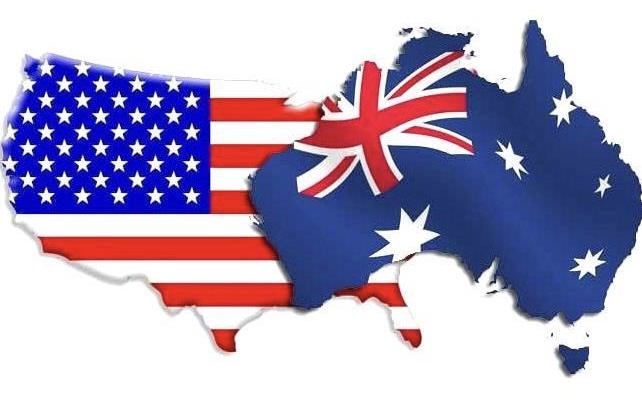
Australia: The Prize No One Talks About

There’s a story playing out on the world stage that barely makes a ripple in most media cycles. While the headlines fixate on Ukraine, Gaza, or Taiwan, an unspoken contest is quietly unfolding for influence over a country that has, for too long, been treated as a polite and distant cousin in global affairs: Australia.

We’re used to thinking of the United States as having eyes on Canada, economically, culturally, and strategically. The integration is old news: NORAD, pipelines, the world’s longest undefended border, and the quiet assumptions of shared destiny. But if you really want to understand the next chapter of global power politics, don’t look north. Look west. Look south. Look to Australia.

What’s emerging now is not a scramble for land or flags, but for strategic intimacy, a deep intertwining of interests, logistics, defense capabilities, and ideological alignment. Australia is the prize not because it’s weak, but because it’s vital: geographically, economically, and politically.

The American Pivot
The United States is already entrenched. Through AUKUS, it has committed to helping Australia build nuclear-powered submarines and integrate into the U.S. military-industrial supply chain. But this is more than just a defense pact. It’s about locking Australia into a security and technology architecture that positions it as a forward base for U.S. naval and cyber operations, a southern anchor against Chinese ambitions in the Indo-Pacific.

What few people understand is this: Australia is becoming America’s new front line. Not in the sense of war, but in the grand strategy of containment, deterrence, and projection. The U.S. doesn’t want Australia as a vassal, it wants it as a platform, a co-pilot, a bulwark. In many ways, it’s happening already.

India Enters the Frame
But Washington isn’t the only capital watching Canberra. New Delhi is quietly but deliberately courting Australia too, not for bases, but for bonds.

India sees Australia through a different lens: not as a strategic outpost, but as an extension of its civilizational, economic, and diasporic reach. With a large and growing Indian community in Australia, rising trade links, and joint naval exercises in the Indian Ocean, India’s interest is long-term and layered.

What India understands, and what many in the West overlook, is that Australia is a natural expansion point for a rising democratic Asia. It’s a source of energy, food, space, and credibility. In a world where climate instability and resource scarcity are redefining security, having Australia in your corner isn’t optional. It’s essential.

Why It Matters
This isn’t a turf war. It’s not a return to Cold War blocs. It’s more fluid than that, a web of influence where infrastructure, education, culture, and soft power matter just as much as tanks and treaties.

The real story is this: Australia is shifting from the periphery to the center of global strategic thought. It’s no longer just “down under.” It’s at the crossroads of the world’s most dynamic (and dangerous) geopolitical contest: the one unfolding across the Indo-Pacific.

And here’s the kicker: Australians are waking up to this. The era of benign non-alignment is over. The decisions they make in the next decade, about alliances, sovereignty, and identity — will echo far beyond their shores.

So the next time someone tells you it’s all about Europe or the South China Sea, remind them: The most consequential strategic competition of the 21st century might just be quietly unfolding in the sunburnt country; and it’s not just China who’s watching. The U.S. and India are, too. And they both want Australia in their future.

Carriers, Claims, and Crude: Why the Caribbean Is Becoming 2025’s Most Dangerous Flashpoint

In the windswept corridors of Latin American geopolitics, the tensions between the United States and Venezuela have quietly transformed into something far more consequential than a mere counternarcotics campaign. As of late 2025, the scale of U.S. military deployment in the Caribbean, centered around the gargantuan USS Gerald R. Ford carrier strike group, marks not just a show of force, but a deeply calculated exertion of power.   Beyond the stated mission of interdiction of drug trafficking, this posture suggests a layered strategy: pressuring Maduro, reasserting Washington’s influence in the region, and signaling to Latin American capitals that the era of passive U.S. tolerance may be drawing to a close.

From Caracas’s perspective, this is viewed not as a benign counternarcotics mission but as a direct existential threat. The Venezuelan leadership has responded by mobilizing broadly; ground, riverine, naval, aerial, missile, and militia forces have reportedly been readied for “maximum operational readiness.” Estimates suggest on the order of 200,000 troops could be involved, underscoring how deeply Maduro’s government perceives the risk. In public discourse, the Venezuelan regime frames this as defending sovereignty, not only against cartel-linked accusations but also against what it claims is a looming imperial design.

This confrontation cannot be fully understood, however, without examining Guyana and the long-running territorial dispute over the Essequibo region. Essequibo is no trivial piece of geography: historically claimed by Venezuela, it comprises more than two-thirds of Guyana’s land mass and borders rich offshore blocks. In recent years, ExxonMobil, Hess, CNOOC, and others have developed significant oil infrastructure just off Guyana’s coast, especially in the Stabroek Block.  

Tensions flared visibly in March 2025, when a Venezuelan coast guard vessel sailed deep into waters claimed by Guyana, radioed warnings to floating production storage and offloading (FPSO) platforms, and asserted those vessels were operating in “Venezuelan” maritime territory. Guyana’s foreign ministry publicly protested, noting that the incursion violated not only its sovereign economic zone, but also a 2023 International Court of Justice order that prohibited Venezuela from taking actions that might change the status quo. Guyana also emphasized that its exploration and production activities are lawful under international law, and referenced its rights under the 1899 arbitral award.  

From a strategic lens, Venezuela’s behavior in Essequibo aligns too neatly with its military mobilization against the U.S. The annexation drive, or at least the territorial claim, is not ideological romanticism, but realpolitik rooted in energy security. On multiple occasions, President Maduro has authorized Venezuelan companies, including PDVSA, to prepare for fossil fuel and mineral extraction in the disputed Essequibo territory. In Caracas’ calculus, asserting control over Essequibo could transform its geopolitical position: it reclaims a historical claim, undermines Guyana’s sovereignty, and potentially gives Venezuela leverage over lucrative offshore oil fields.

The U.S. is not blind to this. Washington’s backing of Guyana is deliberate and multilayered. Secretary of State Marco Rubio’s warnings to Maduro, at a joint press conference with Guyanese President Irfaan Ali, make clear that the U.S. considers any Venezuelan aggression against Guyana, especially against ExxonMobil-supported oil platforms, as a red line. For Guyana, which has very limited military capacity, the American presence is both a shield, and a bargaining chip; for the U.S., it’s a way to protect strategic investments, ensure energy flows, and project influence in a region increasingly contested by non-Western actors.

Yet, this is not a zero-sum game with only force on the table. Venezuela’s framing of U.S. activity as an imperial threat resonates powerfully with its domestic base, allowing Maduro to marshal nationalist sentiment and justify radical mobilization measures. The Bolivarian militias, riverine units, and civilian enlistment signal a willingness to wage not just conventional defense, but also hybrid and asymmetric warfare. The mobilization is as symbolic as it is practical.

At the same time, Guyana is investing in a diplomatic-legal offensive. The Guyanese government has formally protested Venezuelan naval incursions and made repeated appeals to the ICJ. International support for Guyana is gathering pace: the Organization of American States and other regional bodies have backed its territorial integrity. In parallel, Washington’s military buildup, dressed as counternarcotics, is likely calculated to saturate the region with deterrence against both terrorist/criminal maritime networks and more ambitious Venezuelan designs.

The risk now is of miscalculation. If Caracas underestimates Washington’s resolve, or if Guyana feels compelled to resist more aggressively, escalation could spiral. But equally, if the U.S. overplays its hand, moving from deterrence to coercion, it risks pushing Venezuela further into isolation or desperation, which could destabilize not only Caracas, but the broader region.

In the broader sweep of history, this crisis may well mark a turning point. Venezuela’s push into Guyana is not just about land; it’s about energy, influence, and the assertion of sovereignty in a global order where resources still drive power. For the U.S., the operation may begin as counternarcotics, but the strategic subtext is unmistakable: protecting American economic interests, reestablishing hemispheric primacy, and shaping the future of Latin America in an era of renewed geopolitical competition.

At Rowanwood, we often say that old maps matter: not just for their lines, but for what those lines mean when power shifts. Here, in the tropical currents of the Caribbean and the oil-laden jungles of Essequibo, the maps are being redrawn – quietly, dangerously, and with very real stakes for the future.

The United States: Rogue Superpower in a World of Rules

Among the ironies of our time, few are more stark than the United States’ position as the architect of the postwar international order, yet increasingly its most consistent violator. While Washington projects itself as the defender of liberty and law, its behavior on the global stage reveals a pattern of exceptionalism that borders on outright rogue conduct. Through its rejection of international legal institutions, selective engagement with treaties, and deliberate undermining of multilateral frameworks, the U.S. has placed itself outside the moral and legal structures it once championed. It is not a rogue state in the traditional sense of irrational belligerence, but a rogue superpower: one that acts with impunity, claims special exemption from global norms, and expects deference without accountability.

Nowhere is this more visible than in the United States’ relationship with the two primary institutions of international justice – the International Criminal Court (ICC) and the International Court of Justice (ICJ). The ICC, established in 2002 to prosecute individuals for genocide, crimes against humanity, and war crimes, was initially shaped with U.S. involvement. Yet when it became clear that the Court could assert jurisdiction over American officials and soldiers, Washington turned hostile. Under the George W. Bush administration, the U.S. “unsigned” the Rome Statute. Two decades later, the Trump administration went so far as to impose sanctions on ICC officials investigating alleged U.S. war crimes in Afghanistan, a breathtaking rejection of international accountability.

The ICJ, which adjudicates disputes between states, has faced similar rebuke. In 1986, after the Court found the U.S. guilty of unlawful use of force in its covert war against Nicaragua, the Reagan administration withdrew from the ICJ’s compulsory jurisdiction altogether. This pattern of participation-when-convenient and withdrawal-when-challenged defines American behavior toward supranational courts. While the U.S. demands accountability from adversaries, condemning Russia’s invasion of Ukraine or China’s abuses in Xinjiang, it immunizes itself from any comparable scrutiny. This is not justice. It is legal imperialism.

This attitude extends well beyond the courts. The U.S. has refused to join, or has actively sabotaged, numerous treaties and international organizations when their mandates threaten to constrain American power. It never ratified the United Nations Convention on the Law of the Sea (UNCLOS), despite abiding by its provisions in practice, because the treaty might impede U.S. naval dominance and deep-sea exploitation rights. It signed but never ratified the Kyoto Protocol, then withdrew from the Paris Agreement under Trump—undermining global climate efforts at a critical juncture. It refused to ratify the Arms Trade Treaty, unsigned the ICC, and withdrew from UNESCO and the UN Human Rights Council under various pretexts, only to rejoin later with little reflection. This stop-start diplomacy, driven by domestic politics rather than principled internationalism, has eroded trust in the United States as a stable global partner.

Nowhere has this erosion been more visible than during the COVID-19 pandemic. In 2020, at the height of a global health emergency, the Trump administration withdrew from the World Health Organization (WHO), accusing it of pro-China bias. The move was as symbolic as it was destructive, signaling to the world that the United States would rather abandon multilateral coordination than tolerate criticism or compromise. Though President Biden reversed that decision, the damage to global confidence in American leadership was profound.

What makes all this especially corrosive is that the United States does not retreat from these institutions out of isolationism or irrelevance, but from an inflated sense of exceptionalism. The underlying logic, whether expressed by a Republican or Democratic administration, is that the U.S. is a unique force for good and must therefore not be bound by the same rules as others. This belief animates laws like the American Service-Members’ Protection Act, which authorizes military force to free any American detained by the ICC. It is the rationale behind the rejection of nuclear disarmament treaties like the Treaty on the Prohibition of Nuclear Weapons. It fuels the refusal to ratify core labor rights conventions under the International Labour Organization. This is not principled leadership. It is institutionalized impunity.

The consequences of this behavior ripple outward. When the world’s most powerful democracy refuses legal oversight, it licenses others, Russia, China, Israel, even allies like Saudi Arabia, to do the same. It weakens the authority of the very institutions designed to prevent war, protect civilians, and resolve disputes peacefully. It turns what should be universal norms into optional guidelines for the weak, and ignites a global cynicism toward international law as a whole.

America’s rogue status is not merely a theoretical concern for academics or human rights lawyers. It is a real and present danger to global order. The United States wields extraordinary influence over international finance, trade, and military alliances. When it breaks the rules, it doesn’t just bend them, it reshapes the entire system. The result is a world where power substitutes for principle, and might defines right.

If the United States wishes to restore its global standing, not as a bully, but as a builder, it must recommit to the legal frameworks it once helped design. That means rejoining and respecting the jurisdiction of the ICC and the ICJ. It means honoring treaties even when inconvenient. It means ending the era of selective multilateralism and embracing the responsibilities that come with its global reach.

Until that shift occurs, the United States will remain a paradox in the international system: the indispensable nation behaving, more often than not, like a rogue one.

Sources:
• ICC Rome Statute: https://www.icc-cpi.int/resource-library/documents/rome-statute-of-the-international-criminal-court
• ICJ Nicaragua v. United States (1986): https://www.icj-cij.org/en/case/70
• UN Treaty Collection: https://treaties.un.org
• Human Rights Watch: https://www.hrw.org
• Arms Control Association: https://www.armscontrol.org
• United Nations Framework Convention on Climate Change (UNFCCC): https://unfccc.int
• Congressional Research Service: https://crsreports.congress.gov

The Budapest Memorandum of 1994: A Cautionary Tale in Security Assurances

The Budapest Memorandum on Security Assurances, signed on 5 December 1994, stands as a pivotal moment in post-Cold War geopolitics. Emerging from the ashes of the Soviet Union, it marked a rare convergence of nuclear disarmament and multilateral diplomacy. Ukraine, Belarus, and Kazakhstan, each inheriting a share of the USSR’s vast nuclear arsenal, were persuaded to relinquish their strategic weapons in exchange for assurances from the United States, the United Kingdom, and the Russian Federation. The signing took place at an OSCE summit in the Hungarian capital, hence the document’s name.

At the heart of the memorandum was Ukraine’s possession of the third-largest nuclear arsenal in the world. Though the warheads were technically under Russian operational control, they remained physically on Ukrainian soil. The U.S. in particular led efforts to prevent the emergence of new nuclear states from the former Soviet republics, promoting the Treaty on the Non-Proliferation of Nuclear Weapons (NPT) as the legal mechanism for disarmament. In return for joining the NPT as a non-nuclear weapon state, Ukraine was promised political assurances regarding its sovereignty, territorial integrity, and security.

The terms of the Budapest Memorandum were significant, though pointedly not binding under international law. The signatories pledged to respect the independence and existing borders of Ukraine, refrain from the threat or use of force, and avoid economic coercion. They also committed to seek UN Security Council action if nuclear weapons were ever used against Ukraine, and promised not to use nuclear weapons against the country themselves. The inclusion of a clause requiring consultations in the event of disputes or threats was intended to provide a diplomatic channel in times of crisis.

What is critical to understand is that the memorandum was not a formal treaty. It lacked enforcement mechanisms and legal penalties, relying instead on political goodwill and international norms. This distinction would prove fatal to its credibility two decades later.

The annexation of Crimea by the Russian Federation in early 2014, followed by its support for separatists in the Donbas region, represented a direct challenge to the core principles enshrined in the Budapest Memorandum. Ukraine’s territorial integrity was violated by a state that had explicitly committed to uphold it. While the United States and the United Kingdom issued strong condemnations and imposed sanctions on Russia, neither country provided direct military support to Ukraine, citing the memorandum’s non-binding nature.

Russia, for its part, has argued that the circumstances of 2014, namely, the change in Ukraine’s government following the Maidan Revolution, nullified the commitments under the agreement. It has also claimed that Crimea’s “referendum” justifies its actions. These positions are widely rejected by the international legal community and by the other signatories of the memorandum, but the damage to the credibility of security assurances was done.

The legacy of the Budapest Memorandum is now viewed with a mix of regret and realism. It illustrates the limits of non-binding agreements in deterring aggression by great powers, and it has become a central reference point in discussions on nuclear disarmament and non-proliferation. For Ukraine, the memorandum is a bitter reminder of the price paid for denuclearization without robust, enforceable guarantees. For the global community, it raises hard questions about the viability of relying on political promises in an increasingly unstable world.

The Budapest case has also had ramifications beyond Eastern Europe. It has been cited by countries such as North Korea and Iran in debates over nuclear policy, reinforcing the perception that possession of nuclear weapons may offer more reliable security than any assurance signed on paper. In the decades since, the gap between rhetoric and reality in international security agreements has only widened.

Sources
• United States Department of State Archive. Background Briefing on Ukraine, March 2014. https://2009-2017.state.gov
• United Nations Office for Disarmament Affairs. Treaty on the Non-Proliferation of Nuclear Weaponshttps://disarmament.un.org
• Council on Foreign Relations. Why Ukraine Gave Up Its Nuclear Weapons, 2022. https://www.cfr.org/backgrounder/why-ukraine-gave-nuclear-weapons
• Chatham House. Ukraine, Russia and the West: The Budapest Memorandum at 30, 2023. https://www.chathamhouse.org

Five Things We Learned This Week

Here is the latest edition of “Five Things We Learned This Week” for May 17–23, 2025, highlighting significant global developments across various sectors.

🛑 1. UN Warns of Escalating Humanitarian Crisis in Gaza

UN Secretary-General António Guterres described the current stage of the Gaza conflict as possibly its “cruellest phase,” with Palestinians facing immense suffering amid escalating Israeli military operations. He warned that the entire population is at risk of famine and criticized the limited humanitarian aid reaching Gaza, citing that only a fraction of permitted aid trucks have reached those in need due to insecurity. In the past 24 hours, at least 60 people were killed, including strikes on Khan Younis, Deir al-Balah, and Jabaliya, with over 50 people still buried under rubble. UN agencies and aid groups have raised alarms about inadequate food and medical supplies, with over 9,000 children treated for malnutrition and the healthcare system near collapse—94% of hospitals are damaged or destroyed. Israeli airstrikes have also targeted hospitals, further straining emergency services. Despite easing an 11-week blockade, aid remains minimal, far below pre-war levels. International criticism of Israel’s military actions continues, with leaders calling for a ceasefire and increased humanitarian access. Meanwhile, discussions are underway among Western nations about formally recognizing the state of Palestine, adding a new diplomatic dimension to the ongoing crisis. 

💉 2. NHS England Launches World’s First Gonorrhoea Vaccine

On May 21, NHS England introduced the world’s first gonorrhoea vaccine, demonstrating an efficacy of 30–40%. This development aims to combat the rising rates of gonorrhoea infections and represents a significant advancement in public health efforts to control sexually transmitted infections. 

📉 3. Trump’s New Tariff Threats Shake Global Markets

President Donald Trump’s evolving trade policies continue to send shockwaves through global markets. After a brief period of de-escalation in the U.S.-China trade war, markets were rattled on May 23, 2025, when Trump threatened to impose a 25% tariff on Apple iPhones not manufactured in the U.S. and a 50% tariff on EU goods starting June 1. These moves undermined recent optimism following tariff reductions between the U.S. and China, which had reignited S&P 500 gains and stabilized investor sentiment. However, concerns about tariffs resurfaced alongside rising inflation, tepid economic growth, and persistent federal debt nearing 100% of GDP. Despite some temporary relief—such as tariff pauses and incentives for auto and tech firms—Trump’s unpredictable trade tactics, especially his criticism of Apple’s offshore manufacturing and pressure on trading partners like the UK and India, have reintroduced uncertainty. Furthermore, even with promising AI infrastructure investments from the Middle East, the U.S.-China relationship is strained by export restrictions and sanctions tied to Huawei’s semiconductor use. Economists warn these erratic policies could spur stagflation and erode S&P 500 earnings growth, highlighting the risks of Trump’s tariff-heavy strategy amid widening fiscal deficits and global trade tensions. 

🧬 4. Discovery of New Dwarf Planet Candidate in Outer Solar System

Astronomers have reported the discovery of 2017 OF201, a new dwarf planet candidate located in the outer reaches of the Solar System. This celestial body adds to our understanding of the Solar System’s composition and the diversity of objects within it. 

🎭 5. Hay Festival of Literature and Arts Commences in Wales

The Hay Festival of Literature and Arts began on May 22 in Hay-on-Wye, United Kingdom. This annual event is one of the largest literary festivals globally, attracting authors, thinkers, and readers to celebrate literature, arts, and ideas through various talks, readings, and performances. 

Stay tuned for next week’s edition as we continue to explore pivotal global developments.

A Tale of Two Nations: Why Canada Celebrates Differences While America Seeks Sameness

For over a century, the United States has proudly embraced the metaphor of the “melting pot,” a vision in which immigrants from all over the world come together to form a singular American identity. This idea suggests that while people may arrive with distinct languages, customs, and traditions, they are expected to assimilate into a common culture; one that prioritizes English, democratic values, and a shared national ethos. The melting pot is often framed as a symbol of unity, a place where differences dissolve in the service of a greater whole. However, this model has its critics, who argue that it pressures immigrants to abandon their unique cultural heritage in order to conform.

The roots of the melting pot concept can be traced back to Israel Zangwill, a British playwright whose 1908 play The Melting Pot romanticized America as a land where old ethnic divisions would fade away, forging a new, united people. While Zangwill gave the concept its famous name, the push for assimilation had been shaping U.S. policy and attitudes long before. Theodore Roosevelt, the 26th president, was one of its most vocal proponents, arguing that immigrants must fully adopt American customs, language, and values to be considered truly American. The early 20th century saw the rise of the Americanization movement, which reinforced these ideas through public education, labor policies, and civic initiatives. By mid-century, the expectation of cultural conformity had become deeply embedded in American identity, influencing everything from language policies to popular media portrayals of immigrant life.

Canada, on the other hand, has cultivated a different metaphor, that of a “cultural mosaic.” Rather than seeking to merge all cultures into one, Canada actively encourages its people to maintain and celebrate their distinct identities. This approach is not just a social philosophy, but an official policy, first enshrined in 1971 with the introduction of the Multiculturalism Policy by Prime Minister Pierre Elliott Trudeau. Unlike the American melting pot, which emphasizes assimilation, Trudeau’s vision was one of inclusion without erasure. His government recognized that Canada’s growing diversity, particularly from non-European immigration, required a shift in how the country defined itself.

The passage of the Canadian Multiculturalism Act in 1988, under Prime Minister Brian Mulroney, further reinforced this philosophy by guaranteeing federal support for cultural communities, anti-discrimination measures, and the preservation of minority languages. Unlike the U.S., where English is seen as a central marker of national identity, Canada has long embraced bilingualism, officially recognizing both English and French. Additionally, Canada has extended support for Indigenous and immigrant languages in education and public services, further emphasizing its commitment to cultural pluralism.

The differences between these two models of integration are profound. In the United States, the expectation is often that newcomers will embrace “Americanness” above all else, whether that means speaking only English, adopting mainstream American customs, or minimizing their ethnic identity in public life. While the U.S. does recognize and celebrate diversity in some respects; Black History Month, Indigenous Peoples’ Day, and the popularity of international cuisines all attest to this, there remains a strong undercurrent that to be truly American, one must fit within a specific cultural framework.

Canada’s approach, by contrast, views multiculturalism as a strength rather than a challenge to national unity. Cities like Toronto, Vancouver, and Montreal are known for their ethnic neighborhoods, where different cultures not only survive, but thrive. Unlike the American approach, which often treats diversity as something to be managed or assimilated, Canada has built institutions that actively encourage it. Government funding for cultural festivals, multilingual public services, and policies that allow dual citizenship all reflect a belief that preserving one’s cultural roots does not weaken Canadian identity, but enriches it.

This difference is especially clear in the way both countries handle language. In the U.S., English is often seen as the primary marker of integration, with political debates regularly emerging over whether Spanish speakers should make greater efforts to assimilate linguistically. Canada, meanwhile, has long recognized both English and French as official languages, and has even extended support for Indigenous and immigrant languages in education and public services.

Ultimately, the American melting pot and the Canadian cultural mosaic reflect two very different visions of national identity. While the U.S. values unity through assimilation, Canada finds strength in diversity itself. Neither model is without its challenges, but the contrast between them speaks to fundamental differences in how these two North American nations define what it means to belong.

The Power of AgriFood Supply Management: Protecting Canadian Grocery Costs

Canada’s supply management system for dairy, poultry, and eggs is about to prove its worth as U.S. tariffs threaten to drive up food prices across the country. Unlike the free-market volatility seen in other parts of the grocery sector, supply-managed goods benefit from a carefully controlled production and pricing system that shields both farmers and consumers from external shocks. While some food categories, particularly those reliant on global trade, are expected to see price hikes due to shifting tariff policies, supply management will help ensure that Canadian shoppers don’t feel the full brunt of these disruptions when it comes to staples like milk, cheese, chicken, and eggs. This is part of the reason why the Bloc Québécois has been fighting to protect Canadian agrifood supply management from future trade negotiations with the U.S. 

At the heart of this system is production control, which ensures that Canadian farmers produce only as much as the domestic market demands. This prevents overproduction, which can drive prices down unsustainably, and underproduction, which leads to shortages and skyrocketing costs. By maintaining a predictable balance between supply and demand, Canada avoids the kind of dramatic price swings that often plague food markets when international trade is disrupted. If American producers face steep tariffs on their agricultural exports to Canada and Mexico, they will likely respond by raising production or looking for alternative markets, creating instability in global food supply chains. However, because Canada’s system prioritizes production for domestic consumption, our supply-managed sectors will be largely insulated from this volatility.

Another key advantage of this system is import restrictions, which limit how much foreign dairy, poultry, and eggs can enter the Canadian market. These restrictions act as a buffer, shielding the domestic food supply from sudden external price shocks. If U.S. tariffs make it more expensive for American farmers to produce and export their goods—whether due to higher costs for feed, fertilizers, equipment, or transportation—the price of their products will rise accordingly. But because Canada strictly controls how much foreign dairy and poultry can enter the market, these increases won’t directly impact the availability or affordability of Canadian supply-managed goods. While consumers in the U.S. could see price hikes on essential groceries due to their country’s changing trade policies, Canadian shoppers will find more stability in their supply-managed products.

Perhaps the most critical component of Canada’s approach is price regulation at the farm level, which guarantees that producers receive a fair, cost-based price for their goods. This system prevents the kind of unpredictable swings that occur in unregulated markets, where external factors like trade wars, economic downturns, or climate disruptions can send food prices soaring overnight. By ensuring that Canadian farmers earn a predictable and stable income, the system also reduces the likelihood of sudden price hikes at the grocery store. Even as global food markets react to U.S. tariffs with rising costs, supply-managed products will remain steady, providing much-needed price relief for Canadian households.

That’s not to say that supply management is a perfect shield against inflation. Many inputs required for farming—such as animal feed, fuel, transportation, and packaging—are still subject to global market forces, meaning that rising costs in these areas could indirectly influence retail prices. Additionally, supply management does not cover all food categories. Sectors like beef, pork, grains, and processed foods remain more exposed to international price fluctuations, meaning that consumers will still feel some of the effects of U.S. tariff policies. However, compared to a fully unregulated system, Canada’s approach offers a crucial layer of protection for both farmers and consumers.

As the impact of U.S. tariffs unfolds, Canadians may start to appreciate the stability that supply management provides. While some critics argue that the system limits consumer choice and keeps prices higher than they would be in a fully open market, the reality is that it prevents the extreme price fluctuations that can wreak havoc on household budgets. In uncertain economic times, a reliable and predictable food supply isn’t just a convenience—it’s a necessity. Canada’s supply management system ensures that, at least when it comes to dairy, eggs, and poultry, Canadian shoppers can count on consistent pricing, regardless of what happens in the broader global economy.