Lansdowne Park: A Case Study in Public-Private Partnership Failure

In the heart of Ottawa lies Lansdowne Park, a public asset that has undergone over a decade of controversial redevelopment under the banner of public-private partnerships (P3). Initially hailed as a visionary collaboration between the City of Ottawa and the Ottawa Sports and Entertainment Group (OSEG), Lansdowne has instead become a cautionary tale; an emblem of how private interests can hijack public value, with taxpayers left holding the bill. Despite grand promises of economic revitalization, self-sustaining revenues, and community benefit, the Lansdowne project has consistently failed to deliver on its core goals.

The Origins: Lansdowne 1.0 and the Rise of the P3 Model
The current saga began in 2007, when structural concerns forced the closure of Frank Clair Stadium. In response, the City sought partners to reimagine Lansdowne as a revitalized hub for sports, entertainment, and urban life. The resulting Lansdowne Partnership Plan (LPP), approved in 2010, was a no-bid, sole-source agreement with OSEG. It created a 30-year limited partnership through which OSEG would refurbish the stadium, build retail and residential developments, and share profits with the City through a revenue “waterfall” model.

The City’s share of the original $362 million redevelopment was around $210 million, used for stadium upgrades, a new urban park, parking facilities, and relocating the historic Horticulture Building. OSEG contributed roughly $152 million, not as direct capital, but largely through operational losses rolled back into the project in exchange for an 8% return on equity. The land remained public, but OSEG was granted long-term leases for commercial components, at just $1 per year.

A Financial Model Built on Sand
The P3 structure was sold to the public with the assurance that Lansdowne would eventually pay for itself. Early forecasts predicted a $22.6 million net return to the City. In reality, those profits never materialized. Retail revenues rose steadily, but so did costs. By 2016, OSEG was reporting $14.4 million in losses. As of 2023, the partnership had not returned a cent to municipal coffers. The revenue waterfall prioritized OSEG’s return on equity before any surplus could flow to the City, meaning taxpayers bore the financial risk, while private partners had guaranteed returns.

Worse, the project locked the City into a complex financial structure that made renegotiation difficult. The Auditor General of Ottawa has since criticized the model, citing opaque accounting and a lack of oversight over cost estimates and projections.

Lansdowne 2.0: Doubling Down on a Broken System
Rather than reassess the underlying flaws of Lansdowne 1.0, the City has pressed forward with an even more ambitious sequel: Lansdowne 2.0. Approved by Council in 2023, this next phase proposes to demolish and rebuild the north-side stadium stands, construct a 5,500-seat event centre, and erect two residential towers atop a retail podium. The estimated cost is $419 million, with over $300 million of that funded by the City through new debt.

Despite lessons from the past, the same P3 framework persists. The City continues to rely on OSEG’s management and forecasts, despite repeated underperformance. Recent findings from the Auditor General suggest that construction costs may be underestimated by as much as $74.3 million, bringing the actual cost closer to half a billion dollars.

Community Concerns Ignored
One of the most damning aspects of the Lansdowne saga has been its consistent disregard for community needs. Neither Lansdowne 1.0 nor 2.0 includes affordable housing. This, in the midst of a housing crisis, is a glaring omission. Public green space will be reduced by more than 50,000 square feet in Lansdowne 2.0. Traffic and parking concerns persist, especially given the site’s poor access to Ottawa’s light rail system.

Environmental groups have flagged the project for increasing the urban heat island effect and ignoring climate resilience standards. Ecology Ottawa and other watchdogs note that the loss of mature trees, additional hard surfaces, and energy-intensive stadium lighting run counter to the City’s own climate goals.

Public feedback has been overwhelmingly negative. A survey by the advocacy group Better Lansdowne found that 77% of respondents opposed the new plan. Critics have called for a full reassessment, independent cost-benefit analysis, and alternative development models that prioritize public use and affordability.

The Broader P3 Problem
The Lansdowne project exemplifies the risks inherent in the P3 model. When private partners are guaranteed returns and public entities assume the risk, the result is rarely equitable or efficient. While the private sector pursues profit, as it must, government has a duty to prioritize public interest. In this case, the lines blurred, and profit came first.

Public-private partnerships are often promoted as a way to leverage private investment for public good. Yet in practice, they can enable private actors to extract value from public land and public funds, with minimal accountability. Lansdowne is a textbook case of this imbalance.

Time to Reclaim Public Space
As Ottawa moves forward, the Lansdowne experience should serve as a clear lesson: public infrastructure must be publicly driven. The City needs to step back, reassess its relationship with OSEG, and consider alternative models that place public interest at the centre. This could include establishing a municipal development corporation, returning retail management to the City, and mandating affordable housing in all new residential builds.

If Lansdowne Park is truly to be the “people’s place” as once envisioned, it must serve the city, not subsidize private profit. The future of Ottawa’s public assets depends on getting this right.

Sources
• Ottawa City Council Reports, 2023–2025 – ottawa.ca
• Ottawa Auditor General Report, June 2025 – link2build.ca
• Better Lansdowne Community Survey – betterlansdowne.ca
• Ecology Ottawa – ecologyottawa.ca
• Ottawa Business Journal Archives – obj.ca
• Lansdowne Park Redevelopment History – en.wikipedia.org

OC Transpo: A Two-Decade Decline in Rider-Centric Service

As a long-time Ottawa resident and observer of our city’s public utilities, I’ve witnessed firsthand the transformation of OC Transpo from a model of efficient public transit to a system riddled with challenges. Over the past two decades, a series of missteps, underinvestment, and a departure from rider-focused planning have led to a decline in service quality, reliability, and public trust.

From Transitway Triumph to LRT Troubles
In the 1980s, Ottawa’s Transitway was lauded as a pioneering bus rapid transit system, setting a benchmark for cities worldwide. Its dedicated bus lanes and efficient service made public transit a viable option for many residents. However, the shift towards the Light Rail Transit (LRT) system, particularly the Confederation Line, marked the beginning of a tumultuous era. 

Launched in 2019, the Confederation Line was plagued with issues from the outset. Frequent service disruptions due to door malfunctions, electrical failures, and even derailments became commonplace. These problems not only inconvenienced riders but also necessitated the reallocation of buses to cover LRT routes, further straining the bus network .

Service Cuts and Declining Reliability
In recent years, OC Transpo has implemented significant service reductions, often without adequate public consultation. For instance, in 2021, the agency planned service cuts without seeking rider input, leading to widespread criticism . By 2024, the city had cut $47 million from OC Transpo’s capital budget, removing 117 aging buses without replacements, resulting in a 3.5% reduction in bus service hours . 

These cuts have had tangible impacts on riders. Students, for example, have reported overcrowded trains, erratic service, and high fares, leading to dissatisfaction and calls for meaningful reforms . Community feedback has consistently highlighted issues with reliability and a lack of focus on the city core .   

Financial Strains and Leadership Challenges
The COVID-19 pandemic exacerbated OC Transpo’s challenges. A 38% drop in ridership since 2019 led to a $36 million revenue shortfall . Despite these financial strains, the agency increased fares in 2024, disproportionately affecting seniors and youth riders .  

Leadership changes have also marked this period. The recent departure of General Manager Renée Amilcar underscores the need for a strategic reevaluation of OC Transpo’s direction. Transit advocates have called for a “serious, honest” review of the system to address its myriad issues . 

A Call for a Rider-Centric Vision
To restore public trust and improve service quality, OC Transpo must adopt a rider-centric approach. This includes engaging with the community to understand diverse transit needs, investing in infrastructure to ensure reliability, and providing transparent communication about service changes. Equitable access must be prioritized, ensuring that transit services are affordable and accessible for all demographics.

The challenges facing OC Transpo are significant, but not insurmountable. By focusing on the needs of riders and committing to transparency and accountability, Ottawa can rebuild a public transportation system that serves its citizens effectively and efficiently.

The Family Tradition of Rhubarb and Ginger Jam

I first published a version of this post back in June 2011. Sadly, Grandpa is no longer with us, but we are still making this delicious condiment, while the rhubarb patch continues to give generously. 

As a Brit, I’ll admit my palate is rather different from that of many North American friends and family; think Marmite, fish and chips, black pudding, and Indian cuisine, to name a few essential food groups. Over time, some of these traditional flavours have been happily adopted by my Canadian household. The clearest example? A proper roast beef dinner with Yorkshire pudding.

But this time of year brings a particular delight for many Brits: rhubarb season.

It’s the first week of June, and we’re already onto our second, or is it third? rhubarb crumble of the year. The twenty or so crowns in our perennial vegetable and fruit garden just keep on giving. So, as tradition dictates, it’s time to make rhubarb and ginger jam.

Ever since moving into my first flat (that’s “apartment” for my North American readers), I’ve been making preserves of one sort or another. Given my love of Indian food, pickles and chutneys have always topped the list, but when fruit is abundant: strawberries, blackcurrants, rhubarb, out comes the jamming pan.

Yes, I do freeze plenty for later, but there’s something deeply satisfying about having your morning toast slathered in jam you made with your own hands. That simple pleasure, paired with a cup of coffee, is hard to beat.

My all-time favourite preserve book remains The Penguin Book of Jams, Pickles & Chutneys by David and Rose Mabey, first published in 1976. I’ve acquired many others over the years, but this was my first – and I return to it again and again.

One notable difference between UK and North American cookbooks is the way ingredients are measured. North American books use volume – cups, tablespoons, etc., while British texts rely on weight. When I first moved to California, this forced me to buy a set of measuring cups and introduced all sorts of anxiety about measuring chunky foods like beans or cut rhubarb by volume. I’ve since adapted, but my kitchen scales remain front and centre. I still find myself drifting back to the traditional recipes of my twenties.

The Mabeys’ rhubarb and ginger jam recipe is simple and elegant: just rhubarb, sugar, lemon juice, and a muslin bag of bruised root ginger. Over the years, though, my love of that spicy root has led me to make some adjustments. I now chop the fresh ginger directly into the jam and toss in a generous handful of crystallized ginger as well.

The process is straightforward. I layer the rhubarb and sugar in a large ceramic bowl, that once belonged to my grandmother, pour over the lemon juice, and let the mixture sit overnight. The next day, I transfer the resultant syrupy and fruit into my preserving pan, add the fresh and crystallized ginger, and bring it all to a rolling boil. The setting point usually arrives quickly, and the result is twelve 250 ml jars of thick, tart, spicy jam with a texture and flavour unlike anything else.

This family tradition of making and devouring rhubarb and ginger jam may only go back thirty-odd years, but it now spans three generations. Each spring, someone inevitably exclaims, “We have to keep a jar or two back for Grandpa’s visit!” as the breakfast jars begin to empty.

Looks like it’s time to plan a second batch.

I learned over the years to fill a number of 125 ml jars for guests as gifting 250 ml of this delicious manna from the heavens is just too generous, even for visiting family. I was also lucky enough to acquire a hardback copy of the Mabey book a few years ago, and it’s never far from my side.

Canada’s Strategic Shift: Weighing the Costs and Benefits of Joining Europe’s ReArm Program

Canada’s decision to signal its intention to join Europe’s ReArm initiative marks a significant pivot in its strategic and procurement priorities, with implications that extend well beyond the defense sector. This pan-European effort, catalyzed in the wake of Russia’s invasion of Ukraine and the shifting tenor of transatlantic politics, aims to coordinate defense procurement, scale industrial capacity, and strengthen European security autonomy. For Canada, a non-European NATO member with strong ties to both the U.S. and Europe, alignment with ReArm offers both substantial opportunity and strategic complexity.

At the forefront of the appeal is diversification. Canada has long relied on the United States for upwards of 75% of its military procurement. While the U.S. – Canada defense relationship, particularly through NORAD, remains indispensable, the risks of a politically volatile or inward-focused Washington have grown. Europe’s response, particularly Germany’s ramped-up defense commitments, and the €800 billion EU proposal to stimulate continental arms production, presents an alternative axis of reliability. Canada’s participation could signal to both NATO allies and global partners that it seeks greater resilience in its defense posture.

One of the most concrete areas of cooperation could lie in the domain of submarine procurement. The CBC reports that Canada is exploring options for the German-Norwegian Type 212CD submarine, a next-generation conventional submarine being co-developed by ThyssenKrupp Marine Systems and Kongsberg. This class boasts extended underwater endurance through air-independent propulsion and quiet operation ideal for Arctic patrols, long a capability gap in Canadian naval strategy. The possibility of Canada becoming a formal partner in the 212CD project would not only address its aging Victoria-class fleet but also create industrial synergies through potential domestic assembly and technology transfer agreements.

Beyond submarines, ReArm opens the door to collaborative fighter jet production. Canada’s inclusion in discussions around final assembly of Swedish Saab Gripen fighters suggests that Ottawa is seeking industrial offset opportunities beyond its existing Lockheed Martin F-35 commitments. These talks, while preliminary, reflect a desire to reassert domestic defense manufacturing after years of outsourcing.

Still, the risks are considerable. Aligning procurement strategies with European standards could create friction in interoperability with American systems, particularly relevant given NORAD modernization and Canada’s Arctic commitments. There is also the question of cost. Canada’s new defense policy promises to increase military spending to 1.76% of GDP by 2030, a notable jump, but still short of NATO’s 2% target. Adding ReArm investments could strain the federal budget, and force trade-offs in domestic priorities.

Geopolitically, joining a European initiative risks being interpreted in Washington as a soft decoupling. While this may be overstated, managing the optics with U.S. defense officials will require careful diplomacy. At the same time, any major procurement projects pursued under ReArm would need to be justified as both value-for-money, and strategically essential in a Canadian context.

ReArm represents a chance for Canada to assert greater agency in its defense strategy, while leveraging European innovation and industrial momentum, but this is no risk-free proposition. Ottawa will need to walk a careful line: embracing new partnerships without compromising old ones, and ensuring that each procurement project is grounded in long-term strategic logic, not simply in search of novelty.

Five Things We Learned This Week

Here is the latest edition of “Five Things We Learned This Week” for May 31–June 6, 2025, highlighting significant global developments across various sectors.

🧬 1. Breakthrough in HIV Treatment Using mRNA Technology

Researchers have achieved a significant milestone in HIV treatment by successfully delivering mRNA into white blood cells that harbor hidden HIV. Utilizing specially formulated nanoparticles known as LNP X, the mRNA instructs these cells to reveal the concealed virus, marking a pivotal step toward a potential cure. This advancement opens new avenues for eradicating latent HIV infections that have long evaded traditional therapies.  

🚀 2. China’s Tianwen-2 Asteroid Mission Launches Successfully

On May 28, the China National Space Administration successfully launched the Tianwen-2 mission aboard a Long March 3B rocket. This ambitious endeavor aims to collect samples from the near-Earth asteroid 469219 Kamoʻoalewa and explore the main-belt comet 311P/PANSTARRS. The mission underscores China’s growing capabilities in deep-space exploration and its commitment to advancing planetary science.  

 3. MIT Develops High-Energy Sodium-Air Fuel Cell

Engineers at the Massachusetts Institute of Technology have developed a new type of fuel cell that utilizes a reaction between sodium metal and air. This innovative design offers three times the energy per pound compared to the best current lithium-ion batteries, potentially revolutionizing energy storage for electric vehicles and aviation. The breakthrough could lead to lighter, more efficient power sources, accelerating the transition to cleaner transportation technologies.  

🏆 4. Brittany Force Sets Speed Record at NHRA New England Nationals

At the NHRA New England Nationals, drag racer Brittany Force delivered a remarkable performance, setting a new speed record in the Top Fuel category. Her achievement highlights the ongoing advancements in drag racing technology and the increasing competitiveness of the sport. Force’s success also emphasizes the growing prominence of female athletes in motorsports.  

 5. Major League Soccer Hosts 13 Matches in a Single Day

On May 24, Major League Soccer (MLS) featured an unprecedented lineup of 13 matches across the United States. This action-packed day showcased the league’s depth and the growing popularity of soccer in North America. Fans were treated to a full spectrum of competition, reflecting MLS’s commitment to expanding its reach and enhancing the spectator experience.  

Stay tuned for next week’s edition as we continue to explore pivotal global developments.

Unpopular Opinion: Mission: Impossible 2 Is the Quintessential Ethan Hunt Film

Let’s get this out of the way: my favorite Mission: Impossible movie isn’t FalloutGhost Protocol, or even Brian De Palma’s stylish original. It’s Mission: Impossible 2 – yes, the one with the doves, the slow motion, the leather jackets, and the long-haired Ethan Hunt. Directed by John Woo, MI:2 is often derided as the weakest in the series, but I’m here to make the case that it’s not only misjudged, it’s the most essential Mission: Impossible film ever made.

Why? Because MI:2 dares to be different. It wears its emotions, its aesthetic, and its mythic ambitions on its sleeve. It isn’t trying to be slick and restrained, it’s trying to be opera. While all the following franchise movies blur into one non-stop stream of Ethan, running, jumping and swimming, Woo’s offering stands out with epic, colourful, emotional scenes, even as we ignore the tension between the stars on set.  

John Woo’s Operatic Vision and Mirror Play
John Woo didn’t just direct this movie, he painted it in fire and shadows. Known for his balletic action and emotionally-driven storytelling, Woo transformed the franchise from a Cold War puzzle box into a mythic fable about identity, loyalty, and sacrifice. His signature use of slow motion, dual pistols, and flying doves isn’t just flair – it’s true storytelling. His visuals aren’t grounded in realism, but in emotion, in metaphor, in motion.

Nowhere is this clearer than in the mirrored choreography of the Spanish flamenco scene and the car chase that follows. The flamenco, intense, rhythmic, intimate, sets the stage. Nyah (Thandiwe Newton) is framed in a dance of danger and desire, her fate hanging in every beat. Then comes the high-speed courtship: Ethan and Nyah’s cars spin around each other on a cliffside, their metal dance echoing the flamenco footwork. Tires screech like heels on tile. It’s absurd, yes, but it’s also visual storytelling at its boldest. Love, risk, seduction, all told through spinning machines and glances, not exposition.

Woo is obsessed with duality. Mirrors, masks, doubles – these are his tools. The villain Sean Ambrose isn’t just another bad guy; he’s Ethan’s shadow. Same training, same skills, different soul. Woo externalizes this conflict in every frame: Ethan and Ambrose are fire and ice, destiny and destruction, two sides of a cracked mirror.

Romance as Central Conflict
Unlike the rest of the franchise, where Ethan’s personal life is often secondary, here it’s the engine. Nyah isn’t a plot device, she’s the heart of the story. Her relationship with Ethan isn’t just emotional texture; it’s the moral battlefield. And when she chooses to inject herself with the Chimera virus rather than let Ambrose use her as a pawn, she reclaims her agency in a way few MI women have.

This romance gives MI:2 its soul. The stakes aren’t just global, they’re personal. Ethan isn’t a superspy on autopilot. He’s a man in love, out of control, running toward catastrophe not just to save the world, but to save her. Later Ethan Hunts are defined by loyalty to team and mission. This Ethan is driven by something more elemental: passion.

Set Pieces as Mythic Theatre
MI:2
 is filled with over-the-top set pieces, but each one has a purpose beyond spectacle. The free solo rock climb at the film’s start isn’t just cool – it’s symbolic. Ethan hangs off a cliff, alone, testing his limits. He’s already defying death before the mission even starts. The final motorcycle joust on the beach? Absurd, yes! But also a culmination of the film’s themes: man versus shadow, control versus chaos, love versus fear. Every slow-motion dive, every dove flying through flame, is there to remind us, this isn’t a covert op. It’s a Greek tragedy with motorcycles.

A Stylized, Mythic Ethan Hunt
Cruise leans into this version of Ethan with rare abandon. He’s romantic, cocky, vulnerable. He doesn’t just complete the mission, he bleeds, he burns, he breaks. This is the most emotional Ethan Hunt in the series, and possibly the most human.

Thandiwe Newton brings grace and strength to Nyah, whose sacrifice is the film’s emotional peak. And Dougray Scott, as the villainous Ambrose, is often dismissed but deserves better. He’s not just a bad guy – he’s a cracked reflection of Ethan, a reminder of what power without conscience looks like.

Why It’s Misjudged
Mission: Impossible 2
 came out in a cinematic moment that wasn’t ready for it. Audiences were beginning to crave realism, the Bourne films were about to reset spy cinema, and Woo’s aesthetic – so earnest, so heightened – felt out of step. Critics saw melodrama where they should have seen myth, but time has been kind to MI:2. Rewatch it today, and it’s clear: this is the franchise’s emotional, artistic outlier, and maybe its boldest film.

It’s not the sleekest. It’s not the smartest. But it’s the one that took the biggest swing. In a franchise built around deception, misdirection, and masks, Mission: Impossible 2 may be the only film that dares to show us the face beneath. Not just Ethan’s, but the franchise’s own: ambitious, romantic, operatic, and unapologetically alive.

The Northlander Returns: A New Era for Rail in Northern Ontario

The vast majority of my readers know how enthusiastic I am about the continued development of public transportation capacity, and especially trains for regional services.  

After more than a decade of absence, the Ontario Northlander train is poised to make its triumphant return, and for many in Northern Ontario, it couldn’t come soon enough. This isn’t just a story about a train line being revived. It’s about equity, connectivity, environmental sustainability, and economic renewal. As someone who has spent the better part of my career analyzing and advocating for robust public transit solutions, I see the Northlander’s revival as a long-overdue correction to a critical transportation misstep.

The Ontario Northlander was first launched in 1976, operated by Ontario Northland Railway (ONR), as a passenger rail service running between Toronto and Cochrane. For decades, the train was a vital artery, an essential link between rural northern communities and the political, economic, and cultural hub of Southern Ontario. Students rode it to university. Seniors depended on it for healthcare visits in the city. Tourists boarded it in search of pristine lakes and forests. And entire communities built their sense of connection around it.

Then, in 2012, the service was cancelled. The provincial government at the time pointed to financial unsustainability and declining ridership, replacing the train with bus service. But buses, while useful, were never an adequate substitute for the comfort, reliability, and year-round stability of rail. For the people of the North, many of whom already feel excluded from Queen’s Park’s decision-making, the cancellation was a bitter pill. And so, for over a decade, the memory of the Northlander lived on not as a nostalgic curiosity, but as a symbol of something lost and needed again.

Fast-forward to 2021, when the Ontario government formally announced that it would restore Northlander rail service. The new plan is far more ambitious than a simple restart of the old route. This time, the train will run between Toronto and Timmins, with a continuation to Cochrane, and it will serve up to 16 stops along the way. North Bay, Temiskaming Shores, Kirkland Lake; these are not just waypoints, but communities that have long been underserved by modern transportation infrastructure. The revival is no half-measure. It’s a $139.5 million commitment, involving track upgrades, station refurbishments, and the acquisition of three brand-new Siemens Venture trainsets. These aren’t your grandfather’s rail cars. They’ll feature accessible washrooms, Wi-Fi, wider seating, power outlets, and onboard storage for mobility aids, meeting the full range of needs for modern travellers.

One of the most exciting aspects of the Northlander’s return is the attention being paid to operational timing and scheduling. Service is expected to begin by the end of 2026, with trains running between four and seven days per week, depending on demand and seasonal needs. The journey from Toronto to Timmins will take about 10 to 11 hours, and both daytime and overnight departures are being considered to best accommodate passengers. This scheduling approach reflects a deeper understanding of how people in the North actually travel, whether they’re making medical trips, visiting family, or commuting for work. It’s not just about frequency; it’s about relevance and reliability.

There are several layers of benefit to this project, each more meaningful than the last. First and foremost, it’s about connectivity. For too long, Northern Ontario has been left behind in the transportation conversation, despite its immense contributions to the provincial economy through mining, forestry, and tourism. Reconnecting the North to the South by train helps bridge not only physical distances but economic and cultural divides as well. Trains don’t just move people, they move opportunity.

Economically, this revival is a catalyst. Local businesses will benefit from improved mobility for both workers and customers. Tourism operators can expect a boost as more visitors opt for the scenic, stress-free route north. And for municipalities along the route, the return of passenger rail service is a magnet for investment in everything from hospitality to infrastructure. The Northlander isn’t just arriving—it’s bringing momentum with it.

There’s also a compelling environmental case. In a province increasingly focused on climate resilience, rail offers a significantly greener alternative to individual car travel and regional flights. Each trainload of passengers represents dozens of vehicles off the road, translating into measurable reductions in greenhouse gas emissions. For Ontario to meet its long-term sustainability goals, projects like the Northlander aren’t just helpful, they’re necessary.

Perhaps most importantly, though, this train is about accessibility and inclusion. Whether you’re a senior with limited mobility, a student on a tight budget, or a resident of a remote community without a driver’s license, the Northlander offers something invaluable: freedom. The freedom to travel without dependence on a car. The freedom to access services and opportunities that would otherwise be out of reach. And the freedom to feel seen and served by the systems meant to support you.

The Northlander’s return is not a silver bullet, and challenges will remain. Ridership must be cultivated through thoughtful marketing and community outreach. Service quality must be maintained. And long-term funding must remain a political priority, no matter who holds office. But none of these challenges are insurmountable. What matters most is that the train is coming back, new, improved, and loaded with promise.

For too long, the Northlander was a missing piece of the provincial puzzle. Its return is not only an act of restoration but of renewal. It affirms that every corner of this province matters, and that no community should be cut off from the future by virtue of its geography. So, all aboard. The North is on track once again.

Sources
Ontario Northland: The Northlander
Ontario Government Announcement: Passenger Rail in the North
BayToday: All Aboard for the New Era of the Northlander
Wikipedia: Ontario Northlander
Northern Policy Institute: Passenger Rail and Northern Access

Fields or Fences? The Controversy Around the Planned Prison in Kemptville, Ontario

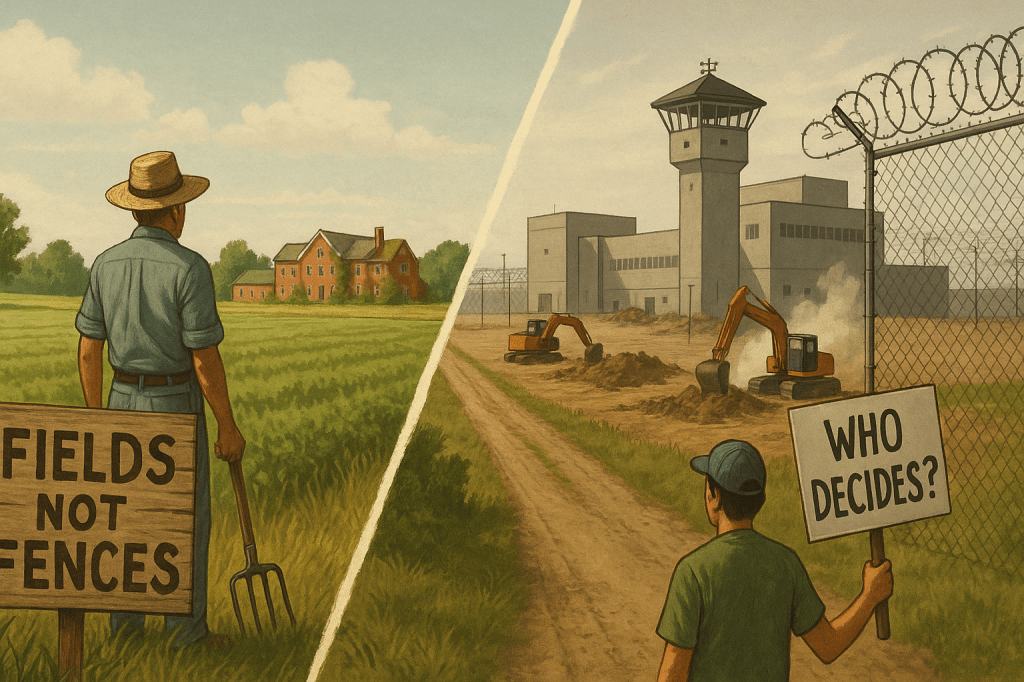
Across a quiet stretch of rural Eastern Ontario, a storm is brewing, not of thunder and rain, but of land use, justice policy, and civic trust. In the town of Kemptville, just 60 kilometers south of Ottawa, the Ontario government has proposed building the Eastern Ontario Correctional Complex (EOCC), a 235-bed provincial jail, on what was once part of the Kemptville College campus; prime agricultural land with deep community roots.

The story of this proposed prison is not only one of construction and policy, but of clashing visions for the future of Eastern Ontario. It is a story of farmland and fences, of children and correctional officers, of infrastructure gaps and political decisions. And perhaps most importantly, it is a story of a community asking why? Why here, and why now?

A Campus Reborn… and a Prison Across the Street

Following the closure of Kemptville College in 2016, the lands were acquired by the Municipality of North Grenville and repurposed into the Kemptville Campus Education and Community Centre. The site now houses educational institutions, youth programs, early learning centres, agricultural innovation hubs, and outdoor experiential learning, drawing hundreds of children and families onto the grounds daily.

Literally across the street, however, the province of Ontario plans to build a modern jail to alleviate overcrowding in Ottawa’s aged and strained Ottawa-Carleton Detention Centre. In 2020, the EOCC was announced without prior consultation with local residents or municipal authorities. Since then, Ontario’s Ministry of the Solicitor General and Infrastructure Ontario have proceeded through environmental, geotechnical, and archaeological assessments, while the procurement process to select a construction partner continues.

In preparation, the province announced a $21.8 million investment in late 2024 to expand the local wastewater treatment facility, an infrastructure boost that would support both the prison and North Grenville’s projected population growth. While this has been framed as a win for the municipality, many in the community see it as paving the way for a facility they never asked for.

Local Voices, Deep Opposition

The backlash has been loud and sustained. The Coalition Against the Proposed Prison (CAPP) has been leading opposition efforts, supported by environmental groups, farmland advocates, and concerned citizens. Their concerns are rooted in what they see as a violation of planning principles: the conversion of 182 acres of prime farmland into a high-security facility in a region ill-equipped for such a purpose.

Their slogan – Fields Not Fences – captures the sentiment. To them, the decision is symbolic of a top-down, opaque approach to governance that neglects local values and long-term sustainability. And perhaps nowhere is this more palpable than on the Kemptville Campus itself.

What About the Kids?

With daycares, high schools, after-school programs, and even an agroforestry centre on the Kemptville Campus, many parents and educators are worried. While there are no official restrictions announced for youth-focused activities, the mere proximity of a medium-security correctional facility raises real questions.

Will the presence of the EOCC, even at a distance, impact perceptions of safety for school trips, outdoor learning, and daycare enrollment? Will families hesitate to send their children to programs just meters away from a working jail? These are not hypothetical concerns, they are being asked by parents, including Mayor Nancy Peckford, whose own children attend the Campus. In public statements, she has pushed the province for assurances, including appropriate setbacks and enhanced communication with the municipality.

The Ministry has agreed to locate the facility as close to Highway 416 as possible, rather than directly beside the campus. It has also committed to design considerations to shield the facility from view, but critics argue that no amount of landscaping can change the fact that children and correctional officers may soon be sharing a road.

Why Not Ottawa?

Perhaps the most confounding part of the province’s decision is its choice to build the jail outside of Ottawa. The provincial rationale, that Eastern Ontario needs more capacity, and that the Kemptville site is government-owned and available, seems less persuasive when weighed against logistical realities. Somehow it feels as if not having to purchase land in Ottawa was the main provincial concern.

Ottawa already hosts the region’s justice infrastructure: courts, legal aid offices, probation services, and public transit. Incarcerated individuals often require court appearances, mental health supports, and visits from family or counsel. Placing a prison in a small town without intercity transit creates additional barriers and isolates the incarcerated even further. It also forces staff to commute from Ottawa, increasing carbon emissions and reducing accessibility.

From an urban planning perspective, this is the antithesis of smart growth. It moves essential services away from existing infrastructure hubs, while forcing a rural community to absorb the impacts, social, environmental, and reputational, of a decision made elsewhere.

The Bigger Picture: Justice, Land, and Power

The Kemptville prison story reveals a broader tension between provincial power and local agency. On one side, a government seeking to modernize correctional infrastructure, reduce Ottawa’s jail overcrowding, and use its own land holdings efficiently. On the other, a community that sees farmland, education, and public trust being sacrificed for a carceral future they do not endorse.

It also reveals the contradictions in Ontario’s approach to land use and justice reform. While it invests in mental health, rehabilitation, and community supports rhetorically, its actions suggest a continued reliance on incarceration, disproportionately impacting Indigenous and racialised people. And while the province claims to value sustainable development, it is choosing to pave over productive farmland at a time when food security and climate resilience are becoming increasingly urgent.

What Comes Next?

Construction of the EOCC has not yet begun. The procurement process is ongoing, and opposition efforts, including a judicial review, are still active. What happens in the next year may determine not only the future of one community, but the direction of Ontario’s justice philosophy.

Will the province revisit its decision in light of sustained resistance? Will it reconsider siting the facility closer to Ottawa, where its infrastructure already exists? Or will it press forward, betting that time and investment will outlast protest?

For now, the fields across from Kemptville Campus remain untouched, but as bulldozers wait in the wings, the people of North Grenville are asking: are we building something we need, or destroying something central to a sustainable community?

Sources

Mr. Carney, Let’s Be Bold and Smart: A Revenue-Neutral Universal Basic Income Is Within Reach

The election of Mark Carney as Canada’s new Prime Minister marks more than a changing of the guard, it signals a chance to transform how we think about economic justice, social policy, and the role of government in a post-pandemic, post-carbon, AI-disrupted world. Yet, if this new Liberal administration wants to do more than manage decline or tinker at the edges, it must champion Universal Basic Income (UBI), and it must do so within this first term.

To skeptics, the usual pushback is cost. “We can’t afford it.” But what if I told you we can, without adding a cent to the deficit?

A bold, revenue-neutral UBI is not only possible, it’s the smart, responsible, and forward-thinking choice. It would simplify our bloated patchwork of social programs, reduce inequality, and stabilize the economy, all while respecting fiscal realities. Carney, with his reputation for monetary prudence and social conscience, is uniquely positioned to make this happen.

The Case for UBI, Now More Than Ever
We live in precarious times. AI and automation are displacing jobs once thought secure. The gig economy has redefined work for an entire generation, offering flexibility but no stability. Climate change is reshaping our industries, economies, and communities. And regional inequalities, from rural depopulation to urban housing crises, are deepening social division.

UBI provides a powerful, simple solution: a no-strings-attached income that ensures every Canadian can meet their basic needs, make real choices, and live with dignity. No complex eligibility criteria. No stigma. Just a stable foundation for all.

This isn’t a call for endless spending. This is a plan for smart reinvestment, one that replaces outdated, fragmented systems with a coherent, efficient, and humane approach.

Revenue-Neutral UBI: A Practical Path
The key to political and economic viability is fiscal neutrality. Here’s how we get there:

Streamline the Social Safety Net
Our current welfare architecture is costly, overlapping, and often punitive. We propose replacing core income support programs, provincial social assistance, EI for low-wage workers, and a range of targeted income-tested tax credits, with a single, universal UBI. This simplification reduces administrative duplication and restores dignity to recipients.

Rethink OAS and GIS
These seniors’ programs already operate as a basic income for the elderly. By integrating them into a universal model, with UBI replacing these benefits for most, but supplemented by needs-based top-ups for seniors with unique medical or housing costs, we ensure fairness without duplication.

Restructure (Not Eliminate) CPP
CPP remains essential as a pension earned through contribution, but some recalibration of contribution thresholds and benefit tiers, alongside UBI, can reduce reliance on inflated public pensions to cover basic needs, while preserving the contributory principle.

Modest, Targeted Tax Reform
To close the revenue loop, introduce a small surtax (e.g., 2%) on individual incomes over $150,000, and slightly increase capital gains inclusion rates. These are not radical measures, they simply ask the wealthiest Canadians to help ensure every citizen has a secure foundation. For 95% of taxpayers, no increase would be necessary.

Numerous economic models (including work by Evelyn Forget, UBC’s Kevin Milligan, and CCPA researchers) show that a well-designed UBI can be nearly or entirely self-funding when paired with smart policy adjustments like these.

Political Opportunity and Liberal Legacy
Prime Minister Carney doesn’t need to look far for historical inspiration. Universal healthcare, bilingualism, the Charter, these were all ambitious Liberal achievements once considered politically risky and fiscally daunting, yet they reshaped Canada.

UBI can be his legacy. It would resonate across voter blocs: rural Canadians seeking stability, urban millennials burdened by debt and housing costs, women and caregivers locked out of full-time work, and gig workers with no safety net. It’s a unifying policy in a fragmented nation.

Moreover, by leading with a revenue-neutral model, Carney can neutralize opposition from deficit hawks and centrists, while winning support from social democrats, Indigenous leaders, environmentalists, and the entrepreneurial class alike.

A Step-by-Step Roadmap

  • Launch a National UBI Task Force in the first 100 days, chaired by experts in economics, social policy, and Indigenous governance.
  • Table a UBI White Paper by the end of Year 1, outlining fiscal models, legal changes, and implementation scenarios.
  • Pilot the program in a representative region (e.g., Northern Ontario, Atlantic Canada, or an urban-rural mix) with independent evaluation.
  • Introduce legislation in Year 3, with phased implementation beginning before the 2029 election.

This is not pie-in-the-sky. This is responsible governance meeting bold vision.

The Values We Must Uphold
UBI is about more than money, it’s about modernizing our social contract. It says to every Canadian: you matter. You are not a cost, a case file, or a problem to manage. You are a citizen with rights, worth, and potential.

Mr. Carney, you’ve spoken eloquently about “values-based capitalism” and “inclusive transitions.” UBI is the policy vehicle that delivers on those values. And by designing it to be fiscally neutral, you can bring the skeptics along without compromising ambition.

Now is the time to lead not just with caution, but with courage. We can afford Universal Basic Income, not in spite of economic constraints, but because of them.

Let’s stop managing poverty. Let’s start guaranteeing security. Let’s build a Canada where no one is left behind.

Shared Spaces, Different Rules: When BDSM, Swinging, and Polyamory Collide

This has been an ongoing topic of conversation among a number of my friends and community members over the last year. While this post is not the definitive answer, I hope it helps continue the discussion.

Merged doesn’t have to mean blurred

More and more, those of us in the BDSM, polyamory, and swinger communities are finding ourselves in overlapping spaces: at events, online, and even in our relationships. What used to be distinct subcultures with their own values and norms is starting to feel like one big, blended scene.

For some, this is energizing. For others, it’s disorienting.

The truth is, we don’t all approach relationships, power, or sex the same way. And while there’s room for overlap, there’s also the risk of misunderstanding, boundary friction, or even cultural erasure if we don’t approach this merger with care.

So let’s talk about what we’re gaining, and what we could lose, when our communities start to share the same space.

Why the Overlap is Happening

The convergence of these communities isn’t random. We all operate outside traditional relationship structures and sexual expectations. We value consent, self-determination, and authenticity.

And let’s be honest; finding safe, welcoming spaces can be hard. It makes sense that events and groups are becoming more collaborative and open to cross-community participation.

Many people don’t want to pick just one label. A polyamorous submissive might enjoy occasional swinger parties. A Dominant may explore romantic non-monogamy. Shared spaces let people experiment and connect without feeling boxed in.

On a practical level, venue access, costs, and organizers’ energy also drive collaboration, yet collaboration only works when we recognize how different our needs and expectations can be.

What We Gain by Coming Together

💬 Bigger, Stronger Communities
Merging creates larger, more resilient networks. Whether we’re sharing resources, building friendships, or pushing for social recognition, we’re stronger together.

📚 Learning Across Lifestyles
Each community has something to teach. BDSM offers detailed consent frameworks and boundary-setting. Polyamory brings emotional literacy and communication models. Swingers know how to host low-pressure sexual spaces. Shared wisdom benefits us all.

🎉 More Inclusive Events
Workshops, discussion nights, and play parties with room for cross-community participation give people a chance to explore without committing to a label.

📢 Amplified Visibility
Speaking together helps shift the narrative about non-normative relationships and sexualities. We challenge stereotypes more effectively when our voices are united.

But There Are Real Risks, Too

⚠️ Different Cultures, Different Norms
Each community operates on its own foundation:

  • BDSM: Structured power dynamics, not necessarily tied to sex or romance.
  • Swinging: Primarily recreational sex, often in couple-based social networks.
  • Polyamory: Emotional intimacy, often with long-term relational goals.

These are more than an orientation or styles, they’re cultural languages. Colliding without translation causes friction.

🚧 Consent and Boundary Confusion
In BDSM, consent is explicit and often negotiated in advance. In swinger circles, casual physicality may be expected. Poly meetups might center on emotional connection, not touch. If expectations aren’t clear, people get hurt, even unintentionally.

🏠 Loss of Dedicated Spaces
Some BDSM dungeons now carry sexual expectations introduced through swinger norms. For those who use BDSM as a non-sexual, power-centered expression, that shift can feel deeply alienating.

🧩 Risk of Exclusion
When merged spaces cater mostly to those who fit all three categories, others get pushed to the edge. An asexual Dominant, or a solo polyamorous person uninterested in parties, may not find what they need in these new environments.

🤷‍♂️ Public Misunderstanding
Outsiders already conflate BDSM, polyamory, and swinging. Merged visibility can increase confusion: polyamory gets reduced to casual sex, BDSM gets sexualized, swinging gets dismissed. Nuance is lost.

So How Do We Do It Right?

Clarity Above All
Be transparent. Is this a BDSM workshop with room for poly topics? A swinger party with structured scenes? People need to know what they’re walking into.

Consent Is More Than a Buzzword
It’s not just about sex or play – it’s about everything. Don’t assume touch, energy, or conversation is welcome without agreement.

Shared Events, Distinct Zones
Merged doesn’t have to mean blurred. Offer spaces within events that honor BDSM protocol, support poly dialogue, or provide swinger-friendly play. Let people choose their comfort zones.

Center Marginalized Voices
Make space for the folks who get overlooked – queer, trans, neurodivergent, BIPOC, disabled, and asexual folks deserve to feel included in merged scenes, too.

Final Thoughts

The blending of BDSM, swinging, and polyamory is happening, whether we plan for it or not. The question is: will we do it with care?

We don’t need to erase our boundaries to share space. We just need to see each other clearly, communicate well, and build with intention.

If we do that, we create a community that’s not only broader; but deeper, richer, and more resilient than any of us could build alone.


Suggested Tags

#BDSM #Polyamory #Swingers #Community #ConsentCulture #NonMonogamy #EthicalNonMonogamy #PowerExchange #RelationshipAnarchy #RespectTheDifferences #MergedSpaces #AltSexualities #NavigatingBoundaries #FetLifeVoices