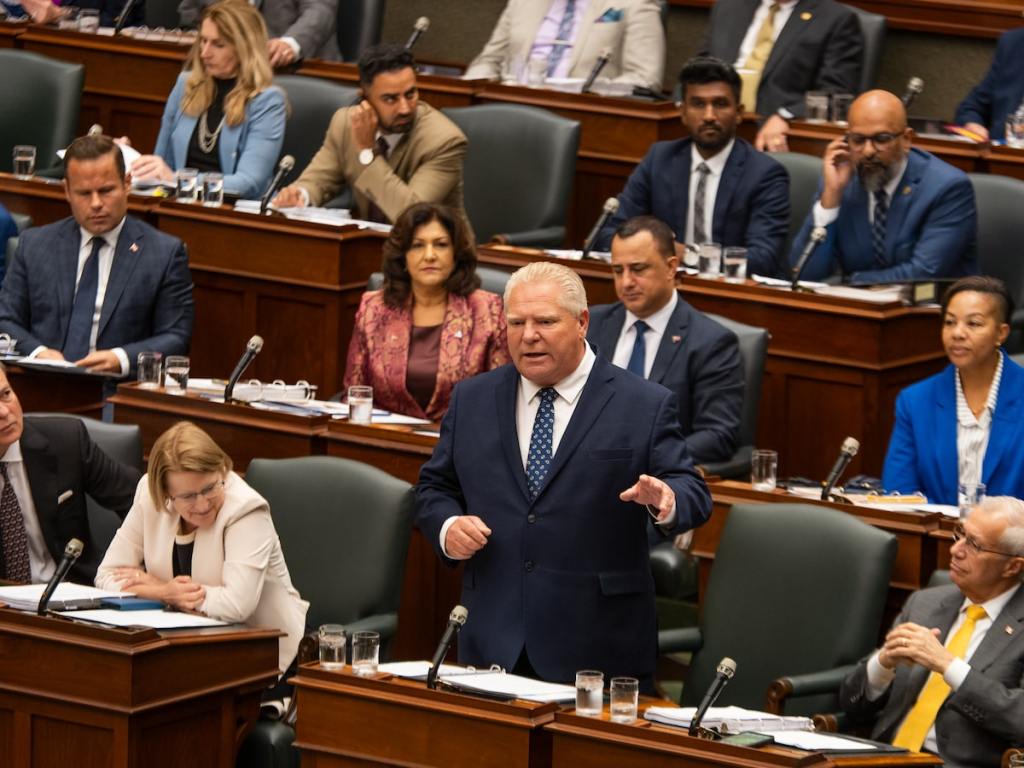
The Ontario government has introduced a proposal that would fundamentally alter the province’s access to information regime. The amendments under consideration would exclude records held by the premier, cabinet ministers, and their political offices from the scope of the province’s Freedom of Information law. At the same time, the proposal would lengthen the time government institutions have to respond to information requests and apply the new rules retroactively to requests already in the system. Taken together, these measures would mark a sharp departure from the principles that have guided public access to government records in Ontario for more than three decades.
Access to information legislation exists for a simple reason. Democratic governments exercise power on behalf of the public, and the public therefore has a right to understand how decisions are made. Ontario’s Freedom of Information and Protection of Privacy Act was built around that principle. While certain categories of information have always been protected, particularly cabinet deliberations and personal privacy, the general premise has remained clear: records created in the conduct of public business belong, ultimately, to the public.
The proposed amendments would carve out a new and sweeping exception. Records located in the offices of the premier and cabinet ministers would no longer be subject to access requests. In practical terms, that means that political offices at the centre of provincial decision making could become zones of administrative opacity. Documents relating to policy discussions, communications with stakeholders, or advice provided by political staff could simply fall outside the reach of the law.
The implications are not merely theoretical. Many of the most significant investigative revelations in Ontario politics have emerged through freedom of information requests directed at ministerial offices and related records. Journalists and public interest groups have relied on those requests to understand how decisions were shaped, who was consulted, and what information was available to decision makers at critical moments. Removing political offices from that framework would inevitably narrow the public record.
The proposal’s retroactive component raises an additional concern. Retroactive secrecy sits uneasily within a legal framework designed to promote transparency. When governments change the rules governing access to information after requests have already been filed, the effect is not merely administrative. It risks creating the perception that the rules are being rewritten to shield particular controversies or decisions from scrutiny.
The extension of response timelines from thirty days to forty five business days may appear modest by comparison, yet it reinforces the same broader trend. Access delayed is frequently access denied, particularly in an environment where timely disclosure is essential for public debate. Journalists working to inform citizens about active political controversies depend on the timely release of records. Lengthening the process reduces the practical value of the information that is eventually disclosed.
Governments routinely argue that greater confidentiality is necessary for effective decision making. Cabinet discussions require a degree of privacy. Political staff must be able to offer candid advice. Those principles have long been recognized within the existing law. The problem arises when the zone of confidentiality expands so far that it begins to swallow the principle of public accountability itself.
Ontario’s access to information system has never been perfect. Delays, redactions, and bureaucratic caution have always limited the flow of records. Yet the framework established a basic expectation that the machinery of government would operate under a presumption of openness. The proposed amendments would move the province in the opposite direction, concentrating greater informational power within the political executive while reducing the public’s ability to examine how decisions are made.
Transparency laws are not technical administrative instruments. They are structural features of democratic governance. When access to information narrows, the distance between citizens and the institutions that govern them inevitably grows. The current proposal therefore represents more than a routine legislative adjustment. It signals a shift in the balance between political authority and public oversight, one that risks weakening a cornerstone of democratic accountability in Ontario.
Across the industrial world there has been a long and sometimes quiet struggle over the ownership of essential infrastructure. Electricity grids, railways, telecommunications networks, and pipelines have all passed through cycles of public construction and private acquisition. Yet among these, water occupies a fundamentally different category. It is not merely an economic input or a commercial service. It is a precondition for life, public health, and social stability. When a society debates the governance of water systems, it is not arguing about a typical utility. It is debating the stewardship of a shared biological necessity.
Ontario now finds itself at the edge of such a debate.
Recent legislative changes, most notably those contained within Bill 60 – Fighting Delays, Building Faster Act, 2025, create new mechanisms through which municipal water and wastewater systems may be transferred into corporate governance structures. The government’s stated intention is administrative efficiency and infrastructure financing. Ontario’s rapidly growing population requires substantial investment in water infrastructure, and municipalities are under increasing fiscal pressure to expand treatment capacity, pipelines, and pumping stations. From a narrow administrative perspective, the argument is straightforward. Corporate utilities can borrow capital more flexibly and operate with financial tools unavailable to traditional municipal departments.
But efficiency arguments alone cannot settle the deeper question.
Public utilities exist because certain services are too fundamental to leave entirely to the logic of markets. Water systems in Canada were built during the twentieth century precisely because the private delivery of drinking water had repeatedly proven unreliable, inequitable, and sometimes dangerous. Municipal ownership was not an ideological experiment. It was the result of a century of public-health lessons learned through epidemics, contamination events, and uneven private provision.
Ontario’s own history contains one of the most sobering reminders of that truth. The tragedy of Walkerton Water Crisis demonstrated with painful clarity that water governance demands uncompromising accountability. The response in the years that followed was not to dilute public oversight but to strengthen it. Ontario built one of the most rigorous drinking water regulatory regimes in the world, premised on the principle that safe water is a public responsibility.
That principle deserves careful protection.
The concern raised by critics of the new legislative framework is not that privatization will occur immediately. Rather, the concern lies in the structural pathway that corporatization creates. When water utilities are moved out of direct municipal governance and into corporate entities, the nature of decision-making changes. Boards replace councils. Rate structures become financial instruments. Infrastructure planning is evaluated increasingly through the lens of return on investment rather than the broader calculus of community welfare.
None of these shifts automatically produce privatization. Yet they move the system closer to the institutional architecture within which privatization becomes possible.
The international experience provides numerous examples of this progression. In several jurisdictions, the path toward private water delivery began not with outright sales of infrastructure but with the creation of corporate utilities, public-private partnerships, and long-term concession agreements. Over time, financial pressures and political incentives often pushed these arrangements further toward private control. Once essential infrastructure is embedded within corporate governance frameworks, the distinction between public service and commercial utility can gradually blur.
The risk is not merely ideological. It is practical.
Water systems require long-term investment horizons measured in decades. Pipes laid beneath city streets may remain in service for half a century. Treatment plants operate for generations. Public ownership aligns naturally with these timelines because governments exist to steward infrastructure across electoral cycles. Private entities, even well-regulated ones, operate under shorter financial expectations. Shareholder value and quarterly performance rarely align with the slow maintenance rhythms of buried municipal infrastructure.
There is also the matter of democratic legitimacy. Municipal water systems today are ultimately accountable to elected councils. Citizens can vote out the officials responsible for water policy. Rate increases, infrastructure investments, and service priorities are debated in public forums. Corporate governance, by contrast, places these decisions within boardrooms whose members are not directly accountable to voters.
Water policy should not be insulated from democratic oversight. It should be anchored within it.
None of this denies the real financial pressures facing municipalities. Ontario’s growing cities must build enormous quantities of new water infrastructure to support housing construction and economic expansion. Financing models will need to evolve. Innovative approaches to capital investment may be necessary. Yet innovation in financing should not be mistaken for a justification to weaken public ownership.
The core principle should remain simple and clear.
Water systems belong to the communities that depend on them. The reservoirs, aqueducts, pumping stations, and treatment plants that sustain modern cities were built with public resources over generations. They represent a shared civic inheritance. Their purpose is not to generate profit but to safeguard public health and ensure universal access to a basic human necessity.
Public utilities exist precisely because some services are too important to treat as commodities. Water is foremost among them.
Ontario’s policymakers would therefore be wise to proceed with caution. Legislative frameworks designed for administrative flexibility can sometimes produce unintended consequences decades later. Once governance structures shift, reversing course becomes difficult. Infrastructure systems have a way of locking in the institutional assumptions under which they were built.
The question facing the province is therefore larger than the technical design of utility corporations. It is about the kind of stewardship Ontarians expect for the most essential resource in their society.
A civilized state recognizes that certain responsibilities cannot be outsourced. Among them is the simple but profound duty to ensure that every citizen can turn on a tap and trust what flows from it.
Water, quite simply, should remain in the hands of the people.
There are political decisions that change a nation’s trajectory, and then there are political decisions that change the clock on the microwave twice a year.
British Columbia’s long-gestating move to end seasonal time changes belongs to the second category. And yet, like so many small administrative reforms, it reveals more about governance, coordination, and federalism than its modest subject suggests.
When David Eby says the issue is about “making life easier for families” and “reducing disruptions for businesses,” he is not wrong. Twice a year, millions of people reset schedules, disrupt sleep cycles, confuse meeting times, and briefly destabilize routines. The economic cost is diffuse but real. The human irritation is universal.
But the British Columbia story is not simply about clocks. It is about interdependence.
A Province Ready, A Continent Not British Columbia passed legislation in 2019 to adopt permanent daylight saving time. The public consultation showed strong support. The mechanics were prepared. The legal framework exists. Yet implementation stalled because BC tied its decision to the U.S. Pacific Northwest, particularly Washington, Oregon, and California.
Why? Because Vancouver and Seattle function less like distant cities and more like adjacent economic zones. A two-hour time gap for part of the year would complicate trade, transportation, markets, and daily cross-border life. So BC waited on American congressional action that never arrived.
That is the quiet absurdity of modern federalism. A provincial legislature can pass a law. A neighbouring state legislature can pass a similar law. And both remain inert because a third legislative body, thousands of kilometres away in Washington, D.C., controls the clock.
BC’s renewed political framing signals impatience with that paralysis.
Canada’s Patchwork Time Regime Canada does not have a single national time policy. Provinces decide.
Saskatchewan effectively does not change clocks. Yukon moved to permanent time in 2020. Ontario passed legislation that would end seasonal changes, but only if Quebec and New York follow suit. Nova Scotia has debated similar moves.
In other words, the legislative scaffolding already exists across multiple provinces. What is missing is synchronization.
This is the core tension. Canadians dislike changing clocks. Legislatures have responded. Yet every province that is economically entangled with a neighbour hesitates to move unilaterally.
BC’s decision, if implemented regardless of U.S. action, would break that coordination norm. It would demonstrate that a province can absorb the temporary inconvenience of cross-border time divergence in exchange for internal consistency.
That matters.
The Real Policy Question No One Likes to Debate There is also a deeper issue that remains politically underexplored. Ending clock changes is popular. Choosing which time to keep is less so.
Permanent daylight saving time means brighter winter evenings and darker winter mornings. In northern latitudes, those mornings become very dark indeed. Sleep researchers often argue permanent standard time aligns better with human circadian rhythms. Politicians prefer the marketing appeal of longer evening light.
BC chose permanent daylight saving time.
The choice is not trivial. It reflects a cultural preference for after-work daylight over morning biological alignment. It favours consumer time over solar time.
That debate is barely visible in the political messaging, but it exists beneath the surface.
What This Means for Canada If BC proceeds, several things follow.
First, Ontario’s conditional legislation becomes harder to justify. The argument that “we must wait for everyone” weakens once one major province decides not to.
Second, public debate will intensify in provinces that have already prepared legislative tools but lack political momentum.
Third, the federal government may find itself facing pressure for coordination, even if timekeeping remains a provincial power. A national conversation could emerge not because Ottawa initiated it, but because provincial asymmetry forces it.
Will the rest of Canada follow immediately? No.
Will BC’s move increase the probability of broader change within five years? Very likely.
Clock policy is rarely transformative. But it is revealing. It exposes how deeply integrated provincial economies are with the United States. It demonstrates the limits of legislative autonomy in a continental marketplace. And it shows that even mundane administrative reforms require geopolitical choreography.
In the end, this is not about daylight. It is about governance friction.
And as with so many small reforms, once one jurisdiction proves that the sky does not fall when the clocks stop changing, others tend to follow.
Trade agreements are rarely about trade alone. They are instruments of strategic positioning, domestic reassurance, and geopolitical signaling. The proposed Comprehensive Economic Partnership Agreement between Canada and India sits squarely at this intersection. It is less a conventional tariff-cutting exercise than a test of whether two pluralistic democracies with complicated domestic politics can construct a durable economic relationship in a fragmenting global order.
For Canada, the motivation is increasingly structural rather than opportunistic. An export economy anchored overwhelmingly to the United States faces persistent vulnerability to policy shifts south of the border. The impulse to diversify markets is not new, but recent protectionist currents and the volatility of U.S. trade policy have transformed diversification from aspiration into necessity. India, with its scale, growth trajectory, and relative institutional stability, represents one of the few markets capable of absorbing Canadian exports at meaningful volume while also offering reciprocal opportunities.
India’s motivation is different. New Delhi seeks capital, technology, energy security, and access to advanced services while preserving policy autonomy and protecting domestic producers. Indian trade strategy has historically favored gradualism, selective liberalization, and strong safeguards for agriculture and small industry. Any agreement with Canada will therefore reflect asymmetry not only in economic structure but also in negotiating philosophy.
The present talks must also be understood as a recovery operation. Bilateral relations were deeply strained by political tensions and security allegations in recent years. The resumption of negotiations signals a pragmatic decision on both sides that economic interests outweigh diplomatic estrangement. However, the shadow of mistrust has not disappeared. Trade negotiators may speak the language of tariffs and regulatory alignment, but political leaders must manage constituencies that view the other country through a lens of suspicion. This complicates ratification even if technical negotiations succeed.
Structural Complementarities and Frictions At first glance, the Canadian and Indian economies appear complementary. Canada is resource-rich, capital-intensive, and export-oriented in commodities and advanced services. India is labor-abundant, manufacturing-aspiring, and consumption-driven. In theory, this creates a classic pattern of mutually beneficial exchange: resources and expertise flowing one way, manufactured goods and services the other.
Agriculture illustrates both promise and tension. Canada is a major exporter of pulses, grains, and oilseeds that India periodically requires to stabilize domestic food prices. Yet India also protects its farmers aggressively for social and political reasons. Tariffs, quotas, and sudden regulatory changes are common policy tools in New Delhi’s domestic management of food security. Canadian producers seek predictable access; Indian policymakers seek flexibility. Reconciling these priorities will be among the most technically complex elements of any agreement.
Manufactured goods pose a different challenge. India wants improved access for its industrial exports, particularly in sectors where it aims to move up the value chain. Canadian industry, smaller in scale and already exposed to U.S. competition, may resist additional pressure from lower-cost producers. Trade agreements often redistribute opportunity within economies as much as between them, creating domestic winners and losers whose political influence shapes final outcomes.
Energy, Minerals, and the Strategic Core If there is a single domain capable of anchoring a durable Canada–India partnership, it is energy and critical resources. India’s economic expansion will require enormous quantities of fuel, electricity generation capacity, and raw materials for infrastructure and technology. Canada possesses many of these in abundance, from hydrocarbons to uranium to battery minerals.
Uranium cooperation is particularly significant. India’s nuclear energy program is expanding as part of its strategy to reduce carbon intensity while maintaining baseload power. Canadian uranium, already exported to several countries under strict safeguards, could become a cornerstone of this effort. Such trade is not merely commercial; it embeds long-term strategic interdependence through supply contracts, regulatory oversight, and technological cooperation.
Critical minerals represent another convergence point. The global transition toward electrification and digital infrastructure has elevated materials such as lithium, nickel, and cobalt from niche commodities to strategic assets. Canada seeks reliable buyers and investment in extraction and processing. India seeks secure supply chains independent of geopolitical rivals. Agreements in this domain may proceed faster than broader trade liberalization because both sides perceive them as mutually reinforcing national priorities.
Energy exports more broadly face logistical constraints. Canada’s infrastructure has historically been oriented toward the U.S. market. Expanding shipments to Asia requires pipelines, liquefaction facilities, and port capacity that take years to build and are subject to domestic environmental debates. Thus, even if market access improves on paper, physical delivery capabilities will shape the real economic impact.
Services, Mobility, and the Human Dimension Trade in the twenty-first century increasingly involves services, knowledge, and people rather than goods alone. Canada’s strengths in education, finance, engineering, and digital industries align with India’s demand for advanced expertise. Conversely, India’s vast pool of skilled professionals seeks opportunities abroad, including temporary work arrangements and educational pathways.
Mobility provisions are therefore likely to be politically sensitive but economically important. Canadian policymakers must balance labor market needs with public concerns about immigration levels. Indian negotiators view mobility as a central benefit of any agreement. Achieving equilibrium may require targeted programs for specific sectors rather than broad liberalization.
Educational links deserve special attention. India is one of the largest sources of international students in Canada, generating both economic activity and long-term people-to-people ties. Regulatory changes affecting student visas have already demonstrated how quickly this channel can expand or contract. A trade framework that stabilizes educational cooperation would have effects far beyond tuition revenues, influencing innovation networks and diaspora relations.
Political Economy and Ratification Risks Even the most carefully negotiated agreement must survive domestic politics. In Canada, provinces hold significant authority over areas such as natural resources and procurement. Their support is essential. Agricultural regions, manufacturing hubs, and energy-producing provinces will evaluate the deal through different lenses, potentially producing a fragmented national consensus.
In India, federal structures and state-level interests also complicate implementation. Agricultural policy in particular is intertwined with regional politics and rural livelihoods. National leaders may sign agreements that require delicate internal balancing to enforce.
Public perception will matter as much as economic modeling. Trade deals are often judged not by aggregate gains but by visible disruptions. Industries facing adjustment costs mobilize more effectively than diffuse beneficiaries. A government that frames the agreement as part of a broader strategy for economic resilience rather than a narrow commercial bargain stands a better chance of sustaining support.
Timeline Realities and the Meaning of “Signing” Predictions that a comprehensive agreement could be concluded within a single year should be treated cautiously. Modern trade agreements are sprawling legal instruments covering intellectual property, digital governance, investment rules, dispute settlement mechanisms, and environmental standards. Negotiating these provisions typically requires years.
A more plausible scenario involves a staged process. An initial framework agreement or “early harvest” package could address less contentious areas such as investment facilitation, cooperation on energy and minerals, and selected tariff reductions. This would allow political leaders to demonstrate progress while leaving more difficult issues for subsequent rounds.
Such incrementalism aligns with India’s negotiating tradition and Canada’s desire for tangible diversification gains. It also reflects the reality that trust, once damaged, must be rebuilt gradually.
Strategic Significance Beyond Commerce Ultimately, the importance of a Canada–India partnership extends beyond bilateral trade statistics. It represents a recalibration of middle-power diplomacy in an era when the global system is increasingly defined by great-power rivalry and economic fragmentation. For Canada, engagement with India signals participation in the Indo-Pacific’s economic architecture. For India, deeper ties with a G7 country reinforce its status as a central actor rather than a peripheral one.
The agreement, if realized, would not replace Canada’s relationship with the United States, nor would it transform India into Canada’s primary market. Its value lies in diversification, resilience, and optionality. In a world where supply chains can be weaponized and alliances can shift abruptly, having multiple reliable partners is itself a form of economic security.
Whether the deal is signed this year or several years hence, the direction of travel is clear. Both countries perceive that disengagement carries higher long-term costs than cooperation, even when cooperation is difficult. Trade agreements often emerge not from optimism but from recognition of shared necessity. The Canada–India negotiations appear to fit this pattern precisely.
For most of the postwar era, Canada treated defence dependence on the United States not as a vulnerability but as a convenience. Geography, shared language, integrated command structures, and the comforting mythology of permanent alignment made it easy to believe that continental security was a solved problem. The bill would always be paid in Washington. The industrial base would always be American. Canadian sovereignty, in practical terms, would be exercised mainly through polite consultation. That arrangement delivered peace dividends, but it also produced a quiet atrophy of national capability.
The emerging shift associated with Mark Carney signals a different mood. Not anti-American, not theatrical, simply overdue. Strategic adulthood rarely arrives with fanfare. It arrives when a country realizes that dependence is not the same thing as partnership, and that insurance policies only work if one can pay the premium personally when required.
Canada is not uniquely weak, nor uniquely trapped. It is simply a medium-sized power that spent three decades optimizing for efficiency instead of resilience. Defence procurement favored off-the-shelf purchases from the largest supplier. Supply chains stretched across borders because accountants, not strategists, set the terms. Domestic production became episodic, revived only when a crisis or regional jobs program demanded it, then allowed to fade again. None of this was irrational. It was merely short-sighted.
Yet history offers a reminder that capability can be rebuilt when a state decides it matters. During the Second World War, Canada transformed itself into one of the world’s major industrial producers almost overnight, constructing ships, aircraft, vehicles, and munitions at a scale wildly disproportionate to its population. The lesson is not that such mobilization should be repeated, but that industrial capacity is not a natural resource. It is a political decision sustained over time.
Aerospace as Proof of Latent Capacity Canada’s aerospace sector demonstrates what consistent investment can achieve. Firms such as Bombardier, Pratt & Whitney Canada, Bell Textron Canada, and CAE occupy world-class positions in their niches. Engines designed in Quebec power aircraft on every continent. Flight simulators built in Montreal train pilots from dozens of air forces. These are not symbolic achievements. They are the infrastructure of modern military power, even when marketed as civilian products.
What is striking is not that Canada lacks expertise, but that it rarely organizes this expertise toward sovereign capability. The country produces components for other nations’ systems while importing finished platforms for its own forces. It is the industrial equivalent of exporting lumber and importing furniture. Economically sensible in peacetime, strategically questionable in an era defined by contested supply chains.
Shipbuilding and the Slow Return of Patience Naval construction tells a similar story. After decades of decline, Canada chose to rebuild shipyards through long-term programs rather than one-off contracts. Irving Shipbuilding and Seaspan are now producing vessels again, slowly reconstituting skills that had nearly vanished. The process has been expensive, imperfect, and frequently criticized. It is also precisely how industrial capacity is restored: by accepting that competence cannot be purchased instantly from abroad.
The deeper lesson is psychological. A country accustomed to buying finished products must relearn how to tolerate development risk, schedule overruns, and the political discomfort of long timelines. Sovereignty is not a subscription service with monthly billing. It is capital expenditure.
None of this implies a clean break from the United States, nor should it. The continental defense relationship is anchored in geography and mutual interest, not sentimentality. Integrated warning systems, intelligence sharing, and joint planning are rational responses to a shared landmass facing the Arctic. What changes is the assumption that Canada must therefore remain permanently industrially subordinate. Allies can cooperate without one being structurally dependent on the other’s factories.
Critics often argue that Canada lacks the scale to sustain a full defense industry. The argument is only half true. No middle power produces everything domestically, including the United States, which relies on global supply chains despite its rhetoric of self-reliance. The real question is not whether Canada can be fully independent. It is which capabilities are too important to outsource indefinitely. Ammunition, surveillance systems, cyber tools, Arctic infrastructure, and logistics resilience fall into that category far more than prestige platforms designed primarily for alliance interoperability.
Economic logic alone will never justify these investments. Autonomy is inefficient by design. Domestic production costs more than bulk purchasing from a superpower. Redundant supply chains look wasteful until the moment they become essential. The decision to proceed anyway reflects a shift from peacetime accounting to strategic accounting, where resilience has value even when it sits idle.
There is also a quiet geopolitical realism behind the change. The United States itself has become less predictable, not necessarily hostile, but increasingly focused on internal priorities and great-power competition elsewhere. Allies are being encouraged, sometimes bluntly, to shoulder more responsibility. Taking that message seriously is not disloyalty. It is compliance.
From this perspective, the move toward greater Canadian defence autonomy feels less like a bold new doctrine and more like catching up with the obvious. A wealthy G7 country with vast territory, critical resources, and Arctic frontage should not rely on external production for core security needs. That it has done so for so long reflects historical good fortune as much as strategic wisdom.
The transition will be slow, uneven, and occasionally frustrating. Procurement systems will resist change. Budgets will provoke domestic debate. Some projects will fail. Others will succeed quietly and receive little attention because resilience rarely makes headlines. Over time, however, a more balanced posture can emerge: one in which Canada remains a committed ally while also possessing the means to act when alliance consensus falters.
In that sense, the prevailing attitude of “about time” is not triumphalism but relief. A mature state does not measure sovereignty by how loudly it proclaims independence, but by how calmly it prepares for the possibility of standing on its own. Moving in that direction now, before necessity turns into crisis, is not alarmism. It is prudence finally outrunning complacency.
📅 Saturday, February 21 → Friday, February 27, 2026
🇺🇦 1) Ukraine War Enters a New Phase ⚔️
Ukraine’s war with Russia continued with intensified fighting and renewed Western support discussions. While front lines shifted only marginally, the scale of combat and equipment losses remained high.
Key points:
Heavy fighting persists in eastern regions
Ongoing debates over additional sanctions and aid
Concerns about long-term war fatigue in allied nations
➡️ The conflict remains one of the central drivers of global security uncertainty.
🇺🇸 2) U.S. Politics Heats Up Ahead of 2026 Elections 🗳️
Early maneuvering for the 2026 midterm elections accelerated, with both major parties sharpening their messaging on the economy, immigration, and national security.
Key points:
Campaign organizations expanding operations
Key swing states receiving early attention
Policy debates intensifying in Congress
➡️ Political rhetoric is expected to escalate as the election cycle unfolds.
📉 3) Global Economy Sends Mixed Signals 💹
Financial markets delivered uneven performance as inflation cooled in some regions while growth slowed in others. Central bank policies continue to dominate investor expectations.
Key points:
Interest rates remain a major concern
Energy prices fluctuate amid geopolitical risks
Manufacturing weakness in parts of Europe and Asia
➡️ Economists describe the outlook as fragile rather than stable.
🌦️ 4) Extreme Weather Continues Worldwide 🌪️
Floods, storms, and unusual temperature patterns affected multiple regions, highlighting the ongoing impact of climate volatility on infrastructure and communities.
Key points:
Flooding events in several countries
Drought concerns persist elsewhere
Rising costs for insurance and recovery
➡️ Scientists warn that extreme weather is becoming more frequent and disruptive.
🚀 5) Space Exploration Momentum Builds 🌕
National space agencies and private companies continued preparations for lunar and deep-space missions, underscoring the accelerating pace of the modern space race.
Key points:
New missions in development or testing
Growing international cooperation
Expanding role of commercial providers
➡️ Space exploration is increasingly multinational and commercially driven.
✨ The Big Picture
This week reflected a world balancing geopolitical tension, economic uncertainty, climate pressure, and technological ambition. Rather than a single dominant headline, multiple long-term trends continued to shape global events simultaneously.
There is a recurring belief in Canadian municipal politics that scale solves problems. If governance feels messy, make it larger. If coordination is difficult, centralize it. If local voices disagree, fold them into a single chorus and call it harmony. The proposal to merge the municipalities of the Regional Municipality of Niagara into one city rests squarely on this assumption: that bigger government will behave more rationally, more efficiently, and more strategically than a collection of smaller ones.
History suggests otherwise.
Niagara is not a fragmented city waiting to be assembled. It is a region of distinct places bound together by geography, not by a single urban heartbeat. Niagara Falls lives on tourism and spectacle. St. Catharines functions as an educational, service, and industrial hub. Welland carries a canal town identity shaped by manufacturing and working-class roots. Niagara-on-the-Lake trades on heritage, agriculture, and controlled growth. The lakefront communities of west Niagara look toward Hamilton, not the Falls. Rural townships measure success in acres preserved, not towers approved.
To govern these places as though they share identical needs is not efficiency. It is administrative wishful thinking.
The Ottawa Example: A Warning, Not a Blueprint Advocates of amalgamation frequently point to the creation of the modern Ottawa from the former Regional Municipality of Ottawa–Carleton as proof that diverse municipalities can be fused into a single functional city. What is often omitted is that the fusion solved technical coordination problems while creating enduring political ones.
Ottawa gained unified transit planning, standardized services, and the ability to execute large infrastructure projects. It also inherited a permanent rural-urban divide that shapes every budget, planning decision, and election cycle. Farmers in the outer wards pay for light rail they will never ride. Suburban taxpayers argue they subsidize downtown priorities. Former municipalities continue to organize politically along pre-2001 boundaries, a quarter century later.
Amalgamation did not erase local identity. It merely removed the local governments that once represented it.
Niagara would face this tension in amplified form. Ottawa, despite its diversity, had a dominant employment core and a single metropolitan labour market. Niagara has several centres and multiple economic logics. Tourism, agriculture, manufacturing, retirement living, cross-border trade, and suburban commuting do not pull in the same direction.
Power Will Flow Somewhere Every amalgamation produces a gravitational centre, whether intended or not. Decisions must be made, staff must be housed, budgets must be prioritized. In a single Niagara city, influence would inevitably concentrate in the largest population centres, most likely St. Catharines or Niagara Falls. Smaller municipalities would not disappear, but their ability to shape outcomes would diminish.
This is not a moral failure. It is mathematics.
Residents of smaller towns would still vote, but their votes would be diluted across a much larger electorate. Local issues that once dominated council agendas would become minor items competing with region-wide priorities. A zoning dispute that matters deeply to a village could be invisible in a chamber preoccupied with housing targets or tourism infrastructure.
Democracy at scale becomes less intimate and more transactional.
Coordination Without Erasure None of this suggests the status quo is perfect. Niagara does suffer from fragmented planning, duplicated administration, and occasional municipal rivalry. Regional transit integration demonstrates that cooperation can produce tangible benefits without dissolving local governments. Shared services for policing, utilities, and infrastructure can achieve economies of scale while preserving local autonomy.
The real strategic question is not whether Niagara needs to function more cohesively. It is whether cohesion requires uniformity.
A region can behave like a federation rather than a unitary state. Strong regional planning frameworks, binding growth strategies, and pooled services can align municipalities without forcing them into a single institutional mold. This approach accepts that diversity is not a problem to be engineered away but a reality to be governed intelligently.
Bigger Is Not the Same as Better Large cities do not automatically make better decisions. They simply make larger ones. When those decisions are wrong, the consequences are correspondingly bigger. A misjudged development strategy, infrastructure investment, or tax policy applied across a half-million residents can entrench problems for decades.
Small municipalities, for all their limitations, retain the ability to experiment, adapt, and reflect local priorities quickly. They function as laboratories of governance. Amalgamation replaces this patchwork of experimentation with a single policy regime that must suit everyone and will inevitably fit some poorly.
Uniformity feels orderly from a distance. Up close, it can be suffocating.
The Strategic Path Forward If Niagara seeks a more prosperous and coherent future, the priority should be integration of function rather than consolidation of identity. Build region-wide systems where scale truly matters: transit, major infrastructure, environmental management, economic promotion. Preserve local decision-making where place matters most: land use, community character, local services, cultural priorities.
The lesson from Ottawa is not that amalgamation fails or succeeds. It is that it solves some problems while creating others that cannot easily be reversed. Once municipalities disappear, recreating them is practically impossible.
Niagara does not need to become one city to act like a mature region. It needs governance arrangements that respect the fact that it is not one place, and never has been.
Bigger government can coordinate more. It cannot care more, listen better, or understand the nuances of twelve different communities at once. Those qualities arise from proximity, not scale.
At the Munich Security Conference, European leaders openly discussed preparing for a world where U.S. protection may no longer be guaranteed 🇪🇺⚔️.
Greater European military autonomy
Expanded defense spending
Discussion of relying on France’s nuclear deterrent
The tone was stark: leaders warned that the post-Cold War security framework may be fading. This points toward a long-term restructuring of global power relationships.
✈️ 2. Italy Moves to Ban Strikes During the Winter Olympics
With millions expected to travel for the Milano-Cortina Winter Games, Italy announced emergency measures to prevent airport shutdowns 🚫✈️.
Planned labor strikes threatened major disruption
Government intervention to suspend airport walkouts
Security concerns following prior transport incidents
Hosting the Olympics often leads governments to prioritize uninterrupted transport and security over normal labor actions.
🎭 3. Massive Indian Cultural Festival in Kuwait
More than 700 performers showcased Indian heritage at a major open-air festival on Kuwait’s Green Island 🇮🇳🎶.
Traditional dance and music performances
Food, crafts, and cultural exhibits
Strong participation from expatriate communities
Free public access
The event highlighted the growing influence of diaspora communities and cultural diplomacy in the Gulf region.
Large-scale Russian drone attacks struck energy facilities and port infrastructure, particularly around Odesa ⚡🚁.
Damage to power systems
Economic disruption
Pressure on export routes
Ongoing humanitarian risks
The conflict continues to shape global security, energy markets, and political alignment across Europe.
🪐 5. Saturn Enters Aries — A Cultural Moment
Saturn’s transition into Aries generated widespread global attention in astrology circles 🔮✨.
Last occurred in the late 1990s
Interpreted as a period of accountability and upheaval
Major engagement across social media and popular culture
Regardless of scientific validity, such symbolic narratives often reflect public mood and influence social discourse.
🌟 Weekly Takeaway
This week revealed structural shifts rather than a single dominant headline — evolving security alliances, governments prioritizing mega-events, ongoing war impacts, expanding cultural globalization, and a search for meaning in uncertain times.
In the old rhythms of Canadian public service, the federal workplace was always Ottawa. Parliament Hill, rising above the banks of the Ottawa River, anchored not just governance, but geography itself. For decades, the logic was simple. If government work was done in one place, then the people who did that work would go there.
That logic no longer fits the country we live in.
What is often framed as an “Ottawa problem” – empty office towers, struggling downtown businesses, and debates about return-to-office mandates – is in fact a regional and national economic issue. The conversation has focused narrowly on the capital’s core, while ignoring the quieter, more fragile economies that surround it.
Small towns and villages do not have the economic buffers that large cities enjoy. They do not have diversified commercial districts, deep tourism markets, or the ability to absorb sudden shocks. When people leave town every weekday morning and return only to sleep, the effects are immediate and visible. Cafés close. Retail shrinks. Volunteer organizations struggle. Municipal tax bases flatten. One employer leaving, one policy shift, one lost opportunity can tip the balance.
And yet, this is where population growth is increasingly happening.
Across Eastern Ontario and much of Canada, families are choosing towns like Kemptville not because they are cheaper versions of cities, but because they offer something cities increasingly cannot. Space. Community. A sense of belonging. The growth is not speculative. It is real, measurable, and ongoing. The problem is that economic policy, particularly federal workplace policy, has not kept pace with that shift.
This is why North Grenville Mayor Nancy Peckford’s proposal to establish a federal remote work hub in Kemptville deserves to be understood as more than a local initiative. It is a response to a structural imbalance. Peckford pointed to the Kemptville Campus as an ideal off-site federal workspace, with secure buildings, high-speed internet, and flexible co-working space. Its location, she noted, offers a practical alternative to grinding commutes and limited parking in downtown Ottawa.
But the deeper argument is economic.
When federal employees work where they live, money circulates locally. Lunch is bought on Main Street, not in a food court. Childcare is local. Errands happen mid-day. The economic multiplier effect in a small town is outsized because the base is smaller. A handful of stable, well-paid jobs can sustain multiple businesses. The presence of daytime professionals supports services that would otherwise be unviable.
Large cities, including Ottawa, undoubtedly face challenges, yet they are resilient in ways small towns are not. They attract private investment. They adapt. They reconfigure. Small towns rarely get that luxury. Growth may be happening there, but it is fragile growth, easily reversed if policy decisions treat these places as peripheral rather than integral.
There is also the environmental dimension, one that aligns neatly with federal climate commitments. Long daily commutes from surrounding communities into Ottawa generate emissions that are entirely avoidable. Distributed work hubs reduce traffic congestion, lower greenhouse gas output, and do so without massive infrastructure spending. This is climate policy that improves lives rather than restricting them.
Mayor Peckford framed her proposal in terms of quality of life and community sustainability, emphasizing the importance of keeping people close to their families and rooted in their towns. That framing matters. It acknowledges that public servants are not abstract units of labour. They are neighbours, parents, volunteers, and taxpayers.
Ottawa will always matter. Parliament Hill will always be the symbolic heart of federal governance. But a modern public service does not need to be physically concentrated in one city to remain effective, coherent, or accountable.
If anything, the legitimacy of federal institutions is strengthened when they are visibly embedded across the regions they serve.
Kemptville’s proposal points toward a future where federal employment supports not just a capital city, but an entire constellation of towns and villages that are quietly doing the work of growing Canada. It is not about taking something away from Ottawa. It is about recognizing where the country already is – and where it is going.
The election of Zohran Mamdani as mayor of New York City marks a qualitative shift in North American progressive politics. This is no longer a story about insurgents pushing from the margins. It is about democratic socialists governing major institutions, commanding budgets, shaping public narratives, and translating movement demands into administrative power.
Alongside figures like Alexandria Ocasio-Cortez and Bernie Sanders, Mamdani’s ascent signals that U.S. progressivism has entered a new phase. The question for Canada is no longer whether these ideas resonate culturally, but whether the Canadian New Democratic Party is capable of learning the deeper strategic lessons now on offer.
The answer remains conditional. The NDP can benefit from the American progressive surge only if it studies how power is being built and exercised, not just how it is branded.
Structural and Cultural Constraints Canada’s parliamentary, multi-party system should in theory favour a social democratic party. The NDP does not need to fight a hostile primary system or operate as a faction inside a centre-right coalition party, as U.S. progressives must within the Democrats. Yet despite this structural advantage, the NDP has struggled to convert progressive sentiment into durable electoral growth.
The party remains caught between ideological clarity and managerial caution. It often campaigns as a movement party while governing, or aspiring to govern, as a risk-averse administrator. This has produced a persistent credibility gap. Movement activists do not feel represented between elections, while swing voters hear careful policy talk without an emotionally compelling story of change.
Meanwhile, U.S. progressive discourse has become culturally influential in Canada. Class-conscious language, housing-first politics, and explicit critiques of corporate power now circulate widely through social media and activist networks. But cultural influence does not automatically translate into organizational renewal. That requires infrastructure, discipline, and leadership development.
From Insurgency to Governance: The Mamdani Moment Mamdani’s election as New York City mayor is significant precisely because it closes the loop between organizing and governing. His political roots lie in tenant unions, transit justice campaigns, and DSA-backed electoral work that treated municipal power as a strategic prize rather than a symbolic platform.
As mayor, Mamdani now governs through the same principles that animated his rise: rent stabilization, public ownership, resistance to privatization, and an explicit alignment with working-class and immigrant communities. Crucially, these commitments are not framed as ideological abstractions, but as practical solutions to daily crises like housing costs, transit access, and public services.
This matters for the Canadian NDP because it demonstrates that democratic socialist politics can scale without dilution when rooted in permanent organizing structures. The DSA model, now validated at the level of North America’s largest city, treats elections as moments in an ongoing campaign rather than endpoints. Governance becomes an extension of movement pressure, not its replacement.
By contrast, the NDP remains largely election-centric. Local riding associations often go dormant between cycles. Policy development is centralized. Grassroots energy is mobilized episodically, then dissipates. Even when the party holds power provincially or influences federal policy, it rarely uses that position to expand organizing capacity outside the party itself.
Some Canadian organizations have attempted to replicate aspects of the DSA approach, including Courage Coalition and SomeOfUs. These efforts show promise but remain disconnected from a mass electoral vehicle capable of sustaining them. Mamdani’s mayoralty demonstrates what becomes possible when that gap is closed.
What the NDP Would Need to Change If the NDP wants to benefit from the U.S. progressive breakthrough, including Mamdani’s victory, it would need to make several strategic shifts.
First, it must invest in permanent grassroots infrastructure that exists independently of campaign timelines. Organizing around housing, labour rights, and public services cannot be treated as messaging exercises. They must be lived relationships.
Second, the party must reclaim class-based language without apology. Housing affordability, food prices, wages, and corporate profiteering are not niche issues. They are the material conditions shaping political identity. Mamdani’s success shows that naming antagonists clearly does not alienate voters when tied to credible solutions.
Third, bold policy must be localized and nationalized in Canadian terms. Public power, green industrial policy, and decommodified housing already align with Canada’s institutional history. Crown corporations, cooperative ownership, and Indigenous-led land stewardship provide a domestic frame that avoids shallow American mimicry.
Fourth, the NDP must cultivate leaders who organize year-round and govern transparently, rather than relying on tightly controlled national figures. Mamdani’s credibility did not emerge from media polish but from years of visible, accountable work.
Finally, the party must abandon technocratic restraint as its default tone. Emotional resonance is not manipulation. It is how people recognize themselves in politics. Urgency, fairness, and dignity are not slogans. They are organizing principles.
A Blueprint, Not a Shortcut The rise of U.S. progressives, now culminating in Mamdani’s mayoralty, does not offer the NDP an easy revival narrative. What it offers instead is a blueprint for how movements become institutions without losing their soul.
The NDP does not lack progressive values. What it lacks is a movement culture capable of sustaining those values under pressure. Mamdani’s transition from organizer to mayor shows that such a culture can win, govern, and endure.
Whether the NDP studies that lesson seriously, or continues to treat U.S. progressivism as aesthetic inspiration rather than structural instruction, will determine whether it remains a protest party with influence, or becomes a governing force with momentum.
Sources Mamdani, Z. 2024. Interviews and public statements as New York City mayor. Jacobin. McGrane, D. 2019. The New NDP: Moderation, Modernization, and Political Marketing. UBC Press. Taylor, K. 2023. “The lessons Jagmeet Singh should learn from Bernie Sanders.” Policy Options. Democratic Socialists of America NYC. 2022 to 2025. Electoral and governance strategy documents.








 The Rowanwood Chronicles