In a move that marks the end of an era in Canadian public broadcasting, TVO has announced it will sunset its flagship current affairs program, The Agenda with Steve Paikin, after an impressive 19-season run. The final broadcast is set for June 27, 2025, and for many Ontarians, it will feel like saying goodbye to a trusted dinner guest—one who always brought facts, balance, and an impressive Rolodex of guests to the table.
Since its launch in 2006, The Agenda has been a cornerstone of civic discourse in Ontario. It emerged from the ashes of Studio 2, with Paikin at the helm, guiding viewers through complex political, social, economic, and cultural landscapes. Whether you agreed with his guests or not, you knew you’d come away smarter for having watched.
But fear not, public affairs junkies—TVO isn’t abandoning the field. Come fall 2025, a new show, The Rundown, will take its place. While details remain sparse, TVO promises it will carry on the tradition of thoughtful journalism that The Agenda embodied. One notable change: The Rundown will not be hosted by Steve Paikin.
The Paikin Legacy: A Journalist’s Journalist For those unfamiliar with Steve Paikin’s long and storied career (where have you been?), the man is a broadcasting institution. Before The Agenda, he co-hosted Studio 2 and anchored Diplomatic Immunity, showcasing his deft moderation skills and encyclopedic knowledge of politics and international affairs. His journalistic journey began in the 1980s, with stints at CHCH-TV in Hamilton and CBC Newsworld, and he even authored several books exploring Canadian politics and leadership.
Paikin’s interviewing style—unfailingly polite, often probing, never performative—earned him accolades and respect from all corners of the political spectrum. He doesn’t shout, he doesn’t sensationalize. He listens. And in today’s media landscape, that’s become a rare and precious commodity.
What’s Next for Steve Paikin? Though he’s stepping back from full-time hosting duties, Steve Paikin isn’t exactly riding off into the sunset. TVO has confirmed he will remain part of the team in a part-time capacity. He’ll co-host the weekly political podcast #onpoli, continue as a columnist on the TVO website, and lead Ontario Chronicle, a history-focused series on YouTube. He’ll also serve as a host for public events—likely to be as packed as his Twitter mentions during election nights.
So, while The Agenda may be coming to a close, the Paikin chapter in Canadian journalism is far from over.
The goodbye may be bittersweet, but it’s also a reminder of what good, measured, insightful media can look like, and if the past is any indication, Paikin’s next act will be worth watching too.
As Australia prepares for the 2025 federal election on May 3, the national mood carries a distinctly restive undercurrent. While the major parties, the governing Labor Party under Anthony Albanese and the Liberal-National Coalition led by Peter Dutton, continue to dominate the headlines and stage debates, there is an unmistakable stir among the electorate. It’s not just about who will win, but about how Australians want to be represented in the years ahead. And this year, more than any in recent memory, the answer may lie in a growing movement determined to disrupt the traditional two-party stranglehold on power.
This discontent didn’t arise overnight. Over the past two decades, the combined vote share for Labor and the Coalition has gradually eroded. In the 2022 election, only 15 of the 150 seats in the House of Representatives were won on first preferences, down significantly from 46 in 2019. This decline in first-choice support reflects a broadening desire for alternatives, and the cracks in the old foundations have only widened since then. Australians are increasingly looking beyond the major parties to a field of independents and minor parties who promise to speak to the concerns long ignored: climate change, political integrity, housing, Indigenous rights, and gender equity among them.
At the forefront of this insurgency are the so-called “teal” independents, many of whom are professional women with strong credentials, campaigning for climate action and a more accountable, less adversarial form of politics. In 2022, they claimed several safe Liberal seats in wealthy urban electorates, sending a clear signal that voters were no longer content with business as usual. Now, in 2025, these candidates and their supporters are back, energized and better organized, facing off not only against the majors, but also against newly formed, sometimes opaque groups like “Repeal the Teal” and “Better Australia.” These groups claim neutrality, but have drawn scrutiny for shadowy funding, and messaging strategies that mirror traditional conservative talking points.
What makes this electoral fluidity possible is Australia’s unique and, in some ways, underappreciated voting system. In the House of Representatives, voters use preferential voting, where they rank candidates in order of preference rather than picking just one. If no candidate achieves a majority in the first count, the one with the fewest votes is eliminated and their ballots redistributed based on second choices, and so on, until someone crosses the 50 percent threshold. This system rewards candidates who may not be first on everyone’s list but are broadly acceptable to most voters, an ideal scenario for strong independents or minor party contenders.
The Senate, meanwhile, uses proportional representation via the single transferable vote. Voters can either rank individual candidates or select a party group, and the allocation of seats is determined by how many votes each candidate or party garners relative to a calculated quota. This system allows smaller parties, be they progressive Greens, libertarian groups, or issue-focused movements, to punch above their weight. It’s why the Senate has consistently been more diverse and less dominated by the major parties, and it’s increasingly becoming a model for what many Australians would like the lower house to reflect as well.
The major parties are far from blind to these shifts. Both Labor and the Coalition are attempting to reframe themselves in ways that respond to this moment of political flux, but their efforts are often read as reactive rather than visionary. Labor has enjoyed diplomatic and trade wins in its relationship with China, but is grappling with domestic fatigue around housing and healthcare. The Coalition, for its part, has doubled down on culture war rhetoric, and economic orthodoxy, hoping to rally its base. In taking this approach, it risks looking out of touch with a population more worried about rising rents than ideological crusades.
Nowhere is this tension more visible than in Australia’s growing Chinese-Australian communities, whose votes may swing marginal electorates. Both major parties are courting this demographic carefully. The ALP points to its restored ties with Beijing as a diplomatic success; the Coalition pushes national security fears. Yet neither approach may be enough to capture the full complexity of voter identity and aspiration in a country as diverse, and as impatient for change, as modern Australia.
A hung parliament is not only possible; many analysts consider it likely. If that happens, power will shift dramatically toward the crossbench: the independents and minor parties who are no longer content to be “preferences”, but now aspire to real leverage. For some, this signals instability. For others, it is a long-overdue correction, a rebalancing of a political system that has for too long treated voter discontent as an aberration instead of a force.
In the end, the 2025 election will be more than just a contest of parties. It will be a referendum on a political system straining under the weight of modern expectations. Voters are not just deciding who governs, they’re redefining howAustralia should be governed. If the results reflect the momentum of the past three years, then the two-party system may not collapse overnight, but it will be forced to make room for a future that looks far more plural, more negotiated, and perhaps, finally, more representative.
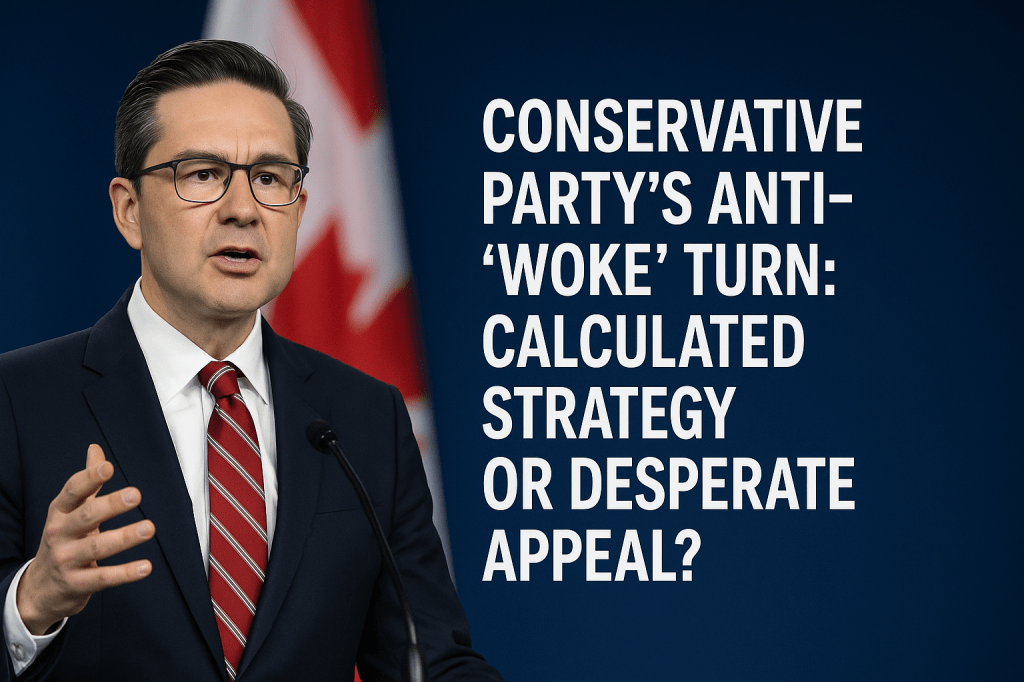
The Conservative Party of Canada has quietly republished the English-language version of its platform to reinsert a plank that had been conspicuously absent; a pledge to crack down on so-called “woke ideology” within the federal public service, and in university research funding. Described as a “publishing oversight,” this addition raises far more questions than it answers, particularly about Pierre Poilievre’s political calculus as the next election draws closer.
First, let’s interrogate the substance. “Woke ideology,” while undefined in the platform, is often shorthand on the political right for progressive stances on diversity, inclusion, gender identity, anti-racism, and decolonization efforts. To include language targeting these frameworks suggests the Conservatives are not just passively uncomfortable with current equity-focused public policy, they’re actively preparing to dismantle it. But why now?
One possible explanation is strategic: this is a deliberate overture to Canada’s emergent far-right electorate. While still fringe in some parts of the country, this voter segment has grown increasingly vocal, particularly on social media, and within alternative media ecosystems. By tapping into their grievances, against public sector DEI programs, gender-inclusive language, or research funding tied to Indigenous reconciliation, the Conservatives may be attempting to consolidate a reliable, energized bloc of voters.
Another interpretation is more inward-facing: Poilievre is shoring up his base, not for the election, but for what comes after. Should the Conservatives form government, he may face internal fractures between establishment conservatives and newer ideological hardliners. This platform language signals allegiance to the latter, potentially ensuring his continued leadership in a post-election caucus that could be divided on everything from fiscal policy to foreign affairs.
There’s also the broader issue of timing. The re-publication came after criticism that the party had been “softening” to appeal to moderate or urban voters, many of whom are uncomfortable with overt culture war rhetoric. By reaffirming this pledge, the party might be trying to reassure its core that the campaign’s centrist gestures are mere optics, not policy commitments.
But this move is not without risks. Canada’s public service is one of the most diverse and professionalized in the world. Federal civil servants are unlikely to respond positively to a government that frames their professional values as ideological threats. Likewise, university researchers who rely on federal grants will see this as a chilling signal that academic freedom could be compromised by political litmus tests.
And then there’s the broader electorate. While “anti-woke” politics have gained traction in the U.S. and U.K., Canadian voters have historically been more moderate. The risk for Poilievre is that in appealing to a narrow base, he alienates the swing voters he’ll need to actually win. Recent polling shifts, driven in part by U.S. President Donald Trump’s aggressive new tariffs on Canadian goods and Liberal leader Mark Carney’s boost in credibility, suggest the tide may already be turning against Poilievre’s hard-right gambit.
The re-insertion of this controversial language into the Conservative platform isn’t a glitch, it’s a signal. The question now is whether it’s a strategic masterstroke aimed at cementing a new ideological alignment in Canada, or a desperate hedge against the possibility that Poilievre wins the election, but loses control of his own party.
This is the first of hopefully many guest posts for this blog.
I have been heartened by the civility characterizing the 2025 Canadian Federal Election Campaign. Amid global unrest, our nation’s commitment to respectful discourse has been a beacon of hope. Until today.
Today, Pierre Poilievre crossed a line. He didn’t just resort to name-calling; he employed fear on a scale that is both alarming and disheartening.
Leadership demands vision, a comprehensive plan, and the ability to inspire confidence. A true leader assesses situations holistically, allocates resources wisely, and maintains composure under pressure.
However, Mr. Poilievre chose a different path. He took a speculative report, designed to explore potential future scenarios, and distorted its findings to paint a dystopian narrative. This manipulation wasn’t just misleading; it was a calculated attempt to exploit Canadians’ emotions for political gain.
The report in question, published by Policy Horizons Canada, is intended to inform policymakers about possible future challenges and opportunities. It’s a tool for strategic foresight, not a definitive prediction. By presenting its content as an imminent threat, Mr. Poilievre has not only misrepresented the report, but also undermined the very purpose of such forward-thinking analyses.
This approach is not just a deviation from responsible leadership; it’s a betrayal of the trust Canadians place in their elected officials. It sows unnecessary fear and distracts from constructive dialogue about our nation’s future.
I urge every Canadian to read the report themselves at Policy Horizons Canada. Understand its intent, and see through the fear-mongering.
Our future is ours to shape. Let’s base our decisions on facts, not fear.
About the Author
Angela is a Canadian veteran who was honoured to be part of the first class of women at Collège militaire royal de Saint-Jean and retired from the Canadian Forces in 1991. Since then, she has built a diverse career in industry and has owned and operated small businesses for over two decades. Her lifelong commitment to service, leadership, and community informs her thoughtful perspective on Canada’s future.
In an era of mounting economic uncertainty, geopolitical tension, and post-pandemic recovery, Alberta has quietly emerged as North America’s top subnational performer in a critical and often overlooked metric: the Human Development Index (HDI). For policy watchers and socio-economic analysts, this isn’t just a number to file under “interesting trivia.” Alberta’s position at the top of the HDI rankings among all Canadian provinces, American states, and Mexican territories marks a significant case study in the relationship between natural resource wealth, public policy, and long-term human development outcomes.
As of the most recent figures, Alberta boasts an HDI score of 0.947, narrowly edging out perennial Canadian leaders like British Columbia and Ontario, and standing shoulder to shoulder with wealthy U.S. states like Massachusetts (0.956). The HDI, developed by the United Nations, is a composite measure of life expectancy, education, and per capita income. It is often used as a more holistic gauge of prosperity than GDP alone, as it reflects not only how much wealth a region generates, but how that wealth translates into actual well-being.
Alberta’s strong showing may come as a surprise to some, especially given the narrative often pushed about the province being overly reliant on fossil fuels or politically out of step with the rest of the country, but the truth is more nuanced. Alberta’s prosperity, particularly in the past two decades, has allowed it to make significant investments in healthcare, education, and infrastructure. Its high-income levels have supported strong public services, when policy has aligned with long-term development goals, and its young, well-educated workforce has given the province a demographic advantage. This is not to ignore Alberta’s volatility or the challenges of a boom-and-bust economy, but rather to acknowledge that, when things align, the outcomes can be extraordinary.
Education is a particular strength. Alberta consistently ranks among the top in Canada, and even internationally, in literacy, math, and science scores, according to the OECD’s PISA results. Its public healthcare system, while strained like others across Canada, remains broadly effective and accessible. Meanwhile, high wages, especially in the energy and trades sectors, boost the per capita income metric significantly, even when adjusted for cost of living.
Of course, HDI doesn’t capture everything. Alberta’s Indigenous communities, rural populations, and recent immigrants often experience very different outcomes than the provincial average. Income inequality, climate vulnerability, and questions around economic diversification remain pressing concerns, but as an overall measure of human potential realized, Alberta’s HDI score offers a compelling counter-narrative to those who dismiss it as a one-note petro-state.
The implications of Alberta’s top-tier HDI rating should not be understated. For federal policymakers, it underscores the importance of regional economic engines in lifting national development indicators. For other provinces and territories, it poses a question: what mix of resources, governance, and vision leads to sustained human flourishing? And for Alberta itself, it’s a reminder that the province’s legacy need not be only pipelines and politics, it can also be about how to build a society where people truly thrive.
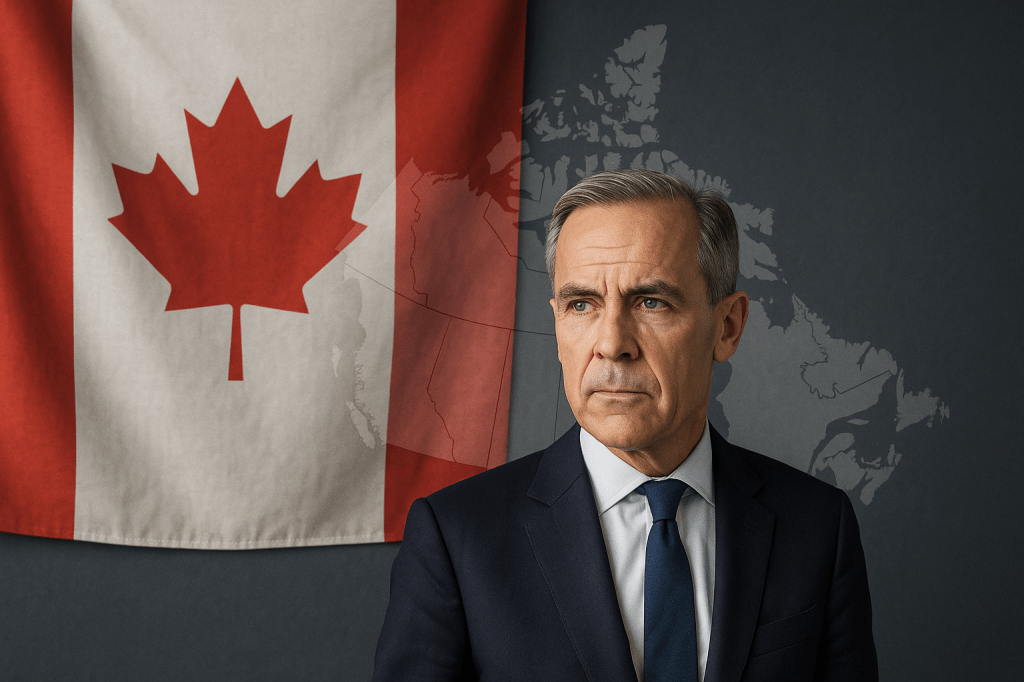
Mark Carney’s call for “one Canadian economy, not thirteen” isn’t just the idle musing of a former central banker with time on his hands, it’s the warning shot of a man who has sat at the helm of two of the world’s most powerful financial institutions and seen, up close, how countries succeed and fail. Carney’s frustration with Canada’s fragmented economic landscape is both practical and philosophical. He knows the potential this country holds – vast natural resources, educated people, global ties, but he also sees how much of it is squandered by a patchwork system where ten provinces and three territories act like neighbouring fiefdoms instead of building blocks of a common national purpose.
The problem, as Carney lays it out, is that Canada often behaves more like a loose confederation of mini-economies, than a modern unified state. Each region guards its turf: labour standards vary wildly, professional credentials don’t always carry across provincial lines, and tax regimes are a bureaucratic maze. Even something as basic as securities regulation, the rules that govern how companies raise money and protect investors, is balkanized, with no single national regulator, making Canada unique among developed nations in all the wrong ways. This isn’t just inefficiency; it’s economic self-sabotage.
Carney has always had a policy wonk’s precision, but in recent years he’s added the rhetorical flair of someone preparing to step onto the political stage. When he talks about the climate transition, for example, he doesn’t mince words: Canada will fail to meet its emissions targets if each province charts its own course. British Columbia might be ahead on carbon pricing, while Alberta and Saskatchewan cling to fossil fuels, and Quebec stands off in its own hydro-powered world. Without a shared strategy, Carney argues, we’re running thirteen separate races instead of pulling together in the global marathon toward sustainability.
Underlying Carney’s vision is a call for greater productivity and global competitiveness. He sees a Canada that could lead in clean energy, advanced manufacturing, digital innovation, but only if it acts in concert. That means building national infrastructure, fixing interprovincial trade barriers (which some federal estimates say cost the economy up to $130 billion a year), and aligning provincial policies on education, investment, and labour force development. It’s not just about growing the economy, it’s about making sure that growth is fair, inclusive, and forward-looking.
Of course, Carney knows the hurdles. This is Canada, after all. The constitution gives provinces enormous authority over key economic levers like natural resources and education. Regionalism runs deep, from the grievances of Western alienation to the distinct society of Quebec. Even the idea of a national strategy can provoke suspicion, seen less as vision and more as Ottawa’s overreach. And the political will to forge consensus is in short supply, especially in an age where short-term gains too often outweigh long-term planning.
Still, Carney keeps beating the drum. His is a voice urging Canada to get serious about itself. To stop coasting on inherited wealth and institutional stability, and start acting like a country that actually wants to lead in the 21st century. Whether as a private citizen, a public thinker, or elected Prime Minister, Carney is pushing us to imagine what Canada could become if it truly operated as one economy, not thirteen.
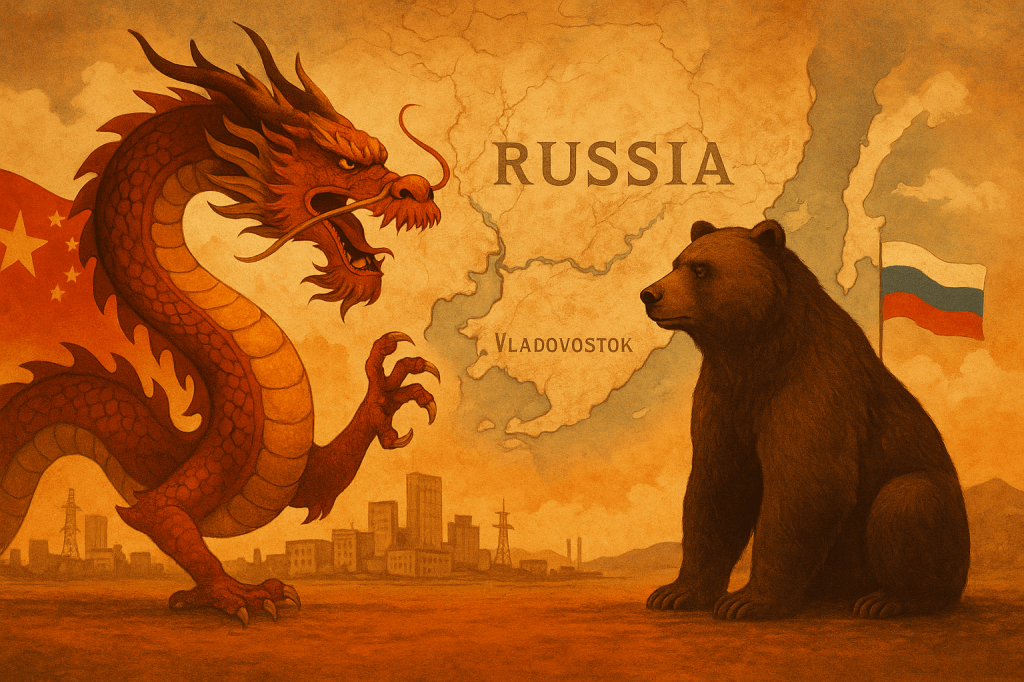
It’s a strange sight to behold – the old bear, once feared across continents, now leaning heavily on the dragon, who circles with a slow, calculating grace. Russia, once the hammer of the East, has been brought to heel by a grinding war in Ukraine, and while the West cuts ties and imposes sanctions, China, with the patience of a millennia-old civilization, sees opportunity, not just to profit, but perhaps to reshape history.
There’s a sense of irony that hangs over this moment. In 1860, the Qing dynasty signed the Peking Accord under duress, ceding vast swathes of land to the Russian Empire. That territory, now known as the Russian Far East, includes strategic regions like Vladivostok and the Amur Basin, lands that had once been part of China’s imperial periphery. The Chinese state, pragmatic in diplomacy, but deeply historical in self-conception, has never fully forgotten these losses. While official maps no longer lay claim to those regions, nationalist narratives in China occasionally whisper about redrawing what was once erased.
Fast forward to today, and the tables have turned. The war in Ukraine has battered Russia’s economy, and severed its connections to Europe. In desperation, Moscow has tilted eastward, selling gas, oil, and influence to Beijing at discount prices. This is not a partnership of equals. Russia needs Chinese markets, Chinese currency, and Chinese technology. China, meanwhile, gains leverage with every shipment of discounted crude, and every signed memorandum that ties the Russian economy tighter to the yuan. Where once they competed in Central Asia and the Arctic, now Russia finds itself the junior partner in a relationship it once dominated.
But China’s strategy isn’t conquest, it’s saturation. In the underpopulated stretches of Siberia and the Russian Far East, Chinese traders, laborers, and companies are embedding themselves quietly, but firmly. Towns along the border increasingly do their business in yuan, and many look more to Harbin or Heihe, cities in China’s Heilongjiang Province, than to Moscow. Infrastructure projects, often funded with Chinese capital, and executed by Chinese firms, are weaving a new economic fabric, one that binds these regions more to Beijing than to the Kremlin.
This isn’t a territorial war. China doesn’t need tanks to reverse the Peking Accord. It just needs time, capital, and a weakened Russia with few other friends. What we may be witnessing is not the formal return of lost lands, but something more subtle and enduring; a slow-motion annexation by way of economy, trade, and cultural seepage. A kind of imperial inversion, done not with gunboats, but with invoices and supply chains.
In geopolitics, history never dies, it just waits for the moment when the balance tilts. With every sanctioned ruble, and every Chinese-funded deal, the echoes of the 19th century grow louder. Russia may not yet realize it, but the dragon is already at the gates. Not to conquer, but to reclaim, softly, surely, and without ever having to fire a shot.
For over a century, the United States has proudly embraced the metaphor of the “melting pot,” a vision in which immigrants from all over the world come together to form a singular American identity. This idea suggests that while people may arrive with distinct languages, customs, and traditions, they are expected to assimilate into a common culture; one that prioritizes English, democratic values, and a shared national ethos. The melting pot is often framed as a symbol of unity, a place where differences dissolve in the service of a greater whole. However, this model has its critics, who argue that it pressures immigrants to abandon their unique cultural heritage in order to conform.
The roots of the melting pot concept can be traced back to Israel Zangwill, a British playwright whose 1908 play The Melting Pot romanticized America as a land where old ethnic divisions would fade away, forging a new, united people. While Zangwill gave the concept its famous name, the push for assimilation had been shaping U.S. policy and attitudes long before. Theodore Roosevelt, the 26th president, was one of its most vocal proponents, arguing that immigrants must fully adopt American customs, language, and values to be considered truly American. The early 20th century saw the rise of the Americanization movement, which reinforced these ideas through public education, labor policies, and civic initiatives. By mid-century, the expectation of cultural conformity had become deeply embedded in American identity, influencing everything from language policies to popular media portrayals of immigrant life.
Canada, on the other hand, has cultivated a different metaphor, that of a “cultural mosaic.” Rather than seeking to merge all cultures into one, Canada actively encourages its people to maintain and celebrate their distinct identities. This approach is not just a social philosophy, but an official policy, first enshrined in 1971 with the introduction of the Multiculturalism Policy by Prime Minister Pierre Elliott Trudeau. Unlike the American melting pot, which emphasizes assimilation, Trudeau’s vision was one of inclusion without erasure. His government recognized that Canada’s growing diversity, particularly from non-European immigration, required a shift in how the country defined itself.
The passage of the Canadian Multiculturalism Act in 1988, under Prime Minister Brian Mulroney, further reinforced this philosophy by guaranteeing federal support for cultural communities, anti-discrimination measures, and the preservation of minority languages. Unlike the U.S., where English is seen as a central marker of national identity, Canada has long embraced bilingualism, officially recognizing both English and French. Additionally, Canada has extended support for Indigenous and immigrant languages in education and public services, further emphasizing its commitment to cultural pluralism.
The differences between these two models of integration are profound. In the United States, the expectation is often that newcomers will embrace “Americanness” above all else, whether that means speaking only English, adopting mainstream American customs, or minimizing their ethnic identity in public life. While the U.S. does recognize and celebrate diversity in some respects; Black History Month, Indigenous Peoples’ Day, and the popularity of international cuisines all attest to this, there remains a strong undercurrent that to be truly American, one must fit within a specific cultural framework.
Canada’s approach, by contrast, views multiculturalism as a strength rather than a challenge to national unity. Cities like Toronto, Vancouver, and Montreal are known for their ethnic neighborhoods, where different cultures not only survive, but thrive. Unlike the American approach, which often treats diversity as something to be managed or assimilated, Canada has built institutions that actively encourage it. Government funding for cultural festivals, multilingual public services, and policies that allow dual citizenship all reflect a belief that preserving one’s cultural roots does not weaken Canadian identity, but enriches it.
This difference is especially clear in the way both countries handle language. In the U.S., English is often seen as the primary marker of integration, with political debates regularly emerging over whether Spanish speakers should make greater efforts to assimilate linguistically. Canada, meanwhile, has long recognized both English and French as official languages, and has even extended support for Indigenous and immigrant languages in education and public services.
Ultimately, the American melting pot and the Canadian cultural mosaic reflect two very different visions of national identity. While the U.S. values unity through assimilation, Canada finds strength in diversity itself. Neither model is without its challenges, but the contrast between them speaks to fundamental differences in how these two North American nations define what it means to belong.
In communities across Canada, the housing crisis has become more than a policy debate, it’s a daily struggle. While costs rise and waitlists grow, the Municipality of North Grenville, just south of Ottawa, is offering a bold response. Its $25 million proposal to convert Bell Hall, a vacant dormitory on the Kemptville Campus, into more than 60 affordable rental units is both practical and symbolic, a microcosm of what’s possible when local governments lead.
The campus itself is a 630-acre hub of community, education, and sustainability activities. Once part of the University of Guelph’s agricultural network, it’s now owned by the municipality and governed by a 2021 master plan that prioritizes adaptive reuse, environmental responsibility, and deep community engagement. Bell Hall fits that vision precisely; a municipally owned, appropriately zoned, fully serviced building, already standing and waiting to be converted.
This is not a speculative plan. Developed over months with input from senior staff and not-for-profit partners, the Bell Hall project targets the real needs of North Grenville’s most vulnerable; seniors, veterans, and working families being priced out of their hometown. It offers not just housing, but stability, dignity, and a sense of belonging.
And yet, despite being shovel-ready, the proposal remains stalled in a growing backlog at the Canada Mortgage and Housing Corporation (CMHC). It’s a familiar story for municipalities across the country, many of whom are reporting delays due to limited federal processing capacity, particularly in underwriting. As federal priorities shift with the political winds, viable projects are left in limbo.
Mayor Nancy Peckford recently sounded the alarm in the Ottawa Citizen, arguing that the issue is not preferential treatment, but systemic inefficiency. Her call for transparency and faster turnaround is resonating with other small communities also ready to build. In an age where housing need is immediate, the logic is simple: when a plan meets all the criteria, and the groundwork is laid, it should move forward.
Some critics are suggesting that municipalities are just now “stepping up” on housing, but local governments have long managed zoning and development approvals. What’s new is the scale and pace of their engagement, assembling land, forming partnerships, applying for federal tools, and leading where senior governments lag.
North Grenville’s approach is part of a broader shift in small-town Canada, where pressures once confined to major cities are now spreading. The housing crisis isn’t urban anymore, it’s national. In this context, Bell Hall becomes more than a local project. It’s a test of the federal-municipal partnership that modern housing policy demands.
There’s also economic logic behind the urgency. A 2023 Deloitte report estimated that expanding community housing could add $70 billion to Canada’s GDP over five years. In places like Kemptville, where growth is manageable and materials can be sourced locally, the multiplier effects are significant with jobs, procurement, community stabilization, and reduced strain on health and social services.
And this is just one community. Rural municipalities across Eastern Ontario are facing similar challenges – aging populations, limited rental stock, and infrastructure that hasn’t kept pace. A regional alliance, or even a coordinated appeal, could elevate the urgency of rural housing and draw more attention to what’s at stake.
North Grenville is ready. Bell Hall is ready. The question is whether the federal system is ready to respond with the speed and seriousness the moment demands. If the next government wants to prove its commitment to housing, here is the perfect place to start.
The question of whether governments should mandate compulsory citizen photo identification is a complex one, balancing concerns over security, efficiency, privacy, and civil liberties. Proponents argue that such a system strengthens national security by reducing identity fraud, streamlining public services, and ensuring greater integrity in processes such as voting and law enforcement. Opponents, however, raise concerns about privacy risks, potential discrimination, and the financial and administrative burdens associated with implementation.
One of the strongest arguments in favor of compulsory identification is its role in preventing fraud and enhancing security. A standardized ID system makes it easier to verify identities in a wide range of scenarios, from accessing government benefits to conducting financial transactions. Proponents argue that this not only reduces the risk of identity theft but also ensures that public services reach their intended recipients without duplication or misuse. In the realm of law enforcement, such a system can help police quickly verify identities, track criminals, and even assist in locating missing persons. A national ID could also facilitate international travel within certain regions and improve border security by preventing unauthorized entries.
From a governance perspective, a universal identification system can improve the efficiency of public administration. Countries with well-integrated ID systems often experience fewer bureaucratic hurdles in service delivery, whether in healthcare, taxation, or social welfare. Standardizing identity verification can also strengthen the electoral process by reducing the potential for voter fraud and ensuring that only eligible citizens participate. Advocates suggest that, in an increasingly digital world, a government-issued ID could serve as a foundational tool for secure online verification, further modernizing access to services.
Concerns about privacy and government overreach remain central to opposition arguments. Critics warn that a compulsory ID system could expand state surveillance, allowing authorities to track individuals in ways that may infringe on civil liberties. The centralization of personal data also raises the risk of misuse, whether through state overreach or cyberattacks that compromise sensitive information. Given the increasing sophistication of cyber threats, a national ID database could become a high-value target for hackers, putting millions of people at risk of identity fraud.
Social equity is another significant concern. Some populations, including the homeless, elderly, and marginalized communities, may face barriers in obtaining and maintaining identification, potentially excluding them from essential services. If not carefully designed, an ID requirement could reinforce systemic inequities, disproportionately affecting those who already struggle with bureaucratic processes. Additionally, there is a risk of such a system being used to justify racial profiling or discrimination, particularly in law enforcement contexts.
Beyond ethical considerations, the financial cost of implementing and maintaining a compulsory ID program is substantial. Governments would need to invest in secure infrastructure, database management, and ongoing monitoring to prevent fraud or duplication. Citizens might also bear financial burdens in obtaining and renewing their identification, making it a potential source of economic hardship for some. Critics argue that as digital identification methods become more sophisticated, traditional photo IDs may soon become obsolete, making such an investment unnecessary.
The debate over compulsory citizen photo identification ultimately hinges on whether the benefits of security and efficiency outweigh the risks to privacy, civil liberties, and social equity. Any government considering such a system would need to address these concerns through clear legal safeguards, accessible implementation strategies, and a careful assessment of technological advancements. While a well-designed ID system could offer significant advantages, it must be developed in a way that protects citizens’ rights and ensures broad inclusivity.









 The Rowanwood Chronicles