When Sovereignty Drifts Quietly Out of Orbit

There is a peculiar habit in Ottawa that reveals itself most clearly in defence procurement. It is the habit of mistaking alignment for dependence, cooperation for deference, and interoperability for inevitability. The proposed Canadian Forces space command and control project, now quietly priced somewhere between two hundred and four hundred million dollars, is a textbook example. What should be a sober discussion about Canadian sovereignty in the most strategic domain of the twenty-first century has instead become another case study in how deeply the senior civilian and uniformed leadership of the Department of National Defence has been captured by American assumptions, priorities, and frameworks.

The issue is not that Canada works closely with the United States in space. That is both unavoidable and desirable. The issue is that DND increasingly appears incapable of imagining a serious military capability that does not begin with the question, “How does the U.S. do this?” rather than, “What does Canada actually need?” When briefing notes openly frame U.S. assistance as a foundational requirement rather than an optional enhancement, the problem is no longer technical. It is cultural. Strategic thinking has been outsourced long before any contract is signed.

This is institutional capture, not conspiracy. It happens when careers are built inside allied command structures, when promotion rewards smooth interoperability rather than independent judgment, and when senior civilians absorb the same assumptions as the generals they are meant to challenge. Over time, the centre of gravity shifts. Canadian officers and officials begin to see American systems as the default, American timelines as the clock, and American doctrine as neutral truth rather than national preference. At that point, sovereignty is not surrendered dramatically. It simply fades into the background.

The space project exposes this drift with unusual clarity. Space command and control is not a niche capability. It sits at the intersection of intelligence, surveillance, targeting, Arctic defence, and escalation control. A system that cannot function independently in a crisis, even for a limited period, is not a sovereign capability. It is a terminal plugged into someone else’s infrastructure. Yet DND’s language suggests comfort with exactly that outcome, as though Canada’s role is to be a well-behaved node in an American-led network rather than a state with its own strategic thresholds and political constraints.

This is where the Carney government must act decisively, and quickly. Defence reform cannot be limited to budgets and white papers. The problem is not primarily money. It is leadership. Both the senior civilian ranks and the uniformed command structure at DND require a reset in incentives, expectations, and worldview. Canada needs defence leaders who are capable of working with the United States without being intellectually subordinate to it, who understand that alliance management is not the same thing as strategic abdication.

Strategic changes at the top of DND are therefore not punitive. They are corrective. The Carney government should be looking for leaders with demonstrated experience outside permanent U.S. frameworks, leaders who have worked in multilateral, civilian-led, or genuinely independent contexts. It should be asking hard questions about how often Canadian alternatives are even presented internally before U.S. options are adopted by default. And it should be willing to rotate out senior figures who have become too comfortable treating American preferences as Canadian interests.

None of this requires anti-Americanism. It requires maturity. The United States will continue to pursue its own interests in space, just as Canada must pursue ours. True allies respect that distinction. What they do not respect, and should not be encouraged to expect, is quiet compliance dressed up as partnership.

Space is not just another procurement file. If Canada cannot think clearly about sovereignty there, it will not think clearly about it anywhere. The danger is not that Canada will anger Washington. The danger is that Canada will stop mattering to itself. That is a failure no ally can fix for us, and no amount of interoperability will excuse.

Canada and the CUSMA Crossroads: Policy Recommendations for Ottawa

As whispers from Washington grow louder about replacing the trilateral CUSMA with two separate bilateral trade agreements, one with the United States, one with Mexico, Canada finds itself at a pivotal moment. How Ottawa responds over the next eighteen months could determine not just near-term economic outcomes, but the resilience and global standing of the Canadian economy for decades to come.

The U.S. sees bilateral deals as a way to tighten rules of origin, enforce labour and environmental standards more aggressively, and gain leverage on regulatory issues. While these measures might appear to offer Canada the chance for a “customized” agreement, they also carry serious risks: fractured supply chains, diminished investment, and reduced bargaining power on the global stage. Canada cannot afford to approach this negotiation as a passive actor.

Policy Recommendations

1. Protect Integrated Supply Chains
Canada should insist on provisions that preserve existing supply-chain networks spanning Canada, the U.S., and Mexico. Standstill clauses and grandfathering mechanisms should ensure that Canadian investments in autos, aerospace, electronics, and agriculture are not penalized under stricter U.S. bilateral rules.

2. Negotiate Realistic Rules of Origin
Ottawa should push for rules that recognize Canada’s production capacities and global sourcing realities. Overly restrictive thresholds would damage competitiveness; instead, the agreement should balance protection of U.S. interests with Canada’s need to remain a hub of North American manufacturing.

3. Secure Trade Policy Autonomy
A bilateral agreement must not lock Canada into U.S.-imposed restrictions on third-party trade. Canada needs the freedom to deepen relationships with the EU, Asia-Pacific, and emerging markets. Ottawa should insist on explicit clauses preserving this sovereignty.

4. Embed Environmental and Labour Standards Strategically
Canada should leverage the negotiation to advance shared values on environmental protection and labour rights. By including enforceable, mutually beneficial standards, Canada can turn compliance obligations into a competitive advantage for Canadian businesses, particularly in clean energy, forestry, and high-value manufacturing.

5. Diversify Market Access
The U.S. will always be Canada’s largest trading partner, but Ottawa must use this moment to accelerate diversification. Strong bilateral terms with the U.S. should complement, not replace, agreements with other regions. This strategy will reduce vulnerability to U.S. policy swings and strengthen Canada’s global economic resilience.

6. Maximize Leverage on Strategic Resources
Canada possesses energy, critical minerals, and clean-tech assets of global significance. Ottawa should use the bilateral framework to secure access to U.S. markets without ceding control or undervaluing these resources, ensuring that Canada retains long-term strategic advantage.

7. Prepare for Transition and Communication
Any shift from CUSMA to bilateral arrangements will create uncertainty for businesses. Ottawa should implement a clear, phased transition plan and communicate proactively with domestic industries. Providing certainty and guidance can prevent disruption, maintain investment confidence, and reinforce Canada’s reputation as a stable, reliable partner.

8. Protect Agricultural Supply Management Sectors as Part of Food Security Strategy
Canada’s supply-managed sectors — dairy, poultry, and eggs — are vital not only to farmers’ livelihoods but to national food security. Any bilateral agreement must safeguard these systems against excessive U.S. pressure or forced liberalization. This will ensure that Canadians maintain stable domestic production, buffer against global market volatility, and preserve a cornerstone of rural economic resilience.

Conclusion
The U.S. drive toward bilateral deals presents both danger and opportunity. Canada must approach negotiations not as a defensive exercise in preservation, but as a chance to reshape its trade strategy for a new global environment. By insisting on supply-chain continuity, flexible rules of origin, strategic autonomy, market diversification, and protection for food security, Ottawa can turn potential disruption into a springboard for long-term economic strength.

Canada’s response will signal whether it remains a reactive participant in North American trade or assumes the role of confident, sovereign actor capable of shaping its own destiny. This is not a time to defer to Washington. It is a time to plan boldly, negotiate shrewdly, and safeguard Canada’s future.

When Negation Becomes the Message: The Conservative Leader’s Policy Vacuum

The second of a pair of posts to start the week off right.

Pierre Poilievre’s recent performances in the House of Commons and in front of microphones have taken on a strikingly reactive and unanchored quality, particularly when his focus turns to blaming Prime Minister Mark Carney for Canada’s economic and institutional pressures. Rather than advancing a coherent alternative policy framework, his interventions often circle around grievance, accusation, and rhetorical repetition. The result is a leader who appears to be responding to events rather than shaping them, leaving audiences with sound bites instead of a governing vision.

A central reason Poilievre sounds rudderless is that opposition by negation is doing the heavy lifting. Attacks on Carney’s competence, motives, or globalist credentials substitute for detailed Conservative proposals on inflation, productivity, climate transition, or industrial policy. Blame becomes the message. Without clear policy markers to return to, Poilievre’s speeches drift, anchored more in tone than substance. This creates the impression of motion without direction, agitation without destination.

The resemblance to MAGA-style messaging lies less in ideology than in method. Like many populist communicators, Poilievre relies on simplified villains, emotionally charged language, and a constant framing of institutions as captured or corrupt. This approach can energize a base, but it is poorly suited to a parliamentary system where credibility is built through policy seriousness and coalition-building. When every problem is reduced to the personal failure of the leader across the aisle, the speaker forfeits the opportunity to demonstrate readiness to govern.

There is also a structural problem at play. With the Liberals close to a majority and recent Conservative defections weakening caucus morale, Poilievre’s attacks land in a context where power dynamics have already shifted. Blaming Carney for parliamentary outcomes that Poilievre can no longer meaningfully influence only underscores the imbalance. The rhetoric begins to sound performative rather than strategic, aimed at maintaining outrage rather than altering outcomes.

Perhaps most damaging is that this style leaves policy silence where voters expect alternatives. On housing, productivity, health system reform, and climate resilience, Canadians hear far more about Liberal failure than Conservative plans. In a period of economic uncertainty, the absence of a clearly articulated program makes Poilievre’s leadership feel provisional, as though the party is still campaigning rather than preparing to govern.

In that sense, the MAGA comparison is less about American politics and more about political drift. When grievance replaces agenda, leaders risk sounding unmoored, defined by what they oppose rather than what they would build. For a Conservative leader seeking to convince Canadians he is a government-in-waiting, that is not merely a stylistic problem. It is a strategic one.

Pierre Poilievre and the Erosion of Conservative Cohesion

First of a pair of posts to start the week off right. 

The recent developments within the Conservative Party of Canada have marked a notable shift in the parliamentary landscape and exposed significant strains in Pierre Poilievre’s leadership. Over the past several weeks a sequence of defections and a resignation have transformed what might once have been viewed as isolated dissent into a pattern that raises questions about internal dissatisfaction and strategic direction. Conservative Members of Parliament crossing the floor to join Prime Minister Mark Carney’s Liberal government and an unexpected resignation from a sitting Conservative MP signal more than routine political realignment; they suggest deepening fractures in the Conservative caucus under Poilievre’s leadership.

The most visible manifestation of this trend was the decision by Michael Ma, Member of Parliament for Markham–Unionville, to formally leave the Conservative caucus and join the Liberals. Ma’s move, announced in early December 2025, came only weeks after Nova Scotia MP Chris d’Entremont made the same transition, citing dissatisfaction with the direction of Conservative politics and an attraction to the Liberals’ policy approach and governance agenda. These defections have materially advantaged the Liberal government, bringing it within one seat of a majority in the House of Commons and thereby altering the balance of power in Parliament.  

In conjunction with these floor crossings, Edmonton MP Matt Jeneroux’s announcement that he will resign from Parliament rather than continue under the current Conservative leadership has intensified speculation about internal party morale. The combination of defections and the resignation of a sitting MP so soon after a general election is highly unusual; Jeneroux’s departure, though not a floor crossing, underscores wider unease among Conservative ranks and reflects strategic choices by individual MPs about their political futures.  

Commentators and political observers have read these departures as symptomatic of a broader dissatisfaction with Poilievre’s leadership style and strategic posture. Floor crossers have explicitly referenced disagreements over tone and direction, framing their moves as a response to a negative or uncompromising political approach that they believe detracts from constructive governance. D’Entremont’s statements about feeling misaligned with his party’s leadership emphasize a preference for engagement with pragmatic policy solutions over relentless opposition.  

The reaction within Conservative circles has been mixed, but often defensive. Poilievre himself has publicly rejected the notion that his leadership style should change in response to these departures, framing the defections as electoral betrayal rather than internal critique and asserting that the party must remain focused on its core commitments. However, Liberal House Leader Steven MacKinnon has suggested that Ma’s decision is not unique but part of a small but growing contingent of Conservative MPs who are “extremely frustrated” with the party’s political direction.  

In practical terms, the departure of two MPs and the resignation of another in such close succession has a tangible impact on parliamentary arithmetic and strategic leverage. With the Liberals approaching a working majority, the Conservative opposition’s ability to influence legislative business is diminished, altering the dynamics of the minority Parliament. These shifts also have implications for the upcoming Conservative leadership review, where questions about unity, electoral viability, and direction will dominate discussion among delegates and members.  

The cumulative effect of these events is not merely numerical. It reflects a broader narrative of internal tension within the Conservative Party, tensions that revolve around how best to advance policy goals, maintain electoral appeal, and manage ideological diversity within a fractured caucus. Whether these departures precipitate further exits or merely represent short-term recalibration remains an open question. What is clear is that these developments have dealt a substantive blow to Poilievre’s efforts to project unity and discipline, instead highlighting the challenges of leadership in an era of fluid parliamentary allegiances and evolving political identities.

The Fine Line: Public Funding vs. Hospital Foundations in Canada

Canada’s healthcare system is publicly funded, built on the principle that access to essential medical care should not depend on one’s ability to pay. Yet despite this ideal, hospitals across the country increasingly rely on charitable foundations to fill financial gaps; particularly when it comes to acquiring or upgrading capital equipment such as MRI machines, surgical suites, or even hospital beds. This raises an urgent question: where do we draw the line between what taxpayers should fund and what private donations should cover?

Historically, charitable giving and volunteerism have been strong elements of Canadian civic life. From Terry Fox Runs to hospital galas, Canadians have given generously of both time and money. Foundations like those supporting SickKids in Toronto or the Ottawa Hospital routinely raise millions for major equipment and infrastructure projects. This philanthropy has enabled many hospitals to expand their services, acquire cutting-edge technology, and improve patient care. However, relying on private donors to cover essential infrastructure can lead to inequities and accountability challenges.

Public funding should remain the primary source of capital investment for core hospital services. A hospital’s ability to deliver life-saving care should not depend on how wealthy its local community is or how effective its fundraising team happens to be. A well-off urban centre like Vancouver or Toronto may be able to raise tens of millions in months, while smaller or rural hospitals struggle to replace outdated X-ray machines. This creates a two-tiered system by the back door, one that undermines the universality and equity at the heart of Medicare.

Moreover, capital equipment is not a luxury; it is central to a hospital’s mission. When hospitals must wait on campaign goals or donor approvals to purchase a new CT scanner, patients pay the price through longer wait times and reduced diagnostic accuracy. Public infrastructure should be predictable, planned, and guided by population health needs—not marketable donor narratives or foundation marketing strategies.

Local philanthropic families who donate millions often have their names emblazoned across hospital wings or research centres, a modern version of constructing Victorian Follies or erecting statues in the town square. While some see this as genuine civic pride, and a way to give back, others question whether it’s philanthropy or vanity, blurring the line between public good and private legacy.

That said, there is still a legitimate and valuable role for hospital foundations. Philanthropy should enhance care, not substitute for the basics. Foundations can support research initiatives, pilot programs, staff development, and the “extras” that make hospitals more human; like family rooms, healing gardens, or neonatal cuddler programs. They can even accelerate the purchase of capital equipment, but only where government has committed base funding or provided a clear upgrade timeline.

Ultimately, drawing the line is about reinforcing accountability. Governments must be transparent about what the public system will fund and ensure consistent, equitable investment across the country. Hospital foundations should be free to inspire generosity, but not to carry the burden of maintaining essential care. Public healthcare must never become dependent on private generosity. That’s not a donation, it’s a symptom of underfunding.

Sources
• Canadian Institute for Health Information (CIHI). “National Health Expenditure Trends, 2023.” https://www.cihi.ca/en/national-health-expenditure-trends
• Globe and Mail. “Canada’s hospitals increasingly rely on fundraising to cover capital costs.” https://www.theglobeandmail.com/canada/article-hospitals-capital-equipment-fundraising/
• CanadaHelps. “The Giving Report 2024.” https://www.canadahelps.org/en/the-giving-report/

Two Views on the Seattle Pride – World Cup Controversy: You Decide

The 2026 FIFA World Cup is nearly upon us, and already one match has become the talk of the globe. Iran and Egypt are scheduled to play in Seattle on June 26, coinciding with the city’s Pride celebrations. Meanwhile, Belgium and New Zealand play at Vancouver at the same time. It’s a situation that could have been prevented, or at least mitigated, depending on how you look at it.

Below are two perspectives. Read both, then make up your mind: should FIFA swap the venues, or should Pride go ahead as planned and the teams have taken responsibility to negotiate in advance?

Option 1: Swap the Venues – A Simple, Fair Fix
The simplest solution to this controversy is also the fairest: swap the venues. Play Belgium – New Zealand in Seattle and Egypt – Iran in Vancouver. Both games are final group-stage matches, kicking off simultaneously, so competitive integrity is preserved. No team gains any advantage; the rules remain intact.

Geography favors this solution. Seattle and Vancouver are only about 200 km apart, a trivial distance for professional teams, officials, and even fans. Logistically, operations: from security to transportation are already prepared for both matches, so moving the venue is feasible.

This approach respects all parties involved. Pride celebrations continue in Seattle, where they belong, but the teams whose cultural norms clash with the event are placed in a context free of conflict. FIFA would be acting pragmatically and diplomatically, resolving an unnecessary international flashpoint while keeping the tournament fair and orderly.

Swapping the venues is a small adjustment with a big payoff: fairness, reduced tension, and the smooth running of a world-class event.

Option 2: Pride Has Every Right – Teams Should Plan Ahead
The other perspective focuses on cultural context and foresight. Pride is a legitimate, deeply rooted celebration in North America. Seattle has every right to organize its programming around local values and the communities it serves. Pride is not a provocation, it is inclusion in action.

Iran and Egypt, aware that they would play in North America, could have negotiated with FIFA long before the draw about the possibility of sensitive match locations. Waiting until the schedule is published to object is a choice; one that creates conflict that could have been avoided.

From this perspective, Pride remains non-negotiable. Host cities are entitled to celebrate their values, and visiting teams are expected to understand and adapt to the context in which they play. International competitions operate in a global arena; foresight, planning, and cultural diplomacy are just as important as on-field performance.

The lesson here: Pride doesn’t yield. Teams who find themselves in potential conflict have a responsibility to raise concerns in advance, not retroactively, after the headlines are already written.

Your Choice
A precedent for FIFA deferring to host-country cultural norms exists. In the 2022 World Cup in Qatar, players were prohibited from displaying Pride symbols or any politically or ideologically charged messaging, with yellow cards threatened for violations. 

FIFA justified this as respecting the legal and cultural framework of the host nation, even though it conflicted with broader global expectations of inclusion. This shows that FIFA has historically prioritized the host country’s cultural context when determining what is permissible on the field, a reality that frames the Seattle situation.

There it is: two options, two perspectives. Should FIFA make a practical swap to prevent conflict, or should Pride proceed as a cultural right and the teams accept responsibility for negotiating ahead of time?

The tournament, the culture, and the politics all converge in one match in one city. Now it’s up to you: which approach do you support?

Five Things We Learned This Week

Week of December 6–12, 2025

Each week, we take a step back from the noise and look at five developments from around the world that stood out — across science, culture, sport, politics, and the natural world.

🌠 1. Geminid Meteor Shower Peaks with One of the Best Displays in Years

The annual Geminid meteor shower peaked this week, delivering bright, frequent meteors across much of the globe. Astronomers noted especially favorable viewing conditions, with the shower producing vivid fireballs caused by debris from asteroid 3200 Phaethon.

Why it matters: In a world often dominated by bad news, predictable and awe-inspiring celestial events remind us that some rhythms remain constant — and shared by everyone under the same sky.

🎮 2. The 2025 Streamer Awards Highlight the Scale of Live-Streaming Culture

Held on December 6, the 2025 Streamer Awards drew massive global audiences and celebrated creators shaping the modern entertainment landscape. Livestreaming continues to redefine celebrity, media economics, and community building — particularly among younger audiences.

Why it matters: What began as a niche subculture is now a dominant media force, influencing advertising, politics, and how people connect across borders.

🏆 3. Women’s World Floorball Championships Begin in the Czech Republic

The 15th Women’s World Floorball Championships kicked off this week, bringing together 16 national teams. The tournament highlights the rapid global growth of the sport and increasing investment in women’s international competition.

Why it matters: Expanding visibility for women’s sports strengthens international athletic ecosystems and reflects broader cultural shifts toward equity and representation.

🌍 4. Powerful Earthquake Strikes Northeastern Japan

A magnitude-7.6 earthquake struck off Japan’s Aomori coast on December 8, injuring dozens and prompting tsunami advisories and evacuations. Emergency services responded quickly, and authorities warned of ongoing aftershocks.

Why it matters: Japan’s preparedness limited loss of life, underscoring the importance of long-term investment in disaster readiness as seismic and climate risks persist worldwide.

🛂 5. Mediterranean Migration Continues as Boats Reach Malta

Dozens of migrants were brought ashore in Malta this week after dangerous crossings from North Africa. The arrivals highlight the ongoing humanitarian and political pressures shaping migration policy across the Mediterranean.

Why it matters: Migration remains one of the defining global challenges of our time, intersecting with climate change, conflict, and economic inequality.


Closing thoughts:
This week’s stories span wonder and warning — from meteor-lit skies to seismic shocks, cultural change, and enduring humanitarian challenges. Together, they remind us that the world is vast, interconnected, and constantly in motion.

Five Things is a weekly Rowanwood Chronicles feature, tracking global developments from Saturday to Friday.

The Strategic Shift Behind the 2025 U.S. National Security Strategy

The newly released 2025 U.S. National Security Strategy signals a significant departure from the traditional principles that defined American foreign policy for decades. Longstanding commitments to collective defense, liberal internationalism, and multilateral cooperation have been replaced with a posture that treats global engagement as a burden and alliances as conditional assets rather than enduring partnerships.

This shift, framed as a necessary rebalancing of national priorities, is being interpreted by analysts and allied governments as a proactive threat. The threat is not overt or kinetic. Instead, it emerges through the document’s language, strategic preferences, and economic positioning. The resulting landscape places NATO allies, especially Canada, in a vulnerable and uncertain position.

A Reimagined Alliance System

The Strategy redefines alliances in transactional terms. Rather than relying on shared values, mutual defense responsibilities, and long-term strategic vision, the document characterizes alliances as fiscal and strategic obligations that must be justified by allies through increased spending and alignment with U.S. interests. Reports highlight the new emphasis on defense burden-sharing and the suggestion that U.S. commitments may be scaled back for countries that do not meet Washington’s expectations.

This reframing undermines the foundational trust of the NATO system. It places countries like Canada, which historically spends below preferred thresholds, in a position where strategic reliability could be questioned, weakening the security guarantees that NATO has long been built upon.

Europe Recast as a Strategic Project

The Strategy’s rhetoric toward Europe marks a sharp departure from conventional diplomatic framing. The document describes Europe as struggling with demographic decline, economic stagnation, and cultural erosion, and it presents the United States as a guardian poised to steer the continent’s political future. Analysts have flagged the Strategy’s explicit support for “patriotic” political movements in Europe, a development interpreted as a willingness to influence or reshape domestic politics within allied states.

Such language introduces profound uncertainty into the transatlantic relationship. Rather than treating allies as sovereign equals, the Strategy positions them as ideological battlegrounds. For Canada, this suggests that allies’ internal affairs may no longer be off-limits to U.S. strategic intervention, further eroding norms of mutual respect.

The Western Hemisphere as Exclusive American Sphere

A revival of a hemispheric dominance doctrine – effectively a twenty-first century interpretation of the Monroe Doctrine – marks one of the most consequential pivots in the document. The Strategy asserts the Western Hemisphere as an exclusive zone of American influence, intended to be economically aligned, politically manageable, and strategically compliant with U.S. goals.

This shift directly affects Canada. Economic interdependence, continental supply chains, and cross-border migration policies are recast as tools of strategic leverage. Analysts warn that this places Canada in a subordinate position in regional planning and policy formation. Canada’s economic autonomy becomes more limited under a framework that prioritizes U.S. control over hemispheric trade, energy, technology, and resource security.

From Partnership to Asset Management

The Strategy’s architecture suggests a broader conceptual change: allies are treated less as partners and more as assets whose value is measured against U.S. priorities. This represents a decisive break from the postwar model of shared responsibility and common purpose. Guarantees once considered automatic – such as the collective defense obligations that underpin NATO – appear increasingly conditional.

Such a shift introduces strategic instability. Allies must now anticipate fluctuating levels of American engagement based on domestic political calculations rather than consistent treaty commitments. This new posture raises questions about the reliability of alliances in moments of crisis.

Why the Strategy Constitutes a Proactive Threat

Several core elements of the document create a proactive threat to NATO partners and particularly to Canada.

  • Erosion of Collective Defense Norms
    By tying U.S. commitments to spending thresholds and ideological alignment, the Strategy weakens the notion of mutual defense and introduces uncertainty into NATO’s core purpose.
  • Weaponization of Economic Interdependence
    The emphasis on economic nationalism transforms North American trade and supply-chain relationships into pressure points that can be exploited for political or strategic gain.
  • Normalization of Political Intervention in Allied States
    The encouragement of “patriotic” European political movements signals a new willingness to involve itself in domestic ideological debates within allied countries.
  • Marginalization of Allies Not Deemed Strategically Essential
    Countries outside Washington’s immediate priorities risk being sidelined, placing Canada at long-term strategic risk.

A New Geopolitical Landscape for Canada

The 2025 National Security Strategy marks a reordering of global priorities that places Canada in a precarious position. The traditional assumptions underlying Canada’s security and economic planning – predictable U.S. leadership, reliable NATO guarantees, and a shared democratic project – are directly challenged by the Strategy’s new direction.

In this emerging landscape, Canada may face a future in which the United States no longer acts as a steady anchor of the transatlantic alliance, but instead as a dominant regional power pursuing unilateral advantage. The resulting realignment may require Canada and other NATO members to rethink foreign policy strategies, diversify partnerships, and strengthen regional autonomy to avoid becoming collateral variables in an American-centered strategic calculus.

This is the environment the new document creates: one where allies must navigate not the threat of abandonment, but the more subtle and destabilizing threat of conditional partnership, shifting expectations, and ideological intervention.

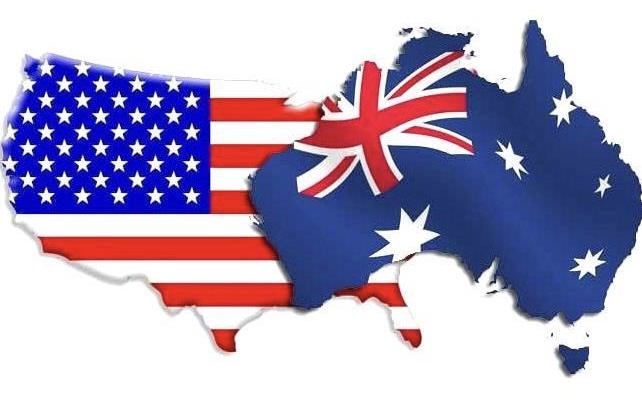
Australia: The Prize No One Talks About

There’s a story playing out on the world stage that barely makes a ripple in most media cycles. While the headlines fixate on Ukraine, Gaza, or Taiwan, an unspoken contest is quietly unfolding for influence over a country that has, for too long, been treated as a polite and distant cousin in global affairs: Australia.

We’re used to thinking of the United States as having eyes on Canada, economically, culturally, and strategically. The integration is old news: NORAD, pipelines, the world’s longest undefended border, and the quiet assumptions of shared destiny. But if you really want to understand the next chapter of global power politics, don’t look north. Look west. Look south. Look to Australia.

What’s emerging now is not a scramble for land or flags, but for strategic intimacy, a deep intertwining of interests, logistics, defense capabilities, and ideological alignment. Australia is the prize not because it’s weak, but because it’s vital: geographically, economically, and politically.

The American Pivot
The United States is already entrenched. Through AUKUS, it has committed to helping Australia build nuclear-powered submarines and integrate into the U.S. military-industrial supply chain. But this is more than just a defense pact. It’s about locking Australia into a security and technology architecture that positions it as a forward base for U.S. naval and cyber operations, a southern anchor against Chinese ambitions in the Indo-Pacific.

What few people understand is this: Australia is becoming America’s new front line. Not in the sense of war, but in the grand strategy of containment, deterrence, and projection. The U.S. doesn’t want Australia as a vassal, it wants it as a platform, a co-pilot, a bulwark. In many ways, it’s happening already.

India Enters the Frame
But Washington isn’t the only capital watching Canberra. New Delhi is quietly but deliberately courting Australia too, not for bases, but for bonds.

India sees Australia through a different lens: not as a strategic outpost, but as an extension of its civilizational, economic, and diasporic reach. With a large and growing Indian community in Australia, rising trade links, and joint naval exercises in the Indian Ocean, India’s interest is long-term and layered.

What India understands, and what many in the West overlook, is that Australia is a natural expansion point for a rising democratic Asia. It’s a source of energy, food, space, and credibility. In a world where climate instability and resource scarcity are redefining security, having Australia in your corner isn’t optional. It’s essential.

Why It Matters
This isn’t a turf war. It’s not a return to Cold War blocs. It’s more fluid than that, a web of influence where infrastructure, education, culture, and soft power matter just as much as tanks and treaties.

The real story is this: Australia is shifting from the periphery to the center of global strategic thought. It’s no longer just “down under.” It’s at the crossroads of the world’s most dynamic (and dangerous) geopolitical contest: the one unfolding across the Indo-Pacific.

And here’s the kicker: Australians are waking up to this. The era of benign non-alignment is over. The decisions they make in the next decade, about alliances, sovereignty, and identity — will echo far beyond their shores.

So the next time someone tells you it’s all about Europe or the South China Sea, remind them: The most consequential strategic competition of the 21st century might just be quietly unfolding in the sunburnt country; and it’s not just China who’s watching. The U.S. and India are, too. And they both want Australia in their future.

Quebec’s Agrifood Strategy: A National Lesson in Food Security

Quebec has quietly become a national leader in agrifood planning and food security. At a time when global food systems are increasingly fragile, the province offers a clear and pragmatic model for how public policy, local investment, and social equity can combine to build a more resilient, sustainable food system. The rest of Canada would do well to take note.

Central to Quebec’s approach is its comprehensive provincial framework, Politique bioalimentaire 2018–2025: Alimenter notre monde. This policy articulates a long-term vision for food sovereignty and ecological stewardship. It promotes value-added processing, regional production, and stronger local supply chains. What sets Quebec apart is not simply the breadth of the strategy, but the coordination behind it. Provincial and federal funds are deployed in tandem, targeting greenhouse expansion, food transformation infrastructure, agri-environmental practices, and innovation. In 2023, Quebec committed $175 million toward increasing regional food self-sufficiency, a move that signaled a shift away from dependence on volatile global supply chains.

This funding strategy has been reinforced by the Canada–Quebec Sustainable Canadian Agricultural Partnership agreement, which committed $955 million over five years to support producers across the province. The agreement includes enhanced compensation under AgriStability, infrastructure renewal programs, and expanded support for environmental and climate-smart practices. With a 25 percent increase over the previous five-year framework, this is one of the most ambitious agrifood investments in the country.

Quebec’s focus on food processing has also paid dividends. In Saguenay–Lac-Saint-Jean, for example, Céréales Normandin received over $3.5 million in combined provincial and federal support to expand its grain-processing capacity. By transforming local cereals into flour, semolina, and plant-based protein concentrates, the facility strengthens Quebec’s ability to retain value within the province. It also reduces dependency on long-haul transportation and foreign inputs. This kind of investment represents a structural shift toward field-to-fork sovereignty.

But production and processing are only part of the story. Quebec integrates food security into its broader public health and education agenda. The province supports farm-to-school programs that connect children directly with local farms, using classroom engagement and institutional procurement to build food literacy and sustainable eating habits. Programs like AgrÉcoles and Farm to School Québec are designed not as symbolic gestures, but as long-term educational investments. They are complemented by robust health policy measures, including proposed front-of-package nutrition labels and consideration of a sugary drinks tax. While other provinces rely on voluntary industry commitments, Quebec has shown a willingness to legislate for public health.

Climate adaptation is another defining element. Quebec has made significant advances in controlled-environment agriculture, particularly hydro-powered greenhouses. These facilities now supply roughly half of the province’s fruits and vegetables year-round. This model aligns well with Quebec’s decarbonization goals and offers a buffer against supply chain disruptions caused by weather, wildfires, or border issues. The greenhouse sector also creates jobs in rural regions, adding social and economic depth to what might otherwise be seen as technical infrastructure.

Quebec’s broader social policy reinforces its food security efforts. The province maintains Canada’s most generous child benefits and has indexed income supports to inflation, resulting in lower levels of food insecurity compared to most other provinces. By recognizing that hunger is not just a supply issue but a matter of income and social policy, Quebec links its agrifood system to social resilience. This integrated approach provides not only food, but dignity and stability.

Cultural identity plays a role as well. Quebec has long embraced supply management in sectors like dairy and maple syrup, not as a form of protectionism, but as a tool for supporting regional producers and maintaining quality standards. This model may not translate directly across all of Canada, but it offers a reminder that local economies thrive when policy reflects place-based values.

Perhaps the most compelling lesson from Quebec is its refusal to silo food policy. Instead, it has created a system where agriculture, health, education, environment, and social equity intersect. The result is not just a stronger food system, but a stronger society. In an era of climate disruption, geopolitical instability, and growing inequality, Quebec is showing how to build something that is local, resilient, and future-ready.

Canada as a whole will face increasing pressure in the years ahead to secure its food systems. If policy-makers are serious about ensuring affordability, sustainability, and sovereignty, they would be wise to study what Quebec has already built.

Sources
• Government of Canada. “Canada and Quebec sign a new $955 million agreement over five years to support Quebec’s agricultural sector.” March 2023. https://www.canada.ca/en/agriculture-agri-food/news/2023/03/canada-and-quebec-sign-a-new-955-million-agreement-over-5-years-to-support-quebecs-agricultural-sector.html
• Government of Canada. “Over $3.5 million for Céréales Normandin to expand its product range.” March 2024. https://www.canada.ca/en/economic-development-quebec-regions/news/2024/03/increasing-quebecs-food-selfsufficiency-over-35m-for-cereales-normandin-to-expand-its-product-range.html
• Equiterre. “Farm to School Québec.” https://www.equiterre.org/en/articles/project-local-food-procurement-farm-to-school-quebec
• The 14. “Reinforcing policies to improve Quebec’s food supply.” https://the-14.com/reinforcing-policies-to-improve-quebecs-food-supply
• West Quebec Post. “Quebec to invest $175 million over five years to increase food self-sufficiency.” https://www.westquebecpost.com/quebec-to-invest-175-million-over-five-years-to-increase-food-self-sufficiency